
The Healthy Home Economist by email

Loading

Video: Liquid Whey and Cream Cheese

by Sarah, The Healthy Home Economist on May 27, 2010

in Fermented Foods,Sauces and Dressings,Videos


This video is a request from a reader.   Thanks Rick for the great suggestion!  

Please also see the poll box just to the right of this post.   Please vote for the topic of next week’s video.  I will be using the liquid whey that I make in the video today.

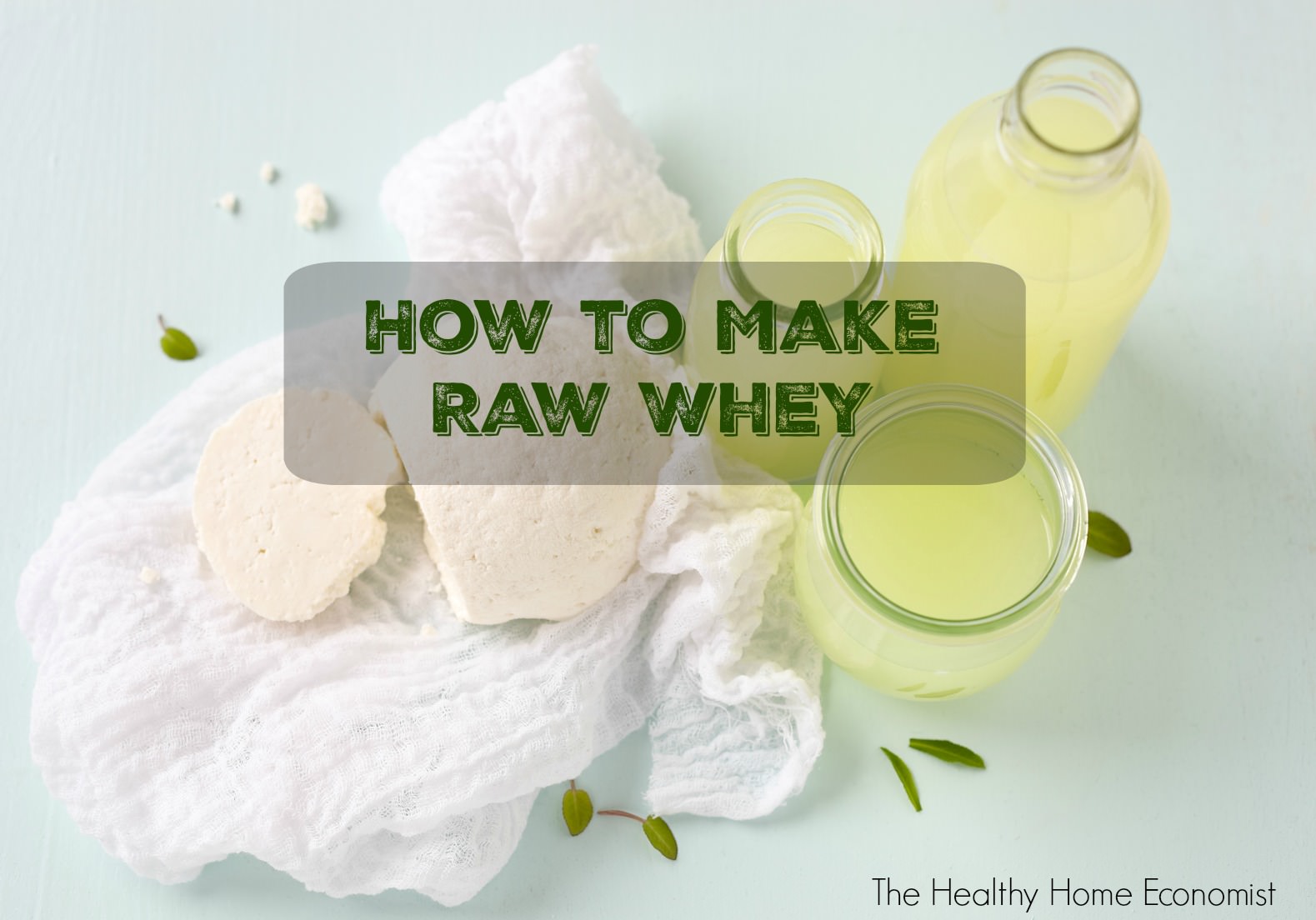
REAL Liquid Whey

Making real, liquid whey in your own kitchen is a MUST step for any traditional cook to learn.  Without liquid whey, many other traditional recipes cannot even be attempted.    You cannot buy liquid whey from the store except in a denatured, unhealthy, powdered form, so make sure you take the time to implement what I show you in this video.   In subsequent videos, I will show you how to use this liquid whey to make many delicious, healthful recipes for your family.     Liquid whey as shown in this video will keep up to 6 months in the refrigerator in a glass mason jar.

If you absolutely have no access to farm fresh milk to make your whey, then you can use plain, organic yogurt instead and do pretty much exactly the same thing as shown in the video.  You won’t get nearly as much whey using yogurt as clabbered, farm fresh milk, but at least you can get enough to get you started.    My favorite brand of yogurt from the store is Seven Stars.   The milk used to make this brand of biodynamic, organic yogurt comes from old fashioned, grassfed jersey or guernsey cows.  

REAL Cream Cheese

The raw, enzyme rich strawberry cream cheese I make in the video is fantastic on a sourdough or sprouted bagel for breakfast.   French Meadow makes a fantastic, spelt sourdough bagel.  Food for Life has an excellent seven grain sprouted English muffin too (don’t buy the Ezekiel sprouted muffins as that one has soy).

To make, just take your cream cheese left over from making liquid whey and add a few strawberries and a dash of Grade B maple syrup to taste.   Mix together by pulsing a few times in your food processor.   This wonderful, fresh, REAL strawberry cream cheese will last one to two weeks in the refrigerator.    You will turn up your nose to the fake, Philadelphia strawberry cream cheese after trying this truly healthy, probiotic laden, homemade version.

Sarah, The Healthy Home Economist


The Healthy Home Economist by E-mail


{ 123 comments… read them below or add one }

Mrs Yoder May 27, 2010 at 2:44 pm

Doesn't cream cheese need to be made with just the cream? I've never made it with the skimmed milk before. The skimmed milk has a gelatinous texture that I'm not fond of so I use that for semi-hard cheeses. The cheese you made in your video did not look like traditional cream cheese (I'm not talking store-bought, but just cream cheese). Cream cheese is thick and holds it's own shape. I'm not quite sure what you just made.

Reply

Mariah Ward August 1, 2011 at 9:07 am

If you go to gnowlings.com she uses cream to make her cream cheese instead of sour milk. It is just as firm as normal store bought cream cheese from the pictures. She follows the same method as Sarah did with the towel and whey. She does let her cream cheese sit for 18-24 hours too. She also has a friend who uses buttermilk instead of cream. I would prefer the sour milk personally because it saves me from buying cream on a normal basis.

As a side note: The lady from gnowlings makes her sour cream with sour milk. She lets her milk sit in a glass mason Jar with a paper towel and rubber band covering the top. She skims off the cream two-three days later and she has what looks like really good sour cream.

Just a thought I would share this with you. Thanks for the great video Sarah, will be sure to make sure of my sour milk this coming week.

Reply

Amy May 27, 2010 at 3:07 pm

Thanks for this video! My milk is on the counter clabbering as I type this. :)

Reply

Audry May 27, 2010 at 5:32 pm

Does the cream cheese stiffen up at all if you put it in the fridge? I have some sour milk in the fridge right that I'm now planning to make whey and cream cheese from as soon as I get home… but what you have there doesn't really look like it's thick/ stiff enough to spread on a bagel.

Reply

Sarah, the Healthy Home Economist May 27, 2010 at 5:33 pm

I could have left the cream cheese in the cloth to drip out the whey further which would have made the cream cheese firmer as you mentioned. I did not make it with skim milk .. it was whole milk. No, cream cheese is not made with just cream. Have you read Nourishing Traditions cookbook? Cream cheese and yogurt cheese are made in the way that I show in the video.

Reply

Sarah, the Healthy Home Economist May 27, 2010 at 5:45 pm

Hi Audry, yes it does spread very well on a bagel. The stuff from the store is artificially thickened – the real stuff is more like a pudding in my experience.

Reply

Rick May 28, 2010 at 2:43 am

Sarah THANKS!!
I did this once before and I was not sure if my whey came out correctly… seeing the color of yours showed me that I did do it correctly. How can you tell if it has been in the fridge too long? I made about a half of a gallon and I still have a quart…and I think I am going on 6 months.

I like the idea on how you hung it… I made a mess. My cloth was too small and I tried doing it with a pitcher. What a mess.

The cream cheese seemed to firm up more when I refrigerated it too.

Thanks again.
r

Reply

Kim May 28, 2010 at 4:06 am

Hi Sarah, Enjoy your blog so much and just have a quick question – can you make whey from raw goat's milk – a couple of us have an allergy to cow's milk. Thanks so much for any help.

Reply

Liz July 6, 2011 at 4:02 pm

Hi Kim, I realize it’s been a long time since this post, but In case anyone is wondering, yes you can make it from goat milk. I do it all the time. Ricotta, mozerella, cream cheese, etc. It’s ALL good! I will say that my children and I are the only ones who love the goat’s milk products. My husband doesn’t appreciate it when I use goat ricotta to make his lasagna. :)

Reply

Tracy August 1, 2011 at 12:29 pm

To add to what Liz posted, yes… I make it from goat milk yogurt, actually. I make the yogurt myself (using organic, but pasteurized, goat’s milk and a non-dairy starter culture, and fermenting for 24 hours), then hang and drip. The nice thing with this method is that you can make a batch of yogurt, whey and cream cheese (well, technically yogurt cheese, tastes the same) at the same time.

Reply

Sarah, the Healthy Home Economist May 28, 2010 at 11:20 am

Hi Kim, that is a great question that I really am not sure the answer to. Nourishing Traditions cookbook says that the milk to make whey and cream cheese should be nonhomogenized and raw goat milk is naturally homogenized, as you know. If you give it a try, please comment again and let us know if it works!

Reply

Attached May 31, 2010 at 3:10 am

Thank you! You made it look so simple. I tried it this weekend and now we have a lovely stawberry cream cheese to spread on our homemade soaked muffins tomorrow morning. I really appreciate your blog – thanks for all you do :)

Reply

Candace May 31, 2010 at 6:02 am

Hi, Sarah:

Is the difference between making cream cheese and making cottage cheese the length of time that you allow the milk to clabber? Will allowing it to clabber longer have any effect on your whey?

Thanks,
Candace

Reply

Sarah, the Healthy Home Economist May 31, 2010 at 11:41 am

Hi Candace, you get let the milk clabber longer if you like .. this will make the cream cheese stronger tasting though, so I don't like to leave it too long for that reason.

Reply

Audry June 1, 2010 at 4:28 pm

Ok, I'm not sure how I could mess this up, but my milk didn't clabber. I left it on the counter for 24 hours, and when I checked it the cream had separated, but it was still perfectly smooth and liquid. Same thing after another 24 hours and after another. I kept having to unscrew the cap to let out pressure too. Finally, Sunday the bottom of the plastic jug actually developed a small split from the pressure. When I dumped it (I wasn't going to use it after that many days on the counter even if it had clabbered)the cream looked kind of cheesy – like a ricotta kind of texture, but the rest of the milk was still liquid milk.

The milk was pretty sour when I started. Other than that I can't imagine what might have gone wrong. Our house temp has mostly been in the 70's.

Reply

Sarah, the Healthy Home Economist June 1, 2010 at 4:52 pm

Hi Audry, if the cream is separated from the liquid whey (it might be cloudy like milk until you separate), then go ahead and separate using the cloth as I show on the video. It turns out a little different every time!

Reply

Kim June 1, 2010 at 8:14 pm

Hi Sarah,
Been watching your video/blog for awhile now and sure do appreciate what you are doing!!! My question – can you use goat milk to do the whey and cream cheese? We have a casein sensitivity in our family, but goat cheese does not seem to be a problem for us. Thanks for you time. Kim

Reply

Sarah, the Healthy Home Economist June 1, 2010 at 8:45 pm

Hi Kim, great question. I've already answered this above as someone else had a similar query. Glad you are enjoying the videos! I will be making saurkraut for this Thursday's video based on the poll results! Stay tuned for that one.

Reply

Danielle June 2, 2010 at 9:29 pm

Hi Sarah,
Great video – very clear and easy to follow. Question on the cream cheese – can it be used as one might use store bought in a recipe? I make a lasagna recipe using cream cheese and I'd love to give this a try.

Reply

Sarah, the Healthy Home Economist June 2, 2010 at 10:17 pm

Hi Danielle, yes you can use the cream cheese I make in the video instead of store bought in any kind of recipe. It should work beautifully with lasagna.

Reply

Danielle June 12, 2010 at 11:33 am

Sarah,
I am 6 months pregnant – is it safe to use this cream cheese since it's made with raw milk? My midwife has advised me to stay away from raw milk (and i have never drank it before)

Reply

Sarah, the Healthy Home Economist June 12, 2010 at 1:27 pm

Hi Danielle, here is a link to the Weston A. Price Foundations recommended pregnancy diet (which includes raw dairy):
http://www.westonaprice.org/childrens-health/311-diet-for-pregnant-and-nursing-mothers.html

Reply

Alina June 23, 2010 at 4:27 am

Hi Sarah,
Does the milk have to be sour before I clabber it? If the answer is “yes” then why does it have to be soured first? How do I know if it is good soured as opposed to milk that has gone a little too far?
Can I strain clabbered milk using a sieve with small holes?
Thank you as always.

Reply

Sarah, the Healthy Home Economist June 23, 2010 at 2:16 pm

Hi Alina, you can put fresh milk that hasn't soured on the counter to clabber, it just might take a few days for this to happen rather than 1 day if the milk was already sour. No, you cannot strain clabbered milk with a sieve as too much of the milkfat will pass through the sieve and you won't separate the whey well enough this way. You must use a clean, white cloth as shown in the video.

Reply

Dale June 28, 2010 at 11:49 pm

Hi Sarah,

I'm quite the newbie, so please excuse me if this question seems like a no-brainer.

I made some yogurt from real milk which required heating it to 180°. Because it was a little too runny at completion, I chose to strain it through a flour sack cloth. Wow, I came up with about 18oz of whey. My question is: Is this whey, strained from my yogurt, the same as whey strained from clabbered milk, or did heating it change it so as to prevent it from being used like whey from clabbered milk?

Thanks…

Reply

Sarah, the Healthy Home Economist June 29, 2010 at 12:25 am

Hi Dale, yes what you have is the same as the whey I made in the video from clabbered milk! Your whey is fine and has live cultures in it as it came from yogurt.

Reply

Alina June 29, 2010 at 1:45 am

Hi Sarah,
What do you think about adding kefir grains or Fil Mjolk culture to the clabbering milk and making the cream cheese from it? Does it make sense?

Reply

Sarah, the Healthy Home Economist June 29, 2010 at 1:54 am

Hi Alina,
Yes, you can make liquid whey and kefir cheese instead of cream cheese/liquid whey if you like. Just use kefir instead of clabbered milk. Adding the kefir grains to the clabbered milk is fine if you want to do it that way. The kefir cheese might turn out a bit strong tasting though .. I would make kefir with fresh milk first and then just strain into liquid whey/kefir cheese.

Reply

Teri Gelseth July 16, 2010 at 6:46 pm

does this work with raw goat milk from our goats?

Reply

Sarah, the Healthy Home Economist July 17, 2010 at 12:05 am

Hi Teri, that is a great question that I really am not sure the answer to. Nourishing Traditions cookbook says that the milk to make whey and cream cheese should be nonhomogenized and raw goat milk is naturally homogenized, as you know. If you give it a try, please comment again and let us know if it works!

Reply

Lori July 19, 2010 at 2:27 pm

Hi Sarah.

Thanks for the video, and I have a question for you. Can you freeze the cream cheese? I am wondering because if one makes a large quantity at a time and not enough is eaten quickly, is it possible to freeze some of the cream cheese for later? Thanks!

Reply

Sarah, the Healthy Home Economist July 19, 2010 at 4:00 pm

Hi Lori, yes by all means freeze what you cannot use. It thaws nicely.

Reply

Anonymous July 23, 2010 at 1:19 am

Hi Sarah,
I have a 1/2 of a gallon of 3-4 week old soured milk in my frig. When I took it out today and strained it, a solid clump of milk solid came tumbling out. Is this stuff cream cheese?

Reply

Sarah, the Healthy Home Economist July 23, 2010 at 1:40 am

Sounds like the milk slightly clabbered in the fridge. Yes, that would be cream cheese. You may want to clabber it so that the solids completely separate from the whey and then strain it.

Reply

Erika August 8, 2010 at 1:24 am

Hi Sarah,
I just clicked over from Kitchen Stewardship, and I am so, so thankful I did! Our family is only now (finally) starting to make some changes to eating "real" food, and it's a bit overwhelming (probably the reason that it has taken so long to make the switch!). However, your video is so helpful! I'm a very visual learner, and seeing how you do it (and how easy it actually is!) is a huge help to me!

It is also very helpful when you tell approximately how long things will last and the best way to store them, like you did in the video. Thank you so much for taking the time to share this! I am really excited to explore your blog and read your new posts!

Erika

ps…this is such a novice question, so forgive me, but why do you put the carton on its side (instead of leaving it right side up)?

Reply

Sarah, the Healthy Home Economist August 8, 2010 at 1:50 am

Hi Erika, the reason I put the carton on its side is to get the milk to clabber more quickly … there is more air touching more of the milk which is why this happens.

So glad you are finding the videos helpful!!

Reply

Anonymous August 11, 2010 at 3:54 pm

We rarely have milk that has soured. We drink it all up and then go for more. We use raw milk is that what you are referring to when you say from the farm? I put a quart of milk in a gallon glass jar sidesways on the counter about 36 hours ago and the cream is separating from the milk and it just smells odd no clabbering!. Is this ok? Should I start over and just leave a quart of milk in the refrigerator until it sours naturally? I love your videos, thank you for taking the time to do them. Cathy

Reply

Sarah, the Healthy Home Economist August 12, 2010 at 12:28 am

Sometimes 36 hours isn't long enough for the milk to clabber particularly if the milk is not yet soured and the house is a bit cool. Glad you are enjoying the videos Cathy!

Reply

Stephanie B. Cornais August 15, 2010 at 4:00 am

I have milk clabbering on the counter now. Learned a new word with that one. So glad I watched your video before attempted to this, the pictures in the NT book are so different with the spoon,etc.

P.S. you crack me up with your comments about philly cream cheese from the store.

Reply

Stephanie B. Cornais August 15, 2010 at 4:02 am

I just had a random thought! Can I do this with breastmilk and make cheese for my daughter to eat? She's nine months, so now cows milk yet for her.
If I could, do you think it would make a difference if it was breastmilk that was thawed and previously frozen?

Reply

Stephanie B. Cornais August 15, 2010 at 4:31 pm

I kinda feel like I am stalking your site, but I just have so many questions!!

My husband wanted to know about the safety of leaving the milk out to clabber. He doesn't understand why its ok to eat sour milk and why its not "bad". I no other answer for him other than I trust Sarah and he said well, that's not good enough for him. He's an engineer and needs; facts! and data! and research! Can you give me a link to quiet him?
:)

Reply

Sarah, the Healthy Home Economist August 15, 2010 at 4:56 pm

Hi Stephanie, that is a way lateral thought about clabbering the breastmilk! Wow! I have never even thought of doing this, but I don't see why it wouldn't work.

I just wrote a post yesterday about why clabbered raw milk is safe and pasteurized milk goes putrid and dangerous if you do the same thing. Here's the link:
http://www.thehealthyhomeeconomist.com/best-use-ever-for-soured-raw-milk

Reply

Stephanie B. Cornais August 19, 2010 at 3:41 am

So I am pretty sure the whey turned out well, but the cheese not so much. I am not sure what I did wrong, or if in fact it was wrong and I just didn't like it.

I used fresh milk and left it on the counter for a little over 48 hours. It didn't look big and chunky like yours in the video but it had seperated and was thick.

It dripped for almost 5 hours and at 11:30p before heading to bed I put in the fridge, still hanging. Not sure when it stopped dripping.

Some of the cheese was kind of crusty and yellow. I just mixed it all togehter and it brought it back to a creamy texture.

It just tasted bad. Sour. Yucky.

Did putting it in the fridge mess it up? How long is it suppossed to drip for?

Reply

Lisa Douglas December 15, 2010 at 8:22 pm

I’ve found that sometimes the taste of the cheese can be sour if the cheese hasn’t dripped adequately. You can do a couple of things. If the inside of your cloth has a thick layer around the outside but the inside is still quite liquid, you’re cheesecloth may literally be clogged. If you lay it in a colander or large strainer, you can scrape the dryer stuff off the outside and mix it back in, then let it hang again. Or you can find a more loosely woven muslin fabric. The more whey you get out of the process, the sweeter the cheese should be. The longer drip time should also produce a thicker cheese.

Also, even though we may not be able to detect it in the very fresh milk, if a cow or goat has eaten a different plant recently, it can especially affect the taste of the cheese. The plant may not be toxic, but sometimes at different times of the season, different plants bloom or grow better. The animals definitely like some better than others and sometimes just the change in their diet will affect flavor.

One other possible problem is if the cow was just starting to develop mastitis. If it was at a subclinical stage, the milk might taste okay for a day or two and then start to go bad quite quickly. It will definitely have an off flavor, especially in the cheese.

Reply

Sarah, the Healthy Home Economist August 20, 2010 at 12:29 am

Hi Stephanie,

Mix in some maple syrup and strawberries and it will taste delicious – great bagel spread! Putting it in the fridge didn't mess it up – you are just maybe not used to clabbered milk so much. There is no set time for it to drip – it just drips until you see that it is done. Much depends

Reply

Sarah, the Healthy Home Economist August 20, 2010 at 12:30 am

on how clabbered the milk actually is. If it is really separated, then it doesn't take as long as if the milk is slightly clabbered.

Reply

Anonymous September 1, 2010 at 4:42 pm

Hi Sarah!

I just attempted this for the first time (thank you SO much for the video – never had the courage to try it before!). My whey is not clear, it's milky looking – is that ok? Does it mean I needed to let the milk clabber for longer? There were big chunks when I poured it into the cloth/bowl, but I'm still not sure I've done this correctly.

Thanks!!
Shannon

Reply

Sarah, the Healthy Home Economist September 1, 2010 at 4:51 pm

Hi Shannon, milky is fine. Sometimes it turns out more clear than other times. When you refrigerate, the white milky part will probably come to the top and the whey will get clearer. Then you can strain it off if you want to.

Reply

Anonymous September 10, 2010 at 12:08 am

Thanks Sarah. When I made this, I didn't try the cream cheese till later that day, and it was very….cow-ey. There is no other way to describe it…it tasted and smelled like a barn. The milk never does, it tastes delicious. I went ahead and tried to mask the taste with syrup and berries, but to no avail – had to dump the whole thing. What might I have done wrong? The whey smells bad to me too, but I don't plan on eating it alone so don't care. I felt like the cream cheese was a huge waste and I was so excited…could this be because of the type of cow, or is it my technique? Our milk comes from Holsteins.

Shannon

Reply

Sarah, the Healthy Home Economist September 10, 2010 at 12:41 am

Hi Shannon, it might be the cow, but not too sure about that .. are the holsteins grassfed? Sometimes if you use really really sour milk the cream cheese can be extremely strong tasting. I have had that happen to me also once or twice. Maybe try it with slightly soured milk next time and see if you can get some milk from a jersey or guernsey cow so the cream is really thick and rich.

Reply

Elizabeth September 10, 2010 at 6:42 pm

Sarah –
Thank you so much for the video's I love having them as reference. I bought raw milk and set it out in a glass dish for the last 4 days. (we were sick some of those days so it got forgotten) When I found it today it was all thick and the top was more yellowish. It was not chunky at all just one big yellowish blob. I hung it up to drip but am wondering if it's okay?

Reply

Sarah, the Healthy Home Economist September 10, 2010 at 6:45 pm

Hi Elizabeth, it should be fine. The cream cheese might be a bit strong in flavor for sitting out so long, but it will be fine to eat. Just add some maple syrup and strawberries and that should mask it pretty well.

Reply

Kelsey September 23, 2010 at 5:22 pm

Hi Sarah! Question – how long is too long to have the milk clabbering on the counter? I put my raw milk on the counter on Sunday night, and here it is Thursday and it still doesn't seem to have clabbered. The milk was not quite sour when I put it on the counter and my house is a bit cool (I live in AK), but I'm worried about how long I've left it on the counter. It hasn't molded or anything. It is goat's milk, so maybe it won't clabber like cow's milk? I know you said you don't know if goat's milk can be separated into liquid whey and cheese, but I thought it would at least clabber, but maybe I'm wrong!

Reply

Sarah, the Healthy Home Economist September 24, 2010 at 12:25 am

Hi Kelsey, I don't think goat milk clabbers like cow milk because it is naturally homogenized (the cream doesn't come to the top like cow's milk). I must say that I have never tried it myself to know for sure. I guess you've answered the question!

Reply

Kelsey September 27, 2010 at 5:22 am

UPDATE! So my goat's milk did clabber – I put it in my laundry room where it stays pretty warm, and in a day it clabbered pretty well. So then I used some of it to make the homemade cold breakfast cereal, and the rest I used to see if I could make liquid whey and cream cheese. It worked! Goat's milk does clabber, maybe it just takes longer than cow's milk to separate. But for all the goat's milk drinkers out there – you can make this! I haven't tasted it yet, but it looks just like yours!

Reply

supermom October 24, 2010 at 4:01 pm

Hi Sarah, thanks for this video. I just completed my second batch of cream cheese and whey, yesterday. And I must say the second batch turned out even better than the first (and that batch was pretty good.) I let the milk sit out for an extra couple of days this time and that seems to have made a really nice difference, giving the cheese a bit more of a tang.

I also reserved out 1/4 c of the clabbered milk to start the process of making buttermilk.

I can't believe how easy this was… I'll never buy store bought cream cheese again. Or buttermilk for that matter.

Reply

Anonymous November 10, 2010 at 3:22 pm

Hi Sarah,

Just found your video. I had tried to make whey a few days ago from raw milk that had soured in the fridge. The curdy part looked clabbered, but what I thought was whey was very milky looking. I left it out 3 days at about 70 degrees and it never seemed to change from how it came out of the fridge. Also very sour and slightly bitter.

Now trying again with fresh milk on the counter. We had dipped some of the cream off for pumpkin pie. There's still some cream on top, but not a thick layer.

Will it still work, but with less cheese left over or do I need more cream to make the process work?

Thanks, love your video.

Sadie

Reply

Sarah, the Healthy Home Economist November 10, 2010 at 9:03 pm

Hi Sadie, clabbering always works – its just the consistency of the cream cheese and the whey may vary a bit from batch to batch. Sometimes the whey is cloudy, sometimes clear. This is the nature of traditional cooking.

Reply

kerry November 12, 2010 at 8:59 am

thanks for your awesome videos! i'm transitioning from a raw vegan lifestyle and you make nourishing traditions very "user friendly"! ; ) can you please suggest a good source for the large 1 gallon & 2 gallon glass jars? we own a dairy supply company in salem, oregon, so i have lots of options for good, clean pastured organic raw milk from beautiful jerseys from several of our customers. i just need some good jars to bring the milk home in. : ) thanks for all you do … i've had a sarah video marathon tonight & i feel armed, knowledgeable & ready to try many new things. thank you!!!!

Reply

Sarah, the Healthy Home Economist November 12, 2010 at 6:04 pm

Hi Kerry,

Target and Walmart both carry large 1-2 gallon glass jars at least in my neck of the woods. So glad you are getting off the raw vegan lifestyle and finding your way back to traditional foods! :)

Reply

Stacey December 7, 2010 at 1:19 pm

This is super interesting, but also incredibly frustrating for me! It is illegal to sell raw milk in Canada, and I don’t feel comfortable breaking the law. I don’t even want to try inquiring around to find a potential raw milk source. I can only do the best I can, and that is Organic whole milk from a local source.
Stacey\’s last post: A favorite Christmas Song

Reply

Sarah, The Healthy Home Economist December 7, 2010 at 1:23 pm

HI Stacey, you can make liquid whey and cream cheese from plain whole milk yogurt from the store. You just won’t get as much liquid whey as you would with clabbered milk.

Reply

gail December 13, 2010 at 8:30 pm

Hi Sarah,
My husband drinks undenatured whey protein isolate, 100% natural. So comparatively speaking it is healthier, but when I make this healthy fresh whey for him, (and I take the cream cheese for myself :-) ) how much of it should he consume when a scoop provides 26 grams of protein. Also, if I make a cheesecake with the cream cheese, does this preserve the nutritional value of the cheese? The enzymes will die, right? Thank you so much, you are awesome!

Reply

Sarah, The Healthy Home Economist December 13, 2010 at 11:20 pm

Hi Gail, I have no idea how much liquid whey equates to processed protein powders. Protein powders are always denatured by definition. They are a very bad idea to consume and no brands are recommended by the WAPF for any reason at any time. They quickly deplete vitamin A stores in the body and are extremely hard to digest. Most are loaded with MSG also .. formed during the processing (not added of course).

Reply

Lisa Douglas December 15, 2010 at 7:55 pm

Technically, I’d call that farmer cheese or the first step of cottage cheese, but a soft cheese like that can be wonderful in a lot of recipes. We mix it with garlic and dill for a wonderful veggie dip. If you wanted to make it thicker, you could use a more loosely woven muslin which would just drain more whey. The resulting cheese would probably be a little sweeter as the whey is where the tangy flavor comes from. If you can’t find butter muslin (real cheesecloth) check at a fabric store for their lightest unbleached muslin. I’ve found it drains much better than the tea towel. If you want to order real cheese cloth, look up some of the cheese making supply companies online. It was funny to me that you specifically make whey since I either throw it out or give it to the hens during the summer when I make cheese. I just have too much. Thanks for the challenge to use what I have.

Reply

Lisa Douglas December 15, 2010 at 8:34 pm

Watching your video brought a couple of questions to mind. I know that in many cases, too much heat can be a bad thing. But there are a couple of recipes I use that I love and now I’m wondering exactly what their nutritional benefits are. First if I want a cream cheese type spread, I often make a quick batch of cheese. It uses fresh milk heated to 185F. Then you stir in 1/4 cup of apple cidar vinegar per gallon of milk. It precipitates the solids immediately and you can drain it through a loose cloth in a short time to make a soft cheese. We can have cheese from the goat to the table in about a half hour that way. The color of the whey changes depending on how much acid you’ve added. The more cheese you get, the more clear yellow the whey. I suppose it just has less milk left in it. I use this whey in breads. Do you think the nutritional benefits of whey have been destroyed by the heat of making the cheese?

Also, when I make goats milk yogurt, I bring the milk to nearly a boil and then cool it before adding the yogurt culture. It makes a much thicker, creamier yogurt. I assumed that adding and growing the culture is where most of the probiotics, etc, come from, but am I loosing other good stuff by heating the milk?

Reply

Ranjani Krishnan January 1, 2011 at 4:41 pm

Any thoughts on how to clean the cheese cloth after making the whey and cream cheese? How do I make sure that I get all the particles out and what kind of cleaning agent do I use? I don’t want to use anything toxic like bleach. Thanks.

Reply

Jennifer January 8, 2011 at 5:11 pm

I live in Georgia and it’s illegal here to sell raw milk. So I’ve never been able to find a farmer who will sell it to me. We do get our milk from a trusted local dairy farm that raises pastured, grass-fed holsteins and jerseys. It’s whole milk and non-homogenized, but it is low-temp pasteurized. I talked to the dairy farmer about it and he says that they use the lowest temp possible to keep it legal here in Georgia. But I can’t get raw milk from them. Do you have any suggestions? You said in your video that you can’t make the whey with low-temp pasteurized milk. So what should I do? I’m really new to all of this, but I just ordered the Nourishing Traditions cookbook and enjoy your blog so much. Excited to try some changes in how my family eats, even if I’m totally overwhelmed and not really sure where to start. Thanks!

Reply

Kay February 16, 2011 at 1:33 pm

Jennifer,
I live in Georgia and there is a dairy that delivers to locations in Metro Atlanta weekly. They sell raw milk that is labeled “not for human consumption..for pet use only”. The dairy is Carlton Farms http://www.carltonfarmsnaturalfoods.com/milk.shtml. Their cows are Jersey cows. Check out their website.

Reply

Sarah, The Healthy Home Economist January 18, 2011 at 7:41 pm

Whey is supposed to be sour. It is fine. No worries. You can certainly use the whey from a piima culture but that would taste sour as well.

Reply

Lauren January 31, 2011 at 4:12 pm

Ok, I am very new at this, so bear with me. I’ve used organic products, well never… I’m not even sure how to get half of this stuff. I’m finally crossing over, and making organic formula for my baby. I am going to make this Whey from the organic yogurt, so do I need to let it sit on the counter, as well, or is it already ready as yogurt has already been processed differently than milk? The steps are step for step the same? Sorry if this question is redundant, but I want to make sure I’m successful at making this the first time.

Reply

Sarah, The Healthy Home Economist January 31, 2011 at 4:45 pm

Hi Lauren, the yogurt is already cultured so you can strain out the whey immediately – do not sit it on the counter. You will just end up with liquid whey and yogurt cheese instead of liquid whey and cream cheese.

Reply

Katie February 17, 2011 at 9:34 pm

Sarah,

Thank you so much for this video! How long can the cream cheese be stored for? And I’m assuming I should store it in the fridge?

Thank you,
Katie
Katie\’s last post: Give Him the Gift He Really Wants this Valentine’s Day- Respect

Reply

JL February 28, 2011 at 12:32 am

Yes, it’s true that selling raw milk is illegal in some states (and in some, it’s not!). Some states sell cow “shares” instead. This means you buy a cow share and pay a monthly boarding fee and get raw milk on a consistent basis (i.e. weekly). Go to http://www.realmilk.com to find out where to obtain it in your state.

Reply

JL February 28, 2011 at 12:40 am

I think I might be doing something wrong. The first time I ever made whey, it came out as is shown in your video (yellowish). However, I just tried to make some a week ago, and it came out milky. It did not clear up after being left in the fridge, so I decided to leave it out on the counter a few more days, and the milk clabbered slightly again. After pouring it through my towel again, it is still milky.

Am I not leaving it out long enough? Am I using the wrong kind of towel? The first time I made whey, I used a regular old kitchen towel. I used a regular kitchen towel this time too, but the whey was not clear. Does using a tea towel make a difference? I know it comes out different each time, but the fact that I could still clabber my “whey” after straining it once is not quite right, right?

Reply

JL March 10, 2011 at 8:08 pm

Well, I answered my own questions! I put the “milky” whey back on the counter for probably a good week before I could finally see big chunks of milk floating with clear liquid mixed in. Sometimes, it just takes longer! I separated it using a regular old dish towel, and it separated perfectly into the cream cheese and the normal yellowish-clear whey. I do think a tea towel would be better though, because I lose a lot of whey separating it through the dish towel.

Reply

Sarah, The Healthy Home Economist March 10, 2011 at 10:17 pm

HI JL, sorry I missed your question the first time around! Glad it all worked out for you! Yes, tea towels work great for separating the whey.

Reply

Alicia March 11, 2011 at 12:16 am

How sour is too sour for my milk to be to use. Right now it probably three weeks past the too sour to drink phase. It is golden yellow ont he bottom half and cream colored the top. Should I throw that out and wait till my current milk sours?

Reply

de March 11, 2011 at 12:28 pm

I am confused, I am assuming I did something wrong. I left my slightly sour milk on the counter to clabbered for over 6 hours and in the right temp but nothing happened to it. When I poured it through the tea towel not one clump of anything…can you help? Is it possible to remove the milk fats and cream? I just dont understand why it did not thicken up…

Reply

Ranjani March 20, 2011 at 9:32 pm

Hi Sarah,

I had quite a bit of luck the first few times I made clabbered milk and ran it through a cheese cloth. Both the whey and the cream cheese turned out really well. However, for the past few times (when I have clabbered it for about 48 hours on the kitchen counter), I have noticed a few disturbing things. The whey and the cheese taste bitter and after a few days start to smell fruity. The cheese even turned pinkish. I assumed it was some sort of undesirable fungus and had to toss everything. I feel strongly about not wasting food (especially quality food) so this caused me to feel quite depressed. Is there something that I am not doing right? Should I pay special attention to the temperature in my kitchen or disinfect my cheese cloth several times? I am quite particular about the hygiene of the utensils and implements I use for cooking. Any suggestions would be greatly appreciated. Thanks,

Ranjani.

Reply

Bridget March 23, 2011 at 12:57 am

My friend and I are new to clabbered milk, so when we both made the cream cheese it tasted TERRIBLE. Just a nasty sour taste. Is it our taste buds that need to “acclimate” to the flavor or have we both missed something? Perhaps it’s in my memory that as a kid I was told not to drink the milk if it’s gone sour! Hope we can get past this, my kids too…lol.
Thanks Sarah! Your videos are incredibly helpful & I appreciate your common sense blogs that are NOT politically correct. How refreshing. I’ve been gluten free for 6 years & was so excited to discover soaking grains. It’s a new world. Thanks again.

Reply

Andrea April 2, 2011 at 4:47 pm

Hi Sarah,

I clabbered my milk for 2 days — oops. I got a ton of liquid whey and my cream cheese is not liquidy at all; it’s well formed, dry and very little of it to be had. Are my end products still edible and nutrient dense?

And, as always,

Thanks so much,
Andrea

Reply

Aileen - CA April 8, 2011 at 9:55 pm

Hi Sarah,
First and Foremost, thank you for posting all those videos. Excellent work!
I’m getting ready to mix my first batch of this Homemade Baby Formula. I was able to gather most of the ingredients from Radiantlifecatalog.com, but I still have a few questions… How long can Liquid Whey be stored in the refrigerator and can it be frozen for later use? I clabbered Raw Milk from Organic Pastures Dairy. Also, what modifications can be done to the Homemade Baby Formula recipe if my newborn is constipated,? I’m using the Weston A. Price recipe that makes 36 ounces. If possible, please provide any links that might be helpful and the exact measurements. God Bless! Aileen from California

Reply

Sarah, The Healthy Home Economist April 9, 2011 at 1:18 pm

Hi Aileen, whey will last in the refrigerator about 6 months. Try making the formula with raw milk kefir or raw milk yogurt to alleviate constipation. I know of several mothers who have had success doing this.

Reply

Aileen April 9, 2011 at 2:27 pm

Sarah, thank you for your prompt reply. I’m not sure I quite understand… So instead of making whey out of clabbered raw milk I should make it out of kefir or yogurt correct? OR should I omit the 2 cups of Raw milk the recipe calls for and use raw milk yogurt or kefir instead? I prepared a batch already (seems to oily) and seperate it in 3 ounce portions, is there something I can add to each portion to avoid from wasting this batch or do I have to start all over again? Aileen

Reply

Sarah, The Healthy Home Economist April 9, 2011 at 4:57 pm

I meant to substitute the raw milk portion of the recipe with raw kefir or raw yogurt.

Reply

Angela April 12, 2011 at 4:41 pm

Sarah,

Is bad bacteria a concern at all? Can’t spoiled milk be harmful and make us sick? I was telling our children’s holistic pediatrician about how our diets have changed due to what we’ve been learning from WAP. He thought bad bacteria might be a concern with raw milk.

Also, I’m making the liquid whey right now for the first time. My bowl was full of whey the minute I dumped the milk in to the bowl with the tea towel. Seems to have completely seperated while clabbering. Is this okay? I saw on your video you had very little liquid whey initially.

Thanks,
Angela

Reply

Sarah, The Healthy Home Economist April 12, 2011 at 5:54 pm

Angela, milk only spoils when its pasteurized! Raw milk clabbers; it doesn’t spoil. It’s ok with getting a lot of whey right away. Sometimes the clabbering results in a complete separation, other times not. Working with Real Food is always unpredictable.
Sarah, The Healthy Home Economist\’s last post: An Airport Terminal With Real Food

Reply

Angela April 12, 2011 at 6:25 pm

Wow! How about that!! Another strike against pasteurization. Ok, my whey looks really good. Only thing is there is a white liquid layer that rose to the top over the more transparent liquid layer. Is this white layer also whey, or do you think maybe my towel was too porous and perhaps I should skim it off?

Thanks Sarah! So excited about my whey!

Reply

Sarah, The Healthy Home Economist April 12, 2011 at 7:59 pm

You can skim the white part that came through off if you like or just leave it.
Sarah, The Healthy Home Economist\’s last post: An Airport Terminal With Real Food

Reply

Lindsey April 28, 2011 at 9:47 pm

Hi Sarah,
I just tried making whey and cream cheese for the first time today…unsuccessful. :( I’m not really sure what I did wrong. I left the milk out to clabber, but it never got chunky, even after being on the countertop for about 36 hours. So I poured it in my clean, cotton cloth anyway and let it drip. My whey has a yellowish tint, the cream cheese wasn’t chunky; it was super runny. I added blueberries and put it through the food processor, and my husband said it was awful and tasted rotten. Did I do something wrong? Is my whey ok if it’s yellow? Any advice is appreciated!

Reply

cindy May 7, 2011 at 4:40 pm

Hi. I’ve not been able to get raw milk for some time. I’ve been making mozarella with store milk at low temp, then straining off the whey to us for LF. It’s worked so far for sauerkraut. Do I need to be worried that this is ‘denatured’ or not the right enzymes in it. The store milk is not ultra pasturized.

Also have a cheese question. Do we really need all those cultures ordered online to make hard cheese? Isn’t there a way to do it with ingredients we have at home?

Thanks for your help and your awesome videos, which break everything down into simple steps!

Reply

Sarah, The Healthy Home Economist May 7, 2011 at 5:00 pm

Hi Cindy, the whey you’re using is not raw but it is still fine .. kind of the same thing that you would get if you strained the clear liquid off pasteurized store yogurt.
Definitely ok compared with powdered whey!

I am not a hard cheese expert .. hard cheeses are difficult to make in FL as you need a cool environment for aging them and there aren’t many basements here in FL as the water table is not that deep in the soil.
Sarah, The Healthy Home Economist\’s last post: New Study- More Vaccines Increase Infant Mortality Rates

Reply

Don May 18, 2011 at 2:21 pm

Sarah, I have 2 month old whey in the fridge that smells off or sour. Is that normal It was fine up until about a week ago? Should i throw it out? Do I have to come back to this site if you respond?

Reply

Don May 18, 2011 at 2:34 pm

Correction: It’s only 1 month old

Reply

Martine June 8, 2011 at 1:44 pm

Hi Sarah,

What’s the difference between cream cheese and fromage blanc? I’m kind of confuse…

Also, I am celiac so if I eat sourdough bagel will that be dangerous with my condition?

Thanks

Martine

Reply

Natalie July 7, 2011 at 8:02 pm

Hi Sarah, Do I have to use soured milk or can I use fresh milk to make whey? If I have to use soured milk can you tell me approx. how many days it takes milk to sour?

Reply

Sarah, The Healthy Home Economist July 8, 2011 at 10:42 am

Hi Natalie, fresh milk takes longer to clabber on the counter. It might take several days or even a week if it is very fresh. Temperature of the house matters also. The warmer the house, the quicker the milk will clabber.

Reply

Mary Ann Butler July 12, 2011 at 7:32 pm

Hi Sarah,

We watched your video on making whey and cream cheese. We tried to do this, however the milk will not clabber. It is raw milk, straight from the farm. I have had it out for a couple of days and it has not clabbered. It smells like it, but it has not thickened. Have you ever had this problem before? What should we do?

Thank You,
Mary Ann Butler

Reply

Natalie July 12, 2011 at 10:22 pm

Hi Sarah, I am making whey and the milk jug that the whey has been in for a day started to leak because it has a snap on lid. I had to pour it into a glass bowl. I covered it tightly with plastic wrap (press n seal) and I am wondering if it will still work?

Reply

Kelley Hagemeister (@mrshaggie810) July 20, 2011 at 1:31 pm

Video: Liquid Whey and Cream Cheese — The Healthy Home Economist http://t.co/ElrqXJP So AWESOME! Must try!

Reply

Natalie July 29, 2011 at 2:53 pm

I made whey and it’s white like milk. Is that normal?

Reply

LUISA OCASIO August 8, 2011 at 4:19 pm

I emailed the chapter leader in Apopka for a source of suet but he has not responded. You said you live in Florida. Where can I find suet? I’m anxious to stop using regular oils.
Thank you, Luisa
PS – I love your videos!!!

Reply

Terry August 8, 2011 at 10:01 pm

Hi Sarah,
Made my whey and strawberry cream cheese from Organic Pastures Raw Milk – I can’t get farm fresh here in Orange County, CA. The strawberry cream cheese has a strong taste – do we just need to get used to it?
Thanks,
Terry

Reply

Dismayed American August 9, 2011 at 1:00 pm

Thank you for this great video!! Now I know how to make real cream cheese and whey!! Can’t wait to try it!! Thank you!!!!!

Reply

veronica cardozo August 11, 2011 at 6:25 am

thanks for the info. yeah ive tried making whey and cheese but i didnt know that when you place the jar lengthways you allow air to act on the milk. ive also tried adding some herbs to the cheese.

Reply

Janice August 12, 2011 at 6:59 pm

Is “farm fresh milk” the same as raw milk? The gov’t is making it very difficult to get raw milk these days…where do you get your unpasturized milk? I assume it is not available in stores….

Reply

Sarah Jane September 12, 2011 at 9:56 am

I just finally made whey from fresh raw milk. My milk was not soured yet, so it took longer to finally separate. I also used full cream milk. After hanging it to drain the whey it seems like something is not right. The cream parts seem to have the correct texture, but there are spongey parts as well. I let it hang for a few hours. Did I let it go too long? What do you think happened?

Reply

City Boy September 13, 2011 at 4:50 am

I am attempting to make buttermilk, starting with raw fresh milk. I clabbered it in a little less than 24 hours (about 78 degrees in my kitchen), but I don’t know what I’m supposed to be looking for. It was thick, but smelled like bread dough rising…it didn’t taste bad, but then I am not a fan of plain yogurt. When I started the milk had sat in the fridge for a couple of days in a narrow mouth bottle, so I might have started with cream anyway. Can I assume that when milk ferments it will smell fermented? Should I start over, removing the cream first? Help?

Reply

Stephanie Hsiao September 28, 2011 at 7:56 am

Hi Sarah,

I’m trying to find on your website if liquid whey can be used in smoothies to add protein instead of using the powdered whey/protein shakes you’ve recommended we ditch. I’m not seeing anything, but a possible addition of nutritive yeast. Can you give a little more detail on adding some protein to smoothies when we don’t have time to cook some meat immediately after working out?

I’m still new at this and haven’t clabbered any milk yet, but I’m hoping to rewatch this video and do it soon. Does the milk have to be soured?

Reply

Mariana Magness October 5, 2011 at 12:33 pm

I have a large jar of fresh raw goat milk that was frozen then I defrosted in the refrigerator but did not used it. It has been about 3 days defrosted and you can see the liquid with bumps (coagulation?) Anything edible I could still make with it or anything else? Cheese or yogurt?
Thank you

Reply

Carolyn October 26, 2011 at 8:39 am

Hello. I made some whey from yogurt with live cultures about 3 months ago. Stored in the fridge in a glass mason jar. While my whey has stayed about the same color as when it was fresh, it is thicker. It tasted and smelled more sour but not overly so, but did leave an aftertaste, (I did a finger lick just to check). Does this thicker texture mean bad bacteria grew? I was going to use it to ferment some hot sauce I made but when I saw it was thicker, somewhat slimy, I want to find out first if this is normal with aged whey. Does whey get thicker over time, and more sour or has mine gone bad? Thanks for any help!! I am new to this and this will be the first time I use my whey, don’t want to make my family sick.

Reply

lisa February 9, 2012 at 1:02 am

Hi, love your site, Very inspiring! I am wondering if you can make whey from store bought, organic plain kefir, and is the process for that the same. Thank you so much for all this wonderful information!

Reply

Dawn February 25, 2012 at 5:45 pm

To make liquid whey could you use vat-pasturized non-homogenized milk from grass-fed cows?

Reply

Carolyn March 20, 2012 at 10:33 am

I did this method of making cream cheese and whey, and mine was very bitter. It was awful and so was my whey. So I tried again and this time used Junkett rennet and it was much better. Any thoughts why my first batch was so bitter? Just curious.

Reply

Bonny March 22, 2012 at 2:07 pm

I misunderstood the directions in Nourishing Traditions the first time and made whey by straining homemade raw kefir instead of milk. It’s a very yellowish color. Next time I will do it with raw milk, but until then, is it ok to use it from whey, will it produce the same results, or do I need to start over with milk?

Reply

Laura March 28, 2012 at 9:55 am

Do you know if this would work with goat milk? I can’t find raw cow milk where I live and some of my family members have food sensitivity/allergy to cow milk. I do buy raw goat milk for my 2 yo directly from a farm. When fresh, the milk dosn’t have that “goaty” taste and I was able to keep it in the fridge for up to 1 week without that taste but I wonder if makeing whey and leaving the milk at room temperature like that would make the whey and cream cheese taste goaty. Any advice/suggestions?

Reply

Lucy March 28, 2012 at 10:29 am

Hello! So I just want to clarify, it seems that many people are talking about bits and pieces, but I am a big picture person so I want to make sure I have the straight.

If I buy raw milk, I can separate the cream and make butter with that. Left over from the butter will be buttermilk, which I can let sit out and it will separate into cream cheese and liquid whey. Is this right???? Also, what can I do with the part of the milk that I separated the cream from?

I am new to this and very excited to try, I just want to make sure that I am understanding this all. Thank you SO much for your website! It is so informative and accessible for a first timer like myself.

Reply

Melaine March 28, 2012 at 4:25 pm

Hello,
My question is this…I bought plain non-homoginized yogurt (It must be pasturized by law where I live :( So I seperated it and got the cream cheese and whey…. but on another blog I read that it MUST be raw for the whey to be able to use in lacto-fermentation. Can you please clarify this for me as to whether or not my whey is going to be useful? Thank you so much for all your great information!!

Reply

kabiss April 2, 2012 at 11:55 am

Hello Sara,

Thank you for the good instructional videos, extremely helpful! For Lacto-Fermentation can we use whey produced after making cheese?

Thank you!

Reply

Jeanette April 4, 2012 at 3:59 pm

Sarah,

I live on the Wi/Il boarder, and am having a hare time finding raw milk. Any suggestions?

Reply

Ariana April 14, 2012 at 3:45 pm

Thank you so much for this video and your blog in general. I used to think I was doing good because I drank whole milk. Now I’m going to begin my adventure into raw milk! I’m really excited as I absolutely love milk and dairy now it’s going to actually be good for me and my family. :)

Reply

Brigitte April 17, 2012 at 9:23 pm

I am attempting to make whey. Got the recipe from “Nourishing Traditions” cookbook. I filled a 1 quart mason jar with raw goats milk on the 11th of April, to the brim. The milk just now smells sour. Should I pour it into a larger container or just leave it in the mason jar? Does the lid have to be tightl on the jar?

Reply

Leave a Comment

CommentLuv badge

{ 3 trackbacks }

Previous post:

Next post: