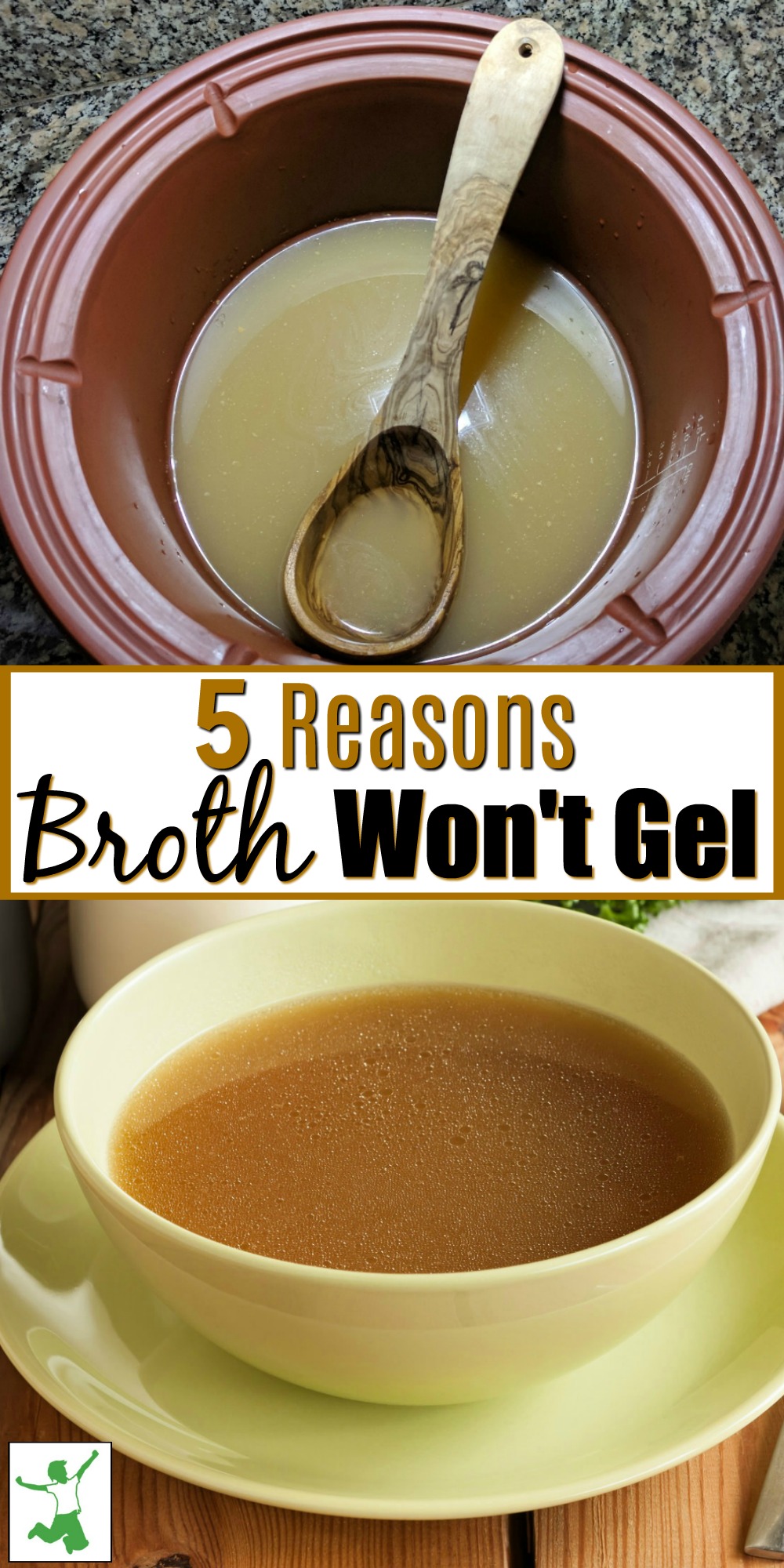


5 Reasons Why Your Stock Won’t Gel

by Sarah, The Healthy Home Economist on March 31, 2012


Correct preparation of homemade stock is one of the foundational techniques of Traditional Cooking.

So critical is homemade stock to the ongoing maintenance of health that Dr. Francis Pottenger MD, author of the nutrition classic Pottenger’s Cats, considered the stockpot the most important piece of equipment in the kitchen.

Homemade stock is so essential because it contains ample amounts of gelatin, a colloidal substance that attracts digestive juices to itself and prevents gastrointestinal bugs from attaching themselves to the gut wall and wreaking havoc.   Natural gelatin both assists digestion and keeps you well!

In addition to gelatin, stock contains minerals such as calcium, silicon, sulphur, magnesium, phosphorus, and trace minerals all in a form that is incredibly easy for the body to absorb.

Do you take expensive supplements for joint pain or arthritis?

Simply adding homemade stock on a frequent basis to your diet will do your cartilage, tendons, and joints a world of good as stock also contains collagen, chondroitin sulphates and glucosamine.

With homemade stock such a critical food to health, it is important to make it correctly.   One sign that you have indeed performed the task well is that your stock gels beautifully once it is chilled in the refrigerator.

If you find that your stock consistently does not gel, here are the 5 typical reasons why as described by Monica Corrado, MA, CNC and author of the blog Simply Being Well.  Monica teaches cooking classes and does consultations, so be sure to check her website for this information if you could use some coaching.

Reasons Why Your Stock Won’t Gel

  1. The stock rolled at too high a temperature.  If stock is simmered too high, the heat will break down and destroy the collagen.  To see what the perfect simmer on your stock should look like, see my short video on the subject by clicking here.
  2. The stock did not roll long enough.  Once you get that perfect simmer or “roll” going, be sure that chicken stock rolls for 6-24 hours and beef stock for 12-50 hours.  Less than that will likely not draw enough gelatin into the stock from the bones.
  3. Not enough of the right kind of bones were used that yield gelatin.  To get the right mix of bones that yield gelatin versus other types of bones that add flavor and color, make sure you use one of the following methods:  1 whole, free range layer hen with neck and wings cut up, 3-4 lbs of boney chicken parts which includes a combo of necks, backs, and wings, OR the picked carcass of 2 meat chickens.  For beef stock, use about 7 lbs bones total (4 lbs of boney bones and 3 lbs of meaty bones).
  4. Too much water was used in proportion to the bones.  For chickens, the correct proportion is 3-4 lbs of bones per 4 quarts of filtered water. For beef stock, the correct proportion is 7 lbs of bones per 4 quarts of water or more to cover.
  5. Using bones from battery chickens or chickens raised in cages.  Conventionally raised chickens or chickens raised in cages typically yield little to no gelatin.   It is worth the extra money to get quality when you buy meat especially if you will be using those bones to make stock.

To get additional gelatin, adding a chicken head and/or 2 feet to the stockpot will add even more!   If your chicken is a rooster, add the comb.  This will also add gelatin along with testosterone to the stock which adult men may find appealing as testosterone levels tend to decline with age.

If Your Stock Still Does Not Gel, Do This

If despite all your best efforts, you still come up with a pot of stock that does not gel, add 1 TBL of powdered gelatin per quart of liquid.

Vetted sources of good quality gelatin are available under the Supplements Section of my Resources page.

Hopefully, these tips will help you solve the riddle of why your stock doesn’t gel so that the time you spend on this age old culinary tradition is well spent producing the most nutrient dense stock possible!


Sarah, The Healthy Home Economist


The Healthy Home Economist by E-mail


{ 86 comments… read them below or add one }

Linda March 31, 2012 at 2:14 pm

How do you use the gelatin from the stock? Reheat it or how ?
Thank you !

Reply

Sarah, TheHealthyHomeEconomist March 31, 2012 at 9:19 pm

The gelatin is part of the stock and is not removed from it .. you use the stock to make soups and sauces.
Sarah, TheHealthyHomeEconomist\’s last post: 5 Reasons Why Your Stock Won’t Gel

Reply

Sarah, TheHealthyHomeEconomist March 31, 2012 at 9:19 pm

Click on the recipes tab in the header of the blog and select “soups and sauces” from the pulldown menu for many recipes for using homemade stock.
Sarah, TheHealthyHomeEconomist\’s last post: 5 Reasons Why Your Stock Won’t Gel

Reply

Linda April 1, 2012 at 11:45 am

Thank you Sarah. I’m an old farm wife and mom and I guess i just took stock geling for granted because mine always did and does . I just assumed it was part of cooking. So I thought maybe you all used it somehow differently! I boiled many many veggies in stock over the years. I am drinking the stock now as i did 13 days of the milk fast , would still be doing it but i ran out of milk . I’m going back on when it comes. I have never felt so good! And Thank the good Lord I almost always feel good! But in the mean time I wanted to put some good things into my body so did a chicken in the crock pot. It gelled(sp) beautifully.I never really thought of it NOT geling … :)

Reply

Lois March 31, 2012 at 2:37 pm

I’m concerned about leaving anything cooking or simmering while out of the house or sleeping. Is this fear unfounded?

Reply

Sarah, TheHealthyHomeEconomist March 31, 2012 at 2:51 pm

The heat for simmering stock is so very low when it is simmering correctly there is very little danger. I have another post to write about this as well. Some folks do it in a crockpot instead. I will try and write that this week :)
Sarah, TheHealthyHomeEconomist\’s last post: 5 Reasons Why Your Stock Won’t Gel

Reply

Bree April 1, 2012 at 2:51 pm

Whenever I don’t want to smell mine all night long, I turn the flame off just before I go to bed and wrap the stock pot with a thick towel. First thing in the morning, I turn the flame back on and the broth is simmering in 15 minutes. I’ve read that a lot of other people do this too and it works great. Maybe Sarah has some info on whether this is a good idea or not.

Reply

LeslieintheGarden March 31, 2012 at 4:34 pm

Linda,
In addition to its nutritional benefits, gelatin adds a ‘mouth feel’ or texture to the stock/broth, so it doesn’t seem like drinking water. The gelatin is not a distinct component of the stock, like say, the fat that rises to the top to be skimmed off. The fat can be skimmed and melted then filtered through cheesecloth a couple times for use in frying or baking.

Reply

Beth April 1, 2012 at 11:37 am

I never skim off the fat from my stock. When made from properly raised animals, I feel it’s an important and delicious part of the total nutrition of the stock (and my trad food oriented doctor agrees).

Reply

Kristi March 31, 2012 at 5:10 pm

Thank you so much for this Sarah. I just went to a local farm and bought a freshly butchered pastured, organic fed happy chicken, the livers and the feet. I’m excited to make broth with the feet for the first time!

Reply

Sarah, TheHealthyHomeEconomist March 31, 2012 at 5:23 pm

Excellent Kristi. Congratulations … learning to make traditional stock is a huge step toward learning how to maintain health with nutrition.
Sarah, TheHealthyHomeEconomist\’s last post: 5 Reasons Why Your Stock Won’t Gel

Reply

Peggy March 31, 2012 at 5:48 pm

My stock NEVER gelled. One time, after removing bones, meat and veggies, I left it on the stove to cool, but forgot to turn off the stove! By the time I remembered it, the two gallons had cooked down to two quarts of stock that gelled perfectly. Aha!
Peggy\’s last post: Fond Farewell

Reply

Tim Wightman March 31, 2012 at 7:34 pm

Hi Folks..
Good post Sara, but no where in the post did you explain what “Gel” means
I get a thick layer of gel and or fat on my stock but are you talking complete gel like stock jello or just really thick yet liquid broth?
Thanks
Brothman in training…
Tim

Reply

Sarah, TheHealthyHomeEconomist March 31, 2012 at 7:45 pm

Hi Tim! :)

Check the video link in the first sentence of the post. A picture of gelled stock is shown. But, to answer your question with words, yes – all the stock liquid should turn jelly like after being cooled in the fridge.
Sarah, TheHealthyHomeEconomist\’s last post: 5 Reasons Why Your Stock Won’t Gel

Reply

Tim Wightman March 31, 2012 at 9:59 pm

Ok got it!!
Now I know what to shoot for.
Thanks as always.
Tim

Reply

Dawn McKinney March 31, 2012 at 8:21 pm

I just found this blog…

Wow, I guess i took a lot for granted… my stock & soups always gelled… It never occurred to me that someone’s stock wouldn’t… I always use home grown, organically fed (grass fed), hand raised livestock for my meats, always boil the carcasses clean… all of the cartilage always intact, and the bones of the carcasses always dry virtually chalk white when I’m done. I know I have gotten everything I can out of them. I still have about 30 of my own chickens, 3 or my own turkeys, and just a little bit of my beef left in the freezer yet… I was raised on bone broths, and have been making this and many other traditional things by hand, since I was a little girl…

Reply

Melissa March 31, 2012 at 10:02 pm

If you are making beef broth, throw in some calf’s feet :) This is a gaurenteed gell-getting ingredient! I find them at the ethnic grocery in the stock bones section…
Thanks for the tips, Sarah!
Melissa\’s last post: Homemade Raw Goat’s Milk Soap

Reply

Rachel March 31, 2012 at 10:46 pm

I put mine in the oven when we’re away or sleeping and it’s not done yet.

My stock doesn’t gel typically, I think I tend to use too much water. But the last batch I added in 3-4 chicken feet, which I found at a new asian store in town and it was more gelatinous!! Not rigid, but better than it has been. I think I just need to pay more attention to how much water I use.

Reply

Jasmine April 1, 2012 at 3:26 am

What a timely post. I have a big stockpot full of beef stock bubbling away on the stove right now. This is the first time that I’ve made it solo. I’ve always made it at cooking school under the watchful eye of a trained chef. I’m hoping it gels this time :) I made chicken stock last weekend which turned out beautifully!

Reply

Mary Kate April 1, 2012 at 3:29 am

Made one of those chickens tonight that we bought the other day. WOW!! It cooked so differently. It was our 1st real free range chickens. You are not kidding when you say that it is well worth the money. We have a full bowl for more meals!! (sorry, but that is another 1st in our house.) I am making stock now and I thank you for this post. I hope it will turn out great. I will be off the milk cure tomorrow and would LOVE to drink some of this for breakfast!!! I will need a pick me up.
Oh, and I am down again to taking the steroid once every few days. Hoping to cancel that med in a month. I think I was rushing it before. So, I am feeling better about slowing it down a bit. Oh, and I read Paula’s post from Feb. about fish stock. Now I am going to have to make that as well.
Thank you for a great post!!

Reply

Sarah, TheHealthyHomeEconomist April 1, 2012 at 8:12 am

I have cup of fish stock with breakfast many mornings. I LOVE fish stock. I think it is a must for any woman these days as it keeps the thyroid so very strong. I learned this trick when traveling in Japan many years ago. The women there have basically no problem at all with menopause and they don’t have midlife weight gain either. Fish stock is very widely used there. Of course there are other big dietary pluses in their diet as well, but the fish stock thing I feel pretty confident is a big reason for women’s amazing post menopause health there.
Sarah, TheHealthyHomeEconomist\’s last post: 5 Reasons Why Your Stock Won’t Gel

Reply

Jennifer V April 1, 2012 at 9:00 am

Thanks for this! Just pondering this exact question yesterday…I think I’m using too much water. I use a 20 QT stockpot and fill it to a couple inches above the chicken and veggies. That AND to hard of a boil — hard to control on such a big pot and an electric stove. Gonna tweak it. Thank you!! And, thanks for the fish stock info…my thyroid could use the help (Hashimoto’s and I j ust had a baby). You are always such a great source of motivation and information.

Reply

Leslie R. April 1, 2012 at 11:26 am

Sarah,

Thank you, again, for such useful, informative directions. Because I am married to a firefighter, there is never going to be stock simmering on our stove top. I must use a crock pot, and I still have to turn the stock off while we sleep. In the morning, I put it all back into the crock pot. It is no wonder I never get gelatin. I can’t wait to read your crock pot suggestions.

Reply

Brenda April 1, 2012 at 3:21 pm

Leslie R., I just wanted to let you know that you’re not alone in having to turn off the broth at night. My husband is a long-haul truck driver, but won’t allow it for safety reasons. So, I just make sure that it is definitely heated through (rolling gently), turn it off for the night, then back on first thing in the morning. I use an ss stock pot, and leave it on the stove overnight, and I’ve had no problem because of that yet, but won’t say it’s perfectly fine for everybody. I just tend to think about what women might have done before they had refrigeration – they certainly couldn’t move it to the fridge overnight. Then, I figure the probiotics from my Kefir can handle any infraction(s).

Reply

Mikki April 1, 2012 at 11:30 am

Thanks Sarah! Very helpful! For sure I do not get good results from using a previously cooked carcus, even when I add a few chicken feet or necks/backs along with it. The easiest to get good gelatinous quality in a short time, every time, is fish stock. How long do you simmer your fish stock for?

Reply

Sarah, TheHealthyHomeEconomist April 1, 2012 at 11:37 am

4-6 hours. Fish stock is the fastest, most nutritious, most tasty stock there is. Fish stock rocks. It’s amazing to me that hardly anyone I know makes it. Fish heads cost next to nothing too. Who says it takes a lot of $$ to stay healthy? It’s dirt cheap folks.
Sarah, TheHealthyHomeEconomist\’s last post: 5 Reasons Why Your Stock Won’t Gel

Reply

Aimee April 1, 2012 at 7:34 pm

I’ll second that! I can get fish heads for free from my fish monger! I made a big batch in December and froze pint size containers, I have it for my chowders, gumbo and for drinking straight up ( with a little dulse sprinkled in). The best stuff!

Reply

Mikki April 2, 2012 at 9:25 pm

I agree and it’s so mild and delish; not fishy and just like “the sea.” I’m blessed to live 15 miles from The Pacific in SoCal and our local fish monger gives me the whole fish that they’ve filleted for free. Last time it was a 4 foot long white sea bass from our local waters! What an adventure cutting him up to fit into my stock pots! It took two pots to make stock from his large frame but I ended up with quarts and quarts of wonderful, healthy stock for hardly any money at all. You are blessed to live near the Atlantic! :-)

Reply

Sarah, TheHealthyHomeEconomist April 1, 2012 at 11:39 am

Here’s my video on making fish stock. One caveat: you CANNOT use just any fish to make it. You MUST get the right kind of fishheads else the results will be disgusting.

http://www.thehealthyhomeeconomist.com/video-making-fish-stock/
Sarah, TheHealthyHomeEconomist\’s last post: 5 Reasons Why Your Stock Won’t Gel

Reply

Nicole, The Non-Toxic Nurse April 1, 2012 at 5:20 pm

When you make the fish stock with the correct kind of fish heads, does it taste really fishy, or is it a fish taste that can be masked with garlic or such? Thanks:-)
Nicole, The Non-Toxic Nurse\’s last post: Smart Meters Are An Even Larger Threat Than I Had Thought: A More Detailed Consideration of Smart Meters’ Microwave Technology, and Its Threats to Health and Civil Liberties

Reply

Sarah, TheHealthyHomeEconomist April 1, 2012 at 6:28 pm

I tastes like fish broth for sure but it isn’t overly fishy. I think it is just so delish … plus I LOVE what it does for my thyroid :)
Sarah, TheHealthyHomeEconomist\’s last post: 5 Reasons Why Your Stock Won’t Gel

Reply

Nicole, The Non-Toxic Nurse April 1, 2012 at 6:35 pm

Thanks! I will try to work up my courage and attempt it in the future:-)
Nicole, The Non-Toxic Nurse\’s last post: Smart Meters Are An Even Larger Threat Than I Had Thought: A More Detailed Consideration of Smart Meters’ Microwave Technology, and Its Threats to Health and Civil Liberties

Reply

Mikki April 2, 2012 at 9:29 pm

Stay away from strong oily fish. Salmon doesn’t work well and I wouldn’t think tuna or mackerel either. Here in California, halibut, rock cod and our local white sea bass are very mild, not oily and certainly not fishy. You do not need to mask these fish at all, just a simple, carrot, onion, celery, bay leaf, white wine, parsley and salt is all you need for a wonderful, light, healthy stock. For a quick soup, and I have this with my breakfast along with an egg like Sarah said the monks in Japan do, and mix a little miso into it.

Bonnie April 15, 2012 at 1:12 am

The simplest thing to take the fishiness out is to add an inch or so sliced-up ginger root and bring the fish heads and water to a boil with sliced ginger in it. Fish the ginger slices out after the stock is done and you have no fishiness. My spouse wouldn’t drink my fish stock until I started adding ginger to it. Give it a try!

Jo-Anne April 1, 2012 at 11:46 am

We buy pastured chickens, but the gelling is inconsistent. I think I add too much water. Getting the feet from our pastrured birds seems to be a big issue from the facility that butchers them. I am nervous about sourcing the chicken feet from an asian store that maybe are from chickens that are not as high of quality as what we routinely purchase. Is this worth worrying about. We always buy the best we can afford in our meats and fats, so I don’t want to ruin what we have invested in, by buying the poorer quality chicken feet…thoughts?

Reply

Helen May 7, 2012 at 5:38 pm

I’ve recently started using just bones from chicken wings which gel so much better than bones from whole bird. It gels solid, amazing.

Reply

Dennis April 1, 2012 at 1:39 pm

I have been using my 7qt slow cooker for my stock just due to the set and forget aspect of making the stock.
Even on low it seems to be a little to hot and I believe I loose a bunch of liquid to steam and leakage out of the top of the lid.
Do the stock pots work better and as the lid traps and directs the vapours etc back down the pot in the cooking stock??
Thanks for any and all advice!!!
Denny

Reply

Sarah, TheHealthyHomeEconomist April 1, 2012 at 1:55 pm

Folks who have a gas stove seem to have this problem a lot .. even on the lowest setting the stock simmers too high.

The solution is to get a hot plate. Problem solved. This is what Monica Corrado suggests as even crockpots seem too cook stock too high in some cases.
Sarah, TheHealthyHomeEconomist\’s last post: 5 Reasons Why Your Stock Won’t Gel

Reply

Sarah, TheHealthyHomeEconomist April 1, 2012 at 1:57 pm

If you are losing a lot of water from the stock, then that is a big clue it is simmering too high as well. You really shouldn’t lose that much.
Sarah, TheHealthyHomeEconomist\’s last post: 5 Reasons Why Your Stock Won’t Gel

Reply

Danielle April 1, 2012 at 1:40 pm

Thanks Sarah – my stock doesn’t gel and I have a feeling it’s either the bones I’m using or too high a temp. Not sure what to do on the temp as I keep the stove as low as it will go. :-(
Danielle\’s last post: Pray, Refocus and Reflect

Reply

Sarah, TheHealthyHomeEconomist April 1, 2012 at 1:56 pm

Try boiling it down and see if it gels. If it does, then it was simply too much water.
Sarah, TheHealthyHomeEconomist\’s last post: 5 Reasons Why Your Stock Won’t Gel

Reply

sarah April 1, 2012 at 3:17 pm

what is the benefit of the stock gelling?!

Reply

Beth April 1, 2012 at 11:47 pm

The benefit is that it’s an indication of a high gelatin content, rich in collagen, super nourishing, great for digestion and assimilation of nutrients, a boost for the immune system.

Reply

Ez November 11, 2012 at 4:46 pm

My thinking is that if the liquid doesn’t gel from too much water, but, cooks down and gels there is gelatin in the mix wether it’s diluted or concentrated. So, the benefits are still assimilated, regardless.

Just my logic, unless there is another reason this would not be so?

Reply

Rashell April 1, 2012 at 3:18 pm

I always get beautiful gel just by using my crock pot. I do always put it on low and use a couple of chickens, or a roast with a bone. It doesn’t seem to matter what animal as long as it has meat and bones.

Reply

Kelli April 1, 2012 at 4:48 pm

My actually completely gelled up the first time I made stock from chicken. I even did it in a crockpot so I wasn’t expecting it to turn out right, but it did!

Reply

Sarah, TheHealthyHomeEconomist April 1, 2012 at 9:08 pm

You’re a natural Kelli!
Sarah, TheHealthyHomeEconomist\’s last post: 5 Reasons Why Your Stock Won’t Gel

Reply

Jennifer April 1, 2012 at 6:29 pm

Just want to make sure – so adding the vinegar won’t harm the process? Also, what do you do after you chill it, scoop it out and warm it back up to drink in individual proportions? And do you HAVE to take the fat off if you know the source of the meat? I was thinking it was good for you, but I mostly read to remove it.

Reply

Sarah, TheHealthyHomeEconomist April 1, 2012 at 9:07 pm

Of course add vinegar. The directions for making it are in the video link in the first part of the blog post. This post was just about the reasons why it wouldn’t gel.
Sarah, TheHealthyHomeEconomist\’s last post: 5 Reasons Why Your Stock Won’t Gel

Reply

Sarah, TheHealthyHomeEconomist April 1, 2012 at 9:08 pm

You do not have to take the fat off if you don’t want to. Personal preference. Some folks find the fat makes the broth too oily; others love it that way. If you do remove it, save that fat as it is spectacular for sauteing veggies..
Sarah, TheHealthyHomeEconomist\’s last post: 5 Reasons Why Your Stock Won’t Gel

Reply

Melinda April 2, 2012 at 1:30 am

For my gas range, I stack the cover plates or frames on top of each other which gives a couple of extra inches from the flame and allows for a slower boil

Reply

Sarah, TheHealthyHomeEconomist April 2, 2012 at 9:33 pm

GREAT idea :)
Sarah, TheHealthyHomeEconomist\’s last post: Tips For Teaching Kids Moderation with Candy

Reply

Leanne April 2, 2012 at 8:03 am

If I make stock in the crockpot on low, it won’t gel. Maybe the temperature is too low. I’ve been sticking with the stovetop and it always gel, but next time I’ll try my crockpot on high.

The pot in your picture looks just like one from a set my mom has had for as long as I remember. She bought them over 30 years ago for $200 (criticized by family for spending so much at the time), but she still uses them! It’s so hard to find a heavy duty stainless steel pot like that now. Any suggestions on a brand?

Reply

Sarah, TheHealthyHomeEconomist April 2, 2012 at 9:31 pm

I’ve had my set since I got married almost 21 years ago! Wedding gift … they have been fantastic. Don’t know much about current brands as I’ve not been in the market.
Sarah, TheHealthyHomeEconomist\’s last post: Tips For Teaching Kids Moderation with Candy

Reply

Molly April 2, 2012 at 12:11 pm

I have now made chicken broth and beef broth, both by stockpot and slow cooker. Never been gelantinous. I’m so discouraged. I follow the recipe in Eat Fat/Lost Fat. I buy online the best source of bones or carcass. I’m beginning to wonder if I am using enough bones? But I’m not going to give up! My stocks taste good but they don’t have gelatin.

Reply

Afton April 2, 2012 at 6:13 pm

A perpetual stock is not a high quality stock?

Reply

Sarah, TheHealthyHomeEconomist April 2, 2012 at 9:32 pm

I’ve never done a perpetual stock. I just make huge batches and that seems to work fine for us.
Sarah, TheHealthyHomeEconomist\’s last post: Tips For Teaching Kids Moderation with Candy

Reply

lori May 11, 2012 at 8:57 am

I have a friend who makes a perpetual stock and she loves it.

Reply

Brenda April 2, 2012 at 6:52 pm

Great post….learned a lot. I make beef and chicken stock and sometimes they gel, sometimes not, but this helped me understand why it may not be gelling! Thanks!

Reply

Sharon April 4, 2012 at 12:51 pm

Great post -
2 questions:
1. Can you tell me more about adding gelatin to the stock. I just purchased some from radiant life. For best results, when do you add it? When it is still hot?
2. I often make stock from a chicken carcass that has been previously roasted. For example, I’ll roast a chicken with butter or oil one night, eat most of the meat as dinner, and then add water to make a stock with the leftover fat and carcass. What are the thoughts on this approach?
Many thanks.

Reply

Michele April 7, 2012 at 9:02 am

I have the same question–I’ve been using previously roasted chicken carcasses for my stock the same way as Sharon described. The leftover broth/gravy from when I originally roasted the chicken usually gels but not the stock made from the leftover bones. Why is that?

Reply

Patt April 4, 2012 at 7:32 pm

I didn’t realize several of the areas for stock making which you suggested, thanks for adding these. When I baked my 7lb pastured chicken, I saved all the “juice” it turned out that was solid gel. I made my stock and added the 2 cups of “juice”. However, the stock had very little taste even with the onions, celery, spices, and 2 cups of chicken. How do I get more chicken flavor? I ended up adding 1 teas curry and a quart of home canned tomatoes; it passes but…
Patt\’s last post: The “Cumulative Time” Approach for Making Stock

Reply

Joyce April 5, 2012 at 12:50 am

Another caveat about using battery/caged chickens is that almost all of them are pumped full of a 12% to 15% “solution” of “natural flavors,” which is basically MSG!!!. I get migraines and avoid MSG like the plague. Ironically, many people who make homemade stock make it to avoid having to buy commercially made stocks that have no gelatin, but are also chock-full o MSG!

Thanks,
Joyce

Reply

Jeff May 10, 2012 at 8:44 pm

I guess we’ve been “lucky.” We accidentally came upon our formula for nicely gelled chicken stock. The bones and of 2 whole roasted chickens or 8 leg/thigh bones. Toss in a quarter of an onion, a few stalks of celery, a teaspoon of minced garlic and let in slowly boil for 2 hours. Then turn off the heat and let it set on the stove for 2 hours. Remove all the stuff and put in the fridge. Make soup right away or put in the fridge. Once it’s cooled use it in soup within a day or two or pour into freezer bags for the next time we need it.

Reply

Joseph Downey May 11, 2012 at 6:27 pm

Can you put wine instead of vinegar? I don’t care for the taste of vinegar in my stock, but Trader Joe’s sells some pretty good cheap wines (2-buck Chuck). I’ve been using that for years, hoping it has a similar effect to vinegar. If not, I could probably switch to lemon juice?
Joseph Downey\’s last post: Substitutions: The Secret to Great Recipes

Reply

Marta May 14, 2012 at 12:41 pm

After you’ve simmered your stock for the appropriate amount of time, there should be no taste (or smell) of vinegar left in it.

Reply

Joseph Downey May 15, 2012 at 7:21 pm

Okay; I’ll try it on my next batch.

Reply

GTH May 23, 2012 at 6:18 am

Should fish stock gel?

Reply

beth June 25, 2012 at 9:09 pm

Okay, just tried to make stock. total failure. I used organic chicken feet, an organic whole chicken, water to just cover chicken, just at a simmer like on the video. Did not gel at all, is kinda of brown and the chicken was horrible. Gave it to the dog, and even he won’t touch.

Reply

Michele June 26, 2012 at 8:48 am

Beth, I read your email as I was making my stock yesterday. Mine didn’t gel at all, either, and I followed all the instructions. It never does, and I can’t figure out why!

Reply

Michele June 26, 2012 at 9:36 am

Oops- I meant to say post, not email. And I just tried boiling it down, as Sarah suggested in one of her follow up comments, but that didn’t work either. :-(

Reply

Faith June 28, 2012 at 1:50 pm

Do you know of any problem with making a TON of broth at one time? I have made 5 gallons of stock at once in my huge pot by using the Nourishing Traditions recipe. I try to keep the same ratio of water to bones and veggies. Also, I use a couple of pounds of heads and feet that I get from a local farm. Is it okay to use just as many pounds of heads and feet as the back and other parts? Lastly, I am so glad I saw your video on the perfect simmer. I have definitely heated mine too much in the past.

Reply

Faith June 28, 2012 at 2:57 pm

I was also wondering…if the stock didn’t gel correctly, would you still keep it and use it?
Thanks!

Reply

Chilloften July 13, 2012 at 12:49 pm

I made beef bone broth that didn’t gel. It just got very dark brown but was soooo good. I love having it. I guess I don’t understand what you mean by “meaty bones”. What would be considered a beef meaty bone?
I heard you with Sean Croxton and loved listening. Peace and blessings.

Reply

dhg August 31, 2012 at 3:30 pm

thank you for this article!

I have been making bone-broth for just about a month, now. I drink a cup a day.. and started because/am hoping it will help a chronic, severe left-ankle tendon injury to heal—

I bought a 3.5 quart crockpot for the job (I live in a tiny NYC apartment!) and have been lucky every time with my chicken broth: it has gelled every time. I use ~1 lb of feet and necks + ~1 quart of filtered water.

but both times I tried making beef broth, it did not gel and I couldn’t figure out why.. your article explains it ! you recommend a ratio of 7 lbs of bones to only 4 quarts of water ! (for me, that means 1.5 lbs + 1 quart of water..) I used a 1.5 lb knuckle bone (24 oz) and added double that, in water: ~48-50 oz- way more than a quart. thank you!

I also was interested to read that you use the fat from the broth.. it has been drummed into me for so long that “fat is bad” that I haven’t done that. I’ve been throwing it away– maybe it’s time for me to experiment..

anyways, my cup of broth a day feels like a great, new habit. if it doesn’t help my tendon/ankle directly, I can’t help believe that it’s still doing me good!

Reply

Julia September 25, 2012 at 11:12 am

I make my broth with the perpetual soup method via http://nourishedkitchen.com/perpetual-soup-the-easiest-bone-broth-youll-make/

Does that method do anything to damage the gelatin? Am I still GETTING gelatin in my broth even if I don’t have enough bones per water ratio? Or am I only going to get gelatin benefits if it actually gels? Does that make sense? I use ACV and the bones for about a week. They completely soft when I’m done so I presume I get all the nutrients out. But is there anything about what I’m doing that breaks down the gelatin? I don’t want to be shooting myself in the foot thinking I’m getting nutrients when I’m not.

Oh, and I usually turn my crockpot on high til it boils, then all the way down to the lowest “keep warm” setting the entire rest of the time. It doesn’t simmer but definitely stays EXTREMELY hot. Thanks so much for any info you can give me!
Julia

Reply

Everett October 17, 2012 at 8:21 am

Mine didn’t gel and I have no idea why. I sourced a knuckle (all grass fed of course) plenty of marrow and meaty bones, I wanna say 10lbs total. Apparently I forgot that I had started it a day sooner so in the end it was on the burner for about 76 hours. Pretty sure Fallon says up to 72 correct? I used 5 quarts of water but given that I had 10 lbs of bones that’s not far off from the 7 lbs/4 quarts ratio mentioned in this article. But here’s the kicker, the second night I scooped and strained a cup of it to make my porridge in the next morning and it gelled, so I thought I was successful. Finished up last night and this morning it’s just like the chicken stock that I can’t seem to get to gel either… did it just simmer too long? Oh also it definitely didn’t roll too high.

Reply

Anna October 19, 2012 at 3:24 pm

I’m having a hard time finding bones but I just found a local wild game processor who will sell the bones. The problem is that they are considered dog bones and they don’t cut them very small and they don’t put them in the fridge. Is it safe to use the bones if they aren’t refrigerated?

Reply

Rebekkah Smith November 5, 2012 at 9:18 pm

Mine seems to be hit or miss on whether it gels. I can’t find perfectly raised chickens, so that’s probably why my chicken stock won’t gel. They are organic, but I can’t find free-range. :( I’e got a great source for beef bones though! Making my first beef stock now!!

Even if my chicken and beef stock don’t gel, are they still nutritious?

Reply

Mark November 19, 2012 at 6:12 pm

Hello, what is meant be “boney bones or meaty bones” for item #3 for beef bones? Forgive me but this is the first time I’m trying to cook something other than a cheeseburger, hotdog, etc. I’m trying to get somewhat serious about healthy cooking. I recently bought 2 pounds of grass fed marrow beef bones which I’ve cooked for nearly 24 hours but the broth tastes like water so far. Are marrow bones considered boney, meaty, or otherwise? Is it ever advised to roast any of the bones before boiling them? Is it advised to include chicken feet in with beef bones or would that be a faux pas? I’ve heard that chicken feet have collagen; hence my contemplation of it. I have Crohn’s Disease which is why I’m seeking ways to heal my gut, thanks.

Reply

SoCalGT November 19, 2012 at 11:43 pm

Hi Mark, your marrow bones would be considered boney bones. Ox tail or beef shank would be meaty bones. Knuckle bones are usually boney bones as well. I have the butcher cut knuckle bones in smaller pieces so minerals can be released easier. You can roast the bones before making stock for a richer taste but I usually don’t take the time and still get a wonderful flavor. Simmer beef stock for at least 48 hours. Use only enough water to cover bones/meat/veggies. Adding some meaty bones will help add flavor as well. For chicken stock I use bones from chicken I have cooked for meals, store bought chicken backs and chicken feet. Adding the chicken feet to your beef stock should be just fine. I don’t get too concerned about following a specific recipe, only general guidelines. Good luck, stock is a great place to start!

Reply

Annette Smith January 11, 2013 at 7:48 pm

Is the stock still nutritious if it hasn’t gelled?

Reply

Deb January 17, 2013 at 3:29 pm

Hi Sarah,
I love, love love your blog! Quesion: once you’ve finished simmering a pot of beef broth, how long can it stay out to cool before going in the fridge? I forgot about mine yesterday and left it out for six hours before putting in the fridge. Is it still OK? Thanks for all you do and write!

Reply

ormwvlgtlqsm March 15, 2013 at 3:42 am

erjtweqtypaz

Reply

yibsiaonmedz March 16, 2013 at 2:10 am

neqzelyokvco

Reply

jszevrjjoorq March 16, 2013 at 2:12 am

wxcjtysmjhfv

Reply

Leave a Comment

CommentLuv badge

{ 4 trackbacks }

Previous post:

Next post: