

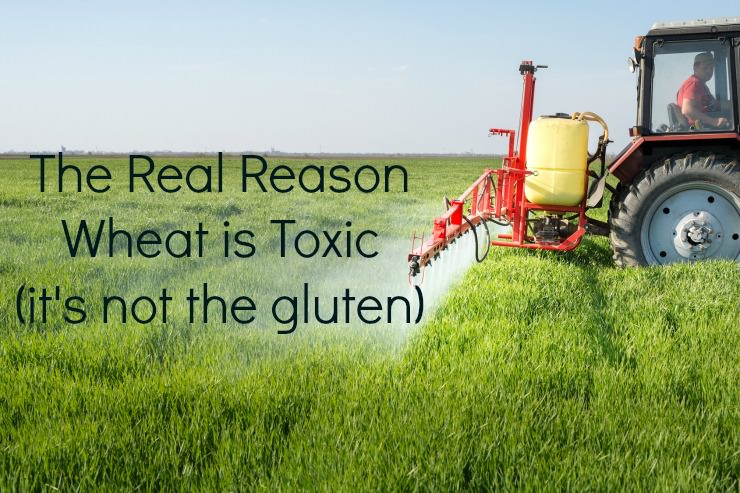
The Real Reason Wheat is Toxic (it’s not the gluten)

by Sarah TheHealthyHomeEconomist

wheat is toxic and it isn't the gluten

The stories became far too frequent to ignore.

Emails from folks with allergic or digestive issues to wheat in the United States experienced no symptoms whatsoever when they tried eating pasta on vacation in Italy.

Confused parents wondering why wheat consumption sometimes triggered autoimmune reactions in their children but not at other times.

In my own home, I’ve long pondered why my husband can eat the wheat I prepare at home, but he experiences negative digestive effects eating even a single roll in a restaurant.

There is clearly something going on with wheat that is not well known by the general public. It goes far and beyond organic versus nonorganic, gluten or hybridization because even conventional wheat triggers no symptoms for some who eat wheat in other parts of the world.

What indeed is going on with wheat?

For quite some time, I secretly harbored the notion that wheat in the United States must, in fact, be genetically modified.  GMO wheat secretly invading the North American food supply seemed the only thing that made sense and could account for the varied experiences I was hearing about.

I reasoned that it couldn’t be the gluten or wheat hybridization. Gluten and wheat hybrids have been consumed for thousands of years. It just didn’t make sense that this could be the reason for so many people suddenly having problems with wheat and gluten in general in the past 5-10 years.

Finally, the answer came over dinner a couple of months ago with a friend who was well versed in the wheat production process. I started researching the issue for myself, and was, quite frankly, horrified at what I discovered.

The good news is that the reason wheat has become so toxic in the United States is not because it is secretly GMO as I had feared (thank goodness!).

The bad news is that the problem lies with the manner in which wheat is grown and harvested by conventional wheat farmers.

You’re going to want to sit down for this one.  I’ve had some folks burst into tears in horror when I passed along this information before.

Common wheat harvest protocol in the United States is to drench the wheat fields with Roundup several days before the combine harvesters work through the fields as the practice allows for an earlier, easier and bigger harvest 

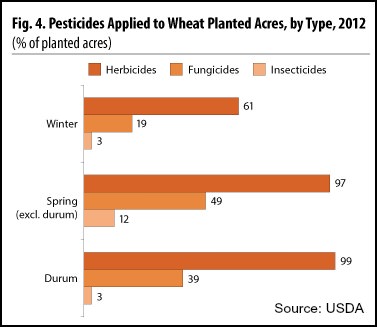
Pre-harvest application of the herbicide Roundup or other herbicides containing the deadly active ingredient glyphosate to wheat and barley as a desiccant was suggested as early as 1980.  It has since become routine over the past 15 years and is used as a drying agent 7-10 days before harvest within the conventional farming community.USDA pesticides applied to wheat
According to Dr. Stephanie Seneff of MIT who has studied the issue in depth and who I recently saw present on the subject at a nutritional Conference in Indianapolis, desiccating non-organic wheat crops with glyphosate just before harvest came into vogue late in the 1990’s with the result that most of the non-organic wheat in the United States is now contaminated with it.  Seneff explains that when you expose wheat to a toxic chemical like glyphosate, it actually releases more seeds resulting in a slightly greater yield:   “It ‘goes to seed’ as it dies. At its last gasp, it releases the seed” says Dr. Seneff.

According to the US Department of Agriculture, as of 2012, 99% of durum wheat, 97% of spring wheat, and 61% of winter wheat has been treated with herbicides. This is an increase from 88% for durum wheat, 91% for spring wheat and 47% for winter wheat since 1998.

Here’s what wheat farmer Keith Lewis has to say about the practice:

I have been a wheat farmer for 50 yrs and one wheat production practice that is very common is applying the herbicide Roundup (glyposate) just prior to harvest. Roundup is licensed for preharvest weed control. Monsanto, the manufacturer of Roundup claims that application to plants at over 30% kernel moisture result in roundup uptake by the plant into the kernels. Farmers like this practice because Roundup kills the wheat plant allowing an earlier harvest.

A wheat field often ripens unevenly, thus applying Roundup preharvest evens up the greener parts of the field with the more mature. The result is on the less mature areas Roundup is translocated into the kernels and eventually harvested as such.

This practice is not licensed. Farmers mistakenly call it “dessication.” Consumers eating products made from wheat flour are undoubtedly consuming minute amounts of Roundup. An interesting aside, malt barley which is made into beer is not acceptable in the marketplace if it has been sprayed with preharvest Roundup. Lentils and peas are not accepted in the market place if it was sprayed with preharvest roundup….. but wheat is ok.. This farming practice greatly concerns me and it should further concern consumers of wheat products.

Here’s what wheat farmer Seth Woodland of Woodland and Wheat in Idaho had to say about the practice of using herbicides for wheat dry down:

That practice is bad . I have fellow farmers around me that do it and it is sad. Lucky for you not all of us farm that way. Being the farmer and also the president of a business, we are proud to say that we do not use round up on our wheat ever!

This practice is not just widespread in the United States either. The Food Standards Agency in the United Kingdom reports that use of Roundup as a wheat desiccant results in glyphosate residues regularly showing up in bread samples. Other European countries are waking up to to the danger, however. In the Netherlands, use of Roundup is completely banned with France likely soon to follow.

Using Roundup on wheat crops throughout the entire growing season and even as a desiccant just prior to harvest may save the farmer money and increase profits, but it is devastating to the health of the consumer who ultimately consumes the glyphosate residue laden wheat kernels.

The chart below of skyrocketing applications of glyphosate to US wheat crops since 1990 and the incidence of celiac disease is from a December 2013 study published in the Journal Interdisciplinary Toxicology examining glyphosate pathways to autoimmune disease. Remember that wheat is not currently GMO or “Roundup Ready” meaning it is not resistant to its withering effects like GMO corn or GMO soy, so application of glyphosate to wheat would actually kill it.
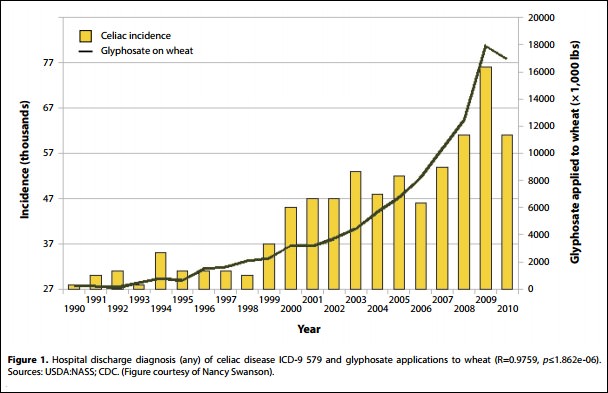
celiac incidence as a factor of glyphosate application to wheat

While the herbicide industry maintains that glyphosate is minimally toxic to humans, research published in the Journal Entropy strongly argues otherwise by shedding light on exactly how glyphosate disrupts mammalian physiology.

Authored by Anthony Samsel and Stephanie Seneff of MIT, the paper investigates glyphosate’s inhibition of cytochrome P450 (CYP) enzymes, an overlooked component of lethal toxicity to mammals.

The currently accepted view is that ghyphosate is not harmful to humans or any mammals.  This flawed view is so pervasive in the conventional farming community that Roundup salesmen have been known to foolishly drink it during presentations!

However, just because Roundup doesn’t kill you immediately doesn’t make it nontoxic.  In fact, the active ingredient in Roundup lethally disrupts the all important shikimate pathway found in beneficial gut microbes which is responsible for synthesis of critical amino acids.

Friendly gut bacteria, also called probiotics, play a critical role in human health. Gut bacteria aid digestion, prevent permeability of the gastointestinal tract (which discourages the development of autoimmune disease), synthesize vitamins and provide the foundation for robust immunity.  In essence:

Roundup significantly disrupts the functioning of beneficial bacteria in the gut and contributes to permeability of the intestinal wall and consequent expression of autoimmune disease symptoms

In synergy with disruption of the biosynthesis of important amino acids via the shikimate pathway, glyphosate inhibits the cytochrome P450 (CYP) enzymes produced by the gut microbiome.  CYP enzymes are critical to human biology because they detoxify the multitude of foreign chemical compounds, xenobiotics, that we are exposed to in our modern environment today.

As a result, humans exposed to glyphosate through use of Roundup in their community or through ingestion of its residues on industrialized food products become even more vulnerable to the damaging effects of other chemicals and environmental toxins they encounter!

What’s worse is that the negative impact of glyphosate exposure is slow and insidious over months and years as inflammation gradually gains a foothold in the cellular systems of the body.

The consequences of this systemic inflammation are most of the diseases and conditions associated with the Western lifestyle:

  • Gastrointestinal disorders
  • Obesity
  • Diabetes
  • Heart Disease
  • Depression
  • Autism
  • Infertility
  • Cancer
  • Multiple Sclerosis
  • Alzheimer’s disease
  • And the list goes on and on and on …

In a nutshell, Dr. Seneff’s study of Roundup’s ghastly glyphosate which the wheat crop in the United States is doused with uncovers the manner in which this lethal toxin harms the human body by decimating beneficial gut microbes with the tragic end result of disease, degeneration, and widespread suffering

Got the picture yet?

Even if you think you have no trouble digesting wheat, it is still very wise to avoid conventional wheat as much as possible in your diet!

You Must Avoid Toxic Wheat No Matter What

The bottom line is that avoidance of conventional wheat in the United States is absolutely imperative even if you don’t currently have a gluten allergy or wheat sensitivity. The increase in the amount of glyphosate applied to wheat closely correlates with the rise of celiac disease and gluten intolerance. Dr. Seneff points out that the increases in these diseases are not just genetic in nature, but also have an environmental cause as not all patient symptoms are alleviated by eliminating gluten from the diet.

The effects of deadly glyphosate on your biology are so insidious that lack of symptoms today means literally nothing.

If you don’t have problems with wheat now, you will in the future if you keep eating conventionally produced, toxic wheat!

How to Eat Wheat Safely

Obviously, if you’ve already developed a sensitivity or allergy to wheat, you must avoid it.  Period.

But, if you aren’t celiac or gluten sensitive and would like to consume this ancestral food safely, you can do what we do in our home. We source organic, naturally low in gluten, unhybridized Einkorn wheat for breadmaking, pancakes, cookies etc. Please note that einkorn is not to be confused with the more general term farro, which includes emmer and spelt, which are both hybridized. You can learn more about the scientific research on the “good” gluten in einkorn in this article.

When we eat out or are purchasing food from the store, conventional wheat products are rejected without exception. This despite the fact that we have no gluten allergies whatsoever in our home – yet.

I am firmly convinced that if we did nothing, our entire family at some point would develop sensitivity to wheat or autoimmune disease in some form due to the toxic manner in which it is processed and the glyphosate residues that are contained in conventional wheat products.

What Are You Going to Do About Toxic Wheat?

How did you react to the news that US wheat farmers are using Roundup, not just to kill weeds, but to dry out the wheat plants to allow for an earlier, easier and bigger harvest and that such a practice causes absorption of toxic glyphosate, the active ingredient in Roundup and other herbicides, right into the wheat kernels themselves?

Did you feel outraged and violated like I did? How will you implement a conventional wheat-avoidance strategy going forward even if you haven’t yet developed a problem with gluten or wheat sensitivity?

What about other crops where Roundup is used as a pre-harvest dessicant such as barley, sugar cane, rice, seeds, dried beans and peas, sugar cane, sweet potatoes, and sugar beets?  Will you only be buying these crops in organic form from now on to avoid this modern, man-made scourge?

UPDATE:  The Soil Association in July 2015 called for an immediate ban on the use of glyphosate for wheat ripening and desiccation purposes.  The nonprofit reports that glyphosate residues are widely found in nonorganic wheat samples and the use of the herbicide on wheat crops has increased 400% in the past two decades.

Dr. Robin Mesnage of the Department of Medical and Molecular Genetics at Kings College in London, revealed new data analysis showing Roundup, the most common brand of Glyphosate based herbicides, is 1,000 times more toxic than genotoxic glyphosate alone due to the inclusion of other toxic chemicals in its mix.

Peter Melchett, Soil Association policy director said; “If Glyphosate ends up in bread it’s impossible for people to avoid it, unless they are eating organic. On the other hand, farmers could easily choose not to use Glyphosate as a spray on wheat crops – just before they are harvested. This is why the Soil Association is calling for the immediate ending of the use of Glyphosate sprays on wheat destined for use in bread.”

Sarah, The Healthy Home Economist


Sources and More Information

Roundup: Quick Death for Weeds, Slow and Painful Death for You

Glyphosate now commonly found in human urine

Study: Glyphosate, Celiac and Gluten Intolerance

The Glyphosate, Celiac Disease Connection

Hybrid Wheat is Not the Same as GMO Wheat

The Dutch Ban Roundup, France and Brazil to Follow

Is it the Gluten or is it the Glyphosate?

How to Mix and Use Gluten Free Flour

Can Celiacs Eat Sourdough Bread?

Pre-harvest Application of Glyphosate to Wheat

The Dirty Little Secret About Gluten Free

Glyphosate’s Suppression of Cytochrome P450 Enzymes and Amino Acid Biosynthesis by the Gut Microbiome: Pathways to Modern Diseases

Yield and quality of wheat seeds as a function of desiccation stages and herbicides

Wheat farmer weighs in on the use of Roundup as a wheat desiccant


Comments (996)

  1. Hi, Sarah,

    I am a freelance writer who was recently sent a link to this blog post. I thought I had developed a gluten sensitivity within the last 8 years. But after hearing anecdotes of people with celiacs eating pasta and bread in Europe with no problem and then reading your blog post, I went out and purchased organic wheat flour and made myself a pan of brownies. After nibbling on them for 2 days, with little (but not NO) ill effects, I am convinced you have something here.

    I WOULD LIKE TO DRAW ATTENTION TO THIS ISSUE. I have often been assigned articles about nutrition, and food safety is a personal concern of mine. Before I develop an action plan, I will continue to research this topic. But If you have any suggestions on steps to add to that plan, please let me know. I do have some questions:

    Q1: Is there an organization leading the charge to draw attention to this problem?

    Q2: I am puzzled by the causative effect of glyphosate on celiacs disease, as shown in the graph. I have in-laws who were diagnosed with celiacs within the last 10 years (but they had problems for years – even decades – before that). I have no medical training, just a strong interest in medical issues. I thought that celiacs was an autoimmune disease with a strong genetic predisposition. Are you saying that the damage caused by glyphosate could cause celiacs – even with no genetic component? Or does it just create conditions for turning on the gene, so to speak?

    Q3: Do you think the damage done by glyphosate is reversible? For example, if someone develops celiacs, can they potentially get better?

    Q4: Tell me whether this is a logical conclusion:
    After reading this, and doing a test with organic wheat flour, it would be easy for others to think that I am just SENSITIVE to glyphosate, not them, so they can continue to eat it. But my conclusion is different: that glyphosate is toxic to everyone, and no one should be eating it, because over time, it WILL do damage. What do you think?

    Now, I realize this post is going viral, and you are probably swamped trying to respond. But I will welcome a personal or public response at your earliest convenience.

    Yours in the fight for food safety,
    Kimberly

    Reply
  2. Sarah do you know if flour can be ordered from other countries. I have a genetic challenge that makes it difficult to tolerate the folic acid added to the flour in America per US law. Perhaps one day that will be refunded as it is not healthy for many citizens. Do you have any resources for this?

    Reply
  3. I cannot possibly read the entire discussion, but hope someone mentioned that it has been reported that the original patent on Glyphosate was as an antibiotic, which would explain how it kills everything in the gut/mirrors brain receptors and directly connected. Coinciding with a recent research article that hard liquors did gut damage, whilst beer, a ferment, not a distillation, did not (re: Alzheimer research, but so many obvious other implications!)

    Reply
  4. The Entropy paper that you reference has been widely critiscised. I agree that not enough is known about the microbiome and that it is possible for chemicals that are non-toxic to mammalian cells to have unforeseen effects on bacterial cells but better studies would be needed before saying that Roundup is definitely causing dysbiosis.

    It’s hard to say if auto-immune disease incidenece is really increasing as we are more aware of these in recent years but if they are then I would say that there’s another correlation and that this is the more and more widespread use of antibiotics, both directly on patients and in animal feed. This is known to have an effect on the microbiome. Added to that more children are being born by cesarian and do not have exposure to the mother’s gut bacteria at birth.

    Reply
  5. Wouldn’t the application of Round-up before the wheat is ripe, result in shrunken, tough kernels? Was a wheat farmer for many years, never sprayed anything on it to hasten the ripening. Nobody in the family has a problem with wheat 9 or any grains for that matter). Love wheat straight out of the combine!

    Reply
  6. Until recently, I thought I was gluten intolerant. Now I’ve discovered (by accident) I can tolerate organic wheat with out ANY symptoms. Commercial wheat has become toxic.
    WARNING!!! Stay away from WHEAT!

    Reply
  7. It definitely IS the Gluten. About 40% of all humans have Gluten intolerance and even if you don’t Gluten are poisonous.

    I have been diagnosed with Coeliac disease and even a small amount of Gluten leads to burning acid in my stomach and a lot of other serious symptoms.

    However sometimes I’m able to eat white bread with NO (Or very little) PROBLEM.

    This is caused by the way the separate the starch from the fibers, if water is used, Gluten do not mix with water so also most Gluten are removed from the starch.

    This is why I can sometimes eat a complete white bread no problem, but the next time get very ill from just one sandwich.

    GLUTEN SHOULD BE ILLEGAL, THEY CAUSE CANCER (FACT) AND THEY ARE POISONOUS TO EVERYBODY ALLERGIC OR NOT.

    40% IS Allergic but don’t know it they use snake oil potion in the form of all kinds of anti-acids.

    Fact is GLUTEN SHOULD BE ILLEGAL!

    But since eating gluten makes you VERY tired, it is a nice way to subdue the population. In my country they put them in almost everything….. So I’m DOOMED!

    They also make sugars from starch so anything could be a poison to me I will soon die, since I’m very allergic and you always make mistakes it can’t be avoided on a low budget and all products infested with gluten. And no good diet products available…. I have just a few years left I think.

    UncleX(NL)

    Reply
    • Sarah TheHealthyHomeEconomist June 17, 2015 at 9:49 am

      If this is true, why did traditional cultures who consumed gluten not get cancer or suffer from gluten related illness? History simply does not support your theory. While some folks do indeed have a problem with gluten, gluten itself is not the bad guy. The problems were triggered elsewhere and a gluten sensitivity is simply the manifestation of that.

      Reply
      • I agree with you because prior generations in America especially those who are farmers, did not experience this medical problem. I lived in Amish country where most things are naturally grown, I also work in the medical industry, and can say accurately that I have not seen any Amish patients with Celiaic or Gluten sensitivity. So the question should be what are they doing to wheat now that wasn’t done in generations of old..

        Reply
  8. Sarah, have you looked into POEA being a primary bad-guy in Roundup? Apparently it’s an “inert” additive that isn’t actually inert.

    scientificamerican.com/article/weed-whacking-herbicide-p/
    en.wikipedia.org/wiki/Polyethoxylated_tallow_amine

    Reply
  9. John Pisano-Thomsen June 15, 2015 at 10:08 am

    For everyone reading this article, I can confirm that ROUNDUP IS THE CULPRIT and not the gluten.

    I have had severe gastroenteritis in the past ten years which has perpetuated terrible acid reflux and inflammation of my esophagus which has created a Schotzky’s ring in my throat. This meant that when I ate and swallowed dense food, most of the time I could not get it to go down and even at times, found myself constricting my windpipe and having to go to the ER.

    Last Summer I went to a new gastroenterologist who told me that I was allergic to something and she had me wait 6 months to get to one of the best in Toronto. When I finally got my visit in the Fall, he put me on an empirical diet of NO WHEAT. From November to beginning of May, I had no wheat and my symptoms subsided — and I could finally swallow everything (even dense peanut butter) since the swelling went down. I was convinced that it was simply the wheat and nothing more. Then I saw this article before leaving on my three-week vacation to Italy (where they don’t use pesticides) and I thought to myself, let’s try this out. Now mind you, I have had slip ups where I thought I wasn’t eating wheat while here in North America. I went to a friends party in last February and they handed out Lindt chocolates as we were leaving. I usually look at labels on all foods to make sure there’s no wheat… but I didn’t suspect chocolate. After eating two, I had the worst cramps in my lower stomach and intestines for two days. And any time I accidently got a smidge of American wheat in my system, I felt like someone kicked me in the stomach.

    So I went to Italy for three weeks this May to June and let me be perfectly clear: I ATE BREAD, PASTRY AND PASTA AND HAD NO CRAMPS AND NO HEALTH PROBLEMS WITH THEIR WHEAT FLOUR OR SEMOLINA. NONE.

    The moment I headed home from Frankfurt on a North American carrier, when they served us treats manufactured in the UK and North America, THE CRAMPS CAME BACK.

    OUR NORTH AMERICAN WHEAT IS TOXIC. I AM CONVINCED OF THIS NOW.

    And since we’ve been home, we have been buying imported Italian flour and semolina and I’ve had NO PROBLEMS.

    Wake up people. Corporate North America is poisoning us.

    Reply
    • It could also be the fact that in Italy, you were eating “farro” grains, aka emmer, spelt and einkorn. They are more of an ancient grain, less hybridization.

      Reply
      • I can attest to what he is saying as I over time developed reactions when I eat anything with wheat – rash on my face, can’t stay awake and also within 15 minutes I am in the bathroom due to intestinal issues. I went to Japan last year – ate bread, pastries all the goodies and NOTHING- came back and it all started all over again. When I went to Brazil the previous year same thing no issues. I believe it it the spraying and other junk they add to the food.

        Reply
    • I agree, I realised I was sensitive to wheat so I avoid it but I have had gluten overseas and was fine. Definitely the Round-up

      Reply
    • I would agree with pretty much everything you said, however, there are many small independent farmers across north america and Canada who grow a broad range of varieties of wheat to organic standards. These growers know that the key to the health of any crop they grow is the health of the soil they grow it in. That should go without saying but it is not the norm.

      The Organic Growers Research and Information Network (OGRIN), is an excellent source for these growers but there are many others out there. Same is true of bakers. Look for small scale artisan bakers who use natural leavens and source local grains. It’s a growing movement. Our customers are diabetics and gluten sensitive or wheat allergic, etc.

      Best,

      Doug

      Reply
    • John -what website or brands of the Italian flour are you purchasing ? I’m concerned that even the organic wheat here in the US might have pesticides in it. Thank you.

      Cheryl

      Reply
  10. After reading quite a few of all of your posts, I realize more and more what Spencer W. Kimball said in the 1970s is true:
    “The day will come when the only [real or healthy] food you will eat is the food you grow [yourself].”

    Reply
  11. Interesting article. I’ve always wondered why my kids have digestive issues, but I as a child, practically lived on wheat growing up (we had cereal and toast for breakfast, sandwich for lunch, bread and cake for tea) and I never had any digestive issues or weight problems until recently. We did actually play outside (running around) a lot more than my kids can and do, but I don’t think that is the difference. But my kids definitely have some issues with eating wheat so I’ve puzzled over why this is. So roundup could be an answer to my riddle!

    Reply
  12. Good article, explains the timing perfectly of why this problem has exploded and explains why there is not a similar problem in most of Europe (I can eat all the bread and pasta there I want and not feel sick)

    Reply
  13. Don’t be so quick to dismiss the other uses of Roundup on crops for human consumption. Here is a Canadian post from 2010. Monsanto in the USA is sneakier than in Canada. agriculture.gov.sk.ca/Default.aspx?DN=d9acb467-df4a-4f2c-acf4-c358055cc207

    Reply
    • from the article you provided a link to:

      “What is the pre-harvest interval following glyphosate application?
      The pre-harvest interval for chickpea, lupin and fababean (minor use crops) is seven days. For other registered crops there is no specified pre-harvest interval, however; apply during the period seven to 14 days (or three to seven days for forage applications) before harvest to ensure best weed control and to maximize harvest management benefits. Thorough weed dry down usually occurs in 10 to 14 days following application”

      !!!!!!!!!!!!!!!! Did you read that????? For EVERY crop except chickpea, lupin and fababean there is NO specified pre-harvest interval!!!!!!!!!!!!!! Which means they can spray crops like wheat in the morning & then harvest it that afternoon if they so wanted to!!!!! Holy sh*t!!!!

      Reply
  14. Bethann chambers May 11, 2015 at 1:15 pm

    I developed hypothyroidism after my youngest daughter was born in 1999. I struggled for many years to get properly diagnosed and treatment for the illness. Of course, losing weight seemed nearly impossible for me. Finally, I stopped eating wheat and sugar and I was able to lose 45 lbs. in 6 months and I have been able to keep the weight off by not going back to eating any wheat, sugar, and several other foods which I am allergic to. Try it.

    Reply
  15. Interesting but largely wrong and misleading, I’m afraid.

    ! – It is so true we did not evolve eating wheat.
    2 – It is so true wheat is obesogenic.
    3 – Coeliac disease is way older than glyphosate.
    4 – Ditto the auto-immune response to gluten.
    5 – Lastly, today’s wheats are very, very, different from even 50 years ago, let alone 10000 years.
    6 – PS – There are so many other reasons to despise both Glyhosate/Roundup and Monsantocorps which are wholly supportable!

    Reply
      • I do no think wheat in prehistoric times was subject to large amounts of pesticides.
        Roundup has been possibly linked to colony collapse disorder in bees and other problems.
        The article refers to pesticide use on wheat not the wheat itself. Maybe you should read it again,
        Monsanto always seems to be at the center of food controversy. Many people believe Monsanto is the most evil company on earth. They are a gmo producing company. The article tells you to eat organic wheat.
        I do not know what kind of health home economist you are, but perhaps you might think about a new profession.

        Reply
      • Well said Sarah. Thanks for sharing this information – A very important reason to only support organic farmers!

        Reply
    • businessinsider.com/gluten-sensitivity-and-study-replication-2014-5

      I think Sarah and the people she cited are probably onto something. It would explain why diets like paleo etc have had good results even though they aren’t backed by science because they just cut out anything that might have this crap in it.

      It’s not the foods themselves, it’s what we are doing to them

      Reply
      • Nice try Modem but there’s no correlation between eating a few apple seeds or a cup and drinking a glass of water sprayed with roundup. I’d do the former any day and the latter never.

        Reply
    • Being a hairdresser, having a wood fireplace in your home, and several of the compounds found in coffee are also classified as a Group 2A by iarc. Let’s not get too excited here. .

      Reply
      • Then wouldn’t it be nice if culturally we could find a way to cut out the frivolous function of hairdressers, eliminate wood char from our home’s air (hint: solar powered heaters), and live without being dependent on coffee? Are any of these civilization “habits” worth risking cancer, when you really stop to think about it? You’re arguing in the wrong direction. “Everything causes cancer, so we shouldn’t do anything to reduce that compounded risk.” ???

        Reply
  16. DownWithMonsanto March 18, 2015 at 3:39 am

    No thanks to Monsanto for creating poisonous products that are infiltrating our food system. Big pharmaceutical companies and uneducated doctors feed off the poor health and illness created by such organizations. Monsanto just wants to monopolize the source of human life and capitalizing on it. Shame on you!

    Reply
    • pretty scary when monsanto is sneaking into your town and nobody really knows. ya think the multimillionaires and some billionaires living in Vero Beach would be smart enough to try to keep it out of their own backyard!!! Or are they the ceos that are getting rich off it I forgot!! At the expense of their own health and their families…forget about the general public. along with florida citrus growers you think some would care that syngenta is right in their backyard and monsanto is buying them???? all kinds of experimental and secretive crap behind their doors and in our soil and runoff water in our canals.which i need to say syngenta (on 58th avenue vero beach florida) property runs right along or very close to our canals that feed into the indian river lagoon ultimately! Wow could this also have to do with the huge problem we r having with all the manatee and dolphins dying?. that they are so diligently trying to figure out. hasnt anyone thought of sygenta and monsantos huge impact on florida in general?

      Reply
  17. Why are we in a modern Homo Sapiens civilization and not a Neanderthal civilization? The answer is our cultivation and consumption of wheat. The Homo Sapiens population has exploded and
    cities formed along with development of arts and sciences since cultivation of wheat about 10,000 years ago whereas the non wheat-eating Neanderthal population remained static for several 100,000 years and eventually became extinct. And we are being told wheat is harmful to us? Really? We are expected to believe such hogwash? Ludicrous. As Dr. Spock on Star Trek would say, “It does not compute”. (Goodbye, Leonard Nemoy, you will live on in our memories.)

    Reply
    • Benjamin Kleschinsky March 6, 2015 at 9:55 pm

      This isn’t true. The amount of grains were eating today is way beyond what has ever been eaten. Not to mention the grains eaten up until 100 years ago was sprouted grains with the full spectrum of nutrients not artificially processed like the grains today. Pilgrims in America used to eat lots of meat and fish. In Europe with the Mediterranean diet it was lots of vegetables and fish. Asia for 1000’s of years used lots of vegetables in their cooking. No where would bread like pizza be considered a meal. It is simply empty calories now that slow down your metabolism. Promoting grains is the biggest lie in the food industry. Cereal does nothing for a morning wake up.

      Reply
      • Tell that to the Irish (oats), Hawaiians(poi), Asians(soybeans,rice), middle east(barley, wheat, rice, couscous), Russia(rye, oat, wheat, barley, buckwheat ), etc, etc.

        Sorry grains were and have been a staple in history for many cultures and not sprouted either.

        Reply
    • It isn’t the wheat according to this article, it is the weedkiller in the wheat!
      If you are insinuating a Paleo diet is healthier, that IS hogwash, depending on you location your diet would have been very different. In the arctic circle people ate mostly meat, no grains, no veg, definitely no fruit. If you lived in Australia, you would have eaten grains fruits veg and some meat or fish.
      The Neanderthal population died out for many reasons, including the fact that modern humans bodies were better adapted to the new warmer climate and more importantly had dogs to help them hunt, thereby when big game was becoming more scarce, they had a very great advantage.

      Reply
    • look bub…did you read the article?…this is since 1980!!..that it is being used in farm practices. Okay now?…get it? now go have your nap-pe-poo, like a good neanderthal.

      Reply
    • The preposterous notion of a neanderthal species existing along side the homo sapiens is just as ludicrous as the science being settled on climate change. Both concepts are man made attempts to confuse and elicit false doctrine (science) for the benefit of secular theology.
      Technocrats from within the food industry have for the past 100 years or so, prided themselves on how they can get more bang from their grain buck simply because they can. Gone is the nutritional premise for healthy living and longer life. Science and technology is man’s attempt to to bolster the bottom line and shareholder dividends. Stop playing with your food….

      Reply
    • John they did not say that wheat was bad but rather the way in which it is harvest .did you not read the article or are you just a troll ?

      Reply
    • “Agriculture: The Worst Mistake of the Human Race?”

      ditext.com/diamond/mistake.html

      This cites evidence that health plummeted after adoption of agriculture. Booming population says nothing about quality of life. In fact, in all booming places, you’ll see slums and misery today, too.

      Chalking up the failure of Neanderthals to wheat is ignoring the myriad of other factors that could have contributed, including being outnumbered by Homo Sapien, the Campi Flegrei volcanic eruption, babies’ heads being to big to give birth to safely . . .

      Reply
    • Glyphosate from the company that considered:

      “Back in 1938 or thereabouts, when the Aroclor applications were relatively few and the customers about equally few, there was indeed the prize application of using Aroclor 1254 as a chewing gum plasticizer. The wording of our label would not be compatible with this sort of thing.” Aroclor 1254 is a OCB!!!

      chemicalindustryarchives.org/dirtysecrets/annistonindepth/toxicity.asp

      Reply
  18. I posted this article on my fb. And a knowledgeable farmer’s wife wrote the following. Anyone care to respond?

    “Roundup is not used as a dessicate. Also, no farmer I know dessicates wheat, because in July its so hot everything wants to dry down, just take away its water. Also…I only know of one farmer that dessicates anything…and it is peas, and that’s pointless because peas also dry down pretty evenly as long as they aren’t over watered.”

    I am not by any means stating that chemicals in our food are not causing problems. I believe to some degree they probably are. Just stating that wheat isn’t dessicated. And if a farmer needed to dessicate wheat…then they surely are doing something wrong. I’m speaking as a farmers wife…nothing more.”

    Reply
    • Sarah TheHealthyHomeEconomist February 27, 2015 at 9:01 am

      Wheat is desiccated all the time. The USDA charts in the post indicate such and Monsanto even states Roundup is used for this purpose. Perhaps this woman does not, but many farmers (most) do even if they don’t admit it.

      Reply
    • I am a farmers wife as welll. Yes, wheat is being decicated, but only when it is needed. Only when it is needed, not on the regular basis as article claims. Applying round up costs us time, tear and wear on the machinery, fuel, cost of round up. We are not going to spend if do not have to. A lot depends on the region you are farming in. Example, crop maturing evenly and drying on its own. Then you have a spell of wet weather. Lots of rain. And guess what happens? Wheat and other crops perked right up, and you start seeing lots of green in the fields. Time is pushing, because you know that crop may have no time to turn around (dry on its own) anymore. You wait as long you can and if time is not allowing you will be dedicating. Or you face the real possibility to leave crop under the snow, completely loose it, or harvest in the spring downgraded crop. Here are my five cents. And by any means I am not advocating chemicals use and are against them. I think it is unfair to make farmers look greedy, and completely responsible for everything. Same reason we can’t blame construction industries for using asbestos. That what was available at the time. Now we know it is dangerous and making changes. Farmers eat bread as well and constantly on the look for better, safe product. And, by the way, are any of us willing to deal with food shortage and sky hi prices?

      Reply
      • Ella, what your wrote seems a little sketchy. Your idiom seems a bit foreign to me. Are you certain your a farmers wife. I smell chemist! You spell poorly, your word-smithing is something like a person from the middle east might speak. I hate politicize this but, I doubt you are a farmers wife, from the US.

        Reply
      • Chuck I read Ella’s comment over several times. I don’t see what you see. I live in the city now, but lived for years on a farm. Are you saying farmers don’t know how to write? Or nothing of politics? Or issues facing us today? Nothing could be further from the truth.

        Reply
  19. There is NO GMO wheat available for planting for production in the United States. So leave that part of it out of the discussion or you just look uneducated and like you are on a witch hunt.

    Reply
    • Maybe you missed this in the news, but GMO wheat has been found growing in the US – it originated from “field trials” but obviously once released into the environment there is no way to completely contain it.
      reuters.com/article/2014/09/26/us-usa-monsanto-wheat-idUSKCN0HL23J20140926

      Reply
  20. Julie Holley, FNP-BC February 22, 2015 at 4:52 pm

    Great info…but at $8.04 for 16oz…most people cannot afford to eat this way. Quite a conundrum….and a situation which leaves the sick and not wealthy sicker….

    Reply
  21. Great info for me as I developed this condition and now any food I eat causes disturbance in my stomach and diarrhea in my bowels. Now I have to find out what’s going on inside. I thought it might be bacterial or viral or parasite. Now from this info it may be a ‘damaged gut’. got to find out how to heal it, as all foods cause disturbance now. thanks for a fine article.

    Reply
    • I have the same issue as you. I am vegan and now intolerant to beans, gluten, and seemingly most foods. Could you stay in touch and we can share findings.
      Thanks!

      Reply
  22. I have a booklet written in 1953 about the Old Hook Mill in East Hampton NY. The written documentation about the mill in the mid to lat 1850’s indicates that old Mr. Hedges came to the mill to get coarse ground wheat flour-it suited his system better than the store stuff. “They make white flour today so it will keep; and they take the goodness out.” The decline of good wholesome, natural food has been in decline for along time and now that that it is being deliberately tampered with I have my own fears about survival.

    Reply
  23. Unfortunately, I’m not at all surprised by what you wrote. Actually surprised it’s something as lowly as a simple, common toxin troubling the people.

    Reply
    • THE GMO SEEDS ALSO HAVE ROUNDUP IN THEM. Industrial farms are too big and can’t manage their waste like the small farms could in the past. As RFK Jr. wrote in his book Crimes Against Nature, they’re actually taking the waste up in planes and spraying it all over the crops as well. The culprit is the huge corporations who have taken farming away from the small farmers all to make MONEY no matter how they have to do it. In order to manage they huge farms, they have to dump tons of Roundup out there because it’s easier for them, to control the insects which….by the way….are actually getting larger.

      Reply
      • This is not even true. They do NOT have round up in them. They contain a gene which makes them RESISTANT to roundup.
        Also, roundup is a HERBICIDE, it is used to control weeds, it is not an insecticide, so is therefore not used to control insects. Please sort your facts out.

        Reply
        • Harriet yes Roundup is a herbicide but I beg to differ about the seeds. The gmo plants are resistant so that they can be sprayed with Roundup to kill the weeds between the rows and among the plants! The plants are taking up the glysophates into their systems and producing seeds which will have traces of it. Correct me if I,m wrong, but where else would Monsanto be getting their seeds? Surely from their own sprayed crops?

          Reply
  24. I just wanted to add a couple of details. The armpit sweating is virtually gone. I wear one shirt per day. Also, a persistent puffiness under my eyes for several years seems to be going away as well. People have actually commented. And the final thing I have noticed is that mild but chronic knee pain is for all practical purposes gone. Is this all a coincidence? I suppose it could be but it is very interesting and I am quite surprised and excited by all of these developments. Again, the only thing I did was stop eating highly processed wheat products.That’s it!

    Reply
  25. This is disgusting. I suspected exactly what this article refers to prior to reading it. Six weeks ago, following pure gut instinct, a made one single change in my life. At that point I had hyperthyroid causing me to develop eight inch sweat rings under my arms every two hours. I would go through six t-shirts every day. Also, I was only able to force my body into a very shallow sleep for two hours at a time all night long with natural sleep aids. I also had psoriasis all over my body and an eczema like rash on my arms. Needless to say, it was horrible. Six weeks ago I stopped eating all forms of mass produced garbage wheat products. I also switched to only occasional eating locally baked organic bread made from ancient grains. So I am still eating wheat! I then and added a very high quality pro biotic and lightly increased my already sizable intake of fresh organic vegetables. That is all that I did! As of now, the recently developed rash on my arms and the psoriasis that has plagued me for twenty years are about 85% diminished and fade a little more every day. And I sleep unlike I have slept in at least ten years. Nice to know that our food producers are poisoning us. This makes me sick. I mean literally, it was making me sick. Thanks farmers. Thanks Monsanto! If either of you read this comment, please wake up!!!!!!!!!

    One final note I would like to make is that I have tried almost every natural approach to healing my health issues. I have tried cutting out different allergic foods very diligently on many different occasions and I have also worked with a lot of quality enzyme, mineral, and vitamin supplements, trying to address these issues. Nothing has produced the results that cutting out poisoned wheat has produced. Again, thank you Monsanto for your blind greed. I find this whole topic amazing and almost hard to believe. It is incredible that people behave like this, that they are actually willing to poison their fellow citizens at the altar of profit and power. Stunning!

    Signed,

    Lab Rat

    Reply
    • I agree Lab Rat, and it is pretty much like a B grade horror movie isnt it? I can only surmise that the farmers are so poisoned themselves that they have been rendered mentaly and morally dysfunctional. The pyschopathy displayed by the monsantos directors should be curtailed by a thorough review of laws governing corporations. This will only occur with a Green government. “We get the government we deserve” , so wake up eveyone!

      Reply
  26. According to Dr Tom O’Bryan (as stated in the Functional Health Summit & on his website thedr.com) gluten IS the problem. And I agree…wheat has been hybridized to contain too much gluten. Dr O’Bryan said that we have a “cheesecloth” lining in our guts. Things that cause the “cheesecloth” to tear are gluten & lipopolysaccharides (exhaust from bacteria). Tears in the “cheesecloth” goes on, day after day, every tie you eat gluten, and your body heals, but one day, you wear out the system and the tears in the “cheesecloth” don’t heal anymore & you get an autoimmunity disease. Dr. O’Bryan also stated that Dr Alessio Fasano, Chief, division of Pediatric Gastroenterology & Nutrition & Director, Center for Celiac Research at Harvard, said that no human can digest gluten.
    I agree w/you that you should get organic heirloom wheat (that has only been naturally hybridized) and soak & sprout it. Dr Weston Price has some interesting research on natural whole foods, and Sally Fallon has carried on his work.

    Reply
    • The fact that humans have been eating grains for millennia is evidence of nothing. We’ve also been smoking tobacco for millennia. Does that mean tobacco must be good for us? Absurd.

      What happened is that millions of people went on low-carb diets and discovered that, aside from weight loss, there was another effect: they felt better.

      It didn’t take long to identify the culprit, and it wasn’t “carbs”. It was grains specifically. All anyone has to do to prove that grains are unhealthy and make you feel bad is to stop eating them. Just go for 3 weeks. Then, for the full effect, start eating them again.

      Wheat is a multi-billion per year dollar industry. Expect that industry to try and confuse people with bogus studies and outright lies.

      One of the lies I see often is that this is about “gluten sensitivity” with acute symptoms like indigestion or other ailments. For most people however, it’s really just about feeling better. All those people who went low-carb and discovered they felt better from not eating grains weren’t suffering from acute digestive problems. I, personally, never even knew wheat was making feel worse until I quit eating it.

      I know now though. I know exactly what will happen if I eat wheat . I will have less energy, feel fatigued, won’t be able to think as clearly, and will even get depressed. I know because I love bread. And I miss it. But after a while I found my cravings for it tempered by my association with feeling bad.

      I have found that gluten free bread has much milder symptoms. But not zero.

      Reply
      • Totally agree about the impact of wheat on energy levels – it depletes them for many.

        The issues are complex, though. There are a number of separate impacts of wheats on human physiology. It is not all gluten but, for example, the very high, very easily metabolised carbohydrates which, as William Davis chronicles in “Wheat Belly”, boost blood glucose levels faster than a spoonful of table sugar.

        This obesogenicity is separate from the auto-immune associations, from Ceoliac syndromes. Never forget, either, the work of Prof F Curtis Dohan who, in the 60s and 70s so clearly described the devastating impact of wheat consumption on mental health. His wheat free regime cleared whole wards of mental hospitals as all the patients were CURED.

        Reply
  27. The people who make a loaf of “organic” bread and feed it to someone who has gluten reactions didn’t read the article. The test subject would need a gut bacteria transplant that has taken hold before this would be a valid test. Glyphosphate according to the article kills of gut bacteria that aids in the breakdown and digestion of food including wheat and gluten. Only on a person who has returned their gut bacteria makeup back to “healthy” would this be a good test.

    I put “organic” in parentheses because it is a poorly chosen word by the industry. Technically it is all organic material in the stores, they chose organic as a moniker because people would be able to mentally accept the word as a description of nature, naturally grown, without chemicals. which does cause confusion to a lot of people, and unfortunately at this point can’t be changed.

    Reply
  28. You have come across a very good reason not to eat wheat, but, you haven’t got the full picture. A Neurologist David Pelmutter has done extensive research on the Neuro aspects of gluten and it appears to cause brain inflammation. Because the brain does not have pain receptors as such, you wouldn’t know that indeed this is an issue, until you do become symptomatic with related S/S. So, it does matter where you may eat your grain products, but as he clearly stated, 7000 years of grains does not make us adaptable to this food source!
    Regards,
    Britishcanadian

    Reply
  29. When we were in Europe for five weeks, we had been told we could eat the wheat items as they are different than in the USA. My wife tried a half of a roll and it was ok, so she started to eat anything with wheat and loved it all, in Poland, Slovenia, Croatia and Germany. When we were heading home we bought sandwiches at a a train station in England and she got the runs the next day. All the way home aboard a cruise ship she stayed wheat free and has since we returned and she’s doing ok. Amazing, no problems in Europe on the continent and trouble here.

    Reply
    • Sarah TheHealthyHomeEconomist December 23, 2014 at 2:34 pm

      I hear this story over and over and over from readers emailing about it. US wheat farmers can deny all they want. We know what most of them are doing.

      Reply
      • Sarah, is there a specific test to find out if you’re allergic to glyphosate? What type of Dr. would administer it?

        Reply
        • Sarah TheHealthyHomeEconomist January 27, 2015 at 3:02 pm

          Not that I know of at this time … glyphosate is toxic to your gut bacteria so everyone would be susceptible to its health robbing effects.

          Reply
    • I have IBS and have found that avoiding wheat has helped me to feel so much better. The pain in my lower abdomen is gone, joint pain is gone and my hypoglycemic crashes have also disappeared. What is most interesting to me is that while I was in Cuba last month, I decided to try a roll. Knowing that Cuba’s farming is organic and learning that the wheat is grown there I thought I would give it a try on my last day there so it wouldn’t interfere with my holiday. I had no ill effects from eating that roll. My only regret was that I didn’t enjoy the bread, rolls and desserts while I had the chance.

      Reply
    • I am Australian and have the same problems with both wheat and corn here. But we were in Italy a while back for 6 weeks and during this time I also ate anything I liked, pizza, pasta, breads etc and never had any problems at all. Then not long before we came home we were on a cruise ship for a few days, and after just two days on the ship (I was not staying off wheat or corn still), I had a bad reaction. This was the first time in all those weeks, and the cruise line was American, so you have to wonder about all this???

      Reply
    • Do you have Celiac or gluten intolerant? I’m wondering if my daughter who has Celiac could potentially have wheat products from Europe. She is only 7 and I would wait until she is older and can tell me if it effects her or not. Right now she doesn’t get bad reacts from wheat we just know it harms her from blood tests.

      Reply
  30. Part of the picture is the horrific vaccinating of so many children and of course, older people. They put gluten as well as MSG, thimerosal, and so many other horrible chemicals and those serve to sensitize people from then on, to varying degrees. We are under assault from every direction.

    Reply
  31. I wish it were really true, because I tried einkorn wheat several times, my mom as well, and we still get the same autoimmune type response from organic einkorn.

    Reply
    • Sarah TheHealthyHomeEconomist December 23, 2014 at 1:00 pm

      As mentioned in the article, if you already have developed a full blown issue with gluten or have celiac, einkorn may still be a problem.

      Reply
  32. The article mentioned that sugar cane is exposed to this practice–how prevalent is that? My husband and I rarely eat wheat, but when we do, it’s always organic. We do, however, utilize a good amount of sugar, and I’m wondering if I should start buying the organic variety for that as well.

    Reply
  33. Why state “It goes far and beyond organic versus nonorganic” and then proceed to blame it all on RoundUp which is not present in organically produced wheat?

    Clearly, it IS about organic vs nonorganic.

    Reply
  34. Sarah, I’ve been sending a link to this article to everyone I know. I simply refuse to eat conventional commercial bread and have always made my own organic breads. Lately I’ve been back on a sourdough (true sourdough with no added yeast) kick, made with organic unbleached flour or some of that combined with organic whole wheat. If anyone wants to know how to make their own sourdough starter, I just posted about that today.

    Reply
  35. My late wife became allergic to Roundup. Two doors up the road she noticed the neighbour’s yard had gone all black. The 12 year-old boy who lived there was walking by, so she asked him what happened. His father worked for a government department, and the boy told her his father had stolen a large container of Roundup from work and had used it undiluted on the yard. A short time later the tropical fish we had in a tank all died, then she became progressively weaker in the muscles until she could no longer walk. She blamed the Roundup for that, although she couldn’t prove it. I think even the literature implied it was just a relatively harmless chemical made from glucose and phosphorous.

    Reply
  36. Wheat farmer from NW Kansas..

    We don’t use any pre harvest Glyco treatments ,, as weed pressure or wishing the wheat to ripen faster is not a problem in our growing area.. Some years in early spring we might do a chemical weed control but thats months ahead of the wheat making any heads.. Yea I can hear you all scream already. .A chemical is a chemical,, and it ends up in the soils and plant..

    I was thinking along this line myself several years ago as my wife came down with a gluten problem.. I knew it was not related to GMOs,, I knew it was not related to our soils changing.. But I can not help but think the chemical fertilizers carry a hidden health cost also..

    We are near the econ level at this time to cut out all chemicals from our farm production as they are not cost effective anymore and only harden off the weeds another generation that make seed and we can’t kill already.. The markets also are telling us we have to cheapen up our inputs to hope to show any income..

    It is just another abuse of man and his self imposed greatness of feeling in total control and a short cut to save costs and labor in a high cost occupation already.. It worked great a for awhile but the glory years are over.. Just like pumping ground water onto crops.. Our grain surpluses might reverse real quickly if both tools are taken away from our worlds farmers over night.

    Not saying chemicals are good,, and I am as sad to read this as anybody.. Just saying its going to be a huge adjustment for everybody to handle the changes and adjust fast enough. It all boils down that the comfort we enjoy today will be hardships without down the road a few more years.

    I truly and always felt,, and in a way wish we could all roll the hands of time backwards 200 years and enjoy life again as it was meant to be to start with.. Im over the 60 year mark so my energy to make drastic changes is limited. But I can advise the younger boys how to farm without water and chemicals as my first 25 years I did ok without it,, and enjoyed my life style much more back then.. Sodbust

    Reply
  37. Thank you for your very well informed article! I am not surprised but I am also very hopeful! This is most interesting to me, as I have been wanting to get good at making homemade naan bread, so that I know what I am eating, and have been wanting to go gluten free, but never have been able to (love bread so much – and it’s everywhere, …) – so with this approach, I have a chance to enjoy it, thanks so much! Also, most interesting, is that I just got a large bag of flour for Naan bread from India, and have for some reason (didn’t know what) was hoping it to be better, and alas, your description here-in may just be what my hunch was about?! Again, thank you for your great work!

    Reply
    • Sarah TheHealthyHomeEconomist December 8, 2014 at 9:46 pm

      Sure, that would be fine. I just prefer einkorn in our family because it adds the additional benefit of being naturally low in hard to digest gluten and it is completely unhybridized.

      Reply
      • On this issue, Sarah, I am going to have to voice my dissention… I STRONGLY disagree that grains are “healthy”, in any way shape or form. The fact that you and your family (or anyone, for that matter) have not yet developed problems related to grains does not mean you WILL NOT in the future… this is like saying no hurricane has ever hit my city in the past, so I’m ok… it defies both logic and rational thought… I am quite surprised…

        Reply
        • Sarah TheHealthyHomeEconomist December 23, 2014 at 11:25 pm

          You are welcome to disagree … I will go with history and the fact that mankind has eaten grains for thousands of years and, gasp, we’re still here! :)

          Reply
          • Exactly. Mr. Paleo is no doubt upset, because common sense suggests ‘Paleo’ is a fad, and at the very least, certainly not right for every body type.

  38. Imagine all the pesticides in meat as cows have to eat the GMO corn that is doused in glyphosphate then you get it in the burger and the bun. Mcdonalds, Wendys, Burger King, Carls Jr. Mmm eat up North America, we need to trim this population down!

    Reply
  39. I’ve read through most (but not all) of the comments and nowhere has anyone mentioned “mutagenic” wheat. Where wheat in the United States was x-rayed, and had many other things done to it to actually change its genes so that it would have more gluten. This was supposedly not done with an evil mindset, but to increase the gluten. Done in the 70’s? I can’t remember. Nevertheless I have thought that this was the reason that so many that I’ve known and read about who can’t eat wheat in the U.s., but can elsewhere could not tolerate it. Maybe it’s a combination of the two? I’m not knowledgeable enough about this…just throwing it out there….

    Reply
    • Mary Kay I have raise wheat for 40years, my only crop. I have never heard of mutagenic wheat. There are land grant universities throughout the US that do the majority of wheat breeding. Not chemical companies. Research Nebraska State, Oklahoma, Washington State, oregon State, and many others. You say your not knowledgeable, thats fine just do some reading, learn. Don’t throw miss information.

      Reply
      • Roger, Mary Kay was very articulate in her comment; I do not see any “throwing” of misinformation. Just because you haven’t heard of it…doesn’t mean it doesn’t exist. We are all searching for answers and in the words of Albert Einstein..”Condemnation without investigation, is the heighth of ignorance.” That pretty much covers it..

        Reply
      • Talked with a former state university ag professor and asked s/he had quit. ,as research was becoming widely known. Lookingat me, said, “Who do you think supports and paysfor ag departments? Point made.

        Reply
        • Sarah TheHealthyHomeEconomist January 2, 2015 at 6:34 am

          And to add to this, who do you think pays for the research in medical universities? Big Pharma of course! If you want to be healthy today, getting one’s head out of the proverbial sand when it comes to industry propaganda is a first step.

          Reply
  40. Pingback: Why Wheat is Toxic | The Juice Lady

  41. Pingback: The Real Reason Wheat is Toxic (it’s not the gluten) | The Healthy Home Economist | Joe Blum's Blog

  42. Pingback: Maybe you aren’t gluten intolerant? You might be poison intolerant? | Jin Shin Jyutsu Sverige

  43. Sarah, then what is picloram aka agent orange~a couple years ago I learned they were allowed to use picloram to ripen the wheat. Thus started my search. A friend at the farmer’s market informed me the laws changed allowing its use even along the roadside for killing plants and trees, which is why you see them dead along the road…which looks hideous. I’d rather see the weeds~! Anyway, I did as much research as time allowed by reading quite a bit of the hearing regarding agent orange and its affects on our service men during Vietnam. I did contact Wheat Montana and inquired if they used a ripening agent and at the time they said they did not use it and allowed it to ripen naturally. Food for thot here.
    Picloram
    Chemical Compound
    Picloram is a systemic herbicide used for general woody plant control. It also controls a wide range of broad-leaved weeds, but most grasses are resistant. A chlorinated derivative of picolinic acid, picloram is in the pyridine family of herbicides. Wikipedia

    Reply
    • Picloram is a chemical name for Tordon 22k. The original formula in Tordon pellets was changed to eliminate the chlorinated end of it. It would not break down in the soil effectively. Agent organs was more closely relate to 24-D. Again Wikipedia gets it wrong.

      Reply
  44. Pingback: Eat Drink Better | Healthy recipes, good food: sustainable eats for a healthy lifestyle!

  45. Almost all Wheat in US is GMO and is infectious in the infections you already have. In fact they are already growing in your skin, guts, and brains in recombinations of fungal/prion synergy of pathological proteins that recombine with whatever they want to survive.

    They have been told repeatedly, they have been shown, and they have been told NO ONE is buying their GMO grains. Soo that means the one’s they want to get rid of the most have to eat it!!!
    http://www.lymeneteurope.org/forum/viewtopic.php?f=13&t=5147&start=10
    Our results indicate that the amyloidogenic proteins,

    +++including those contained in foods and cosmetics,+++

    contribute to Aβ aggregation by binding to Aβ, suggesting their possible roles in the propagation of Aβ amyloidosis.

    The chemical’s are just the icing on the Cake knowing over 95% of the pops is already infected with the real cause of AIDS and sick infected cells do not process toxins well at all.

    Reply
    • Wheat is *not* GMO except for test fields at the present time. Just because a crop is not GMO, however, doesn’t mean Roundup isn’t used. There are plenty of nonGMO crops where Roundup is used, wheat being the most prominent.

      Reply
      • In the first graph you use from the USDA it doesn’t say anything about the use of round-up? It just says the use of herbicides. Also in the second table you used, it appears that the use of glyphosate (which is used in some other herbicides at a much lower dose as a secondary ingredient) is on the decline as of 2010. If you could, could you update your article with more up to date information and not a chart or table showing people what was going on four years ago?

        Reply
        • Sarah TheHealthyHomeEconomist December 11, 2014 at 4:48 pm

          Given the parabolic rise in the curve showing glyphosate used on the US wheat crop, I would say it would be worse today than it was in 2010! As more data becomes available, I will post.

          Reply
      • Rod, the point is that wheat is NOT a GMO crop. Otherwise spraying the wheat crop with Roundup specifically to kill the plants at the same time would not work.

        Reply
  46. Yep, as soon as I heard that they dried down wheat and legumes with round up, I said to myself, and anyone who would listen, it’s not the gluten, it’s the glyphosate! Also, people don’t really read what you write do they, Sarah? I can’t believe the number of people who replied with, wheat is not GMO in the United States… And for those people who don’t believe they dry down wheat and legumes with Roundup, get a clue. This is common knowledge if you’ve done any research at all on the subject.

    Reply
  47. Pingback: December blog 2014 | Ellen Evert Hopman

  48. Made bread using home grown wheat with no roundup and no pesticides and my gluten free friend ate it and spent all day om toilet. Roundup theory wrong,

    Reply
      • I must have. I think your question is a valid one as I have also wondered why the prevalence of wheat related problems. You conclusion is wrong however. How bout This point. I know of no farmer that sprays round up over wheat. It does not happen on a commercial scale. You cited a uk study. I would encourage anyone to call a local farmer and ask for yourself. Plenty of farmers around. I farm thousands of acres and have friends and family throughout Arizona and Mississippi totaling hundreds of thousands of acres of wheat and no roundup is applied.

        Reply
        • Sarah TheHealthyHomeEconomist December 2, 2014 at 8:25 am

          You obviously did not read the article. The study of increasing glyphosate application to wheat was from USDA data.

          Reply
          • Sarah, I am curious if your USDA data actually specified the time during which this RoundUp was applied. I am an agronomist (former Extension Agent) and while certainly some people use desiccants, it is usually only if they absolutely have to. I would specifically wonder if the increase in RoundUp use was more a result of pre-emergence application on wheat fields, to kill weeds in a field where wheat is emerging/about to be planted.
            Farmers, like most of us, try to be as frugal as possible in their practices and would love to avoid a spray if they can. The alternative would be needing to dry it (many of them don’t have/can’t afford drying equipment, depending on the amt. of acreage they have), or deal with losses due to fungal development. While I’m not saying that the practice of desiccation is good- it’s clear that we don’t fully know the health impacts and we need lots more research to investigate this- I don’t think it’s helpful to demonize farmers as spray-crazy people-killers who worship Monsanto. Many farmers distrust Monsanto and agribusiness just as much as anyone else. Ultimately, we all need to work TOGETHER -farmers and city folk, “naturals” and “nozzelheads”- to address these issues- and avoid letting mindsets divide us all.

        • Az…we are farmers/ranchers also..and I think you need to tone down your insistence that you have all knowledge on all things farm/ranch. Everyone has their own experience, so just because yours doesn’t match, doesn’t mean there is no truth to another’s perspective/opinion. Why are people so closed minded? We used to be a nation of free thinkers!

          Reply
        • Local farmer, here. No, we don’t spray our wheat with round-up. It might make it die evenly, not sure? However, it won’t produce more seeds. The number of seeds is determined long before it dies. Think about it, that’s like saying that if you put a flower under distress it will produce more blossoms? No, quite the opposite.

          Reply
    • Home grown doesn’t address the issue that your wheat may also be hybrid wheat. Even organically grown hybrid wheat is suspect for gluten problems. It wouldn’t be the organic’s or the way the wheat is grown, in this case, hybrid wheat has changed the starches, proteins and ultimately the gluten.

      Try ancient wheat such as Kamut, Spelt or Einkorn and see if your friend fares any better. Many of our customers use these ancient grains because they can consume them with no issues, but they cannot consume hybrid red/white wheat/flour.

      Reply
  49. Pingback: The Real Reason Wheat is Toxic–it’s not the gluten | Dregs of the Future

  50. @Ranj. How are any of the assertions she made in the article incorrect. Please respond… A quick rewind of things presented in the article. Glyphosate is used as a crop desiccant, the evidence for this practice is overwhelming. She provides charts, graphs and tables, some are from the USDA. Glyphosate translocates through the crop/plant. The residue persists and becomes part of the plant. The crops become available in the marketplace. Consumer buys these crops at the grocery store and eats them. Consumer gets sick, eventually. MIT study is done by Dr. Senef and her partner linking glyphosate to human health problems. Evidence emerges that glyphosate is turning up in human urine and breast milk. People are getting sick with all sorts of illnesses that are food related. What is wrong with this picture. It does not take a PhD to figure this out. Please school us on what is going on here.

    Reply
  51. This is a very interesting article and a theory which may come to be proven in years to come. The effects of Roundup residues in our food are no doubt detrimental, given that Roundup kills microbes and chelates minerals out of the body. It’s alarming that the EPA recently raised the allowable residue limit on Roundup on in our foods. We grow older varieties of heritage wheat and rye organically on our farm (as well as Einkorn and Emmer though we currently have no way to hull these 2 grains) which we mill into flour ourselves and we feel it is a healthy product. Wheat as a whole grain, grown organically, should not be shunned unless you have trouble digesting gluten. However, whole grain flours in general have a tendency to go rancid more quickly than white flour, and it’s important to always consume flour that is freshly milled. There are many great sources of organic wheat out there and most people can digest gluten well, if consumed in moderation.

    Reply
    • Sarah TheHealthyHomeEconomist November 26, 2014 at 10:41 am

      I agree .. demonizing wheat is not the answer. It’s not a black and white issue. It’s about educating people that the wheat they are eating is by and large toxic and how to source and prepare wheat that can be enjoyed and consumed safely.

      Reply
      • I am reading all these posts with interest because I have recently removed gluten from my diet to try to eliminate issues that I’ve had with processing food through my body. I noticed an almost immediate improvement. Feeling very much better, I have been surprised by a couple of occasions when I know I’ve not eaten anything with gluten but have still had a bad reaction. So, could it have been Round Up on sweet potatoes? Now I am not so sure it’s the gluten that’s causing the problem. Buying organic foods seems to be worth a try and go through a careful process of elimination.

        Reply
      • Sarah, I left employment as an ag agent with extension years ago because I got tired of telling people how to kill things. I began to study calcium through the works of a brilliant mathematician and scientist, Carey Reams. Calcium is the trucker of nutrients in the plant, therefore as it is tied up by the glyphosate it can’t deliver the other nutrients, rendering many nutrient deficiencies. As you mention in your article it (calcium) is also very important with regard to probiotics. In the soil a healthy bacteria population is the key to the digestion of organic matter and crop residues which provide our next year crop with predigested plant foods. At the foundational level (the soil) available calcium and balanced soils are the answer, but that, I am not sure will ever be taught. Many ag consultants view calcium and lime as the same thing, when they are not. Lime I use to increase my total calcium or to increase the ph which reduces losses of fertilization efficiency. Available calcium come only through the release of the calcium that is in the soil through my efforts or natural limestone. Today’s fertilization regiment is focused on N-P-K and it does grow crops in volume. It will never increase the quality though because it can never be a balanced program that feeds the cycle of life that starts in the soil.

        Reply
        • Stan, thank you so much for your comment! We are farmers/ranchers and our kids grew up in 4-H, so we have a special place in our hearts for Ag/Ext. agents! Anyway, my daughter thought she wanted to be one, and after some debate, has found that the ag programs of the big universities are really pushing propaganda about gmos/pesticides/non organic value…etc…anyway, it makes us sad that the old ways are not valued anymore in this nation, except by those who are not afraid to challenge an idea to see if it is truly valid. Our ext agent has voiced his frustration about some of the things he was asked to do/say/push that he found less than truthful.. Thanks for being willing to live what you believe…it is hard sometimes. God bless from west Texas!

          Reply
          • Same thing with the “state/county farm bureaus,” at least in my area in IL. Chemicals, agribiz, and trying to put a friendly face on GMO. Why do they even get to use the name “state farm bureau” or “county farm bureau” anyway? They are private organizations.

      • There are some definitive holes in the theory presented here. I grew up on a very large wheat farm in Utah and Idaho.n I have had Celiac disease my entire life (way before there was ever a thought of something called “Round Up”). My Celiac was not diagnosed until I was 50 years old. Why? Because of lots of reasons; one of which is that the tests to definitely determine the autoimmune disease of Celiac being present have only been in existence since the late 80’s-early 90’s. The gold standard of testing is an actual endoscopy of the small intestine.

        I grew up on organically grown, home milled, home made, whole wheat bread. And yet, I still have Celiac disease and have suffered with the symptoms my entire life until going completely GLUTEN free. Gluten is a protein found in wheat, barley, malt, rye and other grains.

        I suggest reading the book “Celiac Disease, A Hidden Epidemic” by Dr. Peter H.R. Green.

        Reply
        • Sarah TheHealthyHomeEconomist December 31, 2014 at 8:19 am

          This article never claims that the only reason for celiac disease is roundup sprayed on wheat crops. Celiac disease has indeed been around for a long time (genetic) but why the sudden huge spike in the last 10 years or so? Something environmental for sure as it impossible to have a genetic epidemic.

          Reply
  52. Pingback: Gluten Free Dairy Free Gingerbread Cakes | Gluten Free Gus

      • Bee Colony Collapse and White Nose Bat Syndrome are all caused by the same thing that is killing us. Infections caused by using fecal infected wastes for fertilizers knowing in 1981 there was NO way to kill spirochetal prion proteins they gave us for decades. It got worse when the junk gene GMO started recombining as well. It’s why the millions of Autism kids suffering stealth infections cannot tolerate junk gene GMO grain.
        http://www.lymeneteurope.org/forum/viewtopic.php?f=6&t=4840&p=36246#p36246
        It’s also what is killing the Reptiles and Amphibians after giving them to us for decades….
        When you look at the millions suffering all manner of neurological syndromes, psych, and cancers they all have a treatable cause they refused to stop.

        Reply
  53. Pingback: Hello Tuesday: 25.11.14 | when Al met Nellie

      • Rice is a rotational crop with cotton. Arsenic is used on cotton to kill the proverbial cotton weevil. So that is why rice is now known to contain fair amounts of arsenic to the point that recommended rice consumption for children has been lowered much as they have with fish in the Columbia River. California rice has a lower level of arsenic as it is not a rotational crop to cotton most of the time.
        Living in an apple and fruit valley of Oregon, one of our first organic orchardists once jestingly
        remarked, “If the govt. knew how much arsenic is in my soil the govt. would make me put a fence around it.” Why? During the ’40’s orchardists found if they sprayed overhead arsenic drench that they would get spotless fruit. Suurrree!.

        Reply
  54. Thank You for a very informative and well written article. I was unaware of the prevalence of this practice. Sad to say that it does not surprise me. However, by sharing information like this I believe that we will be able to turn the tide against these practices that are essentially so anti-life. Keep up the good work–truly.
    J

    Reply
  55. Pingback: Thermos Cooked Sprouted Wheat Berries | Pam's Tactical Kitchen

  56. Can anybody advise me if this practice done down here in ozz, I do know that experimental plantating of GMO wheat was given the go ahead a couple or so years ago but weather it actually happened or not, well I’m not sure because of a bit of an uproar from the serfs

    thanks in advance

    Reply
  57. Something doesn’t add up here! I called several flour mills and asked them about this article. They all laughed at me. Here is what theytold me: Flour mills test for chemical residue both on incoming wheat and in finished product – they have to! They will not process chemical tainted wheat. They can all certify their flour is chemical free. Hmmm…
    So, I called a few of the largest wheat farmers. Some had never heard of the practice of using Roundup. Some had. The ones that had said the process is used very rarely and only when necessary to save a crop. It is absolutely NOT a common practice. In addition, it is illegal to harvest wheat that has been sprayed until the chemical has entirely dissipated. Furthermore, it does not even get on the wheat seed.
    It seems as though many people are on a witch hunt when it comes to grains these days. The fact is, wheat is one of the most important crops to the United States for export. It is protected, regulated and tightly managed. Still a very important element for vitamins and minerals in a diet that we just don’t get other ways.
    Anyone reading this needs to do themselves a favor! Don’t trust what you read on the internet. Do your own research from credible sources.

    Reply
    • Sarah TheHealthyHomeEconomist November 25, 2014 at 8:22 am

      There are allowable limits on the glyphosate residue in wheat … the EPA recently raised this limit. The “testing” just makes sure the limits are below the allowable amounts which just keep getting raised as farmers use ever more glyphosate. They laugh because they don’t get it nor do they even realize what’s going on.

      Reply
  58. Pingback: Monday Motivation | Linda Wagner

  59. Pingback: Gluten Isn’t the Only Thing in Wheat Making People Sick - Wide Awake America

  60. Pingback: Wellness and a few interesting articles on food, gluten & wheat | GOODS cakes

  61. Pingback: Maybe You Aren’t Actually Gluten Intolerant. Maybe You’re Just Poison Intolerant | wchildblog

  62. Pingback: Wheat? Gluten allergy? | Janice Seto

  63. Your just learning this you should all be subscribing to foodbabe.com she’s been reporting this for months that’s not the only food they mess with she explains all the other chemicals in all kinds of food the largest and oldest company’s are slowly killing us all Kraft Monsanto Campbells miller brewing anheiser Busch and many more all the fast food holes they all get kickbacks from you guessed it our lovely communist government because they make money from all the drugs we have to take to live while eating that crap. So go on a organic non gmo diet and watch the pounds fall off and the energy you once had come back it’s amazing !!!!

    Reply
  64. Pingback: Gluten Free Cranberry Upside Down Cake

  65. I Know they use Roundup in the wheat fields in Kansas because I know a gentleman that rents his land to wheat growers and indeed they use the this product. People think gluten free is the answer to there problems but it was the worst Idea in my sons situation. My son has Seizures and the GMO-Corn and other grains destroyed his gut flora. GF are High in starches that turn to sugar and excites the brain and he had more seizures than he had before. You have to be careful when somebody suggest certain diets because it all comes down to whats right for you. People need to go and get tested for food and mineral deficiency. We need to stop being so obsessively clean about everything with all this antibacterial soap/body washes and kill our good bacteria. How do people live in the amazon with no problems-(Think Poeple THink). They eat things like tree leaves herbs and grasses , berries that we don’t have know knowledge of. We rather have a pretty lawns by killing the dandalions that we could eat and also some grasses that give you great protein from. Goats and cows eat grasses and herbs all day, The average person doesn’t eat anything green all day. (THINk People THink). We eat out of grocery stores that have very limited range of foods People are so blind or lazy to the fact that we are eating foods that are destroying our gut flora/body and destroying the earth. But to the average Joe they don’t care what there eating.or about health until something happens to them . It’s not gluten, its modern food production .The American people are not standing up and fighting for proper food practices we rather fight over other Gov’t issues they have us sidetracked. WaKE UP PEOPLE IF YOU BUY MOST GF PRODUCTS they are GMO Grains. I would be really conscious of corn even organic because of cross pollination. The only corn I would eat is from a old native American seeds. Bottom line our bodies will never be able to properly break down anything because there is very limited number of people that eat from the wild. and the biggest culprit in floridated and clorinated water which is killing gut fora.

    Reply
    • You REALLY need to learn the difference between ruminants and humans. What cows and goats eat doesn’t make a dang bit of difference unless you’re going to eat THEM. Unless you’ve miraculously developed a four-chambered stomach, you just plain can’t eat what they do.

      Reply
  66. Pingback: Toxic Wheat | YoursPurely Health Wellness

  67. Pingback: Marin Healthy Living » The Real Reason Wheat is Toxic…

  68. Pingback: Adding American Wheat to my “No Go” list | Auckland and more

  69. This practice is done rarely, by few, and usually only when the pre-harvest season has been abnormally wet. The wheat plant is already done growing, done taking up nutrients so the application of Roundup at that late of a stage would have no effect on the seed and instead would kill off any weeds growing, reducing unwanted weed seed contamination at the grain elevators. What’s more concerning is the prevalence of misinformed information being provided by non-experts and people’s willingness to follow that. If you are not a farmer, agronomist, chemist, or physician you are not an expert in wheat, it’s production, or nutritional value. You want to eat organic, non-GMO, chemical free food, that’s you’re right but don’t slam conventional agriculture in the process. You don’t know these farming families and thus don’t have a leg to stand on in insulting not only their profession but their livelihoods and that’s exactly what you’re doing.

    Reply
    • Sarah TheHealthyHomeEconomist November 23, 2014 at 10:07 am

      Yes, it can vary season to season as shown in the chart in the article that application of glyphosate containing herbicides goes up and down year to year, but since 1990, the trend is hugely upwards.

      Reply
      • We use wheat in a rotation with different crops. One of the things we do on our farm is to spray the wheat stubble after harvest to prevent weeds from making seed. We and many of our neighbors have went to No- till over the past ten years. We try to disk as little as possible to help prevent erosion. I live in central Nebraska and the wind tends to blow a lot, if we were to disk we would have more erosion. The wheat stubble also helps to catch snow so the moisture can be used for the next crop. We also need to spray the volunteer wheat and other weeds the next spring before we plant the next crop. Many times roundup is part of the mix to kill the volunteer wheat. These two practices may be included in the data as many times once the field is planted, we call it a wheat field. As far as spraying the wheat to kill it for harvest, I had never heard of it until I read this here.

        Reply
    • Yes, and the toxins from the pathogens affecting wheat in a wet season (like tan spot, Fusarium head blight, some rusts etc ) can cause severe disease in humans (more than intolerance), those toxins can even cause death.

      Reply
  70. Pingback: Just Why is (today’s) Wheat So Toxic? | Exopermaculture

  71. After reading several references to the Wheat Belly cult, I had to visit the Facebook page and read some of the comments. For a good laugh, I suggest you do the same!
    While Davis wouldn’t disagree with this blog post, he goes further to say that ANY wheat, in any shape or form, organic or not, or anything containing any sort of sugar or gluten whatsoever, should be avoided.
    His followers worship him, hanging on ever word.
    Someone recently posted that her stretch marks went away a week after she stopped eating wheat.

    Ok, if it’s THAT toxic, sign me up! Seriously though.. that’s just nuts.

    I do believe there is something going on though, and we should avoid the toxic versions.
    But I’m a strong believer in the organic path, and have never suffered from any issues.

    Reply
    • Wheat Belly cult???? You must be one of those GMO fans that buy into the poison that is being feed to us….even foreign countries are starting to say NO to American agriculture….you eat the crap…my family doesn’t anymore and feel much better.

      Reply
      • I agree that the truth has no agenda, but where do you find the truth? and how do you know it when you find it.? We are eating so many things and are surrounded by so many poisons and chemicals that how can we tell what it is that is killing us. Everyone seems to have a magic cure for what ails us and someone else, with no apparent agenda has a different magic cure for what ails us and says the first person is crazy.

        Reply
  72. Odd, we’ve been growing wheat for my entire life, 50 or so years and never sprayed chemical prior to harvest! Wonder where this type of farming is practiced.

    Reply
    • Don’t know about wheat, but here in Devon, UK, I regularly passed a lovely field of corn on my way into Totnes. One day, in the autumn, I passed it and the whole crop looked dead!! I was shocked, as it had been fine the previous week. The following week I noticed that the entire field had been cut, leaving 6″ stumps. Now, after reading this, I know what happened. I’ll not be eating corn again – I already don’t eat any wheat product, already, as I know I’m not strictly a cealiac but know that any wheat-based product immediately causes huge GERD and intestinal problems. I’ve just purchased some organic einkorn wheat, and I’ll even be wary of trying that, but I will, just to prove my reaction to modern wheat is not imaginary.

      Reply
      • I’ve never heard of anyone intentionally killing corn prior to harvest. I of course wasn’t there but it sounds to me like this corn was frost killed and then chopped for silage.

        Reply
        • Sarah TheHealthyHomeEconomist December 18, 2014 at 8:11 am

          This article is about desiccation of wheat, not corn. Most corn is GMO and resistant to roundup application anyway.

          Reply
  73. I recently stopped eating any and all grains such as wheat, barley, rye and oats…all of which contain gluten…but now I suspect also contain glyphosphate. F**K Monsanto and DOW chemical companies. These corporations server absolutely NO purpose whatsoever to the human race or this planet in general.

    Reply
    • No purpose? Maybe you could consider the fact that without herbicides, pesticides, and genetic modification for chemical and drought resistance, our global annual crop yields would be much, much lower — and likely would produce insufficient yield to feed our ever expanding population.

      Reply
      • I disagree entirely. I think we could feed “OUR ever expanding population” quite well. The issues are there would likely not be enough for export and prices would rise. Of course, since these pesticides are only “minimally toxic” that means they are safe enough for us so nothing will be done about them.

        Reply
      • Obviously, Milie, you haven’t at all grabbed the problem at hand. How about couple up your brain with your vocal cords before giving your opinion? Your argument is virtually the same as saying it’s okey for an athlete to consume drugs in order to achieve better results. Your hint at ‘insufficient yield’ is plainly absurd.The ethanol plants process about 40 percent of the U.S. corn production! Read yourself up on what fuel production from grain crops / price hike / hunger in the third world. Try to understand that Monsanto only has profit and control over food production in mind. Not feeding the poor and the hungry. The rule is, ‘who controls the food, controls the people, controls the worldæ! Wake up, Emilie. 😉

        Reply
        • The increase in glyphosate usage is a result of the increase in usage on Roundup Ready crops like corn, soybean, and cotton. Not wheat. I’ve been a certified crop advisor and in the agricultural industry for a short 5 years but in that time I’ve never observed or recommended anyone apply glyphosate to wheat at any point of the growing season. Please contact a specialist like Dr Jim Shroyer or Dr Dallas Peterson (Kansas State University Extension) or Dr Mark Loux or Dr Laura Lindsey (Ohio State University Extension) to learn how wheat is grown in the United States and how often certain practices are used.

          Reply
          • Sarah TheHealthyHomeEconomist November 30, 2014 at 9:09 am

            Whether or not you are recommending it, farmers are using it. The chart in the post showing increasing glyphosate useage is for WHEAT, not any other crop.

      • And that of course would be just fine.

        There is nothing wrong with sustainable far,ing practices. You needn’t feed the whole world, nor an overpopulated US.

        Reply
      • Which is why I’ve been screaming BIRTH CONTROL for the last 50 years, to no avail. We can thank our religious freaks for the destruction of this planet and the poisoning of our food!

        Reply
        • Actually, there is not a single country in the western world with a birth rate that is higher than replacement rate. Even the US is not quite at replacement rate (2.05 children/woman, when replacement is 2.1), and just about every other western country is lower than that. Our population is growing from immigration, not childbearing, and the only reason it’s even at replacement rate is probably because of those religious people you hate so much.

          Reply
          • Thank you! Wish more people understood this – and other countries are heading that way (it was very enlightening to have a class on Population – very!)

        • lol, uhh..?? the scientists that made all those nukes that were thrown all over the ocean contaminating it with mercury ?

          the GMOs? or the twisted studies/research that supported the American and by extension western diet and its manufacturers, constantly pushing products for profit – margarine/partially hydrogenated oils, misconception about saturated fats, supplements, synthetics etc etc, anti-bacterial cleaners, disinfectants, ETC ETC – that has caused obesity, disease, waste, ETC ETC?

          F#ckin seriously?

          Reply
      • Currently worldwide agriculture produces 4600 kcal per person per day. That is enough food to feed 14 billion people. That is a huge amount of breathing room for crop yields. No purpose? Absolutely NO Purpose.

        Reply
  74. Pingback: Sandra Casciato, MH – Why Wheat is Toxic – it’s not gluten

  75. We who are going to do the lobbing? . Most people want to believe what Monsanto tells them as well as the FDA. They criticize the work of the MIT woman who actually works on artificial intelligence and not credible to be reporting her or their findings because she is not a biologist. There aren’t enough people aware of the problem which is our problem. More people need to become aware of this issue and you don’t have to be a biologist to see there is something wrong. These practices over time are showing there true colors with the increase of problems going up right a long with them.
    If each of us can make just one other person a believer and supporter then our numbers will keep growing. Keep spreading this and hopefully sooner then later we can encourage a ban again this practice as well as gmos. Keep studies and reading and keep sharing we need a lot more people to support banning both!
    Thanks for your support!

    Reply
  76. Pingback: Think You Can Get Away with Eating Wheat?

    • Coming from a farmer, I would first like to say that RoundUp is a herbicide. No doubt about it. What you all don’t know, is that it’s a contact killer. This means it attacks the stomates of plants. It directly targets the photosynthetic process. Last time I checked, people don’t have stomates and don’t photosynthesize. So to us, roundup is actually drinkable. People need to do actual research instead of sitting at a computer reading articles written by people with no agricultural experience and have never set foot on a farm. Do scholarly research and see for yourself

      Reply
      • LOL Jeff, thanks for the comedy! Nobody needs to have a Masters Degree to know that they ARE NOT feeling well – Nothing “Scholarly” about that.
        PS – OF COURSE MONSANTO IS GOING TO CLAIM THAT THEIR PRODUCT IS SAFE!
        I was born at night, but Not last night!

        Reply
      • Do you have any idea how many chemical reactions take place inside the human body? I know off the top of my head that the liver is responsible for over 300 alone that we know of so far. This is a chemical used to destroy life at the first stage on the food chain. Please don’t for a second think it will have no consequences for other life forms further down the chain who consume it.

        Reply
      • Farmers love their Roundup. I know, I live in a heavy farming area and know & talk to lots of them. They like it so much that they’ll ignore any evidence about the harmful impact of glyphosate on the environment or human / animal health. Is that what you did just now?
        I think Sarah went to great lengths to explain the mechanism by which glyphosate impacts human health: by targeting gut flora. And if you’ll take the time to browse around this site (and that of the Weston A. Price Foundation) and follow all the references to those scholarly research papers you value, you will come to accept the vital importance of healthy gut flora.

        Reply
      • Your comment lacks any resemblance to logic. Since it is made to kill plants, it is o.k. for people to drink it? Wow! Drink up dude!

        Reply
        • “Since it is made to kill plants, it is OK for people to drink it”

          Onions kill dogs and cats, but are harmless to humans. Not everything that’s poisonous to one species is also poisonous to all others. Eating a berry in the wild because you saw a bird or even another primate do it is no guarantee that it won’t kill you.

          And there is such a thing as a non-toxic level of poison, as well. Oxalic acid is the poison in rhubarb leaves, but it’s also present in spinach and kale and nobody worries that eating a dish of spinach will kill them. It’s perfectly safe to eat apple seeds as well, despite the fact that they contain minute quantities of cyanide.

          Reply
      • Jeff, you are correct that RoundUp is a herbicide and targets the photosynthetic process. It appears to works via the shikimate pathway which occurs not only in photosynthetic plants but also microbes in our gut. In addition, while the target of RoundUp is the shikimate pathway there is also evidence that RoundUp inhibits P450 cytochrome enzymes, an important mammalian component of intermediary metabolism. See http://www.mdpi.com/1099-4300/15/4/1416.

        More study of the impacts of RoundUp on the human microbiome may resolve some issues, but we cannot rule out that RoundUp has direct health effects on non-photosynthsizing life forms.

        Reply
      • Actually, I AM doing scholarly research. I’m currently working on a MSc in Food Production. Right now, I’m actually doing an intensive research project on the effects of Glyphosate use and Round Up. Glyphosate actually attacks the shikimate pathway, the process by which plants and bacteria produce essential amino acids. And while yes, humans don’t have this shikimate pathway, beneficial gut bacteria do. Furthermore, independent studies (read: not paid for by Monsanto) are showing significant evidence that Glyphosate is a endocrine disrupter, carcinogen, and a neurotoxin. There has been a significant rise in the prevalence of every major disease known to humankind since Glyphosate was introduced as a commercial herbicide. Much of the data out there is correlative, and therefore can’t be taken as complete proof of causation, but with near-perfect correlation coefficients such as those shown in this study (http://www.organic-systems.org/journal/92/abstracts/Swanson-et-al.html), we would be wise to investigate the relationship. I would also strongly advise against drinking RoundUp, unless you want to develop cancer, liver or kidney disease, Alzheimers, renal failure, or any number of other life-threatening conditions.

        Reply
  77. This article was an eye opener for me. I am anti-GMO crops. Believing this standpoint protects me from glyphosate. It never dawned on me the chemical was being used on non-GMO crops. While I am still trying to digest this new information, no pun intended, it raises more red flags.

    I am a beekeeper. I just sat through a lecture regarding chemical herbicides and pesticides and their effect on our bees. One chemical that was mentioned more than once – glyphosate. I was shocked to learn it is being used on sugar cane. I am currently supplementing my hives with sugar syrup. Syrup made from sugar and water. What is this doing to the bees long-term? What are my options? How can I find sugar that is not farmed in this manner?

    Reply
    • “What are my options?” – Look into organic beekeeping, a couple of names of the top of my head include Dee Lusby, who runs an organic beekeeping Yahoo! support group, and Michael Bush who has an incredibly deep website full of info. You can and should try to keep bees without feeding them sugar syrup. Less harvesting of honey and allowing them to build up enough stores to feed themselves is the sustainable way to go. Good luck.

      Reply
    • Don’t be ridiculous, there’s no way an herbicide can be killing your bees. I’m aware that the bees are in trouble, and it scares hell out of me, but you’re barking up the wrong tree. It’s those damn neonicotinoids that are killing off bees, and I suggest you focus your outrage in that direction rather than wasting any more time and effort blaming glyphosate for this.

      Reply
      • Arthur – I just read his comment, and cannot find anything that says anything is killing HIS bees. Where did you read this? Your aggressive/defensive attitude betrays a doubtful mindset, i.e., you sincerely HOPE that glyphosate isn’t implicated also.

        Reply
  78. One possible reason for the increase in the number of people sensitive the wheat, the skyrocketing global population and increased dependence on these types of crops to keep people from starving to death?

    Reply
  79. Pingback: The Truth About Toxic Wheat | Truth About Trade & Technology

  80. I think that everyone should grow their own food. But most are too lazy and actually want to be celebrities, rather than doing something productive. And no one is magically healthy or righteous by virtue of being a “farmer”. I also grew up on a farm, and it wasn’t pretty…way back in the 1950’s. There are good farmers and bad farmers. The answer is to be in covenant with the Creator through the blood of Messiah Yeshua for justification, for eternal salvation… and then obey His Law, Torah, for sanctification…for being “set apart from the world”, and for being a steward of the creation, for temporal blessing. We do this because we love and worship the Creator, not the creation. I’m just sayin….

    Reply
  81. Because congress won’t do anything about it. Their corrupt, and not for the people any more. Their for big corporate farmers. The only alternative is to simply not eat the poisoned wheat.

    Reply
  82. Yes. I think the word avoid would be better replaced with boycott. Avoid poisoned wheat, certainly, but make sure the farmers and processors know why.

    Reply
  83. From the Wheat Belly Cultmaster himself:

    While this is indeed an issue for wheat and grains, it is wrong to believe that this is the ONLY problem with them, else we could solve all the problems by choosing organic. You can still, for instance, have sky-high blood sugars and provoke autoimmune diseases with organic wheat and grains! Don’t fall for this headlining.

    Reply
    • Sarah TheHealthyHomeEconomist November 21, 2014 at 11:27 am

      I guess Mr. Wheat Belly can explain why humans have eaten wheat with no problems for over 8000 years then? I don’t buy his black and white arguments against wheat. The reason people can’t eat wheat anymore is because of the way it is farmed and processed just like why so many can’t drink milk anymore but when they return to raw, grassfed milk as it was intended to be consumed, most are just fine drinking it.

      Reply
      • I completely agree, and even though I know some people have a serious allergy to gluten ( my husband has Celiac’s) I think it is almost cult like how paleo people make it seem like if one isn’t on a gluten free diet they are not healthy. I spent most of my childhood in France and I didn’t grtow up with an allergy nor did I know anyone who had one. I have suspected for some time now what you just revealed: there was a change to how wheat is grown or harvested, and indeed Monsanto is involved.

        Thanks so much for all your research!

        Reply
      • I agree. What really sets me off, though, is that it’s not just wheat that’s being poisoned this way.
        I’ve been avoiding wheat because it makes me sick, but I’ve also had the same problem at times when I can’t figure out how I could have possibly been exposed to wheat products. Your article explains it. Thank you!
        Damn Monsanto and their disinformation campaigns. I admit that the company has probably provided us with products that are extremely valuable and useful, even necessary to our present way of life. But their utter lack of corporate conscience, in that they would put people’s health at a lower priority than their profit margin, is intolerable.
        Who can protect us from this? It is unreasonable to propose that everyone grow their own food– we need large-scale farming to support urban population and lifestyle. Because of this, we need some entity that can enforce safe practices, and that doesn’t rely on the likes of Monsanto themselves to determine what “safe” means. Like it or not, the only way that such a thing can be accomplished is through government participation. An imperfect solution, because of undue influence from Big Agro and Big Chem, but it’s all we’ve got.

        Reply
        • I, too, have completely eradicated wheat products, but still get the occasional ‘wheat’ reaction to something else. If I eat chocolate or sugar sweets, I almost immediately get a violent GERD response. Other times I’ll get it in the night and wake up choking uncontrollably on inhaled acid – scarey!! Having read this, I now know why and will also avoid sugar and sugar-containing goods.
          At this rate, there will be nothing left to eat at all. (Oh, OK, apples and cheese and free-range eggs.)

          Reply
      • Has anyone considered the fact that grains are stored in sylos where mold grows. Mycotoxins are a byproduct of mold, a very serious problem to ones health.

        Reply
  84. Pingback: Listening to our bodies | kbowler99's Blog

  85. Pingback: Maybe there is Something to this Gluten-free Craze? - Jacob Thomason

  86. Pingback: Is Gluten Really the Culprit! - Gluten Free Vegan Living

  87. GMO is still an important target. There are only two types of commercially used GMO, ones that emit pesticides (BT) and others that resist the herbicide glyphosate (roundup). The majority of transgenic crops are herbicide resistant. The article says wheat is bad for you but not due to GMO. This is misleading. You can’t have crops doused in herbicide without the transgenic splicing. There is already growing resistance to glyphosate in weeds, meaning it’s only a matter of time before agrochemical companies need to splice a different lethal agent with seed to create resistance. Targeting GMO is a way to end this practice, targeting glyphosate is not.

    Reply
    • You do realize if these are banned that weeds, insects and diseases will affect the crops and you won’t have any food to eat because all crops use these and there wont be enough food produced to feed the world. Think about that.

      Reply
      • Instead of huge farms trying to feed the world, how about doing what I do? Small allotment, shared with neighbour, rented from an organic farm here in Devon. No use of any chemical is allowed, manual weeding only, hard work mandatory, but, hell, those veggies do taste good – way better than anything from a shop.

        Reply
  88. Pingback: Are We Round-up Ready? | Barn Talk

  89. But wait there’s more. Roundup might not be alone among all the toxic assaults that is done to our food. Meet alloxan, a toxic byproduct left over from wheat bleaching. We like our flour white like snow and in order to do that we bleach it. The byproduct left behind is alloxan. This compound is so efficient in destroying beta cells from the pancreas that is used to induce diabetes in laboratory rats. There is no way to removed it from wheat. Best is not to eat white flour at all. Great article

    Reply
  90. Pingback: The Real Reason Wheat is Toxic | All Natural Home and Beauty

  91. Pingback: Woodland Wheat - Whole Grain Hard White Wheat Recipes

  92. Pingback: The Truth About Toxic Wheat | Green Earth Report ®

  93. This is interesting, and useful. I’ve been watching all the Dr. Davis and Wheat Belly blogs, but found those people to be a bit crazy– blindly following this diet without really understanding what is going on.
    This actually has some factual information, and references to support it.
    Very good!

    Reply
  94. I will quibble with this.

    If you look at the anthropological record, scientists can tell the difference between farmer remains and forager (hunter-gatherer) remains just by looking at the skeletons.

    Forager: Taller on average
    Farmer: Shorter on average. Some farming cultures today still haven’t regained their pre-agricultural average heights. (Turkey and Greece come to mind.)

    Forager: Broad face, room for all teeth
    Farmer: Narrower face, sometimes even pinched, with crowded and sometimes missing (never developed) teeth

    Forager: Little to no dental caries
    Farmer: Teeth often rotted right out of their heads

    Forager: Few to no bone lesions indicating infectious disease
    Farmer: Bone lesions out the wazoo

    And that’s just for starters. Even Dr. Price’s numbers tell us that of the traditional peoples he studied, the ones with the most grain in their diets also had the most caries, across the board.

    Roundup is evil, but an over-reliance on grain, or any reliance on it at all, is not associated with healthy human physical development. It both robs us of nutrients and does not replace them adequately.

    So it’s a mistake to say “grain is only a problem because of this one reason.” We’ve had Roundup in regular use for fewer than fifty years, and yet we’ve had problems with grains for far longer.

    /soapbox

    Reply
    • I’m not convinced that it’s grain is the only culprit there. It’s a nice theory, but I’m not convinced. I’m betting it goes deeper than that, that there are other contributing factors, if not an entirely different factor that is the real culprit. It may be that they didn’t clean the rocks well from the grain….not the grain itself, or some such. Also I love the height difference, massive acknowledgment in social norms of taller height being preferred and associated with power, but unlike obesity, isn’t a factor on health to be a bit shorter on the average.

      I think what I’d want to see is under each of those, the nutritional deficiencies that are at the root of those results, and explained how it’s directly tied to the consumption of the wheat itself, rather than say a lack of processing, which essential is the same issue as this roundup bit, a processing problem of a different sort. Again, the way man has dealt with wheat…not the wheat itself, may be an older problem in a different form. People think stuff that was done a long time ago must automatically be right. I don’t think there has ever been anything wrong with wheat, but it’s us humans doing it wrong…again.

      Reply
      • Dana and Amy, I see where your arguments are going, and I think you’ve both got something there. However, logically, the evidence Dana points out really only indicates that there was something less healthy overall about the agriculturists’ lifestyle. It isn’t necessarily the food itself, as Amy points out; perhaps it was also the relative monotony of the diet. Perhaps it was something else, as well, such as OVER-processing, removing what would otherwise be a healthful component of the unprocessed plant. Or something that would be difficult to combat, given other aspects of the lifestyle, such as nutritional depletion of the soil.
        Certainly, the evidence Dana indicated supports the idea that the agricultural lifestyle negatively impacted the health of the participants. What we eventually gained in terms of civilization was obtained at the cost of the farmers’ health.

        Reply
  95. Thank you for sharing Sarah, a very interesting read! Roundup is having a negative affect on a lot of things but seeing articles like this makes me optimistic that we are creating change and working towards a roundup free world! I also explored the gluten issue but took a little different perspective on it http://www.daybreakmill.com/blog/dissecting-gluten
    Thanks again for sharing, I really enjoyed reading this!

    Reply
  96. This is a very good article, and makes a lot of sense.

    I personally am NOT a big fan of Wheat Belly, Dr. Davis and his cult since it tends to preach an overly simplistic view and that wheat is simply bad– no matter what. However, according to him, eating lard covered lard balls simmered in lard enhanced lard is fine. His fans are happy because they can eat Whoppers every day ( just don’t eat the bun!!).

    Finally, a good logical piece of research on the subject. Good to see.

    Reply
    • You may mock Wheat Belly, but my husband’s only followed it for 1 week and his belly has gone down by a good 3/4 inches!! Even I didn’t think it wouldwork that quick.

      Reply
  97. Pingback: The Real Reason Wheat is Toxic (it is not gluten)…… | Herb Corner

  98. Pingback: Wondering about Wheat | Case Notes

    • This article is very informative. However, to call the farmers criminal is to call the government criminal. Look to your government who subsidizes farms and wants results. Our currunt leader signed a number of bills into law that gives Monsanto (creator of round up and many other toxic chemicals over the past century) free reign to do what they want and tak I over farms and others farms just from the laws he has signed. The farmers do what they do based off the rules they are forced to play by.

      Reply
      • Sarah TheHealthyHomeEconomist November 21, 2014 at 11:25 am

        I don’t agree. Farmers always have a choice to farm in a nontoxic manner than won’t harm others or the environment.

        Reply
        • Well, yes, but it takes both courage and motivation. Courage to resist doing what everyone else is doing to be competitive, and motivation to avoid what they’ve been assured is safe. Why would they?

          Even when a farmer knows the truth, when you’re talking about Big Agro, the effect of individual conscience is both diluted, and superseded by economic concerns.

          Reply
  99. Several people have made anecdotal reports of both the use of Glyphosate as a desiccant in their areas, as well as the opposite, that it is not used as a desiccant in their areas. Sarah, is there documentation that it is being used on wheat crops in specific locations in the USA? Thank you.

    Reply
    • Sarah TheHealthyHomeEconomist November 19, 2014 at 3:31 pm

      I don’t have data on where the glyphosate applications are being applied … only that it is happening to the majority of wheat grown in the US.

      Reply
      • How about Organic wheat? I am in Canada- but many organic products are manufactured in the USA.In order to have the Organic label- it would have to be free of these toxins-no? or one can only hope….

        Reply
      • It is my understanding it is less than 5% of the wheat being grown in the United States. If you can prove otherwise could you please share?

        Reply
  100. As an ordinary citizen just trying to eat well, I am increasingly confused. GMO is bad, GMO is fine. Gluten is the root of all evil. It’s not gluten, it’s wheat. Blah blah blah. I don’t know what to believe anymore. What I do know for sure is that we are getting fatter and sicker as a society. Probably it’s a combination of factors – too much fat, sugar, salt and depletion of nutrients caused by industrial food production. I personally have been trying to determine the root cause of my increasingly frequent migraines, which could be linked to any number of environmental toxins in my food supply, or nothing at all. It would be nice to have regulatory bodies that are impartial and aren’t stacked with ex-Big Food company executives and lobbyists. Feeling very hopeless…

    Reply
    • Fat only makes people fat when paired with sufficient carbs to put your body into fat-storage mode because it can’t burn all the sugar (from the carbs) right now. Eating it in the absence of high (for you) carbs, you lack a storage mechanism. Especially if it’s medium-chain triglycerides, like coconut oil.

      I got off wheat in 2012 and I don’t get migraines now. Or if I do they are so mild I can still cope with them and a little medication (just Excedrin, and just half a dose, one tablet instead of two) knocks them right out.

      You could try that. Contrary to what the grain industry and its lackeys (USDA, ADA, etc.) tell you, you will not die without grain. Just go without it for a month or two and see what happens. I would, in your situation, also increase my magnesium intake. Citrate or malate or glycinate if you use a supplement. On the off-chance that there is a controllable diet-related reason you are hurting, best to tackle that first because the prescription drugs they offer for migraines are horrific.

      Reply
      • Dana, just because it is fine to not eat something, doesn’t mean that it wouldn’t be better to eat it.

        You are being illogical.

        I could go without drinking wine, but my soul is made better by drinking it.

        Civilization, and the farming that goes with it, are not bad for people. It is how you farm that is the key.

        Reply
      • Dana, I used to have awful migraines, and I finally figured out that I have multiple food allergies and often they are hidden ingredients..anyway, I started using a homeopathic allergy medicine…2 under my tongue at the first sign and Voila! No more bad headaches! I am like you, in that I do have an occasional mild one. Love your comments! So logical! Thanks!

        Reply
    • Simple fact is that what she stated is true, and the reason GMO is bad is because GMO crop seeds have been injected with Roundup already, the same Roundup that she mentions in this article. Both GMO and this process of wheat production do the very same thing, enter the seed and cannot be washed off. Take a stand and call your representative to have standard farming practices changed and chemicals reduced or taken away.

      Reply
      • The seed are not injected with roundup. That is not how GMOs work. they are modified to resist the chemical roundup. Ask a plant scientist.

        Reply
    • I second the magnesium recommendation. I have gone a year straight without one after simply supplementing mag every day. I am a male who has gotten migraines with aura aphasia, you name it since I was 5. Otherwise never sick (like 3 times in 40 years). Try the magnesium.

      Reply
  101. This explains why I developed such a strong debilitating reaction to wheat so soon in my life. I ate A LOT of conventional wheat as a child. I was born in the late 80s, so most of my childhood glyphosate use was on the rise. We had toast with breakfast, bagels for treats when we went out, wheat-based cereal often as a snack, bread with dinner, and so on.

    Unfortunately, removing wheat was NOT ENOUGH to recover. My stomach had several life-threatening holes in it by the time I was sixteen. I had to change my entire diet and lifestyle to save my life. Because of this experience, I’ve dedicated much of the past ten years to developing recipes and meal plans that are not only wheat-free, but also are delicious and *healing* for those who have already developed digestive concerns.

    Reply
    • It’s still a GMO concern, crops are being modified to make them more resistant to pesticides so that more pesticides can be used.

      Reply
      • This is a completely false statement. GMO have reduced the number of pesticides applied to agriculture…Anyone can understand the simple economical logic that farmers are business people, they need to make money to stay in business. Why would they use a crop that is going to have them spending more money on pesticide applications? They wouldn’t! Before the Roundup Ready GMOs were introduced more harmful herbicides were used as well as tillage practices that caused terrible erosion problems and less fertile soils. Please, please educate yourself on the history of agriculture…talk to a farmer, email a local county agent, area or state specialist from your state land grant university…all of these things can give you the factual, educated information on agriculture and GMOs.

        Reply
          • These super weeds you refer to are called round up resistant weeds that became resistant to round up all by themselves with no modifications from man. You can’t even argue that because I don’t know anyone that wants kochia in there land or can use it for anything. Since weeds like kochia are resistant to round up, we as farmers do not use more round up because it doesn’t work. We use an entirely different chemical altogether. You need more research from an educational source.

        • You are misinformed. The amounts of pesticides being used on crops has skyrocketed and it coincides directly with the introduction and increased planting of GMO crops. The reason the plants are made resistant to Roundup is so they can spray MORE on them, not less. As far as being educated, your recommended sources for GMO information are completely biased towards the biotech industry. You clearly have not done your homework GMO food crops and the biotech companies that have integrated their products into our food supply under the radar, while doing everything they can to prevent people from knowing what they are consuming. An honest company with integrity sells their products by advertising it. If it is a good product it becomes successful because of supply and demand for the product. There has not been any demand from the public for GMO’s, only opposition, yet the products are being forced into our food supply regardless of it. If Monsanto’s products were actually an improvement over the products they are replacing, then they would want it to be included on the product labels so the consumer can find it when they want to purchase it. When a product has no demand for it and production continues to increase, the consumer is being deceived.

          Reply
          • Haha you’re absolutely right, I just go spray round up wherever I please and as much as possible because it’s so cheap and plentiful. I have news for you. Round up doesn’t even work like it did 10 or 20 years ago. Its a worthless product in my opinion and many farmers would agree. Any product that we have to use more of is a pain in the ass basically and takes more time and money. We aren’t oil to do 5that and if you think we are then you are sadly misinformed.

          • Let’s have the facts on both sides. University data shows that GLOBAL population is projected to reach 9 Billion by 2050. With more land daily being covered by houses, concrete and asphalt, there will be less land for food production. While there are roof gardens, containers, etc., the majority of city dwellers cannot produce enough food to be self-sufficient. Organic practices cannot fully meet the needs by 2050. By the way, organic practices include the application of manures onto agricultural production sites. Yummy! Actually, proper application techniques are the most environmentally safe methods of disposing of manure.
            I find it interesting that Liberals, more likely to resist pesticide usage, oppose use of technology that presents the opportunity to reduce the use of pesticides. And Conservatives, famously proposing “Let the market decide!”, resist including a listing of GMO’s on food labels, which would allow the customers to decide the economic survival of GMO’s in their food.
            I have been involved in regulation, investigation, and now education of pesticide use for the past 24 years. In 1990, I was trained to identify the effects of various herbicides based on the visual symptoms they produced on various plants. I was educated on which ones persisted in the plant tissues and environment, and which ones degraded quickly. I find the continued reference to glyphosate as highly toxic to be interesting, as I was taught that, if I could identify glyphosate or 2,4-d as the causative agent(s), I should photograph the evidence but not take tissue samples as our state lab would not be able to extract the chemical due to the rapid degradation of those chemicals.
            Many of the herbicides traditionally used by farmers and ranchers were used at rates of pints or quarts of concentrate per acre. Newer herbicides and insecticides are frequently used at 1.5 – 4.0 fluid ounces/acre, and those that have proven to be at risk of causing human health problems or leaching into ground water have had their registrations cancelled in the U.S. Some of these are still used by our international trading partners who supply our foods. This means our farmers can’t use them, but they may still be on the food we import.
            Does anyone remember 2,4,5-T (component of Agent Orange and a common timber/brush herbicide into the 1970’s), DDT, Chlordane, BHC, Dursban? We found out they were harmful to the environment, people, or both, and that other, safer products were available that accomplished the same goals, so those “Golden Oldies” disappeared from the shelves.
            Did anyone see the old magazine advertisements stating “Better Living Through Chemicals”? Does anyone remember the huge numbers of grasshoppers invading the Northwest Oklahoma/Southwest Kansas/Texas Panhandle area of the late ’80’s? Have you seen the videos of millions of mice invading Australian grain farms SEVERAL TIMES IN THIS CENTURY? Without pesticides, much of that grain would be lost, and the resulting lower food supplies would cause higher food prices, along with more hunger and starvation.
            Pesticides are neither good or bad, they are a tool in the hands of the people. They are costly, and take time, expensive equipment, and labor to apply. They may be helpful or harmful, depending on how they are used or misused.
            As for what they can and cannot be used on, much time and research goes into proving efficacy and safety on each crop. I personally investigated the illegal use of a fungicide on a crop that was not on the label. It was approved for more than 30 crops, including peaches, strawberries, carrots, potatoes, and many others. The illegal use was on peanuts, which grow in a pod in the ground. It was illegal due to the fact that peanuts were not listed on the label, simply because the manufacturer had not done any research to prove the product on peanuts, not because of any proven health or environmental risk. Nonetheless, all the peanuts from those fields were removed from the food and animal feed system.
            Lumping all GMO’s together is irrational. Some GMO’s possess increased resistance to fungal or bacterial diseases, others increase insect resistance, or lengthen shelf life, improving the quality of foods in areas far from where it grows. Some even have higher contents of selected amino acids for improved nutrition. Some scientists are currently working on introducing the nitrogen-production capabilities of legumes into crops like corn, which would reduce the need for commercial nitrogen-containing fertilizers and lessen the risk of high nitrogen levels in our creeks, rivers and lakes.
            And we have to face the fact that other factors may contribute to our diminishing health. We are becoming fatter because of our more sedentary lifestyle in combination with the foods we choose to eat. Many chemicals from our diet and our environment are stored in fat. When we decide to exercise, we may metabolize those fat cells and release those chemicals into our system at a higher rate than when we consumed them. Gluten and other food allergies are diagnosed at an ever-increasing rate. I work a good deal with kids, and now have to be cautious about what snacks are served at our events. And even doctors admit that kids today are more sensitive to certain bacteria than previous generations because they are less likely to be exposed to them in low levels in nature, which would build their own immunity.
            What about other data? When I was a kid (yes, several decades ago!), a soda pop was a real treat, once every couple of weeks or even a month. Now, for most, it is a daily or more common beverage, and this increase in consumption coincides with the same dates mentioned above for increased GMO use.
            GMO’s have the potential to increase food production in drought-stricken areas, reduce pesticide and fertilizer use, improve the environment. They also carry the risk of creating serious health problems for humans, food animals and pets. We simply MUST do the research to find out which ones are safe for human consumption. We must educate the public about the findings of this research. AND WE SHOULD ERR ON THE SIDE OF CAUTION, NOT PROFITS OR RAPID, INCOMPLETE RESULTS THAT SUPPORT THE POSITION OF THE COMPANY FUNDING THE RESEARCH. Pure science, untainted by profits or politics from either side, must provide the answers.

        • Heather, your only problem, is that all your information is coming from one source that has MAJOR conflict of interest. One source…So, all of your suggestions have gotten their information from ONE source. That is the problem.

          Reply
    • THANK YOU for this article. For the last two years when I eat wheat, whether it is wheat pasta or wheat rolls and or bread, etc., I immediately get blister sores inside my mouth and I have digestive problems with constipation. I have been checked for celiac and the blood test came back as normal. I was positive I was reacting to the wheat. I took all grains out of my diet and no sores. After a couple of months I tried eating a roll and the sores reappeared immediately. My doctors ALL have encouraged eating wheat and so does all marketing in the US and might I add they do one heck of a job. I feel better since removing the grains from my diet. Not easy to do but a MUST.

      One more comment – when I was in France and Italy I could eat ALL grains.

      Reply
      • I am 67 and in good health. I LOVE bread, pasta, cereal, etc. I am tall, average weight and have all my teeth. I am most likely a “Roundup Baby.” What Is clear to me in these later years is how common cancer has become. It is epidemic! I am certain it’s the air, the water and the food we consume. These toxins are man made and the toxins created through “better chemistry” is what ails us. It is so prevalent that it has invaded the entire food chain. In all honesty, we need to evacuate this entire planet NOW!!! But of course we cant. And the Big Money is on the corporate entities that “owe it to their shareholders” to turn record profits…no matter how they get there. THIS IS THE CRUX of the problem. Corporate Mindset. Built- in- greed. More proof that Roundup has won. And no doub will go on winning. People don’t want to hear more bad news. They might have to take action, and they are already over-worked, underpaid, and over burdoned. It’s a death of a thousand cuts.

        Reply
  102. Pingback: There are no setbacks, only COMEBACKS! | Dailey Fitness

  103. Pingback: Maybe You Aren’t Actually Gluten Intolerant. Maybe You’re Just Poison Intolerant. | THE INTERNET POST

  104. Pingback: The Real Reason Wheat is Toxic (it’s not the gluten) | Thought Crime Radio

  105. Sarah, Spraying wheat with Roundup (glyphosate) before harvest or any other time is not a standard practice in the U.S. There is no Roundup Ready variety wheat available for farmers to plant in the U.S. Wheat turns a golden color naturally when it is mature and ready for harvest. Don’t let one 50 year wheat farmer make it look as if this is the cause.

    Reply
    • Sarah TheHealthyHomeEconomist November 18, 2014 at 12:35 pm

      The article discusses this please read first before commenting! Yes, there is no GMO (roundup ready) wheat YET in the US (test plots are in process however and have contaminated local NonGMO fields). This is about using roundup to kill regular wheat for dry-down … for an earlier, bigger and easier harvest. If you deny this is done, how do you explain the USDA data that put glyphosate application to wheat at 99% in 2012 for durum? oops, hand caught in the cookie jar it seems!

      Reply
          • Sarah, I am speaking of soft red winter wheat which is claimed 61%. The reason I deny this is done is that I have grown soft red winter wheat for 9 years and no chemicals are sprayed in my area before harvest on soft red winter wheat. The winter wheat is harvested in May and temperatures here are in the 90’s. I can assure you that the winter wheat does not need any help drying down. I do not know about the other types of wheat or where your sources derive their information. I am just stating facts from my wheat farming operation.

          • Sarah, The USDA data you provided does not specifically provide info on Roundup. As the gallons of harmful chemicals has been reducing, the gallons of safer chemicals has been rising. You would prefer to not speerate the chemical use this way. What about BT Sarah, toxic chemical right? Come on take the bait… You know it is a natural chemical and allowed for use on Organic, and also the chemical that was inserted in corn. However you cannot explain why it is ok. Instead you choose to focus on the Wheat… If you spray wheat with Roundup it will die. It will not increase yield, and the grain will not be coated with Roundp chemical because it was growing inside a husk, which would “protect’ it from the spray. Also, the wheat seeds which can go into processing for food, or for animal feed, would be dead. I grow wheat for seed, and if we believe your statements, then the seed wheat wouldn’t grow, it would be dead. That is not the case either. I am a farmer in a wheat production area, I’d like to continue to talk about this with you.

          • Sarah TheHealthyHomeEconomist December 5, 2014 at 11:07 am

            Correct. The data provided is for glyphosate containing herbicides … Roundup is only one of many. I just use the word Roundup because everyone seems to know what it is.

      • Not necessarily disagreeing, but “application to wheat” could also mean “at some time during the planting/harvest cycle.” Doesn’t mean it was applied in the last few days/hours before harvest.

        Reply
      • 1. I am a farmer. It is not “standard practice.” Applying round up is done to ripen the field evenly but at a safe time to do so. Fields that have this done to them, farmers must wait a certain amount of time to harvest which by the time the field is dry, such time has passed.
        2. Applying round up most certainly does not increase our profits! It costs a lot of money ($6-$8 per acre) to do so. Round up does not produce or “release” more seeds from the plant. When plant is ready to be sprayed that means it’s ready for harvest and the plant has run out of plant food or fertilizer and has made all the seeds it can make. If round up could magically produce more seeds you wouldn’t see it on Wal-Mart’s shelf for consumers as it would cost a significant higher dollar.
        3. I love people that talk about GMO wheat. I have news for everyone, all wheat is GMO! All corn, canola, soybeans, barley, you name it, it’s GMO. It’s called introducing traits such as drought tolerance so even on drought years something grows so we have something to feed the people. It would be tough to go to the market and wonder why there is no food one day wouldn’t it?
        4. Farmers will do anything to save a dollar because we are the bottom of the filter. When prices of everything goes up (land, seed, fertilizer, machinery, parts, labor, chemical for weeds disease insects and many others) the farmer does not get to pass that on down the road like the grocery stores marks up their prices and mechanics raise their labor or parts, no the farmer takes a loss. We can’t tell the grain elevator to raise their prices in fact during such time the prices fall and time gets tight and many farmers cannot make it and their passion for growing and feeding the nation falls with it!
        5. Getting into why wheat is getting people sick. With excessive rainfall this year especially, wheat becomes diseased and when it’s marketed it is tested. If it’s too bad it should be rejected but if a milling company makes a mistake (and hey we are human it happens) that wheat goes into production. So I guess I’m here to say don’t be so quick to judge the American farmer as we are doing a service for our country that really goes unnoticed until a non-farmer looks into something and says that’s bad. The miniscule amount of money we make we try to farm the best we can and legally because we love our land and animals and hope to do good practices to hand down to our children someday.

        Reply
        • Sarah TheHealthyHomeEconomist November 19, 2014 at 3:16 pm

          How do you refute the skyrocketing applications of glyphosate to the US wheat crop then (USDA data) as charted in the study above?

          Reply
          • Sarah TheHealthyHomeEconomist November 21, 2014 at 11:28 am

            Europe is a lot of countries. So far, only a few have banned Roundup or have taken steps moving toward it.

        • Sandy my heart goes out to you and the rest of the farmers in America. I’d like to urge folks who don’t farm (which is just about everyone) to not blame the farmers entirely for the problems in our food supply. Working on such small margins they can’t afford to cut out the very parts of farming that are literally killing them (and us).
          Once you are in debt they insist you use ‘best practices’ to insure a crop, and those practices are dictated, yes dictated, by the agri-chem industry through their minions at the farm service agencies and banks. These industries have just one goal, not feeding America, but increasing profits.
          Thirty years ago we went organic on our farm though no one had hardly even heard the word. When asking for information from government agencies we were met with clueless stares and downright hostility. Bank loans? Forget it. Yet we believed in chemical free food so we struggled by and did it anyway.
          In those days people were not willing to pay more for the better product, but now many are. Organic is big and getting bigger and the agri-chem people are scared as it is cutting into their profits. To them I say TOO FRICKEN BAD.
          Today we are still struggling and poor but unlike almost all our conventional farming neighbors we have no health problems yet, thank God!
          I urge everyone to cut out processed food. If it is in a box it is probably worse than worthless. Buy organic fruit and vegetables, local meat if possible. Also, be aware that certified organic by the USDA is only marginally organic. Remember, they work for the agri-chem industry and the standards they use have been watered down big time. Check for third party certification on the label. Best idea is to grow it yourself and cut out all the middle men. But that is pretty hard for most people.
          Remember, above all, you have to protect yourself because if you think the government or anyone else is going to you are sadly mistaken.

          Reply
          • Thanks Alienor. It’s good to know some people actually care about what they produce and are not brow-beaten by the corporate bully-boys. I live in Devon, England, very near a very well-known organic farm, Riverford, that produces many different organic crops and meats. It is so popular and they send veg boxes out all over Europe, every single day. They make their own kefir and yoghurts from their own milk, plus everything else you could think of – it’s where I purchase my Einkorn wheat flour.

            I am sure you are right in saying you have to protect yourself in this world, because nobody else is going to. I don’t even trust doctors anymore, because as soon as you ask about taking quite innocuous supplements, they clam up, they don’t want to know. They only want you to take a chemical drug that will ‘manage’ a condition; they are not interested in discovering a cure. I’m sure that is a generalisation, but, to date, merely from personal experience. This is the first time I’ve been made aware that the trouble I have with wheat could be connected to my kidney’s only operating at eGFR 52. I don’t take drugs and I don’t drink alcohol, so it’s has to be something else.

            Good luck to you and your farming methods, and I’m sure with the changing ethos on food, you will become a little richer in the future.

        • No, EVERYTHING is NOT GMO!

          GMO refers to an organism that has been genetically modified through gene supplementation in a lab. It’s also called a Genetically Engineered crop. The genes are usually taken from things that would NEVER be combined in the plant through any normal or natural selection process.

          Drought tolerance and yields can be enhanced through selective breeding between like species of plants. This can happen either with human encouragement or through natural selection. These types of plants are called Hybrids. NOT GMO.

          There really is a very big difference!

          Sources: http://www.motherearthnews.com/real-food/hybrid-seeds-vs-gmos-zb0z1301zsor.aspx#axzz3JcXZ753l

          http://www.foodrenegade.com/hybrid-seeds-vs-gmos/

          Please learn the difference!

          Reply
    • Here is the how to spray your wheat pre harvest right off the Roundup website. They say it shouldn’t be used as a desiccant but rather as a way to kill weeds just prior to harvest but that is likely because the FDA or similar regulatory body hasn’t approved it for this use. This pdf clearly has a graph showing how the practice increases yield and uniformity of harvest so it’s with a bit of a wink and a nod that the desiccation wording is included. http://roundup.ca/_uploads/documents/MON-Preharvest%20Staging%20Guide.pdf

      Reply
      • The increase in yield comes from the fact that drier wheat and straw will trash better in the combine when harvested. Greener, damp grain caused problems during and afterwards in storage. So with roundup a farmer can harvest more grain out of the field without leaving green unripe wheat behind to rot. I not the the plant increase they out put, the farmer can just harvest more of what is there.

        Reply
        • Roger, you, obviously, know little about the life-cycle of wheat and how and when it is harvested. Harvested wheat is not green (live) and not, typically, damp. Economically speaking, it is unprofitable and more to the point, unnecessary to use Round-up on most wheat crop, much less wheat that is ripe for the harvest. If a farmer were to use it, it would be to kill the weeds after the harvest to prepare the ground for the next growing season in order to kill the wheat for a better yield. However, most of the time, the minimal increase isn’t worth the investment. Please talk with a few dozen (as in 48 or more) actual wheat farmers and you will learn that Round-up (Glyphosate) isn’t applied near the harvest–it’s a matter of simple economics–it’s just not worth the money. The product and application costs are an average of $8/acre. The return on investment (ROI) is very poor. Several wheat farmers have responded and have debunked the Round-up (Glyphosate) harvest application claim presented in the article, yet anti-Round-up zealots refuse to consider the truth from those who make their living from wheat farming. They are not all lying when they say it’s just not economical…and, typically, unnecessary.

          Reply
    • As a rural Canadian in the wheat belt of Saskatchewan, I can tell you that it is common practice here as well. I live amongst and service the farmers in this area. Yes, wheat turns a golden color naturally, but the big farmers here do not want to wait for naturally- they have tens of thousands of acres to harvest and need it out of the ground NOW. Before the weather turns bad, before a freak hail storm, before the snow hits the ground. Another thing, it is not just wheat they are doing this with to expedite the harvest!

      Reply
    • The wheat does not have to be genetically modified to be desiccated with an herbicide like round up. Glyphosate is not the only herbicide used for this either. Nor is wheat the only crop being “dried” Crop desiccation is a HUGE problem for the consumer. People need to wake up and unfortunately, study and learn as much as you can about agriculture-agribusiness. Monsanto gets most of the attention from angry consumers but they are not the only player in this crime against humanity. Syngenta, Dow, BASF, Bayer, DuPont are all in this game. This excellent article focuses on wheat, but wheat is just the tip of the iceberg. If people knew what was being done to their food while it is growing and being shipped there would be outrage. As I said, Crop desiccation is a huge problem for the consumer. Here are a few crops that are commonly sprayed with desiccants. Cereal grains-Oilseed rape-legumes-linseed-lupins-flax-linola-maize-sunflower-kiwi-wine,grapes-raspberries-apples-soy-alfalfa(new gmo too)-potatoes and sugar cane to name just a few.. DOES ANYBODY LIKE TO EAT THOSE FOODS? I do so I eat organic. The problem does not stop there. Certain foods are sprayed with growth regulators like potatoes so they dont grow the roots out in the grocery store. Non organic bananas are fumigated with a fungicide and stuck in bags so they dont rot in shipping. Does anybody like celery? Well you better get organic celery because regular celery is hammered with multiple pesticides, this is just a few examples, please educate yourself on problematic crops and what it takes to get them to market. A few people mentioned super weeds and the resistance to glyphosate. Yes this a real problem and Dow chemical has come to the rescue. We will now have a new breed of gmo crops enter the market place called “Enlist” These new crops will be able to withstand being sprayed with 2,4-D and for those who dont know, 2,4-D was a component of Agent Orange. Please study up, its the best way to protect yourself and your family.

      Reply
  106. Great article. Both Roundup and Reglone can be used as a desiccant. Roundup more to get rid of broadleaf weeds I believe. Reglone to dry down the crop and get rid of moisture for milling. Yes, wheat desiccation has been increasing with increased applications for at least the last 20 years, and increasing particularly when Roundup went off patent and the price reduced.

    This all helps explain why the permitted residues of glyphosate (Roundup) were permitted to increase by 600% in 2007/8. Probably belatedly.

    People going on about organic sprays – neither Reglone or Roundup are certified to be used by organic producers.

    I believe you will find these practices more commonly in temperate climate regions with higher (and possibly less predictable) rainfall. Warmer climates and more rainfall equals more fungicides, more insecticides and more herbicides as there is more overall growth.

    Therefore perhaps the North of France may have more frequently desiccated harvests than the south of France. Ditto for example for Minnesota and Manitoba than for dryer wheat growing regions.

    When we lived in the South of France for a year I didn’t meet any gluten intolerant kids. Interestingly the North of France seems to be the base for French celiac societies etc. Back here in New Zealand where we have a mix of local wheat and Australian wheat I am surrounded by ‘gluten’ intolerant families.

    I believe it is cumulative – higher residues in cereals and drinking water, gluten but also production processes.

    It is for these reasons that I believe drinking water should be tested for commonly applied pesticides particularly in these cereal growing regions – especially for glyphosate, and the sooner our authorities consider how damaging the full formulation of these pesticides, the better we will be.

    Most countries don’t test drinking water for Roundup/glyphosate as they follow WHO as the WHO declares: ‘Glyphosate occurs ‘in drinking-water at concentrations well below those of health concern’ Unfortunately this is based on an outdated, private Monsanto study from 1981. Seriously, where is the science. This can only be rampant protectionism when you consider the work that independent scientists are doing to illustrate that the levels we are currently exposed to are dangerous.
    http://www.rite-demands.org/water/

    I believe that the increased incidence of gut related diseases like celiac disease in these regions world wide mirrors heavier use of pesticides in these cereal growing regions. Known as the mysterious ‘Northern Latitude diseases’ – they follow the pattern of these higher rainfall temperate cereal growing regions.

    http://www.rite-demands.org/geographic-clustering-pesticides/

    But until our governments (that’s yours and mine and the rest of the world) actually look at modern science and test for the full formulation of pesticides. Until our assessment agencies consider the needs of the developing foetus and child in their pesticide assessments – they do none of this now – this will continue to be a disaster for the families dealing with problems related to permeable gut.

    In most of these cases permeable gut is present before onset of disease and is a common cofactor in allergies (including hay fever), bronchial asthma, type 1 diabetes, rheumatoid arthritis, fibromyalgia, multiple sclerosis, CFS & ME, atopic eczema, dermatitis and psoriasis, some cancers, metabolic and cardiovascular disturbances.

    Just to name a few. So until our governments take responsibility and look at the science the incidence rate will continue to soar – not to mention the mental health ramifications.

    We want more science – more research. That’s all. Our assessment agencies – the WHO, US EPA and Europe’s EFSA – are failing us.

    Jodie Bruning https://www.facebook.com/pages/RITE-A-safer-system-of-pesticide-assessment/343933555791024

    Reply
    • This was very informative and alarming. Thank you for sharing your perspective. I live in Seattle, WA and am going to contact my local water company about testing.

      Reply
    • Thank you Jodie.
      I have tried passing on the information to family, especially those who suffer with RA/psoriasis (sister) and heart and circulatory problems (another sister). They trust their doctors and think I’m mad to take the line I do. Well, you can only point to the road, you cannot dictate that they walk it, even if to do so would be to their advantage.

      Reply
  107. For the Australians reading this article:

    My father works for the company that makes and distributes Roundup in Australia and I am a natural therapist so we have these kinds of debates all the time.

    Here is his reply when I queried him on it:
    “Pre harvest application of Glyphosate is a registered use pattern in Australia and we have applied for a label claim on Roundup Ultramax.
    I must object to the use of the words “drench” and “Toxic” as neither are correct.
    For a start Glyphosate as a chemical is less toxic to mammals than is common salt. You can drink it and all that will happen is you will get the runs from the amount of detergent that is used to get it into the plant.
    As for drench – 1.2L of the 570 g/L Roundup Ultramax in 50L of water spread over each hectare [10.000 square metres] is a small amount over a large area.. This product interferes with photosynthesis and starves the plant.
    The alternatives used for desiccation are sprayseed and grammoxone which also act on the nervous systems in mammals so are undesirable. So Roundup is a preferred product.
    The reason for these applications is not just to aid harvest for the machines it is to stop seed set of the weeds and help kill the weeds that other chemicals have failed to kill and to prevent resistance in a well balanced farming system.
    Also this use pattern has been extensively scrutinised by APVMA and USDA and Maximum residue limits have been set and are tested for in the end product. The reason that there is no residues in the wheat is that the glumes which capture the product on the wheat are dying at the time they are sprayed so no translocation occurs and they are thrashed off during harvest.”

    Now I firmly believe in not putting anything toxic into our bodies and here is Aus we are lucky (so far) as we haven’t got GM wheat growing here. As with all commercially grown crops – chemical use is something to be aware of if you are consuming.

    I must also mention that in this article it mentions the affect of the Shikimate Pathway affecting our gut microbes – not sure where this information is found as this pathway doesn’t occur in mammals – including our bacteria. And most of our Tyrosine (the end result in plants) will come from animal products or nuts and seeds.

    From my own research and knowledge, the reason our wheat is more “toxic” is absolutely because it has been sprayed – but not because of the spray at the end of the cycle. The wheat produced in the 1940s had 40% less gluten (gluten is contained in the ‘husk’ of the wheat).. then came along the depression and wheat was one of our biggest commodities so we needed to preserve and produce as much as we could – so we sprayed. Thus, as the wheat grew, the husk grew thicker. As the wheat became resistant, it needed more spraying- and there is our ‘toxic’ cycle.

    Reply
  108. This is simply not true for winter wheat. Who in the world could afford to add that much input cost to the crop? Some people will believe anything, I guess, but the purveyor of this kind of hysterical misinformation should get some kind of penalty.

    Reply
  109. Dear Sarah….
    I appreciate what you had to say here. Meanwhile, I posted this on my Facebook and now I have a query that is looking for proof that farmers are applying Glycophate on their crops just before harvesting. Can you provide such proof/information?

    Reply
    • OMG!! Just spent the last one and a half hours reading this. Thank you. At least I can let my doctor know just why my kidney’s are shot, even if he couldn’t tell me. Do these people not do joined-up thinking? And as for ‘Breast Cancer Awareness’, well, how did they miss this? Or, to keep that good old charity money rolling in, perhaps they may have overlooked it? Yeh, that’ll be it.

      Reply
  110. Where I can found a organic wheat in Mexico? It is really interesting to know this, because we are what we eat, and if we can prevent any disease, we will do it !!

    Reply
  111. When Monsanto says 30% is sucked up into the plant, what more do you need? A 1/3 of the plant has poison in it. Come on folks. What’s the argument? There is poison in our food. Certified Organic is the way to go. Or how about something besides wheat. Is rye, barley etc. also sprayed? You can’t blame the farmers, it’s about money for them. Some farmers have a conscience and can’t bring themselves to spray their ground with poison. You have to do what you know is best for you and yours. We live in a free country that gives us choices. You can make free choices on everything. So rather than stress over it, educate yourselves and then go with what you feel is best for you.

    Reply
  112. Chemicals are innocent until proven guilty.

    I know this, I do not need glyphosate to be healthy. I would rather not take a chance and I’ll happily avoid when I can. The same goes for any other chemical that may or may not harm me…..

    Reply
  113. Pingback: Tuesday, November 18, 2014, Agenda Items: « Daloisio's Blog

  114. Pingback: The Real Reason Wheat is Toxic (It's not the gluten)

  115. I’m having trouble finding anyone in the midwest familiar with this practice. Simply put, wheat is NOT regularly sprayed with Roundup prior to harvest.
    It’s hard for me to figure out is why misinformation is supposed to make people healthier.

    Reply
      • Sarah,
        Are you saying that one farmer in Idaho knows what was applied to 56 MILLION acres of U.S. wheat grown in 2014. I think not. He can’t speak for what my neighbors and I did on our farms in Washington state!

        Reply
        • Sarah TheHealthyHomeEconomist November 20, 2014 at 5:53 pm

          Did you not even read the article and examine the chart on glyphosate applications to US wheat skyrocketing since 1990 per USDA data?

          Reply
          • It would undermine all he has previously believed in to admit, even to himself, that what you have said is the truth. Some people take time to separate from their utter conviction that their version is the truth.

  116. Please go to Wheat Montana’s facebook page. Several people including me ask the question directly if they used this process and they do NOT use any chemicals including roundup or glyphoste on their wheat. A lot of families buy their wheat in 50 lb bags to make their own bread and I will continue recommending their products.

    Reply
  117. Pingback: Maybe You Aren’t Actually Gluten Intolerant. Maybe You’re Just Poison Intolerant. | Miles Johannesburg

  118. Pingback: Survival Podcast - Listener Feedback for 11-17-14 | The Survival Podcast

  119. Pingback: Grandma’s Apple Pie » Once Upon a Time in a Bed of Wildflowers

  120. Pingback: The Truth About Toxic Wheat - Prairie CalifornianPrairie Californian

  121. The U.S. produces about 10% of the world’s wheat and supplies about 25% of the world’s wheat export market. The rise of gluten intolerance is mainly in the US. If all wheat is produced the same way and gluten intolerance is rising only in the US, it seems that wheat and its harvesting may not be the culprit.

    Reply
      • References please; simply stating “its not just rising here” is misleading. Where else is it rising? What are the peer reviewed references? Where are you getting the data?

        Reply
        • As someone who lives in Australia i can tell you that we have a major problem with these type of allergies and intolerances as well. it has risen significantly over the last 15 or so years. this is not a US problem, I have also found evidence of these growing practices being recommended as good practice here as well

          Reply
    • Troll comment meant to confuse. Comments like this are written by “scientists” solely to manipulate. Mr. Troll, Americans eat about 100% of American wheat. Therefore Americans will have a significantly higher % of glyphosate than non Americans.

      Reply
    • Here is MONSANTO’s paper on PRE-HARVEST STAGING for Roundup use. Wheat info is on page 6. If Monsanto is putting out this info regarding pre-harvest use for best harvest of these crops, you can bet many farmers are doing it. Anything to try to save the farm. It DOES NOT mean it is a good practice for people or animals to eat the foods containing Roundup residues.. http://roundup.ca/…/MON-Preharvest%20Staging%20Guide.pdf

      Reply
  122. To anyone that actually believes this, I have good news. I farm in south central Kansas and I would be glad to sell you wheat right out of the field that is guaranteed 100% glyphosate free. 50$/bushel. Come and get it.

    Reply
  123. Pingback: Maybe You Aren’t Actually Gluten Intolerant. Maybe You’re Just Poison Intolerant. -

  124. Charlene Bradt-Rohrer November 17, 2014 at 11:50 am

    This is a spring wheat practice……not a winter wheat practice….. Not many family farms could attempt to try this financially. I would question if anything but a corporate farm could afford to do this.

    Reply
  125. sounds alright, but then you american s have done nothing better in that case. selling your mistakes to the considered third world.

    one needs to keep one simple rule in life, there is nothing better than natural, any other adapted ways will only lead to complications.

    science as such can never reach the stage of natural environmental creation.

    Reply
  126. I’ve seen this posted all over FB and it kind of bothers me. While I’m sure pesticides from Roundup are effing up people’s systems, it is not the cause of Celiac disease and I’m sure there are people who would have wheat allergies/gluten sensititivy regardless of the use of pesticides.

    Celiac disease has been documented for the last 1,600 years (at least), waaaay before the use of pesticides. I also think people have always had issues and are now coming to realize it’s wheat or gluten due to more awareness on it, so it’s not necessarily all because of pesticides. I wholeheartedly agree that the use of pesticides should be avoided and can only lead to more problems, but I don’t think putting all Celiac/allergy/sensitivity issues under one umbrella of Roundup is accurate. Articles like this like to package the issue in a little clean box of a problem and it’s almost always more complex than this.

    Reply
      • Sarah- thanks for your reply, but I’m concerned that you’re lumping Celiac, wheat allergies, gluten sensitivity and reactions to pesticides all under one umbrella of either “genetic epidemic” or “the real reason wheat is toxic.” It’s not either/or.
        I also don’t think one can claim that there has been a surge in Celiac (& that it was minor in the past) when there has not been a conclusive way previously to diagnose Celiac until more recently- and even now it’s still quite fuzzy. In the 1950s most people were still dying from Celiac at an early age because it was so difficult to diagnose then.
        I totally agree that Monsanto is evil and pesticides should NEVER been in our food, and the way wheat is processed now is pretty disgusting (like how most bulk foods are processed). I just take issue with having a sweeping problem and one answer to all of it without leaving room for any other complexities. No one knows exactly how any autoimmune disease works, so you can’t really claim to know what causes it.

        Reply
  127. This is why I’m against GMOs. I know you say that the wheat in the US isn’t GMO, but besides the frankenstein-ish nature of the DNA in GMOs and the untested-ness of it all, GMOs were created so they can spray the dickens out of it without killing the plant. That’s why they’re called “Round-up Ready”. Anyways, that is the *only* reason GMOs are created (created by Monsanto – Monsanto makes Round-up), so any GMOs you consume contain copious amounts of Round-up.

    Reply
    • Again, please, please educate yourself on the true rules and regulations in agriculture and know that GMOs were NOT created to spray more pesticides on them…that makes no sense economically! GMOs have the potential to and have allowed less pesticides and less harmful pesticides to be used in agriculture. GMOs have the potential to be designed to be resistant against pests so as not to have to spray pesticides. NOT all GMOs are ’roundup ready’ so you would never spray glyphosate on them.

      Reply
  128. Pingback: Maybe You Aren't Actually Gluten Intolerant. Maybe You're Just Poison Intolerant. | Ready Nutrition

  129. Pingback: My Mommy Mind

  130. Pingback: permaculturedesigner.co.uk » Celebrating Diversity

  131. Two important facts:
    1. Snopes cannot be trusted, especially when it comes to monsanto.
    2. Even if many farmers do not practice dessication with roundup, all of the wheat is eventually combined with contaminated during processing, milling, and at the point of use in the factories.

    Reply
  132. Great article, thank you! It explains why I am sick now! I worked 6 yrs at an airport, bringing dry noodle soup for lunch b/c it was convenient. I got so sick I became disabled, have been suffering from chronic pain for 8 yrs now! Today I learned that 100 million Americans suffer from chronic pain! Thank you Monsanto! Great work! What guides you? Georgia Guidestones? World depopulation?

    Reply
    • I am so sorry you are sick! But you are right! Monsanto cares only about their mighty profit and is probably being paid a pretty penny to depopulate us. I just wish more people would open their eyes to these and other atrocities. Thank you for your comment.

      Reply
    • Did you ever read the labels on those dry noodle offerings? The little flavor packets contain MSG, a powerful excitoxin. You have probably damaged your brain cells as well as your gut. The stuff is deadly, but immensely popular. And now to discover the Roundup effect. We are, like Jimmy Durante, surrounded by assassins!!!

      Reply
  133. Pingback: Yikes! Did You Know This is How Wheat is Harvested? | Top US News Today

  134. I did some digging after reading your article here… since I have Celiacs and am very wheat intolerant. I also have fibromyalgia and chemical sensitivity disorder, among other lovely stuff. After doing some more digging I came upon this article which talks openly about using herbicides as desiccants. http://shaneagronomy.blogspot.com/2012/08/pre-harvest-glyphosate-and-desiccation.html
    Here the guy talks about using other herbicides as well (i.e. Carfentrazone-ethyl and REGLONE® DESICCANT. If you read the users warning labels on these products, they all specify “not to be used on food source crops”. as well “do not use near wells or drinking water supplies…. Oh really!! But yet it’s being sprayed on food sources. Its to the point that nothing is safe to eat unless grown from your own garden.

    Reply
      • 2,4 D is not agent orange take a chemistry class. just because it binds at the same sites doesn’t mean it is the same chemical. Any intro level chem class would teach you that. Put your head in a science book instead of what you read on the internet.

        Reply
        • 2,4-d is/was a component of agent orange. Also, It is part of Dow’s new GMO line of crops called Enlist. Good ole glyphosate just isn’t working so good anymore, gotta get some stronger chems.

          Reply
  135. You sound very condescending with your PhD in agronomy etc. This article opened up a debate and made me curious to find out more. The writer is entitled to an opinion. If you are looking for something else, I suggest you go elsewhere or write your own article.

    Reply
  136. I’m no fan of glyphosate or GMOs, but, you may have jumped the gun on this one. I read the Dr. Davis blogpost that the Keith Lewis quotation comes from. If you read the discussion in the comments section, it comes out that the practice of spraying glyphosate on wheat before harvesting is common in Manitoba, Canada, where Mr. Lewis used to raise wheat (he retired from that and raises hay). He confirmed that in a back-and-forth discussion with another commenter, who researched the situation in Kansas, which produced more wheat than all of Canada. The upshot is, at least as of 2012, no one in Kansas was doing this nor was there any reason to believe farmers there would do so because it’s an added expense without, according to the other commenter’s research, any benefit. (The situation may be different in Canada because of latitude.) Mr. Lewis then confirmed that he was from Manitoba and this practice was widespread there and, he thought, in North Dakota. I’m not sure how much wheat is produced in North Dakota; I haven’t looked into that. But I encourage you to reread the discussion in the comments at the Wheat Belly blog that you linked to.

    Reply
  137. Pingback: Poisoned Harvest | Michigan Standard

  138. Give me a glass of glyphosate and I will happily drink it to prove that it is perfectly safe for human consumption and this is just scaremongering to add clicks from your site and in order to sell your product. When there are world shortages for food and the price of food skyrockets I think the time for touchy feely pseudo science mis-information will be at an end.

    Reply
    • Ive had roundup on my hands and eaten failing to wash. Its caused severe diarrhea. Just because some can drink it with no immediate effects does not mean it should be ingested.

      Reply
    • I think even Monsanto would advise you that could be lethal. The MSDS certainly suggests so.

      Feel free though, the gene pool could use some weeding. :)

      Reply
    • I am from the Inland Pacific NW, one of the country’s largest producers of wheat. I can tell you for sure stories of watching crop dusters spray miles of brown, mature wheat fields regularly through the years. When your neighbors and friends in town are all farmers, you learn quickly what it is they are spraying. Glyphosate. Spring, Winter, Summer, Fall. It doesn’t matter the time of year or maturity of the crop. My husband also works for the US EPA. If anyone out there still has any doubt about the influence of Monsanto, I will confirm that they are customer #1 at the EPA. They are extremely influential through their lobbying tactics and manipulation of funding and are given top priority by the EPA when it comes to registering and approving pesticides. The comments above regarding “Round Up Ready” crops are absolutely true. These GMO crops have been approved for regular drenching with glyphosate and are still deemed safe for consumption by the USDA (different from the EPA, but close, close bedfellows – my husband meets regularly with Monsanto reps and the USDA). It’s no wonder this very toxic chemical is showing up in our systems. So, drink up, Paul. You probably also believe you won’t die of cancer or heart disease if you only smoke a few cigarettes now and then.

      Reply
    • Dr. Richard Matthews November 19, 2014 at 11:09 am

      Paul Shipley, you are just absolutely wrong. Want to do it anyway? Post a video on YouTube with validating witnesses, then one every day for the next week. Oh, you might want to read this first, from a toxicology journal. I hope you like dialysis. YOU are the one posting misinformation. http://www.ncbi.nlm.nih.gov/pubmed/24400933

      Reply
    • You may be able to so indulge once or twice without damage, but I defy you to do it every day for a 2 year period and be able to come back on here and report no adverse effect.

      Reply
  139. Sarah, a friend asked about the use of non-GMO cane sugar such as C&H to feed bees. She had heard that Roundup is applied to non-GMO sugar cane to make it ripen faster, much like you describe in this post. If this is true, this could be a caution for bee-keepers. Perhaps this is at least partial explanation for widespread bee colony collapse.

    This is also a cautionary tale for people now seeking foods with cane sugar instead of sugar beet sugar or corn syrup, thinking that cane sugar is better because it’s non-GMO. If Roundup/glyphosate is sprayed on these plants to speed harvesting and maximize profits, this could in part explain the wildly skyrocketing rates of gut diseases and autoimmune disorders.

    These diseases are not normal. These diseases are a warning and clarion call to humanity to change its ways or become ever sicker.

    This is all the more reason to use only organic versions of sugar, wheat, and the other foods in your list, and to safeguard and strengthen the national organic standards which are constantly being weakened by the big food corporations.

    Reply
    • Glyphosate has nothing to do with bee colony collapse disorder. It is a HERBICIDE not an INSECTICIDE. It does not kill bees or any other insects!

      Reply
      • Roundup disrupts life by binding and blocking minerals, disrupting digestion and assimilation of nutrients, impairing detoxification pathways and killing beneficial bacteria necessary for health. It stands to reason that these actions harm plant, animal and microbial life.

        I invite you to explore all the links in the article as well as this page: http://people.csail.mit.edu/seneff/

        Reply
  140. Pingback: The Real Reason Wheat is Toxic (it’s not the gluten) | The Healthy Home Economist | FallCreekPW

  141. I know this is happening…it did not used to happen when I was a farm kid in the 1970’s. Almost no chemials were used then. But now in the same area in east central MN where I grew up, to my chagrin, I saw wheat being sprayed about a week to 10 days before combining. There was no swathing before the ombines came, just spraying with RoundUp. The goal was to kill the grasses, weeds or other plants that were not dead as well so that it could be more easily combined. The wheat was mature and the weeds were green. Would I ever want to eat this wheat, no. So maybe some farmers do not do this, but it appears its far more widespread than its not. I found this very disturbing.

    Reply
    • Well Brian it seems you don’t know a lot about farming even though you say you were bought up on a farm. No farmer would combine weeds or other plants to his crop of wheat. You see it would be downgraded to cattle feed which you get less than a third of the money for.
      Secondly Round Up is perfectly safe, you could actually drink a glass of it and have no ill effects. I’d probably put a few tablespoons of sugar in it as it tastes pretty terrible.
      How Round Up kills is by not allowing the plant to assimilate the enzyme EPSPS. This in turns makes the plant go into a feeding frenzy which kills it.
      The commercially important enzyme that glyphosate inhibits, EPSPS, is found only in plants and micro-organisms. EPSPS is not present in animals, which instead obtain aromatic amino acids from their diet.
      So in short line up those shooters. All is good.

      Reply
      • OH my….Paul, what company do you work for and why are you trying to force feed people that chemicals are ok? Go ahead, drink a glass, it’s your health, but it’s YOUR choice. For those of us who are uninformed, we would like to make our own choices. I am not a radical in any sense, I just see patterns, and this pattern hasn’t been here very long. It doesn’t take someone with a PhD to see the slippery slope happening here.

        First and foremost, chemicals should stay out of our food, regardless. The food will grow without them and if the government didn’t put so many regulations on growing food, people could all grow their own, and the local farmers could come back. People need to see that GMO’s and any other synthetically made product put on food is bad. Using chemicals for a higher yield is NO different than a GMO. And RoundUp is manufactured by a Monsanto Company? That should answer everything.

        Now, I am not one of those to go crazy over organic vs non-organic. I am not a big health nut. I eat normal food just as most people. Though, I try to make better choices. I work in the health field and I see people with digestion issues, what look like allergies and hormone issues (but yet tests don’t show it), weight issues even when they eat reasonably healthy and are not sedentary, etc. These are things that were not issues in the 1980’s and prior, as mentioned in a previous comment. Our food has changed so dramatically….as well as our pharmaceuticals, that they are slowly eating away at us. I cannot believe how complacent our country has become in regards to letting our goverments take over and dictate as much as they do. I keep wondering how much more it will take before we break.

        Reply
      • I am a farmer and you are full of BS because every real farmer knows that if you even get a whiff of round up your going to be feeling sick for days… period. As well I know many peiople who have sprayed to close to farm yards and the families felt sick. You sir are a paid shill and an outright liar.

        Reply
      • If these chemicals and other great inventions are so great why do you have to loo for the protection of the government. Why would not be nesasary to lable foods comtaining your products what are you hiding

        Reply
      • Paul, you are a straight up LAIR. My daughter got ahold of roundup and drank some of it and the Poison Control Center Called ME back to make sure she was still alive and doing OK. My step-daughter, who has Asperger’s was in the cabinet getting out a product and forgot to lock (a natural Aspie Mistake). We let our little on run the homestead, she found it, and took a swig. I came up on her as she did it. We had to lock everything here because our youngest was a chemical drinker: Perfumes, cleaning supplies, lotions, chap stick, and round up. I began making my own homemade EVERYTHING. I found out that thieves oil, Tea Tree Oil, and Oregano oil are the best Antibacterial and Antibiotic products you can use. SO if you can drink round like a glass of water. Why was Poison Control in such a panic……and then called us back to check on our daughter. Call Backs are NOT in their protocol. I live in a commercial farming area. My neighbors are corn, soy beans, Milo, and Wheat. Some farmers around here say off comments like…..we put the food in your mouths. Not around here they don’t. It is made into feed, ethanol, and the closest it gets to our food supply is the High Fructose corn syrup (not food). One of our farming neighbors thinks his leukemia is do to his commercial farming. He bets his life on it. In the last two year, my daughter had a friend who is a farmer, had his dad die 2 years ago, then his grandfather 6 months later, and his uncle died last week. Wow, so close together. And a lot to take in for a 24 year old boy. Now he is controlling the farms. Wonder when he will join then. They were are young. Even the grandfather.

        Reply
      • Paul, you say that Round-up targets the enzyme EPSPS and EPSPS is found only in plants and micro-organisms. It is the micro-organisms that are the problem. Human guts are populated by trillions of micro-organisms, known collectively as our biome. Our biome plays a significant role in our health. When the biome becomes unbalanced, the person may experience any number of health problems including celiac disease, asthma, allergies, and so on. There are a number of well researched resources out there that explain in depth how this happens. One you might want to check out is the book Missing Microbes by Martin Blaser. I doubt that Monsanto studied the safety of drinking Round-up. And I doubt that they tested its impact on the human biome. Just how did they conclude that Round-up is safe for humans?

        Reply
      • Paul, obviously you’re speaking from a position of ignorance on this subject. Combine refers to the process of cutting the wheat and has nothing to do with adding weeds to it, etc. A “combine” is a piece of machinery used for harvesting. Please stop making uninformed, tiresome “conspiracy” comments in what has otherwise been a relatively enlightening forum. Your statements end up having the opposite effect and don’t really make much of an educated defense for the practices in question. Perhaps we’re witnessing the mental effects of Round Up ingestion in action?

        Reply
  142. Pingback: The real reason for toxic wheat its not gluten/ » ImAJuicer with Zisa Bader Henderson

  143. Pingback: The Real Reason Wheat is Toxic it’s not the gluten | The Healthy Home Economist | Gluten Free, Bohemian Style

  144. Informative article and I took the time to review your bibliography, which is ok. My approach to reading a quasi scientific article is to see at least see a fair amount of scientific peer reviewed journal entries.. Although the articles you pulled from may link us to such peer reviewed journals, I find it time consuming to follow the links you provided (some with lots of pop-ups) that may lead us to the good science. I would rather have the direct link to pubmed and at least read the abstract. In your next article, partner with a scientific writer and expand on glyphosate, which is very important to know about.

    Second, the American farmer has been the back bone of our country and many Ma and Pa farms appear to indicate that they do not practice this method, and have never heard of it (and I believe them). I would like to see an official stat of the percentage of farmers who practice this application, Unfortunately consumers, the Round Up wheat and non Round Up wheat ends up in the same food supply that we eat, unless it is certified organic. This should enrage farmers who do not apply these chemicals to their wheat prior to harvest.

    Farmers and consumers that read your article and offer a counter point should not be viewed as “kool aid drinkers”, but as those who can strengthen the follow up article you should write. This information can lead to an overhaul in the ethics of large corporate farming and their bedfellows (Monsanto and the FDA) . It’s another mirror of big pharma.

    I am not keen on Roundup and the wide spread applications of chemicals on our food source. I grew up on a farm and remember watching the crop dusters spray the fields next to our house and didn’t think twice about the cool mist of the spray covering my skin as a child. Who knows what chemical damage has been done to me or what type of cancer I am now prone to. My wife’s father ( a career onion farmer ) developed skin cancer and chemical banned many yours ago still existed in his body when they did a tox test. Our careless approach in thinking “gee, look at me, I feel fine” after being exposed to toxins (or drinking them to prove a point) reminds me of the stories I read about the pioneers of xray thinking the same thing. If they didn’t suffer from severe burns initially, they certainly suffered years later.

    This article is a great segue into the ills of glyphosate. Supply us with more direct empirical information.

    Reply
    • wow. I have nothing to add to the conversation at large as I have not done my own research. This is just a complementary reply to Tim. This is on of the best comments I’ve ever seen on the internet in my entire life. While you are not “sold” on the article, you give credit where credit is due, ask for better information where it is needed and never resort to name calling or idiocy. While you give anecdotal examples you don’t expect us to accept them as evidence (it seemed you were simply making the point of short term vs long term effects) and you are explicit to the author as to how they should improve on their article without flaming or otherwise being “a jerk”. This is literally the first time I’ve gotten “involved” in the comments of an internet article. I have often wanted to weigh in on some “jerk” who is clearly irrational and yet I found myself most compelled to reply to your comment simply because it is neutral, inquisitive, and productive. Thank you.

      Reply
    • Like Jerod, I really enjoyed your remarks, Tim. I am concerned with the number of GI maladies that occur now than ever before, and the article’s possible link to Roundup is intriguing, but lacks far too much to make any conclusions, in my humble opinion. Especially, making the jump from Roundup treatments affecting the intestinal microbes without any empirical data to support it. Statements like, “Roundup significantly disrupts the functioning of beneficial bacteria in the gut and contributes to permeability of the intestinal wall and consequent expression of autoimmune disease symptoms”, without any studies to show that tend to make me tune out. Interesting notions but I need to see more data, personally.

      Reply
      • @Todd. The evidence you’re looking for was mentioned in the article. It was Dr. Seneffs work at MIT. Glyphosate causes disruptions in cytochrome p450 enzyme pathways., shikamate pathway etc… Look up her work. Cheers

        Reply
    • Sarah TheHealthyHomeEconomist November 16, 2014 at 9:53 pm

      Hurray! This blog made SNOPES. One of my life goals! Must be making the industrial food complex a little too uncomfortable if it had to resort to SNOPES to do its discrediting dirty work. Too bad I can’t be considered for quackwatch too. That would be a real honor.

      Reply
      • Yeah, apparently Snopes considers worldwide reports of gluten intolerance that ‘magically’ resolves when outside the US to be anecdotal and not scientifically valid. But the comments section of an internet article is relevant when discrediting the content of said article? HAHAHAHAHAHHAHAHAHAHA

        Reply
      • Just so you know, as a diagnosed coeliac I find this tripe offensive. The causal link between gliadin (the triggering protein component of gluten) and coeliac has been established with great confidence, and a GF diet (with gluten-free grains produced in precisely the same way) is 100% effective. The link between gluten and coeliac was discovered in the 1940s, which further undermines your nonsensical conspiracist claims.

        As to what causes the many self-diagnosed or quack-diagnosed cases of “gluten intolerance”, that would be what’s known as the nocebo effect. Yes, you’re part of the cause. Well done.

        The best answer to pesticide use is of course GM strains that are resistant, and it’s quite likely that a combination of currently-experimental vaccines and again genetic modification might benefit coeliacs the future. Those of us in the reality-based community rather enjoy that irony.

        Reply
    • I recently was directed by a friend to a Snopes article claiming to debunk this article. I have often relied on Snopes as a fact-checking site and at first, I was ready to dismiss the claims made here on the basis of Snopes confident “probably false” rating:

      http://www.snopes.com/food/tainted/roundupwheat.asp#UzVJGJxVyFPYKu0x.99”’

      But I decided to gamble a google search just in case and what I discovered has caused me to lose my faith in Snopes as an impartial and honest source.

      In brief the main counter-claim Snopes makes is that Roundup is not commonly used as a pre-harvest desiccant. Snopes quotes a number of supposed farmers who say things like “Round Up is not used as a desiccant. It’s preposterous.” I’m not going to quote all of your article. This is sufficiently succinct and representative.

      When I googled “roundup desiccant” the first search result I got was a guide from Monsanto on pre-harvest application of Roundup as a desiccant “http://roundup.ca/_uploads/documents/MON-Preharvest%20Staging%20Guide.pdf.

      The guide advises farmers to apply Roundup in exactly the manner and for exactly the reasons given in the article: “…typically 3 to 5 days before you would normally
      swath….” “…will result in greater harvest management benefits, such as more uniform maturity and earlier harvest.” On Page 36, Monsanot summarizes the benefits:

      HARVEST MANAGEMENT BENEFITS
      Growers who use Roundup® brand agricultural herbicides for a
      preharvest application report excellent control of thistles and other
      perennial weeds in addition to significant harvest management benefits*
      .
      The 3 main harvest management benefits include:

      Earlier Harvest
      Spraying a Roundup® brand agricultural herbicide allows for uniform crop maturity which gives you the option to straight cut harvest.

      More Uniform Maturity
      The maturation process of the crop occurs simultaneously.

      Increased Combine Efficiency
      Spraying a Roundup® brand agricultural herbicide for your preharvest application allows you to straight cut harvest versus swathing and pickup.

      Quite clearly, the suggestion that Roundup isn’t used for such purposes is the “preposterous” thing and Snopes could have got that right with a minute or two of mild effort.

      I can’t say that Snopes is a compromised site, publishing lies for cash–or anything like that; but I find it at the very least totally irresponsible to have published what they did. It seems like brand-suicide for a fact-checking site to publish things that are so clearly not fact-checked.

      Reply
    • It’s funny how people think that Snopes is the be-all-end-all of truth, when in reality they’re just a mom and pop duo who “research” info on the internet and then post their opinion like it’s gospel truth. Snopes merely states “truth’ for the highest bidder. I have seen enough falsehoods they’ve claimed as truth on their website to know that they are not correct 100% of the time.

      Reply
    • You may want to check out “Grain Brain” by Dr. David Perlmutter. He addresses what consuming corn does to the brain and body and it isn’t good.

      Reply
  145. Pingback: The Real Reason Wheat is Toxic (it’s not the gluten) | The Healthy Home Economist | joe4me

  146. I have been a wheat farmer in the Pacific Northwest for 40 years and have never used RoundUp or glyphosate as a dessicant on my crop. Some of the grain I produce is exported to Italy where you say the wheat is safe. This Dr. Seneff you quote is greatly mistaken when she says that wheat produces more seeds as it dies. The seed is produced and yield is largely established much earlier in the plants lifespan when an application of Roundup would kill it entirely. I believe this dissemination of false and inflammatory information is more damaging to peoples well being than the wheat is. Over consumption of carbohydrates can lead to weight gain but I believe grains are blamed for health problems that they do not cause. Farmers are not pouring on the chemicals as some proclaim.

    Reply
    • Paul, the list of problems that are listed are a list of general issues of “western lifestyle”. So the fallacy here is that of correlation versus causation. I’m not sure that the author is actually saying or believing that wheat “causes” all of those issues so much as to illustrate the types of things that it *could* cause or exacerbate. To say that wheat consumption is the root or even major cause of that list would require MUCH more evidence than is presented in this article. I don’t think that it is a leap to assume that some farmers are using more chemicals than are necessary. The effects of such chemicals is the important question. Sadly, too many people hear words like “chemicals”, “radiation”, “artificial”, and become adamant about rejecting whatever those words are being applied to.

      Reply
  147. Pingback: Sugar is as toxic as wheat — it is not about the gluten | TQIDiet

  148. This has been going on for many years, not only with wheat but others crops as well, especially potatoes. The thing to watch for now in the “new wonders” department are systemic herbicides and pesticides. This stuff you can’t wash off. It enters every cell of the plant.This is mind blowing stuff!!! Also, keep in mind that this is just at harvest. Chemicals are used in filed preparation, growing, as well as storage and transportation. Thanks for a great article…makes me love my garden more.

    Reply
    • Sarah TheHealthyHomeEconomist November 16, 2014 at 10:03 pm

      I find this “he said, she said” going on between farmers in the comments section interesting. Some say it is widespread, others deny it ever happens at all. Who’s lying? The glyphosate in the wheat crop tells the truth.

      Reply
      • The use of glyphosate for the purpose of dry down is regional. It depends on climate, growing conditions of that season, variety of wheat, the crop itself, and so many other factors. You can’t assume because a few farmers say ‘we do’ that the rest are lying!? Where is the data that permits a blanket statement like this?

        Reply
  149. These are exaggerated lies. Roundup must be sprayed then left for a minimum of 10-14 days before harvest. The number of seeds (or grain kernels) are developed 6 weeks before harvest when the plant is plenty green. Spraying grain when it is 98% complete and thinking it will change something that was formed at 15% is just sad. 3 generations of farming and only once had to spray. Spray does nothing for an increase to the grain, the weeds that are green when the wheat is yellow (dead) and ready for harvest is why you spray. To kill the weeds so you can harvest.

    The reason why Glyphos (roundup) is so popular is that it leaves no residual behind and dissipates quickly. If it ever touches the ground it is useless. Take a pail of roundup and stir in a teaspoon of soil and voila….. you now have a pail of completely useless chemical that will do nothing.

    Reply
    • Sarah TheHealthyHomeEconomist November 17, 2014 at 9:20 am

      Glyphosate dissipates quickly? Are you serious? This stuff hangs around for YEARS. A friend of mine with Hashimoto’s recently had her thryoid nodules tested and they tested positive for glyphosate residue. Your definition of “dissipate” must mean into the human body.

      Reply
      • I have had hashimotos since 2003 and eat more than a little wheat as I am certainly a carboholic. Never have I tested positive for glyphosate from any samples they have taken…

        Reply
      • Roundup does degrade quickly. I had drift from a neighbor who sprayed on a windy day get my fruit trees. I called officials to get that careless sprayer in trouble. One problem, by the time the official got here all evidence of the Roundup was gone, so we could not prove that their Roundup had drifted and there went my claim. I was told if I would have picked some leaves right after the spray drift, the chemical could have been found on the leaves in a lab and I would have had a case. IT DOES NOT STAY AROUND FOR YEARS FOLKS. Anyway, all the branches on the wind side of the trees died that season and I now have two very one sided trees but cannot prove it was Roundup damage although it was–so I will know what I need to do if it happens again. Also, if you spray Roundup on a patch of grass or weeds, you will have new weeds within a week if there is enough moisture for germination. I have done it! Roundup is gone as soon as it hits the dirt–cannot explain why though. Anyway, lets not let our prejudices lead to the spread of false information. As for all this gluten free business, I know of several who all of a sudden have become “allergic to gluten” but they do not have celiac and the only times they show gluten sensitivity is when they know they have eaten gluten. When they do not know they consumed it, they are fine. Most of the people eating gluten free have never had a symptom, but have just decided gluten free is “healthy.” To be gluten free is a fad right now–this too will pass!! That being said, I prefer to not have pesticides sprayed on my food sources. Do pesticides cause lots of harm?? I have not seen it proven, so cannot make any kind of claims but that is not to say that there might be some harm that we are not even aware of, so why take the chance. I cannot afford organic foods but try to raise all I can of what we eat and then I know how it was raised.

        Reply
        • Sarah TheHealthyHomeEconomist November 17, 2014 at 1:34 pm

          It is Monsanto mindsets like this that “roundup degrades quickly” that is killing our children. Wake up!

          Reply
    • Trent,
      Spray a little round up on the leaf of a plant, and in a couple of days you will see the leaves turn brown, then the plant dies.

      As Roudup goes through the leaves to the Roots of the plant, Trees, it Dies etc…
      If it does that to one leaf, it goes through the human body like that also, and will kills us.
      Roundup does NOT Dissipate..

      You need to Wake UP.

      Where did you get your information from?
      I’m thinking your from Monsanto, Dow, or Dupont?

      Reply
  150. Pingback: WOW!….Just read this about Wheat! | yourhealthharmony

  151. As someone who has been raised on a grain farm, and as a molecular scientist I have a few things to say on the subject.

    1.) GMOs are not this scary technology that everyone hypes it up to be. Humans have been altering the genetics of domestic grains for THOUSANDS of years through selective breeding and hybridization. The process has just become more selective and faster through gene isolation and incorporation. Similar process are used to mass produce insulin for diabetics. The chemicals used are highly controlled and carefully removed. North America is squandering the GMO efforts when GMO is the solution to feed the rapidly expanding world population. You want to reduce the effect of farming and herbicides on the environment? Then GMOs are the way to go.

    2.) I agree that more research must be done on the effects of human consumption of Roundup. But this argument is severely lacking in evidence based support and the authors are making ridiculous logical leaps. Roundup may very well have a negative effect by increasing allergies/autoimmune disease in predisposed individuals. However this attempt to explain it scientifically and the bit about gut bacteria and ‘intestine permeability’ is complete shit.

    PLEASE PLEASE people. If you are writing an opinion article, or even in the process of forming an opinion, educate yourself on the subject, and support your claims. There are some links here but they only reference similar opinion articles. Even the article about gut microbes is a review paper by an ‘independent scientist’ who does no original research of his own on the subject.

    Next time you write an article, please refer to peer reviewed journals for ALL facts that support your claim. Otherwise you are just spinning sensationalist bullshit.

    Reply
    • Hybridization and genetic modification are very different puppies. Genetic modification combines genes from completely different species such as a tomato and a fish and only happens in the lab. This is not something that happens in nature. And it’s rather deceptive to suggest that it the same as what farmers have been doing for thousands of years. That is just BS. Also the time we have been using GMO’s is only a relatively short time in the history of humanity. We don’t know what havoc they could cause to the environment let alone to the health and reproductive ability of future generations. They are not developed to feed the world. They are developed to make profits. We throw food away, we currently have plenty to feed the world. There is no will by the agricultural industry to feed the world. The only drive is to make profit and hoodwink people that they’re doing it for altruistic reasons. Let’s see some labeling then if GMO’s are so wonderful.

      Reply
      • Denise I am in no way trying to elicit a negative reaction from you but I think you need to read the poster’s comment one more time. She never said genetic modification was an ancient process. Hybridization yes, but not GM.

        Reply
    • Wow.. check the MIT paper ya dummy. Under the link in references titled: Glyphosate, Celiac and Gluten Intolerance. PLEASE PLEASE, person. If you really wanna save the farm ditch the roundup.

      Reply
    • Maybe you should drink a nice tall glass of Round Up and call Big Pharma in the morning. they are waiting for your call. As for me, along with a growing number of people, I will side with the healing power of Mother Nature.

      Reply
    • Well seeing as we are throwing around qualifications. I’m also a farmer and I have a PhD in agricultural science :-) Now that’s out the way.

      About 20 years ago, I was involved in a government study into risks of GM crops. At the time, I concluded that the biggest risk was the sheer amount of hype. The absurd claims being made about what the technology could do, and the continuing decline in crop diversity. Back then nitrogen fixing cereals were “just around the corner”, as they had been in the 1970’s and still are if you believe the hype. So when I recently read:

      http://civileats.com/2014/10/10/plant-breeding-vs-gmos-conventional-methods-lead-the-way-in-responding-to-climate-change/

      I felt a little bit vindicated. Although after I met Dr. Arpad Pusztai and heard his story (which was very different from the one reported in most of the press), I think I probably underestimated the direct dangers of the technology as well as the power and malevolent influence of corporations like Monsanto

      The processes which built up food plant and animal diversity over the last 10,000 years could be best described as “Human influenced evolution”. Some crops like oats and rye (and quite possibly wheat too) evolved from weeds growing in amongst other cereals. They had already evolved considerably to suit farm environments before humans actually consciously domesticated them. Gooseberries were domesticated by amateur gardeners in the north of England a few centuries ago, and quickly diversified into a wide variety of strains. These kind of processes are totally opposite to the kind of hi tech centralised breeding practised since The 1950’s, which has caused a massive decline in crop plant diversity worldwide, increased losses to pests and disease, and no improvement in yield when the effect of increased fertiliser and mechanisation is taken into account. Both processes are very different from genetic engineering.

      GM crops are starting to look like an investment bubble. Huge amounts of money invested, consolidation of seed, chemical and genetics companies and not actually much to show for it. The investors are desperate to recoup the money they have invested and so the technology is being forced on farmers and the public.

      There are a lot of small time farmers in the world and a small number of extremely large scale agribusinessmen. So “what most farmers do” may not be the same thing as “what is done to most of the food in the supermarket”.

      There are errors in the article above, but the fact is that whatever the exact reason (preharvest spraying, herbicide tolerant weeds etc.), roundup levels in real life, commercially sold GM crops are extremely high. According to http://www.independentsciencenews.org/news/how-extreme-levels-of-roundup-in-food-became-the-industry-norm/ The article emphasises that past GM trials did not realistically represent the actual conditions under which GM crops are likely to be grown. That’s putting it politely. The GM trials I witnessed had GM crops being smothered by weeds while the conventional crops they were compared with were sprayed until no weeds remained. The purpose of this farce was to produce “evidence” that biodiversity would thrive around GM crops and that herbicide use would be reduced by GM crops (presumably the “evidence” that GM crops would feed the world came from different studies). The revolving door and strong connections between Washington and Monsanto makes Monsanto scientists and effectively politicians. The history of dodgy science, such as the greenwashing of roundup makes it very hard to believe much they say.

      The issue of GM food covers many areas of science. So yes, I would welcome better science in this debate. I would like developments in evolutionary genetics to be considered in plant breeding, because right now the dominant thinking (symbolised by jargon like “crop improvement” and “genetic progress”) seems to pre date Darwin . The issue of “feeding the world” is a matter of politics and economics as well as agronomy, ecology, geology and many other fields of science. It goes way beyond molecular genetics..

      Reply
      • Thanks, Ian! Your comment is one of the few that rang of truth for me. Keep the wheat neat.
        Where REAL farmers nudge mother nature in a desired direction, Monsatan gives her a brutal shove out of their twisted way. I’m thinking if the folks in Furgeson just have to riot and burn something down soon, let it be Monsanto HQ. 8)

        Reply
    • Selectively breeding a naturally occuring, genetically stable organism, for example wheat, corn, sheep, etc, is a totally different subject to chemically splicing in DNA segments from an unrelated organism. DNA forms a matrix: change one part and you change the whole thing. By splicing (which is inherently inaccurate) you introduce substantial random mutations, which can quickly get out of hand, and which can stay in the organism (and anything that eats it) for millenia, until “evolution” phases it out.

      I would suggest that a more effective way of feeding the masses is to waste less food (in the US ordering excess food at a meal so that you can discard it, is a part of your culture), and to stop building cities on the best agricultural land.

      Since the discovery of synthetic chemicals in the 1940’s our world has become permenantly poluted by far too many toxic chemical compounds that simply will not break down in any human lifetime (or two, or even more). And just because a chemical won’t kill us immediately, doesn’t mean that it won’t kill us at all. After all, this is a closed system, and any toxins introduced into the system get around, be they chemical or genetic. If you want to ensure the survival of our species (that means YOU dear reader) you will do the best you can to minimise the amount of poison you expose yourself and your fellow closed system earth life forms to.

      There is no escape from what we do on this world. Ensure your own survival by ensuring the continuation of systems and life forms that are perpetually stable and sustainable.

      Reply
  152. Pingback: One reason to avoid eating wheat | healthyglutenfreegirl

  153. Pingback: Sorry, I’m NOT Sorry for Being a Picky Eater | Veggies Fuel Running!

  154. I read through the comments yesterday morning, and had to stop and do my own research. I found plenty to help me understand how glyphosate is a major part of causing gluten sensitivities and more.
    Then I discovered that if you go to the source and look for the materials on how to apply and use the forms of roundup produced, you get to the core truth of how it is applied on wheat along with other food crops that are not GMO.
    I am sure there are wheat farmers in the US that are not applying glyphosate on or during the growth or soil of their wheat in any form. But to deny it is a process not used in the US in agri business? I have not found any truth to those refuting this.

    How Glyphosate is promoted for use in the EU
    http://www.monsanto.com/products/documents/glyphosate-background-materials/agronomic%20benefits%20of%20glyphosate%20in%20europe.pdf

    Be sure to check out the last page of this pdf has a graph listing the countries and what glyphosate is allowed to be used for. This also backs up how glyphosate is in the water supply and ends up in urine samples as well as breast milk sampled. AND look at the grape vineyards and olive trees. Across all countries glyphosate applications are allowed.

    I haven’t found this for applications in the US. But if this is how glyphosate is used and allowed to be used in the countries of the EU. It is for sure used in similar ways here in the US. INCLUDING how thehealthyhomeeconomist article reported here is oullined. She is not bullshitting anyone, nor creating a scare bait article. This issue is a serious global health issue. And that is unnerving. Since even if you eat a clean diet of locally sourced, whole food grown certified Organic and certified lab tested. Glyphosate gets into our bodies and sticks around.

    Reply
  155. well, this has been very interesting. I have read all the comments so far…..
    as far as I see, no one has yet mentioned that 1) the use of Roundup as a dessicant MIGHT perhaps be an occassional thing, not a standard practice, and MIGHT be the sort of thing nly a corporate farm of, say, over 500,000 acres would do — and only if the weather seems to be about to make harvest iffy, or (more likely IMHO) if the market price is high right now but is expected to drop next week… if they can lock in the higher price for themselves, their profit goes up. an increase of profit by .01% won’t make much difference to a small farm-er but is worth it to a huge farm….

    2) also, is it possible the Roundup that is in (either bred into, or sprayed onto) the original SEEDS is still in the seeds that plant produces months later ? I may be misunderstanding how the GMO stuff works though. I recall having read that at the electron-microscpic level, certain Bad Things (fungi?) can be found in corn, and it is thought to be the cause of miscarriages in farm animals in South America & possibly even miscarriages in humans…..

    I agree the contamination of the nation’s flour stores is a tragedy. :-( I wonder if other nations are/will be rejecting US-grown wheat??? I recall when there was a big “mad cow disease” (bovine encephalopathy?) scare in europe some years ago, they were scrambling to get beef/other meats from sources such as Australia… I thought “why don’t they use American beef?” years later I learned about the hormones & antibiotics routinely fed to/given to our feedlot animals (read the book “Modern meat”) — then I understood. The european markets knew what Americans did not know, about American meat. :-(

    Reply
  156. Do you know what commercial farms are doing in Canada? Are we in the same Monsanto soup as the U.S.? I’d like to know. I did receive a long email that our government considers most of these products safe…so I’m suspicious of our state of affairs as well.

    Reply
  157. Straight from the mouth of one who is involved in making the oil, I was told when I was photographing a canola field that Canola is sprayed with Round-Up to prevent weeds from sprouting after its harvest, in preparation for planting of winter wheat. This was an experimental field. I was aghast and asked about the contamination of the oil, and he was not worried, he said it would not affect the oil. I stopped buying Canola oil.

    Reply
    • You’re smart for not buying the Canola oil anymore. It would be better to use on cars and garden equipment than to use in cooking, stick with coconut oil, olive oil and grass fed butter. Hydrogenated oils go through a multi-step industrial process where they become rancid at least 2 times and have to be freshened up with more chemicals.

      Reply
  158. Pingback: Maybe You Aren’t Actually Gluten Intolerant. Maybe You’re Just Poison Intolerant | TheSurvivalPlaceBlog

  159. Pingback: The Inner Reality

  160. It was interesting and disturbing to learn of this practice. I have watched agriculture become more industrialised and food less nutritious throughout my life though, so it wasn’t that surprising.

    What i’d like to know is if it is Glyphosate that is causing much of the wheat intolerance, how come avoiding gluten often alleviates the symptoms?

    Reply
    • I avoid gluten by avoiding wheat – it solves both problems. The only grains I will now eat are oats and rice, but I’m not too sure about them now……………

      Reply
  161. I have wheat for sale that has not need treated with Round-Up to knock it down for harvest. You will get a letter from me that garentees the wheat was not sprayed with Round-Up for harvest as well as a picture of wheat in the field. Please Email for details. $50 per bushel plus postage and handling.

    Reply
  162. Based on the comments in the article, it seems to be that in some regions (esp. in Canada) this practice is common and in others it’s not. So, in any particular wheat-based product we buy, we don’t know if we’re ingesting glyphsosate. Perhaps we need labels for foods to show if any glyphosate residues is detected in them.

    Reply
  163. Pr. Seralini issued a very serious study on Roundup, showing that in fact it is not the glyphosate, but the mixture of glyphosate and additives present in Roundup that are most toxic. Why is it relevant ? Because Monsanto made biased tests only on glyphosate, as it was presented as the only active molecule.

    For more info : http://www.gmoseralini.org/en/

    Reply
  164. Harpal Singh Grewal November 16, 2014 at 9:24 am

    There is a need to study all crops. I recently found out that in north India some Potato growers did weedicide spray on Basmati for early maturing. the net result was shrinking of seeds etc. It is an alarming situation, lot of vegetables are drenched in chemicals before taking to market. This is an Indian farming situation.

    Reply
  165. I am a 4th generqtion farmer/rancher and we have NEVER used this type of practice on any of our wheat EVER !!!!! IM sorry some of the farmers are using more chemicals to expidite their harvest time but I will nor will my kids or grandkids ever use a chemical of this intensity so close to harvest , and that’s a promise, it really saddens me that this Is happening . come on farmer people, we don’t need to do this at all, let the plant mature and ripen on its own. granted I know you bigger wheat farmers need to get your crops in the bin or to the local elevator before the hailstorms come so I know where you are coming from but at what price are we infusing on the public for this hurry up methoud.? I for one will not be practicing this form of rapid ripening…..ever

    Reply
    • Jim,
      You reply was a response I was looking for.
      What farmer would knowingly seek to produce a crop that harms the very people he is serving? Do other farmers have a gun at their head? Is Boko Haram holding their family hostage?
      The logic of attempting to save wear and tear on equipment is lost on me when real money must be spent on poison.
      I can understand a farmer buying into Monsanto’s sales pitch once or twice.
      Even Monsanto must recognize poisoning crops and food is death for them as well?

      Or … Is there something more sinister afoot?

      Reply
    • Where are you located. I would love to buy the wheat from you for our family. I am a foster mom with 6 kids. One had leuchemis, another with seisures of unknown source, another with adhd, another with morbid obesity. I now have developed a gluten sensitivity. We are not rich and the product advertised is cost prohibative. Thankyou. Michele.

      Reply
    • Jim, that’s great to hear. I think the conversation should steer away from faulting farmers. Probably ignorance in most cases – they don’t know or don’t believe it makes any difference. I think most are growing food according to their personal beliefs in the best way they know how. If they have been misled & were sold practices that are unhealthy, we need to go higher up to address concerns. And work together, farmers & consumers, to protect our food.

      Reply
      • Sarah TheHealthyHomeEconomist November 17, 2014 at 9:21 am

        The farmers are at fault .. for trusting Monsanto and being more interested in their survival than the health and well being of those eating their food. They sow the seeds of their own destruction as a generation of Americans are coming up that can’t eat their products. Their dishonest food will cause their own bankruptcy.

        Reply
    • As an individual that has had stomach and digestive problems for 15 years, I call BS. I go to Europe, and can eat anything they serve. I come back and touch pasta, bread, anything with wheat in it and my stomach is on fire. I used to think it was a different type of wheat, but it isn’t . They use al the same seeds we do. They do NOT use Roundup hardly at all. American farmers have been begging Monsanto and the banks to let them stop using this, as it eats into their profits and they feel, will make them targets for lawsuits later when this all comes out in the public.

      Reply
      • There is definitely something different from the wheat we consume in North America. I went to Cuba for 2 weeks, ate breads and cereals, my inflammation went down, I noticed less swelling and stiffness in my joints. My doctor was astounded with my bloodwork, I had never had such a low reading for inflammation. After eating wheat here in Canada my inflammatory markers skyrocketed, I put on weight, and I was not eating anymore than what I had been in Cuba. So what is going on. I know my husband, who works for the Canadian Grain Commission, says that our grains are safe, that we are not using roundup prior to harvest. But there is something very wrong with this picture.

        Reply
      • I went to Greece this summer and ate wheat there and had no problem at all! Years a go, a blood test showed I had antibodies to gluten of US based crops. If I eat wheat in the U.S., I have problems. This is a real eye-opener about Glyphosate. Effectively, I had “leaky gut syndrome” and 15 years ago I got off gluten all together, and over a year later my gut was healed, and by the way, my immune system became much better as a
        DIRECT RESULT OF GETTING OFF GLUTEN (and glyphosate, apparently) from US based crops. You know, it really is a test of patience to read from some scientists/geneticists that if there is “no” solid evidence to show against Monsanto, then therefore there is no case. That is just being “bought” into the system. No hard evidence, in your opinion, does not prove negative effects of Glyphosate do not exist (ie, lack of evidence is not evidence of lack). At least we can agree more research can be performed, but, with so many health issues with GI tract-related disorders, one HAS TO ACCEPT that there are problems with U.S. crops (again, I am yet another person who has experienced the difference in health from U.S.-based gluten crops and those from Europe. I have no issues with European wheat!) Another thing is organic farming DOES produce good yields, and there are natural ways to keep off many insects. I therefore make a rebuttal to Grace, that the “way to go” can, and should be organic farming predominantly. For further education on soil maintenance and organic farming, check out this link: http://articles.mercola.com/sites/articles/archive/2014/10/04/symphony-soil.aspx

        Reply
    • You should read the research paper in question, there were no studies actually conducted that linked most of the diseases it claims. It is a theoretic paper without any actual data to support most of it’s claims period, the liver and stomach are two different organs and since no one had tested the effects on the human stomach these two theorists could only make assumptions because as you read you’ll notice they borrowed data from other studies. I cannot say for certain that they are wrong anymore than I could tell you what is on the other side of a worm hole but only a moron would take a theory paper based on bad science for fact. Still I am glad that there are farmers out there like yourself who try to keep their crops as organic as possible because their is simply no way to know the long term effects of these chemicals on the human body. Most of our health problems are based on our life styles, gymnasium is a 3000 year old word meaning even our ancestors knew that you need to exercise regularly to stay healthy, even the ancient Greeks noticed a decline in height and health when their populations became primarily city based.

      Reply
    • Similar to Jim I am a 5th Generation farmer/rancher. My family has specialized in wheat production on the plains of Kansas for decades. I wish you would find your information from factual sources. The current wheat varieties that are being used have been developed by Land Grant Universities such as Kansas State University and Oklahoma State University. These varieties take a typical 15 years to develop after different breeding techniques. There currently is not a production method used to create a profitable GMO wheat due to different constraints. Something I would like to mention is that this is titled as a home economist. As someone with an actual degree in Agriculture Economics I feel you do not look at your data from a non biased view point. If consumers are actually interested in what happens or how wheat is raised I would suggest going to your local extension office which is normally sponsored by the land grant university in your state.

      Reply
      • Hi Nick,
        Can you comment on why wheat in the US causes digestive problems for me but wheat overseas does not? Also, please comment on why beer does not cause me digestive problems. Say what you may Nick, but my digestive problems or lack of, based on where I eat wheat, has a profound effect on my opinion.

        Reply
    • Thank you Jim. I wish there were more like you. From someone who now has to avoid all Gluten when I could eat it with now problems 20 years ago.

      Reply
    • Trouble is, Jim, that unfortunately, once at the mill, your wheat (clean) and someone else’s (dirty) get all mixed up together, so it makes no odds. It’s a contaminated batch.

      Reply
  166. I was under the impression that Roundup killed wheat as well unless it is Roundup resistant wheat which is a strain developed by Monsanto so that they could spray the crops with Roundup and kill just the weeds. If they sprayed the wheat just before harvest to kill it then surely they could not use it to kill weeds in the crop. It doesn’t make any sense to me that they would want to harvest a crop full of dead wheat but also containing weeds.

    Reply
    • Rae, you are right this could not be roundup ready wheat. In fact, there is no commercially available roundup ready wheat as far as I know. Maybe because of the reasons outlined in this article. There are other methods to control weeds, like field cultivation and the use of herbicides that only affect dicots (broadleaves) or monocots (grasses).

      Reply
    • There’s always weed seeds in the harvested products. That’s why there are machines in use at grain elevators and some farms whose job is to clean the grain of other seeds, rocks, and other foreign materials. My hubby used to own a feed mill, and we always cleaned grain when it came in. If this practice is going on, then I’m really glad that we only dealt with small, local Mennonite and Hutterite farmers who do not engage in this practice.

      I do have to cirrect one thing. Roundup is not applied to sugar beets to kill and dessicate them. 98 percent of ALL sugar beets in the US are GMO “Roundup Ready”, which means they can be sprayed with Roundup and have no damage inflicted to the plant. Yes, folks, that means what you think it does. Sugar Beets (what they make thd cheap table sugar from) are genetically laced with herbicide. Sugar cane isn’t. I don’t see how you could desiccate Sugar cane for harvest, since they need the juice to make sugar, but I wouldn’t put anything past Monsanto.

      Would love to see the prez of Monsanto drink some Roundup…

      Reply
    • Nice catch. Made me look that one up. Looks there isn’t any Roundup-ready wheat. Monsanto developed it but farmers didn’t want to lose European and Asian markets where the public won’t buy it. Guess Monsanto didn’t like losing those sales of Roundup.

      Reply
    • The whole point of spraying the wheat with round-up right before harvest would be to kill it so that it would dry out faster and allow for an earlier harvest. Wheat isn’t ever really harvested alive, but at the end of the season when it’s already dead and dry. The idea is relatively ingenious if it weren’t for the need of toxic chemicals to do it. It disgusts me to think that some farmers (I would guess huge corporate farms) would do this.

      Reply
    • The round up is sprayed on the what to kill the wheat so it will dry sufficiently to be harvested. It is only used by a small fraction of farmers in areas where the growing season is very short. Primarily in Canada. Obviously this technique doesn’t work on Roundup resistant wheat.

      Reply
    • You would be correct. Monsanto has not produced a Roundup Ready strain of wheat, so the use of Glyphosate would ruin the entire crop. On top of that, crop dusting is hella expensive and dusting just to be able to ‘harvest earlier’ probably isn’t a worthwhile expense. Spraying ripe/close to ripe wheat with anything greatly increases the risk of fungal takeover, as well.

      Reply
        • Not to mention most gardens in the US, most garden paths, driveways, parks, public open spaces, sidewalks, golf courses, farms, ranches – anywhere that grass and “weeds” will grow. This is Monsanto Land.

          Reply
    • Rae,

      When wheat is harvested normally, most of the plants are dead already. What you are harvesting is the seeds, which are dormant, not dead. Wheat is not a crop normally plagued with lots of weeds, so there is really only a minimal need for herbicides, usually applied early in the season. Later in the season, the wheat plants are so dense in the field that weeds can’t really compete with them. The farmers are not using late-season Roundup as weed control – they are using it to “accelerate ripening” – in other words they are deliberately killing the plants so that all the wheat is at the same stage of ‘ripeness’ when harvested. I think it’s a shameful practice, it goes with the mindset that you need to extract every kernel from the field to be profitable. As an organic farmer, I use no herbicides whatsoever and never will, even though, because I mainly grow vegetables, my weed problems are much greater than most wheat farmers.

      Reply
    • Hi Rae,

      You are completely correct! RoundUp does kill wheat! All wheat that is being planted here in the United States is developed through practices that have been used and improved since the 1860s. This is why we have seen an increase in yeilds!

      Reply
    • It doesn’t kill the kernels. The idea is to kill the still growing stalk and leaves of the wheat plant, thus leaving the kernels to ripen more uniformly and to increase the harvest.

      Reply
    • Guys, wheat is dead when it is harvested. It dies in mid summer. There isn’t any reason to ‘kill’ it again with Roundup. Plus Roundup is not cheap.
      I can’t see where a pre-harvest application would add any value to a wheat crop at all.
      Can the author cite any articles that show the presence of Roundup in wheat products?

      Reply
    • Rae, AS the wheat grows to maternity it dries down and the seed or kernel must be 12% moisture or less to harvest and store or else be damaged in storage (mold, fungus etc). So Spraying roundup pre harvest, ( 30% or less) is spraying it in wheat that is about 99% dead. 4 or 5 95 degree summer days will dry the wheat down from 30% to 12 %. Yet weeds can be growing very fast during that time. Green weeds harvested with the wheat will add moisture to the seed and cause storage damage and also cause the combine harvester to not work right, or even plug up. Dried wheat thrashes better.
      Just some information from wheat grower of over 40 years

      Reply
    • @Rae. The round up sprayed on the wheat, discussed in the article, is for drying purposes. It’s to make it easier on the farm machinery going into the fields. Many crops that are not resistant to round up are desiccated with herbicides. It’s done in such a way to not ruin the crop. Pesticide residues remain though…

      Reply
  167. Monsanto has been given free license to poison Americans while turning over obscene profits, thanks to U.S. politicians whose campaigns are funded by this giant. They have spent billions of dollars fighting propositions in many states to force labeling of GMO “foods”. Americans are being lied to by their so-called representatives and the media that this Frankenstein company controls. U.S. farmers that don’t drink the kool-aid are being sued by Monsanto for “stealing” GMO seeds due to cross-pollinization” of franken seeds with natural seeds. They are going under left and right because none have the money to fight the Devil that is Monsanto. This company needs to be force-fed their own poison food and dismantled by the People.

    Reply
    • I have only one question. What is the determining factor with regard to profit, that designates it as being ” obscene”? Is it a percentage? Is it the fact that monsatan is so fun and easy to hate? Or do you think that any corporation with business plans and practices which differ from your own ideas automatically rate the moniker?

      Reply
      • Corporate general attitude to the population-at-large = try Bhopal, India, and apply to all they touch. That is what designates it ‘obscene’.

        Reply
  168. We are the frog, and Monsanto (and its brethren) are the boiling pot. Smart of them to put us in cold water to start and turn up the heat slowly until it boils. Soon we’ll all be boiled frogs, and we will have taken it with a smile on our faces.

    Thanks for mentioning Autoimmune Disease, (of which MS is a part.) By focusing on it as a group we can affect positive change through awareness, and the sheer shock of how many people it hits.

    Autoimmune disease affects 1 in 5 people, and has 140+ diseases under its umbrella. Out of those affected 75-80% are female. MS is one of them, Lupus, RA, Celiac, Crohn’s, Type 1 Diabetes, Vasculitis, Eczema, and on and on. Some kill, some maim, some are highly disruptive and unpleasant, but all are costly, not just to the patient but to society. I think if we started grouping this disease together people might pay more attention to what big Agriculture and big Pharma (same dudes) are doing to our planet and our species.

    Autoimmune disease also has links to cancer, heart and stroke, mental health, and can lead to answers and improvements in the treatment of AIDS, infectious disease, transplantation, and so much more. These chemical concoctions along with the rampant genetic fiddling are an important piece of the puzzle and fall in line chronologically with the increase in chronic illness. The great thing about chronically ill patients is they make great return customers at the pharmacy. Autoimmune Disease patients are actually the best customers of all. If we survive past diagnosis, chances of our untimely demise by drug side effects is much higher than by disease activity. So we’ll be popping pills till we go horizontal. I’m not a conspiracy theorist, but it’s hard not to sound like one when you talk about these guys.

    Why are we so under their thumb in North America. Europe is burning fields and kicking them out like crazy, yet we allow them to destroy our side of the planet. Hawaii is completely overtaken by open air experiments by Monsanto and the gang.

    We are the frogs for dinner, and we’re almost at boiling temperatures.

    Reply
    • There’s money in sick people….
      It’s becoming ever more clear that Big Ag makes you sick with a disease that hardly existed 50 years ago and Big Pharma comes to the rescue with very expensive drugs that treat the symptoms but don’t get you well. These 2 entities are joined at the hip and we are the mice in the lab.

      Reply
  169. Sarah TheHealthyHomeEconomist,
    While I partially agree with your concerns about the chemical glyphosate to human health (there are a whole lot of unknowns with glyphosate and human health risks currently), I don’t agree with this blog that you have posted about glyphosate being used on small grains. The practice of spraying glyphosate containing herbicides on small grains shortly before harvest is not as common of a practice as you say it to be. In the northwestern part of Virginia where I live, I have never known of local farmers spraying glyphosate on small grains when they are harvested for grain. They don’t do this for a couple of reasons: 1) It is an extra cost in growing the crop that is not needed-the sun will preform the same task for free. 2) Travelling over the small grain crop with a spray rig when the crop is close to harvest will cause crop yield loss due to running the crop down with the tires on the spray rig and will also contribute to crop lodging (falling over)! Now, with that being said, I do know of several farmers here who have sprayed glyphosate on small grain crops that they harvest for straw only about 10-14 days prior to them cutting and baling the straw. This practice allows for quick and even dry down of the crop and is in line with what you stated in your blog. I am associated with a farm operation that grows small grains and I also work with farmers and their operations daily as a part of my profession-I know the ins and outs of hundreds of farm operations in this part of the world. Lastly, in reading your blog and some of your replies to other people’s comments, it gives me heartburn to see how you repeatedly suggest and state that farmers are dishonest by claiming that they are completing the practice of spraying glyphosate on small grains and not being truthful about it. A vast majority of the farmers that I know are more than honest (sometimes they are too honest) and above board with their farming practices and have nothing to hide with their farming practices. Besides, farmers have to keep records on pesticide usage on their farm operations and have to follow label instructions for all chemicals used in crop production. They are subject to spot checks on their records by various state and federal agencies from time-to-time. If they lie on their records, there are various ways for an auditor to find out.

    Reply
      • that commenter mentioned _Straw_.
        Straw is the stalk of grains that put all their energy & nutrients into the seeds (the grains). This includes wheat, oats, rice, & rye. (possibly others too, I dunno).

        Hay on the other hand, is dried grasses which do contain nutrients. Hay is indeed used for food for animals.

        STRAW is the empty dried stalks that do _Not_ contain nutrients. Straw is only used as bedding for those animals.

        When homeowners are looking for a decorative bale of dried plant stems to set their fall outdoor decorations on beside the porch, they don’t care which they use — straw or ha will do equally well. But for the animals it does make a difference.

        Reply
      • that commenter mentioned _Straw_.
        Straw is the stalk of grains that put all their energy & nutrients into the seeds (the grains). This includes wheat, oats, rice, & rye. (possibly others too, I dunno).

        Hay on the other hand, is dried grasses which do contain nutrients. Hay is indeed used for food for animals.

        STRAW is the empty dried stalks that do _Not_ contain nutrients. Straw is only used as bedding for those animals.

        When homeowners are looking for a decorative bale of dried plant stems to set their fall outdoor decorations on beside the porch, they don’t care which they use — straw or hay will do equally well. But for the animals it does make a difference.

        Reply
    • Hey, just a question about the bailing for straw that you mentioned. Would this straw that was sprayed shortly before bailing be used for animal feed? If so, would that not end up back in our diets?

      Reply
    • I think you are being naïve to say the least. I believe some farmers are fed a lot of ‘sales pitches’ and truly are as honest about what they are doing – since they have been fed a line of crap. Spraying even a little is too dangerous. The spray doesn’t stay in the field….it is carried through the air currents – the same as the dangerous nuclear radiation that has found its way to the US Coast from Japan. The glyphosate is in the ground and it stays there and contaminates the ground for years and any future crops planted are soaking it up. It is washed into the water tables in which people and livestock are drinking. It is spread on the ‘feed’ that is given the livestock, so humans and other animals are ingesting it via meats. Not only that, the grains that are fed to the livestock make the animals sick and now you give them antibiotics. That is the reason people don’t respond to antibiotics when they are sick – we’ve developed an immunity to them. Now we need more drastic antibiotics!!!! And honestly….you believe the Monsanto’s and the government are looking our for your best interest??? Your comment about audits and state and federal agencies reviews is comical. At one point in time…the person in charge of the Food & Drug Administration was previously the CEO of Monsanto…..

      Reply
    • .. uh .. do your ‘net research cited from reputable studies, starting here .

      It is well known in the N. American farming community, that Round-Up has been found in over 62% [and rising] of wheat soil samples .. and now .. precipitations studies show that rpercentage is rapdily increasing as well. I do not know specifically about the eastern seaboard, but in the bread-basket, this is standard practice on argribiz operations.

      Reply
    • Where I live in Manitoba, Canada, ‘kill down’ or ‘pre-harvest’ spraying is routine.

      (I’ve also seen them spray soybean and canola then harvest. Spraying the wheat makes sense, as it desiccates, but the others I don’t understand.)

      Reply
    • Thanks, ChickenFarmer, for posting this side of the honest, hard working farming community. I have friends who are farmers, and I can only applaud them for their honesty (even too honest, as you write). The question that begs to be asked is, exactly what is going on with the US crops that have gluten? We MUST ACCEPT that there is a problem with certain US crops and/or the products that are sprayed on them that are somehow creating the severity and large increase in health disorders related to gluten in the US. There are many, myself included, who know first hand that they have GI tract disorders (“leaky gut” syndrome) from eating US crops with gluten, yet have absolutely no problem with eating wheat in Europe, for example. Wishing you the best.

      Reply
  170. These comments remind me of David Blume, Alcohol Can Be a Gas. It is perfectly legal to make alcohol in the US and burn it in your own tractor or auto. He gives workshops and when he goes to TN to teach he learns from the “moonshiners”. Yet when I spent most of 7 months there in 2010 I found no one who knew anybody who made alcohol. They must keep it a secret from “strangers”, just like a farmers would never tell anyone (including family) that they spray toxins on food.

    Reply
    • You can’t “keep secret” what farmers do. It happens out there in front of god and everybody. You would be seen driving the big spray rigs through the fields just before harvest.

      Reply
  171. Not true! I’ve been married to a wheat farmer in Washington State for over 22 years and never once has he sprayed a wheat field with Round Up or any other chemical prior to harvesting the crop.

    Reply
    • .. uh .. do your ‘net research cited from reputable studies, starting here .
      It is well known in the N. American farming community, that Round-Up has been found in over 62% [and rising] of wheat soil samples .. and now .. precipitations studies show that rpercentage is rapdily increasing as well. I do not know about WA, but this is standard practice on argribiz operations. So .. it IS true.

      Reply
  172. Sarah, your statement that gluten and wheat hybrids have been consumed for thousands of years is the first tip off that this is not a conclusion derived from personal research. If it was, you would learn that hybridization is a relatively new practice, begun in the 20th century. Wheat hybrids are not even sold on the market in the U.S. today. And, only two genetics companies are currently engaging in research in wheat hybrids.

    Care to quote your sources on your claim?

    BTW, I am still waiting the publication of an earlier response.

    Kansas farmer

    Reply
    • Sarah TheHealthyHomeEconomist November 16, 2014 at 8:15 am

      Actually, wheat hybrids were first developed centuries ago. What you think is “unhybridized” wheat is actually hybridized. Einkorn wheat is the only unhybridized wheat on earth today and it has 2 sets of chromosomes. Emmer wheat was created by the hybridization of 2 wild grasses. Consequently, emmer has 4 sets of chromosomes. Kamut and Durum wheat are both descendents of emmer. Spelt is the result of hybridization between cultivated emmer and another wild grass and so contains six sets of chromosomes. Modern wheat is a descendent of spelt.

      Reply
      • There is some confusion here because though wheat was initially created by the hybridization of different species, hybridization also refers to the crossing of inbred lines that are self-pollinated generation after generation. That breeding practice is what the poster is referring to, and it is a modern invention as they said. But there is nothing wrong with hybrid seed in that context anyways, other than letting companies exert control because farmers must purchase hybrid seeds year after year to maintain the same fields and decreasing diversity because hybrids are encouraged over other types. They are right that wheat hybrids (in this breeding context) are not very common because wheat naturally self-pollinates so they are hard to cross.

        Reply
      • I cried when I read your article. I quit wheat this last year because I was having breakouts of psoriasis and it seemed to help. In September I visited a wheat farm on the Prairies in Canada and got to ride in a harvester (like in your picture). I had grown up on a farm and it was a good trip down memory lane. I commented on the good yield and healthy looking wheat with no weeds. Imagine my shock as I was told that the increase in yield from years ago is more than tripled because roundup is sprayed on the fields prior to planting, after planting and just before harvesting. I have been thinking a lot about this and then a friend sent me your article.

        You see I was not sure at the time that I could link round to my skin condition. I ate some wheat the other day and I now have raw fingers. For a few years now I have had bowel problems, I have systemic pain in my muscles, I have psroriatic arthritis, fibromyalgia and it has all led to a very debilitating lifestyle. Could this really all be due to roundup? I think so…….

        Reply
      • Paul is technically correct. This is often a very confusing area. Most people cannot tell the difference between an inbred and a hybrid. A hybrid is technically formed as the last cross in the breeding process it is common in corn. It is easier to make the analogy to dogs. Pure bred dogs like Poodles and Golden Retrievers are bred only by maintaining the pedigree and breeding within the families and often the term inbred is applied. These dog families could have started from the same dog, but then certain characteristics were selected for giving us these particular combination of traits. These families are referred to as heterotic groups within breeding. When you cross a Poodle and Golden Retriever you get a Goldendoodle which is a hybrid for that specific generation. What Sarah is referencing is an earlier lineage of hybridization would be, still using the dog analogy, the goldendoodle that was then bred with. The germplasm then starts to get muddy and sometimes a new heterotic group can form such as the one around Emmer wheat.

        Reply
      • Sarah, that is not how genetics work, even in plants. If it were, then every time a plant or animal was bred, they would add a set of chromosomes. So, you and I would have different numbers of chromosomes, and there would literally be thousands, if not hundreds of thousands, of pairs. We have 23. Einkorn and Emmer have different numbers of chromosomes, because they are not the same species.

        Reply
        • Sarah TheHealthyHomeEconomist November 16, 2014 at 9:59 pm

          If you do your research, you will see that emmer is the hybridization of goat grass and wild wheat that occurred around 8000 BC. Around 4000-5000 BC, emmer was hybridized into today’s durum and spelt into soft wheat.

          Reply
    • I think you are getting confused between the words Hybridized and Genetically modified. Humans have been cross breeding and “hybridizing” all sorts of different plants, foods and animals for thousands of years. Genetic modification has only been around since the middle of the last century. All wheat in the US is hybridized UNLESS it is an ancient grain or specifically marked heritage.

      Reply
    • @Paul. Wheat is probably the most heavily hybridized crop out there. It has been since the 40’s. It was one of the first crops to be experimented with as part of the “Green Revolution” spearheaded by the Rockefellers. They wanted it short and manageable and that is what they produced, wheat that grows about knee to mid thigh high and doesn’t blow around in the wind and snap off.

      Reply
  173. I think this is an interesting hypothesis but it only good if it works for people. I do try to listen to my body and tend to avoid wheat altogether but will eat it sometimes when out, for a treat. This may discourage me even more from doing that. But I am curious about the big argument between posters on whether this is common practice or not. The comment that they are lying or are Monsanto in disguise just didn’t resolve it for me. But as Sarah seems to have put all her eggs in the USDA basket, the comment that you can’t trust the USDA got me wondering. Could the government be beefing up the percentages to get the rest of the farmers to go along with this practice? As in, in bed with Monsanto? 97% and 99% are pretty big numbers. We need to get a second source.

    Reply
  174. A reply to this article on another blog from Dr. Joe Schwarcz, office of Science and Technology at McGill University and world-renowned chemist who constantly battles against Dr. Oz, the Food Babe and other charlatans follows: “It is true that glyphosate is sometimes used on wheat just before harvest. There is a reason for this. At full maturity wheat is easily attacked by the fusarium fungus that produces highly toxic metabolites. This is prevented with the use of glyphosate. All wheat is sampled for pesticide residues and maximum tolerance levels must be adhered to These have a huge safety factor built in. There is also a wealth of epidemiological data on glyphosate with no evidence of harm to farmers who use it all the time. The MIT scientist behind the scary outburst is actually a computer scientist who is not any sort of expert on agriculture or toxicology. The real truth is that wheat is not toxic. But that statement doesn’t get you publicity. Scare-mongering does.”

    Reply
  175. Oh, wow. What is the FDA’s purpose if not to protect the US citizens from poison and other seemingly “harmless” garbage in our grocery stores (and on our tables) from all other comsumer retail outlets? I for one am NOT surprised where, in a country that the almighty dollar rules all else, superseding health and safety, but I must admit I feel devastatingly betrayed. My son has suffered from health related issues of all sorts – ranging from obesity to poor health – his while life, eating the very same food stuffs my husband and I have eaten our whole lives. I’ve suspected something rotten was amiss for years, but had no definitive proof. I for one am OUTRAGED that the FDA and the US government is not taking a firm, swift stand to protect the US comsumers/citizens (whom it is their JOB, and they are PAID to do so) from purchasing and consuming utter crap in our grocery stores and pharmacies across the United States. I am disgusted by financial earnings taking prescience over health and wellness of the US citizens (i.e., consumers) of edible crops! Doesn’t the FDA and other government officials – and their families/loved ones, and friends – eat here too? WTF? Nothing is safe or sacred any more! It’s not like we can just stop eating! The bottom line: if you can’t afford to buy and eat TOTALLY ORGANIC – you’re screwed. What a WONDERFUL legacy to pass on to the next generation. Please, PLEASE tell me what steps we collectively need to take to correct this extremely dangerous (and seemingly common) practice of food contamination? I will do whatever it takes to pitch in in order to provide safe food to put on my familie’s – and the world’s – table again. This is a priority!!! Safety – NOT profits – are the bottom line!

    Reply
  176. Read WheatBelly by Dr. Davis. Wheat is a genetic freak of nature with double the chromosomes. Proteins that didn’t exist in nature and an opiate effect on the brain, all due to muta-genesis, which appears be much worse than genetic modification.

    Reply
  177. Pingback: Good News for Gluten, Bad News for Wheat | Challenging the Rhetoric

  178. Interesting article but are we forgetting that the processing off wheat products involve heat. Heat alone should be enough to remove all residue of glyphosate. I’ve read the article by Dr.Saneff and it refers to the ingestion of pure glyphosate residue in cattle from grass . Dosing rates with pure glyhosate with measured increasing doses. The research paper itself is extremely complex and covers multiple different studies using complex toxicological processes.All studies use exposure to pure glyphosate and more than one points to other chemicals such as sufactant TN-20. Infact this paper is not so much research done bu Dr.Seneff but a combination of different studies done globally to come to a conclusion. A lot of the studies are conducted labs under controlled conditions and are experimental.
    “Glyphosate is likely also present in meat, eggs, cheese, and other dairy products
    derived from animals fed glyphosate-contaminated grass, alfalfa, corn, and soy” really ? Thats a hypothesis and not proven until the study is been completed.
    I’ll wait until this study into the bioaccumulation of glyphosate has been done before I pass judgement.

    Reply
  179. Most farmers know that you do not spray Roundup on wheat if you intend to use it for seed.
    The germination rate will drop off dramatically over a 6 month period if the wheat is sprayed with Roundup.
    Roundup continues to kill the seed in storage.
    How many know Roundup (glysophate) was invented in 1960 as a boiler descaler?
    Glysophate is a chelator of metals and is very good at what it was designed for.
    Unfortunately it also make minerals unavailable to humans who eat products sprayed with it.
    Especially magnesium.

    Reply
  180. When it became labeled for preharvest some 20 years ago . Round up was used for control of perennial weeds mainly morning glory . It was spot applied on the morning glory and not field wide . And has done a good job of controlling morning glory. After the 2 year or so the morning glory was gone fairly permently . And didn’t need any more treatments . FyI where the morning glory was in the wheat fields it would choke out the wheat leaving very little wheat in those areas.

    Reply
  181. Is this what they use on our cotton crops to dry out the bushes before they harvest? Great. We absorb this in our clothing too? I watch them spray the fields here in the Phoenix area every year. This makes me really sad that our whole environment is so saturated with these poisons.

    Reply
  182. I have over the past few years had a real decline in my health at the young age of 36. I recently have started to think it may be due to wheat as I have many celiac like symptoms. My symptoms began in 2012 with an irregular heartbeat, meaning my heart would skip a beat or flutter & I also felt tired. Dr.s couldn’t find a cause after much testing and said they were benign. I also began feeling tired. Then at the beginning of 2014 I started losing weight, feeling weak, even more tired than usual, feeling severely off balance, having tremors especially in my legs if I even drank one beer, losing excessive amounts of hair, constipation, increased bowel sounds, nausea & severe brain fog. Doctor’s have not been able to figure out what’s plaguing me. I’ve had MRI’s , CT scans, blood work repeatedly, seen cardiologists, neurologists, oncologists, etc. I have not however been tested for celiacs or allergies. Doctors never even mentioned the possibility that it could be related to food. I decided to stop eating wheat about a month ago and the past few weeks I have noticed some improvement in my symptoms especially the off balance, dizzy feeling, but am still having flare-ups. I am starting to realize that there can be cross contamination in a lot of so called gluten/wheat free foods. I have been eating a lot of rice foods and after reading this article I’m wondering if it is the roundup being sprayed on rice. I guess I should eliminate rice for a month or two and see if my condition continues to improve. It just sucks that stuff is so darn contaminated these days. It’s just utterly ridiculous.

    Reply
    • Angie, find a good naturopath in your area and get tested for gluten, dairy, soy and egg sensitivities as well as cross- reactive foods. These tests can be done through Cyrex labs. It can be life saving. Good luck.

      Reply
  183. Pingback: Monsanto Suggests RoundUp Herbicide Treatment For Many Crops Right Before Harvest, Not Just RoundUp Ready GMOs

  184. Doesn’t glyphosate have a withdrawal period of 10 days? If so, why does the article claim that farmers apply it only “days” before harvesting?

    Reply
  185. I remember when i first relocated from Italy to the United States and i can’t nearly eat anything in the restaurant without having to add lime to it. i discovered that anytime i eat especially in the restaurant, like the buffet restaurant after few mins of eating i will see hives all over my body and i started wondering what was wrong with me and so i begin to observe my self from ,my body cream ,food and environment and i discovered that my body did not like the the food i was eating, having been a Agro consultant for more that 10 years i realize that most of the food produced here in the United States contained excess herbicides or pesticides, this experience is not easy for people coming from europe and living in the States.

    Reply
    • you know it’s all well and good to spout off about organic yada yada….but unfortunately buying organic is something MOST Americans can’t afford. It’s just too expensive. I already purchase as much healthy and non processed food as I can….I grow my own chicken and pork and turkey. I have an extensive garden every year but as far as flour and wheat products go I just can’t justify spending more than 10 dollars on a bag of flour! That’s just ridiculous considering your standard package of Pillsbury flour is just 2.69! It’s just not affordable to buy all grain products organically.

      Reply
      • You don’t have to buy everything organic, just certain items like wheat products and a few other. If you know what to buy you’re not going to spend a lot more.

        Reply
    • The amount of herbacides and pestacides that are GMO enhance bonded to the food item is a problem..It is not the location of where you originallycame from that is the difference..It is what you are currently eating versus what you used to eat at your old locatio in Europe. Being a Master Gardener , I try to select plants and seeds that are non GMO for my garden at home and green house that will yeild great tasting food for years to come..selecting the better results as they are grown instead of getting the ones that monsanto approves or or modifies..Given a shopping trip in the store and I chose to get a mini mellon that was a huge mistake..it was from a GMO seed line and my body immediately knew it was not able to digest the ntrients from the melon..Diareha and vomitted it up and that was the last time i chose a melon that was from a hybred seed line that contained overwhelming features of being a GMO versus what my body was used to from a heirloom series of seeds.

      Reply
  186. Here’ s something I found just doing a simple google search, “herbicide wheat harvest’. It’s from the University of Oklahoma, so I am assuming a reasonable source. It mentions/recommends an application of glyphosate before harvest as well as other chemicals.

    I will continue to look into this, as I am one of those people who cannot touch wheat here. However, when I went to the France this summer for a month, I decided to give it a try. I was able to eat it to my heart’s content with none of my regular symptoms than happen here.

    I must say there is a growing gluten intolerance and other food allergies in France, small but present. My husband is French and go home every year since 1998 and before that I lived in Europe. Food allergies and wheat intolerance seemed widely unknown until the last 5 years or so (by my observations anyway) I wonder if the food chain is justing getting more toxic in so many ways???

    http://weedscience.okstate.edu/4-h/small-grains/PT2009-2-%20Harvest%20Aid%20Weed%20Control%20in%20Wheat.pdf

    Reply
    • “Millions Against Monsanto”, is a movement of the Organic Consumers Association, or OCA; thanks to Facebook, ( was reluctantly back to it), is one good way to fight. (Maybe the ONLY way to fight these multi billion dollar profit industries).
      And prayer, and educating and convincing people.
      To our healthy survival.
      Stephie…(:

      Reply
  187. There are many countries in the EU that have completely banned GMO crop production however the use of glyphosate is sadly another issue. It is incorrect to imply that the ban on glyphosate in the Netherlands is total – it in fact only applies to non commercial use by homeowners (and even then will only be in effect from the end of 2015).

    If you scroll to the end of the document linked below you can see clearly what countries applied to register its commercial use for which crops. Oddly, many countries that have banned GMOs have registered to use glyphosate for pre-harvest purposes. The whole document is a worthwhile and interesting read.

    http://www.glyphosate.eu/system/files/sidebox-files/clarification_of_pre-harvest_uses_of_glyphsate_en_0.pdf

    Thank you for bringing this issue to my attention. I have been anti GMO/Roundup since the mid 80s when I first learned of Monsanto and specifically moved to my current country of residence because of its stance on the issue, only to now find that it approves the use of glyphosate for pre-harvest. I shall be speaking with the mill from where I purchase shortly.

    Reply
  188. God told us to be good stewards of all He created, but us sinners submitted to
    Satan. Thank God for Jesus——He will return & set things right again.
    till then – we fight for Truth , and bring awareness amongst the multitudes, about
    Him, and health issues. <

    Reply
    • So very true! I can’t wait for Jesus’ return! The enemy’s plan is to poison as many as possible looks like, but he won’t succeed… God will take care of us and those that follow Him will be helped through this craziness.

      Reply
      • With all due respect, please, stop this non-sense. God cares very little about this. He’s busier creating much better universes. The ones that don’t have radioactive isotopes, non poisonous frogs and snakes. And btw, he took care of Hitler already. Wanna a better world, do something, don’t leave it to God. It’s called stewardess of the planet. Jesus doesn’t need to come for his flock. His flock has left for Israel. And this flock doesn’t give a hoot how the world is going to hell in a handbasket. They’re busy taking their Wall Street money to buy laws and guns so we the little people don’t stir up the pot and ruin their special luncheon to be held at the White House, or Pink House, or whatever top restaurant and Hotel. It will definitely not be at McD’s you can bet on that.

        Reply
    • agreed. And since our bodies house the holy spirit of the Creator, they (our bodies here) are His temple…. & this chemical attack is literally evil. :-(

      Reply
    • Amen. Come Lord Jesus, come. Heaven is unblemished and sickness doesn’t exist there. Heavenly Father thank you for the gift of salvation.

      Reply
  189. Anyone out there remember Agent Orange? Monsonto said it was safe too. And yes there were SOME farmers who use round-up to kill weeds in the wheat fields in KS when I lived there during the 80’s and early 90’s.

    Reply
      • No, she’s not. Agent Orange wasn’t ‘used to poison the enemy in war.’ It was used in Viet Nam as a defoliant to kill back the jungle foliage that was being used for cover, especially along river banks. At the time, Monsanto claimed that it was perfectly safe and wouldn’t hurt the troops. It was only years later that the hazards of dioxin were determined (or admitted to). Even then, Monsanto fought for years insisting that the health problems veterans experienced had nothing to do with Agent Orange.

        Reply
    • Agent Orange is a 50/50 mixture of 2,4-D and 2,4,5-T. The problem with Agent Orange was that the manufacturing process for 2,4,5-T was flawed and allowed for dioxin contamination to occur. When manufactured correctly Agent Orange is safe.

      Reply
      • tell that to my step-mom, who was widowed when my dad died of cancer brought on by agent orange. he was exposed to it as a pilot in Viet Nam. he came home looking basically okay but he tended to have sores on his head that never really healed. Agent Orange is not safe.

        Reply
  190. Pingback: Wheat and GM Foods- Is It Safe? | kp87731

  191. Pingback: The Real Reason Wheat is Toxic (it’s not the gluten) « Prasad Nutrition

  192. for the doubting thomases or thomasinas, go straight to the source: Monsanto, look at their “pre-staging guide” (aka: crop staging) http://roundup.ca/_uploads/documents/MON-Preharvest%20Staging%20Guide.pdf
    For wheat:
    • Roundup WeatherMAX® • Roundup Transorb®
    Apply when the crop has 30% or less moisture content – the hard dough stage. At this stage, a thumbnail impression will remain on the kernel. This stage is typically 3 to 5 days before you would normally swath.

    Also recommended for barley, dried beans, oats, canola, peas, lentils, soybeans and flax.

    Application 3-5 days before swathing is a nasty practice.

    And yes, glyphosate is an herbicide. Herbicides are a class of pesticides. Hence, glyphosate is a pesticide.

    Reply
    • As a wheat farmer with 41 years of experience, wheat kernels with 30% moisture is on a plant that is mostly dead, that is why the kernel is drying down, plant maturity. So no roundup would be transmitted to the kernel through the plant. The flag leaf is already dead. Flag leaf is the big leaves at the top of a wheat plant where photosynthesis happens. So very little or no uptake of roundup.

      Reply
  193. It seems a lot of the commenters are not bothering to look at the links. I’ve seen three manufacturer publications (guideline-type of bulletins) in the links provided that outline how best to use their products for pre-harvest application. Usually a combination of Round-Up and another product (ie Valor). It seems there are some straw-man arguments being used that glyphosate is NOT a dessicant but an herbicide, therefore this whole thing is a lie or inaccurate, but from these use-guideline bulletins, if one would care to read them, this is exactly what they are being recommended for.

    Reply
    • could well be… I knew a man (back in the mid-80’s!) who got very sick & became disabled, due to the chemicals they’d spray on the potato vines where he worked.

      Years later, in 1998, my daughter needed to bring a potato to grade school for a craft project. It involved cutting the top off the potato, making a small depression in it, & planting some grass seed; when the grass sprouted it would form “hair” for a living craft. We used potatoes we had grown in our garden that year, & I garden organically. Daughter’s potato-head with grass hair was the ONLY one in the whole class that sprouted. All the other kids’ families had sent potatoes from the store…. not knowing of the herbicides sprayed on them. Scary to think that stuff is still effective months later!

      Reply
  194. this is just NOT true of Montana wheat farmers. I talked to a wheat farmer this morning and said this is just not true. Not only that, they have never heard of such a thing. It would not make sense at all if you knew anything about growing wheat.

    Reply
    • Sarah TheHealthyHomeEconomist November 15, 2014 at 4:36 pm

      They won’t admit it … its not a licensed practice. Do you really think a US wheat farmer is going to come on this blog and say, “YES, I’m doing it! I’m one of the ones poisoning your children!” Fat chance. They will get defensive and nasty and deny and attempt to discredit. The contamination of US wheat with glyphosate tells the tale. They can say whatever they want.

      Reply
      • Farmers are some of the most hard-working, honest people I know. Those honest farmers are are my grandparents, uncles, parents, and husband who are NOT liars, never have been, nor care to start. My dad also does custom spraying for a farm supply company. He has NEVER done that to wheat and they spray over 70,000 acres a year. He has never heard of that. They actually put hardly anything on these fields because the genes have been modified in these crops which means fewer chemicals than ever before.

        Reply
      • Why don’t you come to my wheat farm in Montana at harvest, then, tell the public what I do or don’t do. I can tell you myself, my family, and my community do not practice this. It is very upsetting to me that you you assume I am a liar. Please, come to my farm then report what Montana farmers do or don’t do.

        Reply
        • friend, that sounds like a good idea. :-) It’d be good publicity. & I know there’d be people lining up to buy your “safer” wheat. Before I had to give up wheat altogether I used to buy the grain & grind my own flour. (yes, by hand).

          Reply
      • Sarah
        Wheat Montana said they do not use it and they test for any chemical residue on their wheat before labeling “chemical free” because you never know when herbicides and pesticides can come from outside sources. If this is not true then these companies need to be exposed, but you are saying these companies flat out lie. We as consumers have the right to know the truth. Let’s call the Food Babe- she knows how to investigate the truth. Lol

        Reply
    • I am from Rural Nebraska and I agree with the Montana farmer. I have never seen the fields sprayed before harvest. If there are weeds in the wheat at that point they cut around them. I am calling BS on this one.

      Also, we eat very clean and I study nutrition a lot. I don’t like GMOs and chemicals, and most times that means I don’t consume the products that we grow on the farm. However, as a farmer, daughter of a farmer, and granddaughter of a farmer I find this article and even more “The Healthy Home Ecconomist” comment on this comment highly offensive! The farmers are not the villans here. They are providing what the market demands. They are honest hard working people who are busting their backs to make a living and feed their families. They are not liars who are covering things up. If you don’t like the GMOs and chemicals then vote with your dollar and don’t buy those products. If the market stops demanding them, the farmer will stop using them.

      Reply
      • If farmers aren’t buying GMO crops from Monsanto, how is it they have about 80 percent of the corn crop and 90 percent of the soybean crop in America?

        Reply
    • it would not be cost effective to spend money to get a result that mother nature will provide for free I can’t even imagine why or how this practice would ever be necessary.. besides that roundup can take seven to ten days to kill plants gramoxone will do this In a matter of hours so why wouldn’t they just use that??

      Reply
  195. I grew up on a 5,000 acre family owned farm in Montana and now farm a 2,500 acre farm in Eastern Washington with my husband growing winter and spring wheat. I have never heard of this practice until now. It is obviously not being as widely used as you portray. Why spend thousands of dollars on chemicals when waiting a few days will do the same thing? It could never speed up the process enough to grow another crop in the same season.

    Reply
    • I doubt ANY farmer could afford to “DOSE” wheat with Glyphosate..do you have any idea how much that stuff costs..and wheat cannot produce more seed than it already has “in its last gasp.” really folks, are you all really that gullible?

      Reply
  196. Wheat is not toxic. Jesus. Roundup is a HERBICIDE, aka, a PESTICIDE pimped out by MONSANTO. Buying organic would avoid this issue, as organic practices do not use these products and are not GMO by definition. Wheat is not toxic. Pesticides can be. GMOs, possibly.

    Reply
  197. This has changed my way of eating from this day forth!!!!! I will not eat any more ‘bread’ products made with flours of any kind. I have been so careful, too, in what I eat but this is so shameful that our foods are being poisoned so we become sickene by just eating it. Thanks for the article. It is a good read and I also will be more careful what I put on the table.

    Reply
  198. Pingback: Maybe You Aren’t Actually Gluten Intolerant. Maybe You’re Just Poison Intolerant. | From the Trenches World Report

  199. Pingback: Maybe You Aren’t Actually Gluten Intolerant. Maybe You’re Just Poison Intolerant. - Wide Awake America

  200. Pingback: Primal Journal-deMuralist - Page 658 | Mark's Daily Apple Health and Fitness Forum page 658

  201. I think you need to get all of your facts correct and include information for your sources before you publish. My family farms in Wisconsin and this is NOT a practice. State your sources so the layperson like me can also read the same information as what “you are reading”, not your interpretation.

    Reply
      • I highly doubt that the number of wheat farmers that subscribe to this practice is 99% as you suggest. I am a wheat farmer myself, and until I read this article, I had never even heard of this practice. I attend many meetings on wheat production in my state, and never have I heard of this as a practice. Please enlighten me on where you came up with the absurd number of 99% of wheat farmers spraying Roundup right before harvest. Nice attempt at fear mongering, but I would like to see where you came up with that percentage.

        Reply
          • Sarah, the USDA data on the graph shows 99% of durum being treated with herbicides, it does not say roundup, but all herbicides. The 99% could possibly contain no roundup. The graph does not give us this info. And durum wheat is only used in pasta, yeast type breads don’t use it so this lowers the possibility of exposure to roundup

          • Sarah TheHealthyHomeEconomist November 18, 2014 at 12:38 pm

            Please click through to the data in the article from the journal Interdisciplinary Toxicology which charts the increasing use of glyphosate on wheat in the US since 1990.

    • I agree! Thank you for not doing this! However there are countless studies and testing that has been done to prove that these chemicals are found in food that we consume daily. These are facts, not interpretations. This is a common problem that you come across in the nutrition field and I can tell you from personal experience that changing to purely organic products that contain no preservatives, GMO, or chemicals ( whether it be herbicides or pesticides) will change your life. I have come across so many patients that have been diagnosed with several different disorders and or diseases that are linked to the chemicals we ingest on a daily basis. People that have had a 100% turnaround just by eliminating these things. It is wonderful that your family and farm do not employ these practices, but don’t be so quick to judge that it is not common, because it is. If you don’t want to read the extensive studies done, or even read the simply stated scientific evidence that has been documented by numerous privately funded studies that is your decision, but do not discredit things that you have not done, researched, or a field that you do not practice in because there are several people that will read your comments and believe them. You will ruin the awareness that Sarah is trying to give people. Knowledge is power and when people are given the knowledge and are able to educate themselves on nutrition to make themselves and their families healthier, that is vital to their quality of life. Thank you again for not employing these horrible practices on your farm. It would be amazing if we had more farmers like you and your family.

      Reply
    • Interesting that so many comment they have never heard of this, We ourselves do not desiccate our hard red spring wheat,barley oats or peas. We and another family in our area are almost the only ones. All others do. In Sask. the number that do could be in the 90% range. Where we farm the % is HIGHER. The main reason for spraying the crop 10=14 days before harvest is that it will dry down for safe storage and kill all the green. My opinion why it’s so green is because farmers have been sucked in by the fertilizer and chemical co. to seed for optimum yield, hence the crop stays green longer but snow is coming so they have to kill the plant so they can harvest. We use less fert, still get a crop and again this year it’s in the bin and dry. They’re not very concerned about what their grandchildren are eating but the shareholders of these company’s are thrilled.

      Reply
  202. this makes total sence to me. I started having extreme stomach problems and asthma about 15 or 20 years ago. I stopped eating wheat and drastically cut out sugar about 2 years ago. No more stomach issues, and my asthma went away. The few times I’ve eaten wheat my symptoms returned, but not every time. Could never figure out why.
    I have grown to despise Monsanto and the fact that our government seems to be in bed with them. Healthy, natural Seed should be able to be harvested, varied, and all varieties available and reasonably priced for use by everyone.

    Reply
    • Sarah TheHealthyHomeEconomist November 15, 2014 at 4:44 pm

      Why would a farmer who does this admit it … the practice is unlicensed. The contamination of the wheat crop with glyphosate is the smoking gun. They can say what they like … we know what they’re doing.

      Reply
  203. Pingback: Maybe You Aren't Actually Gluten Intolerant. Maybe You're Just Poison Intolerant. | The Daily Sheeple

  204. While I have no doubt RU is getting into our bodies in more than one way, your presentation of information led me to a question. Have you ever read a Round Up label, particularly the section on wheat, barley and other grains? I just did and found a useful word you left out…”feed” barley and wheat, it’s not for human consumption

    Reply
      • Just letting you know as an actual Agricultural Economist there is no such thing as GMO Wheat. That would simply not be profitable. The current wheat varieties used here in the United States have been developed at Land Grant Universities that have been around since the middle of the 1800s. I would please ask you do not use the term economist to describe yourself if you do not evaluate factual data from a non biased view point.

        Reply
    • As a RN, who has worked in the specialty of Allergy, it is not only possible, but common place. Once the markers are in place, they are all read the same by your body. Sorry!

      Reply
    • Here’s two possible explanations for issues with organic wheat that I’m exploring, as I have gastrointestinal pain from wheat too:

      1) Fructans in wheat (and rye and some other grains) are difficult to digest for some people, which is different from gluten allergies. This research on FODMAPs (an acronym explained in the article below) is completed in Australia and a number of other countries besides the U.S. that have different farming practices.

      http://www.npr.org/blogs/thesalt/2014/05/22/314287321/sensitive-to-gluten-a-carb-in-wheat-may-be-the-real-culprit

      2) I believe these farmers in the comments who say they do not use Roundup on wheat. Industrial methods, from agriculture to shipping to flour preparation, is eliminating steps of grain preparation that increase digestibility. Mechanized harvesting within industrial agriculture has nearly eliminated spontaneous and partial sprouting, let alone intentional sprouting, of wheat kernels.

      http://wholegrainscouncil.org/whole-grains-101/sprouted-whole-grains

      I hope this helps!

      Reply
  205. It’s a shame that the USDA seems to be hiding the statistics from us now. It would have been great to have been able to point to stats from them to convince skeptics.

    Reply
    • Please read the response of the Petersen Brothers Farm. I am on a family farm. We do not use GMO wheat or spray round up on our wheat. The article you have sent your email to is the one not telling the truth.

      Reply
  206. This not the first I’ve heard of this. I heard about this earlier this year from my brother-in-law after his discussion with a farmer on the Canadian prairies.. So people who farm and say they have never heard of this is either keeping hush-hush or they do not do it at their farms. This is a way they can usually get two crops in during the shortened summer up here.

    Reply
    • Where in Canada are they getting two crops? Two crops of what? Wheat and wheat, or wheat and something else? Where do they have a growing season more than 200 days? I’d like some sources for this information.

      Reply
      • No kidding. Anyone who thinks a person can get two crops up here is just showcasing the fact they don’t know anything about farming. We farm near the Canadian border, and we’re lucky to get a long enough growing season for one crop!.

        Reply
  207. I live in ND where soybeans, corn, and wheat is everywhere. My dad is a conventional farmer. As stated by many other people as much as RoundUp is used around here, people don’t use it on wheat here especially before harvest. I agree that it is a thing though. A simple Google search will tell you that, but I don’t think very many farmers do it. It would cost a lot of money for a little bit of ripening. I think it would depend on the season and how late the crop is turning. Yes, wheat is chopped down and lies dead possibly for a while (swathing) if a farmer decides to cut it like that. The biggest risk is if it rains now your wheat has to dry out. My dad doesn’t raise wheat anymore because it doesn’t make a lot of money, but when he did he straight cut it meaning he did swath his crop. Nevertheless, just because I grew up on a conventional farm doesn’t mean I like GMOS. I hate them. I rarely eat any crop mass produced and try to always eat local grass fed meat. If I do get wheat I buy it from a local organic farmer in MN. My dad raises about 2000 acres. With the high cost of land right now he doesn’t make a lot of money. People have to understand how the expenses are. I wouldn’t want to be a farmer. He can’t afford to quit. That sounds crazy but it is true. He loses money on a few of his fields, but since it can spread his expenses out he keeps them. Farming= guilt, greed, big pharma, pride. It is craziness. Families will fight. You feel guilty knowing GMOs are bad. The country needs to ban them. Even if he planted organic every field around his would be GMO. Its truly sad.

    Reply
    • Yes, and then Monsanto would accuse him of stealing their crappy patented seed even though they’re the ones contaminating his crops with their franken seeds. Sad indeed!

      Reply
  208. This is a common practice here, but I’m not sure you understand how a herbicide works so I’ll break it down for you.

    1) Crop is sprayed and spray droplets break through the plant cuticle and into the cell walls.
    2) Herbicides then attack the “mode of action” within the plant that they affect. For Glyphosate it is Amino Acids Synthesis, (the amino acids Tryptophan and Pheneylalanine. For Group 1 herbicides, ALS inhibitors are attacked, Group 2, 3, 4, and etc. all affect different areas of the plant.
    3) Herbicide that enters the plant cell are then translocated to the meristems, or growing points of the plant. Where they inhibit further plant growth and ultimately result in plant death. The ESPS Amino acid that glyphosate binds to and affects is only found in plants, and micro-organisms. This amino acid is not found in humans and would not affect human amino acids or bodily function.
    4) Herbicide degradation in the environment takes several days. After a plant has died, the herbicide will begin to degrade because it is no longer active. After a suitable period, usually a week, no herbicide is present in the now dead plant and harvest and now can commence.

    Reply
  209. I am appalled at this article! You respond only to the ones favored to your cause. And when you do respond to their request regarding the source of your information you state, “Click through to the sources in the article and look at the graphs and charts … data source is the USDA.” Where????????We’ve looked and can’t find the information you are stating. My husband and I raise soft white winter wheat on 2000 acres in Washington State. The practice of spraying Roundup (Glyphosate) as a wheat desiccant before harvest is bogus. As many farmers have posted, it is way to expensive (hiring a pilot to fly the HERBicide…no one in their right mind would drive and crush their wheat), let alone have the time, as harvest is intense. I would encourage you to visit a true farm throughout the year and see really what happens, rather than relying on disinformation. You have done a true disservice to all the hard working honest farmers in this country by spreading your ill informed ideas. You are welcome to visit us in WA state to see what really happens on a wheat farm.

    Reply
    • This practice of spraying round up on crops prior to harvesting them is common in Alberta, Canada. Farmers do drive their sprayers thru the fields trampling their crop but the yield increase must be worth the trampling. How can the yield increase by killing the plant? My understanding is that the ‘green’ or not ripe ‘seeds’ dry up and thus act as a mature ‘seed’ in how they will open be added to the yield instead of the ‘green’ seed passing thru the combine and being returned to the soil.

      The farmers really don’t care that they are poisoning the food supply for humans and other living organisms. All the farmer cares about is how much more they will make at any expense. If the weather is not conducive to growing a good yielding crop the farmer complains and the government steps in and bails the farmer out. If the yield is a bumper year (above average) then the farmer still complains because there are not enough rail cars to transport their crops to ‘market’.

      A farmer cannot loose as good or bad year they complain and they get help but the poisoned folk has to suffer because of the knowingly poisoned seeds the farmer sells to market.

      I encourage all farmers in Alberta, Canada who use this practice to please respond to this comment so we can here their side of the story.

      Reply
      • Johnny, perhaps you shouldn’t eat ANYTHING a farmer grew. Perhaps you need to move to the middle of nowhere and grow your own. Farmers eat what they grow because they know the truth of how it’s grown/harvested. And you apparently don’t know swat about farming.

        Reply
        • I know enough farmers in the area to know what they are doing and seriously all most farmers care about is $$$.

          The farmer obviously must believe Monsanto or whoever told them that this practice is safe, hence they eat it too. I would be interesting to see if Monsanto told farmers that if they jumped off a bridge their crop yield would double and no harm would come to the farmer that jumped off the bridge how many farmers would jump off a bridge.

          Reply
  210. interesting to read that wheat consumed in Italy doesn’t have the same side effects as wheat in the U.S. Most of Italy’s durum is grown in North Dakota.

    Reply
  211. Everyone’s computer or bookshelf has a dictionary. A pesticide is a chemical that kills animals or plants. Three types of pesticides are herbicides, insecticides and fungicides.

    Reply
  212. Excuse me, but you need to read labels like most farmers, Ag retailers, and Ag applicators are required to do when applying herbicides. Look up Roundup Powermax label section 9.1 look at the preharvest interval, “label is considered law”, this is why they spend money on research. Also provide information packets on every herbicide sold, proper training for commercial applicators.

    Reply
  213. interesting and understanding the level of emotion by the people in the industry, mabe many of them do not do this, i have been looking for a few minutes just to see if it is happening here in Australia and have found the following information about this. This personally impacts my family and has done over the last 15 or so years

    first an interview with a researcher http://articles.mercola.com/sites/articles/archive/2014/09/14/glyphosate-celiac-disease-connection.aspx

    then a document that is available to farmers here about what is acceptable http://www.grdc.com.au/~/media/76E91298B77646BBAA36C0D302535B58.pdf

    Reply
  214. Thank you for your article. I have been wondering why I can eat organic bread and not have any of the digestive issues I have with regular bread. I am not surprised to see that Monsanto recommends the use of Roundup prior to harvest (http://roundup.ca/_uploads/documents/MON-Preharvest%20Staging%20Guide.pdf) and that the practice is being shared at agro conferences (https://umanitoba.ca/faculties/afs/agronomists_conf/media/Dec_15pm_6_Thiessen_presentation.pdf). Thank you to the readers who shared these documents. Here is a link to a USDA report that summarizes the 2012 Chemical Use Data for Soybeans and Wheat (http://www.nass.usda.gov/Newsroom/Notices/05_15_2013.asp) and supports the statistics in Sarah’s article. I’m encouraged to hear that not all farmers use this practice – I can only hope that this type of information will help those that do change their ways. The health of our country is at stake.

    Reply
  215. Pingback: The Reason Wheat Is Still Killing You Even If You’re Glutenfree, And It’s Not What You Think | My Color Is Lyme

  216. Pingback: LOVME » The Real Reason Wheat is Toxic (it’s not the gluten)

  217. Thank you for this informative article! I never heard this before today, and after doing a bit of my own research, I see that this is absolutely true. I don’t understand all the people who are denying that this practice occurs when every agricultural university and Monsanto themselves discuss the practice in detail on their websites. Denying it won’t make it go away, unfortunately. I’m frustrated that it’s becoming increasingly difficult to buy safe food….it seems that even organic isn’t good enough because of cross-contamination, etc.

    One thing I did find in your article that I don’t think is accurate is “In the Netherlands, use of Roundup is completely banned.” When I looked into this, I found that the Dutch plan to reduce the availability of Roundup outside of the agriculture industry. So farmers can still use it, but a home gardener cannot. So it’s not banned, it’s just not available for the average consumer to purchase in the store.

    Reply
  218. Here’s the videos where Dr. Seneff (a senior researcher at MIT) discusses RoundUp use and consequences with Jeffrey Smith. Sarah – these were filmed by our friend, Farmageddon producer/director Kristin Canty, in her home.

    Intro http://www.youtube.com/watch?v=RoOm2dPA6ws
    Glyphosate http://www.youtube.com/watch?v=h_AHLDXF5aw
    Triptophan/ Seratonin http://www.youtube.com/watch?v=lZ2gCx3WFSo
    MS and Leaky Gut http://www.youtube.com/watch?v=TTx2TTBeGL0
    Diabetes http://www.youtube.com/watch?v=3rIHhdYCUVw
    Heart Disease http://www.youtube.com/watch?v=6co6VHjf1Mg
    Parkinson’s http://www.youtube.com/watch?v=8ICCCXMvHek

    Reply
  219. I must admit that after reading a few of these comments I had to chucke at the ignorance… I beleibve it is indicative of the truth you are sharing …..if it were not true they wod not be trying to defend them selves so fiercely . I married into a canadian farming family 5 years ago . prior to our marriage my husband farmed as all conventional farmers do . he also worked for several years as a custom sprayer for one of the largest chemical companies here in Canada agricore united (vitera) he has dessicated hundreds of thousands of acres of wheat and barley . It is common practice here in Canada and I assure the commenters it is also common practice in the USA . it is done for many of the reasons you stated …..a big issue here in Canada is getting the crops ripe enough to harvest in time before the snow falls …..a major issue here in Canada as well as the USA I believe is that the farmers now have so much land to harvest in a short period of time (the family farms are now few and far between and most farms are 10,000+ plus acres, they are not farms they are companies) meaning they have to go when time perminaturally. . with that being said i dont think the farmers relize what theor doing to the food sorce ……they are just trying to make a living like everyone elses out there and choose to beleive what they have been told by their chemical rep and the FDA. Since being married 5 years ago we have now switched to organic farming ….because once you know the truth and see the devastation it causes you can’t help but not change …..all it takes for evil to prosper is for good men and women to do nothing ….I believe that . for those of you defending that this practice is not done in the USA ….simply do a quick you tube search of pre harvest dessication ….farmers live to put their farming videos up on YouTube ….you may not practice that way but it is done by many !!!

    Reply
    • Thank you for sharing & your family for
      I agree that most farmers do what they do because it is their livehood & they are not being properly educated. I live in Asia & many of our organic products comes from USA & Canada. Do you switch farmland when you go on organic farmland? I know that each countries organic practice is different. Where can I find the info on organic regulations in Canada?

      Reply
  220. For all of the commentary claiming you’ve never heard of spraying wheat with Roundup – your either trolls for Monsanto or ill informed. Here is a link to a PDF produced by none other than Monsanto. Pdf is entitled PreHarvest Staging Guide. It contains information on when to spray Wheat, Feed Barley, Tame Oats, Canola – and on and on and on.

    This Preharvest Staging Guide provides information on how to
    maximize the efficacy and benefits of Roundup WeatherMAX® and
    Roundup Transorb® HC herbicides in a preharvest application. The
    Guide is designed to help you assess weed and crop staging, and
    maximize your herbicide investment.

    WHEAT
    Registered products
    • Roundup WeatherMAX® • Roundup Transorb® HC
    Crop Staging
    Apply when the crop has 30% or less moisture content – the hard dough
    stage. At this stage, a thumbnail impression will remain on the kernel.
    This stage is typically 3 to 5 days before you would normally swath.

    Here is the link to the PDF

    http://www.google.com/url?sa=t&rct=j&q=&esrc=s&source=web&cd=1&cad=rja&uact=8&ved=0CCAQFjAA&url=http%3A%2F%2Froundup.ca%2F_uploads%2Fdocuments%2FMON-Preharvest%2520Staging%2520Guide.pdf&ei=-ItmVMm6FsOoogTzn4DIAg&usg=AFQjCNEz9gsCTipK9_MqGsXl8HFnx0fReg&sig2=Qb_fE8qw1HvblLC91zpr-w&bvm=bv.79142246,d.cGU

    I think your trolls for Monsanto

    Reply
    • If you are going to swath the wheat you would not use glyphosate on the crop. Swathing is done to kill weeds and wheat so it is easier to harvest. Most wheat today is cut as it goes into the combine if it is dry enough, it is only in wetter climates that it must be killed by another means before harvest.

      Reply
    • These instructions from Monsanto regarding preharvest Roundup application to wheat are specifically for the control of perennial weeds. Where is there suggestion to use it as a dessicant to improve harvest? Don’t go nuts on me — I’m just asking.

      I view Roundup’s application guide like I do the shampoo instructions “Apply, Lather, Rinse, Repeat”. Its only there to help sell more of their product. (never mind its an infinite loop)

      And interestingly, the Journal of Seed Science article (Brazil) that Sarah lists in her end citations concludes that “use of desiccants on wheat at the two stages of development have not affected yield, but they have negatively influenced physiological seed quality”. So I’m wondering if farmers see a similar result why would a farmer us it a 2nd time at preharvest when not absolutely necessary for the maintenance of perennial weeds?

      And just a question since you seem like you tend to dig deep to the facts –> have you found the original source for Sarah’s statement that 99% of certain wheats had this preharvest application of Roundup?

      By the way, I’m not a troll for Monsanto :)

      Reply
  221. [after reading comments by others] why are we splitting hairs – there are very serious heath issues arising for some people eating wheat and some people should not eat wheat ever… period.

    Reply
  222. Pingback: The Real Reason Wheat is Toxic (it’s not the gluten) | The Healthy Home Economist | Joe Blum's Blog

  223. Interesting thoughts.

    I cannot eat modern wheat, it gives me horrible joint pain.
    I can eat spelt, but it gives me some pain being less problematic than modern wheat.
    I can eat einkorn with no pain.
    So, pretty much I only eat einkorn or nothing at all in the wheat family.

    My daughter cannot eat modern wheat as it causes major bloating and pain in her gut, spelt is less problematic, but she can’t eat it everyday. einkorn does not bloat her at all.

    It’s a shame and it shouldn’t have to be this way. I’m glad we can use einkorn. The wheat industry (whatever the problem) is losing sales do to people unable to eat their product.

    Reply
    • wow, thank you for sharing that. I switched to spelt (& rye & oats) after giving up wheat, & noticed I began to lose weight & had to slightly (only slightly) reduce my thyroid medication. BUT it was only after I cut out all gluten, altogether, 6 months later – only then did I suddenly (almost overnight!) become well. My overactive immune system settled down, my thyroid healed itself, I had to quit the T4 replacement stuff (Synthroid), I had SO much energy, & have continued to lose weight…

      I still am baffled as to WHY this all happened. At first I thought just wheat (modern hybridized or perhaps GMO) was the problem. After I cut out gluten from all sources, I became so much better. (BTW my illness was verified by lab tests & 3 doctors, I was sick for 7 years, & my cure was verified by lab tests and 3 doctors.)

      I garden organically, and have been gradually switching to only using all heirloom seeds.. This year my husband insisted on doing the garden. He used whatever appealed to him for seeds. He likes to grow 2 kinds of corn, one ripening sooner than the other, so he can have fresh corn longer in our short, northern MN summers. That always worked out until this year, when the first variety was fine, but the second variety — although beautiful, impressive and delicious — made our stomachs hurt!!! a LOT ! for hours after we ate it!!… I waited a few days & served corn on the cob again… nothing else was different, only the corn. We again had intense long-lasting stomach pain. I said “that’s enough!!” and fed the rest to a friend’s goats. i refused even to give the extra to a local food shelf. The variety was “Bodacious”, & husband is under very strict orders to not ever plant that kind again if he wants to stay married !!! Interestingly, a neighbor who gardens also had a lovely corn crop & he gave it all away. This is unusual because he gardens to feed his family………. I mention this with the corn because I do not know if it was the variety itself that caused our pain, or the chemicals sprayed onto the seeds husband planted. We ourselves did not use any chemicals on our garden as it grew.

      Reply
  224. I read this article and wanted to do some research for myself…found this publication about how and when to apply roundup preharvest on Wheat, Barley, Oats, Soy, Flax, Dry Beans….link and text I found most disturbing…

    http://roundup.ca/_uploads/documents/MON-Preharvest%20Staging%20Guide.pdf

    Best Management Practices for Application Water Volume

    roundup WeatherMaX® and rounduptransorb® HC

    A minimum of 5 gallons per acre is required to penetrate the crop canopy and to ensure good coverage of weeds and the crop. Use up to 10 gallons of water per acre when the crop canopy is heavy and weeds are sheltered by the crop – especially important if dandelions are present.

    Straight Cut Recommendations

    Swathing may be eliminated when a preharvest herbicide application is used on wheat, barley, oats, peas and flax. The crop may be straight cut 7 days after application.
    If swathing after a preharvest treatment, wait 3 full days (72 hours) after application to allow thorough translocation for long-term weed control.

    Livestock Feed Crops that have been treated with a Roundup® brand agricultural herbicide in a preharvest application can be fed to livestock and the straw can be baled for livestock bedding or feed. Vines, screenings and seed can also be fed to livestock – a use registered by the Pest Management Regulatory Agency

    Reply
  225. As a former conventional wheat farmer in the Prairies, I can attest that this desiccation is a common practice. We did it, and so did many people in the region. As it is normally with everything, it is a combination of factors that make conventional wheat a big issue. Aside from the reports that some is GMO, it has been highly hybridized since its “ancestor” seed resulting in a much higher gluten content. Aside from the poisons, wheat isn’t “bad” in and of itself. It’s just changed, we’ve overeaten it, and our “dessicated” digestive systems don’t have the proper bacteria to digest it normally. If you go with an ancient grain with lower gluten, make it organic, and make a good old fashioned sourdough without the commercial yeast, you’ve got the best version of wheat bread you could ingest. Enjoy in moderation.

    Reply
  226. Nice to see a post revealing the dangers of pesticides but I think there are other issues involved as well. If pesticides were the only issue then just buying organic wheat would be a total answer!

    Einkorn wheat may indeed help some folks but still negatively affect others – but it is worth a try because it is less likely to have toxic residues. Same for Spelt wheat.

    One of the problems with commercial bread is the type of yeast involved. If yeast is your problem then Soda bread may be easier on your digestion as well as flatbreads which are typically unleavened. another problem is the kind of oven used.

    Commercial bread feels soggy and spongy because it is cooked in a steam oven and not a normal oven like we have at home. Most people can eat pizza without the problems they have with bread – pizza ovens are typically normal “flame” ovens and not steam ovens.

    So many problems with shop bought bread and so many reasons for us to make and bake our own!

    Alex

    Reply
  227. Very very interesting…I have suffered from migraines to no avail for 14 years. I have not been able to find any reason for them, I have literally tried everything. I tried gluten free for several months but still continued to have them every 6 weeks or so. Could my migraines be due to what is mentioned I this article? That it hurt my gut flora but it never healed in the 3-4 months g-free? If this is all somehow related to this article, anyway you can point us in the right direction on how to heal our guts or how to rid our systems of this toxicity and how long it could take to rid ourselves of these effects?

    Reply
    • wow – my daughter used to have issues with dizziness spells that came on suddenly; since she has been staying at home she has much less access to wheat (I had to go gluten-free), so has had no dizzy spells… but she does still get migraines. Something to think about….

      A couple years ago I had a back injury & needed to alleviate the pain so I used aspirin. Sometimes (trying to reduce modern chemical overload) I substituted willow bark tea, which contains salycilates for pain relief. I overused both & developed bleeding in my stomach. I healed my stomach by avoiding asprin (& will tea), and eating a lot of raw aloe vera. I have had friends who also ate yogurt to help especially after a round of antibiotics. Just wondering of my experience might be helpful to you. Good health is a challenge to get & keep these days but it’s worth it. Good luck!

      Reply
  228. Someone already posted this (hence why I was able to find it) but this information sheet/usage-guide from the UK in 2008 directly confirms pre-harvest application to winte rwheat in the UK and Scotland, and to spring barley in Scotland. They seem to have had mixed results but this obviously is an established practice on some level, even if not everywhere at every farm in every country all the time.

    http://www.hgca.com/media/185527/is02-pre-harvest-glyphosate-application-to-wheat-and-barley.pdf

    Quotes:

    “Pre-harvest glyphosate application for cereals was introduced in the UK in 1980.
    The potential benefits are:
    to control weeds, notably perennials such as common couch (Elytrigia repens) and annual weeds
    to improve harvesting efficiency, ie as a harvest aid.”

    and

    “Currently, a much greater area of crop is treated with glyphosate to aid harvesting than for weed control. Benefits have been recorded in wheat and barley crops where there were sufficient weeds to delay and/or slow harvesting operations. ”

    and

    “Serious yield losses can occur when much of the grain is well above 30% moisture content. This highlights the potential risk of using pre-harvest glyphosate to ‘even up’ harvesting. Residues are likely to be higher if glyphosate is applied to such moist grain.”

    Reply
  229. I went wheat and gluten free in February of this year, then in September took it a step further by not including any grains in my diet, which now includes plenty of vegetables, healthy fats and grass fed/pastured sources of protein. I feel so much better eating this way. Gluten intolerance has been an issue for me in the past. I had leaky gut at about 4 years ago. Interesting article. I don’t know if I will ever eat wheat again, maybe not. If I do, it won’t be the wheat that is sprayed with RoundUp. I don’t want to end up like dead weeds!

    Thanks Sarah for the article, good to know!

    Reply
  230. Pingback: What's wrong with wheat - Kitsap Cuisine

  231. Pingback: Desiccation quidelines with glyphosate on cereals - Page 4 - The Combine Forum

  232. Maybe that’s what contributed to my histamine intolerance and eczema problem. I ate a lot of lentils and barley bought from the bins at Sprouts. I wonder if they were sprayed with Roundup, and if the store will be transparent about that. Trader Joe’s is abysmal in transparency- I called and asked and the way they answered was defensive and against transparency. What a shame.

    Reply
  233. Pingback: Is Glyphosate (Monsanto’s Roundup) Used On Wheat? | Real Food Houston

  234. Pingback: Another Reason to Not Eat Wheat | Live Toxic Free

  235. Pingback: The Real Reason Wheat is Toxic (It isn’t Gluten)

  236. Pingback: The Real Reason Wheat is Toxic (it’s not the gluten) | Our New World

  237. Disgusting… but not that surprising, really. I just finished listening to Dr. Jeffrey Smith’s talk on the Digestion Sessions and after hearing how the FDA lied about GMOs… We’ll never find out the truth from ‘them’. Do we really expect to see articles or data in the news about Roundup being sprayed on the crops?? Forget it!!! Will not happen.
    I myself have a non-celiac gluten sensitivity and haven’t eaten wheat in years. I did recently discover a local organic true sourdough bread (only flour, water and salt in the ingredients) but even that wasn’t quite digested by my body. I think there is more than one reason wheat/gluten allergies are on the rise. Our bodies are simply too overburdened with heavy metals, chemicals, bad food, etc. For me right now going completely grain-free is the best decision. I just haven’t had the time to do a proper healing (such as GAPS) to even try grains again (I did do GAPS for 1.5 years and that did help tremendously).

    Reply
  238. A quick search brings this up: http://fivefllp.com/wp-content/uploads/2011/03/WW-109_Cereal-harvesting-methods-Roundup-Approvals.pdf

    I don’t know the validity of all of Sarah’s statements, but here is pretty definitive evidence from Monsanto itself that Roundup is sprayed on wheat to dessicate the plants just before harvest. Look at Paragraph 2. Refuting what you presume to be erroneous research with your own ignorant statements doesn’t add any intelligence to the conversation.

    Reply
  239. Sarah, a farmer friend asked about the use of non-GMO cane sugar such as C&H to feed bees. She had heard that Roundup is applied to non-GMO sugar cane to make it ripen faster, much like you describe in this post. If this is true, this could be a caution for bee-keepers. Perhaps this is at least partial explanation for widespread bee colony collapse.

    This is also a cautionary tale for people now seeking foods with cane sugar instead of sugar beet sugar or corn syrup, thinking that cane sugar is better because it’s non-GMO. If Roundup/glyphosate is sprayed on these plants to speed harvesting and maximize profits, this could in part explain the wildly skyrocketing rates of gut diseases and autoimmune disorders.

    These diseases are not normal. These diseases are a warning and clarion call to humanity to change its ways or become ever sicker.

    This is all the more reason to use only organic versions of sugar, wheat, and the other foods in your list, and to safeguard and strengthen the national organic standards which are constantly being weakened by the big food corporations.

    Bravo to you for boldly exposing the secretive, damaging practices of conventional agriculture.

    Reply
  240. I read the article – was shocked but not surprised – and then I read the comments. I wonder if the people who are so sure this is NOT happening live and/or work on family farms rather than on the large corporate owned food production farms? I suspect the practices of these different kinds of farms are very different. Having a 100 acres of wheat to harvest and having a thousand acres probably asks for different approaches to harvesting. We live gluten free and I am considering sprouting einkorn wheat to see if it would make a difference. We don’t see to have digestive issues with gluten; rather my daughter (adult) suffers from achy joints and skin break-outs when she eats gluten. We’ve only been gluten free for 2 years but she complained about achy joints all her life – never occurred to us that it had anything to do with wheat until we read Wheat Belly.

    Reply
  241. Plenty of farmers spray wheat and other cereal crops with Roundup pre-harvest. This is a perfectly safe practice and any lingering toxicity is insignificant to the health of the consumer. The purpose is to get the crop off before the cold weather kills it.The practice helps keep the price of cereal grains low and affordable, especially for poorer people who cannot afford organic products.

    If someone wants to go all organic, good on them. I prefer to consume products without bug guts or weed infestation and with more protein, and at a good price.

    And I prefer to get my information from reputable scientific journals and government health agencies rather than from what some blogger overheard at the dinner table and looked up online.

    Don’t live in fear, people. Most producers in this world — farmers, corporations, etc. — are not psychopaths, despite what’s alleged in articles like these.

    Reply
  242. Sarah, I shared your article last night on FB and have had almost 20 shares. I have also had a lot of questions about the stats of preharvest roundup being applied, including some farmers from my area who say they have never used it in this way. I did share the round up document which cites the benefits of using roundup for preharvest, but I am still uncertain about the validity of the numbers of farmers actually spraying for preharvest. I am not sure how to determine that from the article either. Any help would be appreciated. Regardless of the numbers, I am glad to know that this is becoming a common occurance and want to spread the word so we can perhaps turn the tide on this practice.

    Reply
  243. My husband works in the wheat industry export and we have many friends that are wheat farmers. Not a single one of them has access to Gmo seeds and they are very conscientious about their growing practices. We have 150 acres of wheat locally not far from us and they absolutely do not spray in the manner that you mentioned above.

    There was a time when reporters were required to go directly to the source and immerse themselves completely into the culture of what they were reporting on. 30 years ago, a writer would have spent a summer on a wheat farm, interviewed the farmers, visited the fields in person, visited the companies that were handling the exports and more. Now we have bloggers who are just repeating snippets of what they read or hear here and there at a dinner party without having any background or experience in the subject they are reporting on. It is very unfair to our farmers here in the US who are working very hard to provide high quality products. Have you ever visited and walked among a wheat field and talked to the farmers here in both the U.S. and Europe to give a fair and accurate comparison? As someone who has a lot of loyal followers, your readers need a better more thorough reporter.

    One thing to keep in mind about Europe is that their growing practice is not that much different than ours. What IS different is this: they have a much wider access to variety of wheat seeds than the farmers here in the US do. Farmers in the US have access to two primary seeds: hard red and soft white. A European farmer has access to over 150 different varieties. Does this make hard red and soft white evil? Absolutely not, but there is a possibility with Europe offering a broader variety as well as more ancient strands of wheat, you will see less gluten issues. One other component is the amount of wheat everyone is eating. If one had to raise and harvest their own wheat, they would not eat more than two times a week. Now, everyone has wheat at every meal and every processed snack food item has wheat.

    In addition, wheat is processed very differently here. In Europe, you see very few ingredients in a loaf of bread. Often less than three or four. Here in the U.S., bread has almost 20 ingredients and lot of sugar to boot. If a person consumes bread in Europe, chances are that their body recognizes it much more easily. Eat bread, cakes, cookies or pasta here and it has to filter and recognize ingredients that don’t belong in our bodies.

    Reply
    • Infact, the real culprit behind wheat trasfprmation is Norman Boralug tecnics which gives life to a new venom called dwarf wheat, causing an havoc on human population.

      Reply
    • The only problem with that is the crops in the US are not even regional anymore. All the wheat harvested will mixed together after harvest from all the sources, so even if a few farms are ‘clean’ at harvest the wheat they produce will be mixed in with contaminated wheat at the silos. It is a game of Russian roulette – and Russia just banned GMOs

      Reply
      • Shano,
        No, all wheat is not mixed together! There are 6 or 7 classes of wheat grow in the U.S . Each with different end uses. They cannot be mixed! Thousands of different varieties , each bred to grow well in a geographic location and with certain traits for flour quality and milling. If ” wheat harvested will mixed together after harvest from all the sources,” that grain tank would have to be the size of the state of Texas! USDA reported 2014 US wheat crop at 1,999,050,000 bushels, bushel = 60 lbs or 1.25 cubic feet. You do the math. And a great deal of wheat is exported. All of the 45,000 bushels I grew this year will be.

        Reply
    • My husband is a farmer. We have been married 42 years.. I have never heard of this practice either, but he said he knew farmers that did use this practice. It makes me want to throw up! How do we know which wheat we are eating.

      Reply
    • Thank you. Being a young farmer I appreciate the effort of trying to get the real truth out there. I am very afraid of the future of ag in the united state. But thank you for defending the honest truth. Thank you.

      Reply
    • I farm in Saskatchewan, Canada and almost every acre of crop grown in this province is dessicated with roundup before harvest to ripen it faster and evenly. Roundup is used on every crop grown and that includes wheat, barley, flax, canola, peas, oats, soybeans, etc.

      Reply
    • Michelle, You are incorrect about the number of varieties in Europe vs the US. You could just as easily say Europe has only 2 types of wheat, feed wheat and bread wheat. The US has at least 6 different classes of wheat, hard red and soft white being but two of them. There are also winter and spring versions of hard red, and there is soft red winter, Durum, and hard white wheat. Each of these classes has hundreds of varieties available to farmers.

      There are also different eating habits in Europe vs the US. In many European towns, bread is bought daily from a local bakery. In the US, most bread is bought from supermarkets where it is expected to have a longer shelf life than 1 day. Some of those extra ingredients are used to preserve freshness. All of those extra ingredients have been found safe by the FDA.

      Reply
      • Rosanna, We have thousands varieties of wheat seed . There are six different classes or types of wheat. Each with a different end use, some for bread, Durum for pasta, Soft white for crackers and flat breads. Hundreds of varieties in each class, many developed for a certain milling quality, or climate or region where it is grown. Check out this sight. http://www.uswheat.org/wheatClasses

        Reply
    • i am with michelle on this one it is just a bash on the american farmer they to eat from the same stores as everyone else and i can tell you they are fined if a load of wheat goes in and round up is found on it and they will be shut down so fast it would make your head spin so stop bashing them

      Reply
    • I’ve been a farmer for over 30 years, both in Canada and in the UK, and I can tell you that farmers have been spraying pre-harvest glyphosate on their grain crops since the early 80’s. It’s become more and more the norm, the aim being to kill all green growth in the field and facilitate harvesting. The desiccation of the (usually wheat) crop is viewed as an added bonus. Special desiccant chemicals such as Reglone (diquat – related to paraquat!!!!) are usually used to dry the crop down if there aren’t too many weeds.The reason it’s not used on malting barley is that it kills the seed, rendering it useless for the malting process. I can’t believe that the farmers you know are denying knowledge of this practise – it’s extremely widespread. Here is an article from a prairie farmers’ newspaper from 5 years ago which demonstrates how common the practice has become :http://www.manitobacooperator.ca/2009/12/24/reglone-versus-glyphosate/

      Reply
    • Well, why US food is banned in 30 countries??
      I’m not saying that you and your friends are doing the right thing, but we can count these type of farmers maybe with one hand. The rest is just about what they can get $$$$$ people sell their souls just for that.

      Reply
    • How do you know the writer didn’t do research? According to your standards did you spend weeks with the author while this article was being prepared? I doubt it.

      As it is common knowledge Monsanto along with the rest of big agra pays people to do just as you are doing, it is more likely you are on Monsanto’s payroll undermining anything shedding light to their evil greed.

      Reply
    • Sorry to inform you, but the American wheat farmer raises six different classes of wheat and within those classes, are hundreds of different varieties. Hard red and Soft white is an oversimplification of the differences that are present.

      By the way, Italy consumes nearly all of its wheat and imports much of its wheat from North Dakota. It’s called Durum wheat.

      Reply
  244. Your facts are not correct. There are no glyphosate-tolerant wheat varieties on the market in the United States. Meaning if the wheat was sprayed with this it would die. Fields are sometimes used to practice something called burn down where a crop may be grown, sprayed, and then burned to give the soil a clean slate. Your statistics about Round up have to be extremely out of context and I’m guessing are in relation to a burn down field instead of one being harvested for consumption. I grew up and still am around a farm that produces over 500+ acres of wheat and that is not at all how it’s harvested nor is that how it’s harvested in thousands of other acres around the state. Round up has no need to be sprayed before harvest and farmers don’t put anything on wheat months before harvest as it slows down the drying process in turn delaying harvest. It saddens me that people feel that farmers in the United States are only out for the bottom dollar and don’t care about the health and well being of others. It’s not always about the bottom line and having been around farming since I was born have seen the good that farmers do. Are there some practices in some places that are probably not the best, yes, but to clump that as farmers as a whole is unfair and wrong. Most people have no clue how their food is actually harvested and grown and researching that would open a lot of people’s eyes.

    Reply
    • Sarah TheHealthyHomeEconomist November 14, 2014 at 10:32 am

      Yes … killing it prior to harvest is the idea. Please read the article. You’re coming at this with pro-GMO eyes.

      Reply
      • I continue to wonder about how wheat is grown and harvested today versus say in 1950. Certainly I didn’t always have leaky gut and today I can’t go anywhere near wheat/gluten without getting pretty sick. I feel like I ate glass, my head hurts and I feel like throwing up. And this problem is epidemic which is why there are so many gluten free products now. Course few realize those are full of GMO corn which is also a contributor to leaky gut because of Round Up.

        What I do know is that something has changed in the way we grow food in this country and it’s destroying our guts and Monsanto is behind it.

        Reply
      • Wheat has a fantastic way of drying down on its own once it matures. Upon maturity the crop produces its own ethylene that spreads and helps speed the ripening process. Think of your bananas, one one starts to turn just a little brown if you don’t remove it from the others you will very shortly have all brown bananas. This is also the reason to store fruit and vegetables in the fridge (it slows the production of ethylene so you can keep the product longer).
        The margins for producing wheat are also very small, if a farmer doesn’t have to spend the extra money for not only the product(roundup) but also the cost of application, which during the pre harvest time would be done by an aerial applicator. Both of these expenses are not necessary and therefore not done under normal conditions.
        I am an agronomist that covers more than 200,000 acres of wheat annually and I can say that 0% of my fields get sprayed with roundup pre harvest.

        Reply
        • Hmmm…go to Monsanto’s website and look it up. Since when did Monsanto farm wheat? Just because something might appear on a chemical company’s website doesn’t mean it is a common practice. I’m a wheat farmer, and until now I have never even heard of this practice. Monsanto doesn’t make the day to day decisions on any farm that I am aware of.

          Reply
      • Your information on glyphosate is incorrect as to the toxicity. Glyphosate has a very low toxicity rating. The LD 50 ( the lethal dose per kilogram on weight for 50% of test animals) is over 5000 mcg/kg. This places it in the very low toxicity catagory.

        Reply
      • I am unsure of how to leave a comment and not just a reply.
        Anyhow, while dessicants can and are used. The reality is I have never seen this practice in wheat in Michigan or Indiana or the midwest, which goes to the point that while this is done, it is unclear in your article of how many acres actually undergo this practice. You also don’t mention what rate glyphosate is applied per acre. This usually encourages people to think that the use of herbicides are to “drench the wheat fields with Roundup”. Actual recommended rates are no greater than .75 lb of glyphosate per acre!. Roundup would be 22 oz/acre. Semantics perhaps but taking two pop cans worth of fluid and spreading that over an entire acre seems to be less than drenching.
        Finally I would wonder what the actual amount of actual glyphosate ends up in the end products consumers use? Wheat is a highly processed product, and for the very little that might make it on the grain… remember spraying glyphosate will only be done once the wheat grain has an abscission layer and is mature and separate from the plant; would likely be destroyed. As a farmer, certified crop advisor, and a lover of bread I must respectfully disagree with the thesis of this article.

        Reply
    • Ti, I spent the last 14 years of my life among Farmers and though I admire your attempt to defend Farmers the truth is Farmers could care less about what they plant as long as it pays their bills and affords them to plant the next year. I tried to educate those that I knew on Monsanto and the reply was, “We don’t want to hear it!” It pays our bills and payments on land rents and our machinery and helps me buy a new tractor or truck every year. Farmers still spray the crops as much as they did before and now we have superbugs, killing bee’s and Monarchs, not to mention the wild life that feeds on the crops. Farmers are forced to sign Contracts with Monsanto. One that forces them to buy their seeds instead of being able to Save the Seeds from year to year like they had done for thousands of years before Monsanto Claimed all Seeds as their own. Farmers looks at Monsanto and gang and believe their is No Way They Can Fight them so they settle. The High Cost of Farming from seed to harvest has caused many to stop farming and thus the Big Corporations come in and swoop up land and farms. Truth of the matter..Farmers hands are tied…but the spraying continues and we are discovering these poisons in our bodies and in our children and newborns. Instead of Defending the Farmers we must Educate them on what they are feeding the world they so proudly brag about! Instead of our Government giving Monsanto everything they want we must demand serious Scientific Studies that do not include their own Scientist to determine if the food we eat is safe for human and animal consumption. There has been a great crime committed against humanity albeit it is a good way to help depopulate. Our Government Agencies no longer protect the interest and welfare of humans and animals and instead support the Big Corporations. This is a flaw in our own government. Farmers are known to work hard but I found they work hard for about 3 to 5 months a year and then live off the profits for the rest of the year. At least the larger farmers. The smaller farmers usually have a Job on top of farming because they cannot survive on what they produce. Those that raise and claim their beef or pork is organic feed them Monsanto crops thus their meat is not truly organic. Until the Farmers understand they are poisoning the world with Monsanto products and unite to combat this evil we will continue to EAT contaminated GMO foods that are now called, Frankenfoods! The truth is out there. We just have to care enough to seek it out.

      Reply
      • Thank you, KACHINA, for being one of the FEW on this BLOG that knows what’s REALLY going on. We need to listen to this and help the farmers get on board with the truth, before it’s too late.

        Reply
      • Kachina, if you take the time to think about your arguments, you have provided a rebuttal against yourself. You say we will do anything to pay our bills and buy new tractors and trucks every year. By applying glyphosate before harvest, that would cost us money to purchase the chemical, cost us money to apply the chemical, and then we would lose money due to a decreased yield from applying the chemical before harvest. That doesn’t fit in with your argument that we do anything to pay the bills. As for buying new equipment every year, unless you have corporate backing (which is less than 2% of the farms in America) that rarely happens. We run 5 tractors that are anywhere from 5 to 60 years old, 6 trucks anywhere from 18 to 61 years old, and 2 combines that are 5 and 15 years old. It just doesn’t work like you think it does.

        Reply
      • >Farmers could care less about what they plant as long as it pays their bills and affords them to plant the next year. –

        So it makes perfect sense to spend thousands of dollars on a chemical just before harvest to get a small increase in the yield of the wheat (multiplied by the pittance farmers get per pound of wheat). If in fact all the farmers care about is money, they wouldn’t do this.

        Reply
      • I take offense to this comment. I am a farmer. I care about what I produce and those I produce it for. This is why we have chemical applicator licenses (I don’t personally have one, but pay someone to spray our fields when needed,) and have beef quality assurance training for the beef we produce. I would never put something on food I produce that I wouldn’t ingest myself. We don’t use this particular method and MOST in the United States don’t either.

        Reply
      • Farmer’s have been spraying 2-4D on their wheat fields for over 50 years, a chemical more toxic than Roundup. Why blame Roundup when the problem would still persist if it was no longer used on wheat?

        Reply
    • That is exactly what he says: They spray the wheat a few days prior to harvest and as it dies it releases more seed. Read the article!

      Reply
      • Angie, the number of seeds produced by the wheat plant is determined months BEFORE the crop is harvest, depending on growing conditions. Roundup sprayed on wheat kills it!
        I know, I have done it! Please read my comment, I have 4 decades of wheat growing experience.

        Reply
    • actually, the author did not at anytime suggest that glyphosphate tolerant wheat was at issue, in fact, the opposite. the author stated the round up was used to “kill” the wheat. before you go off on your high horse maybe you read a little more carefully….

      Reply
    • Did you read the article? The whole point was that Roundup was used off label to KILL the wheat making it easier to harvest.

      Reply
    • Dr Jonathan Colter November 15, 2014 at 4:16 pm

      There is good intent with people concerning themselves with the agricultural process. We need farmers to be more expressive so the consumer can make an intelligent informed decision as to the food they wish to ingest. We need to do less finger pointing and more reading and listening to the true facts. As a doctor concerned about our food and lack of nutrients, I welcome your comments and the comments of your colleagues. Every profession has the good, bad, and ugly. Please keep a dialogue up and get your fellow farmers involved so the consumer has better information when making nutritional choices. Thank you for your post.

      Reply
  245. No symptoms eating pasta in Italy? I don’t understand that – why then does Italy have a huge problem with gluten intolerance?

    8 years ago when we first took our son who was GFCF to Italy, I mentioned my worry about finding food for him to eat while there and my friend who is a doctor in Italy told me not to worry, they have a bigger problem with gluten than we do and I would have no problem finding Gluten free stuff and sure enough she was right. Even in the tiniest store in a small village had gluten free stuff. Easier to find than in Germany where we live and the States where we are from!

    But it is true that the our reaction to wheat is much worse in the States than in Germany even tho we buy all organic food. I can eat regular bread here in Germany but can’t tolerate it in the States even organic. So there is something different for us in the german vs american bread but clearly there is something that is causing Italians to have problems with their own pasta.

    Love your research into this question. It’s very intriguing.

    Reply
    • The wheat products you consume in Italy are not made from 100% Italian wheat. Millers seek specific traits in the flours they use and blend from wheat all over the world including Canada and the United States. The “Amercian bread makes me sick” statements make no sense for this reason.

      Reply
    • I’m in Italy and I can tell you all wheat is a real venom here, pasta more than others. the new pasta wheat have been made by Norman Borlaug hybridization in an atomic center near Rome called “grano creso” and since the 80 coeliac skyrocket. In my small hamlet there wasn’t a single coeliac sufferer, now there are more of 80. People who ate wheat for 30/40 years have suddenly became coeliacs with this new wheat.

      Reply
    • Gluten intolerance still exists but not all wheat-related sensitivities related to gluten,at least that is what this article suggest.

      Reply
  246. Having grown up on a wheat-raising farm myself, and in a very conservative family, I believe you have your facts completely wrong and you are spreading misinformation.

    Reply
    • Good for you figuring this out. In 1985 we moved from MI (wheat coming from up north?) to AZ (wheat from OK?) and all of a sudden I had intestinal trouble. I thought it was lactose intolerance but hindsight and all this news about changes in wheat farming tells me now that it was the wheat. I ate more fruits and vegetables and was OK until 2005-ish when the GMO beet sugar that was sneaked into our food system caused me to be intolerant to many foods. All of these people who think they are gluten intolerant are really unable to process the new protein that the hybrid wheat made for itself called gliadin which is similar to gluten.

      Reply
  247. I’m not sure if you are familiar with Jayer Si’s research on wheat, but it goes way beyond toxic wheat or substituting with organic. In a nutshell, his research shows that we as humans are not meant to eat wheat at all. This is a tough pill to swallow since it’s so ingrained (no pun intended) in our society. Here’s a great two-part article about his findings: http://www.greenmedinfo.com/page/dark-side-wheat-new-perspectives-celiac-disease-wheat-intolerance-sayer-ji. It was a huge wake up call for me when I read this.

    Reply
    • Sarah TheHealthyHomeEconomist November 14, 2014 at 10:34 am

      Yes, I am familiar with Sayer’s work. Very intriguing, but I disagree. Humans have been eating wheat for thousands of years. I don’t believe it is as bad as it is portrayed and I continue to eat it … organic only. Of course, when you douse wheat with poison to get an easier and earlier harvest, that is another matter entirely!

      Reply
      • You need to tell us which strain of wheat (there are three different genetic types) that you are eating. Any farmer can buy any kind of GMO seed or a hybridized wheat (original genetic modification in the mid century before they knew what they were doing) and grow these seeds with organic methods and call the product “organic”. Kamut (registered trademark) Khorisan wheat is an ancient wheat developed for commercial use by Dr Bob Quinn. This wheat must be grown organically with a field used for this wheat in one year out of three. These farmers must adhere to these rules. Over half of the crop is sold to Italy.
        From http://www.kamut.com:
        “All wheat belongs to the genus Triticum. From that classification wheat can be divided into three groups based on their number of chromosomes. Diploid wheat (14 chromosomes) is the earliest grouping. Cultivated varieties in this group are rare and very unusual. The only example that was known to be cultivated is einkorn. Einkorn was cultivated by the ancient Egyptians and has been found in 4000 year old tombs of the Pharaohs.

        “Tetraploid wheat (28 chromosomes) is more common. This includes ancient varieties such as emmer and khorasan Triticum turgidum ssp.turanicum (sold as KAMUT® brand wheat) as well as modern varieties such as durum. Durum is most commonly used to make pasta. The most common wheat is hexaploid wheat (42 chromosomes) and includes spelt, modern bread wheat and soft wheat used for cookies and cakes.

        “Wild tetraploid wheat was thought to have occurred mostly in the Near East where it was first gathered by man. Varieties in early agriculture were not pure lines, but consisted of a mixture of closely related grain lines called land race varieties. This is in contrast to the varieties of single lines that occur today with modern agriculture. The diversity of these land races gave protection against attacks of disease or insects. If one strain was susceptible to an attack, other strains could be resistant and the whole crop would not be lost. The khorasan wheat which is grown today and sold under the KAMUT® brand name is a heritage grain and of a land race containing this same diversity and advantage of ancient land races.”

        Reply
    • but then — why only the crazy gluten intolerance in the last 5 to 10 years? i understand what you say — we weren’t meant to eat wheat — but we did as far back as when Jesus walked the earth and broke bread and ate it without breaking into hives — and only in the last 5 to 10 years has it gotten to be such a problem. so it can’t be just that we shouldn’t eat wheat. something is different!!!!!

      Reply
      • agreed. I used to buy wheat “berries” and grind my own flour by hand & then make my own baked goods by hand. I did not add the presrvatives, etc that you see listed on store-bought labels. I prefrred soft white winter wheat for pizza dough & biscuits but hard red wheat for cookies & pancakes. The last few years before I went gluten -free, soft wheat was hard to find in my area. (dunno if it is that way in other areas)….anyway yes, something is up within the last few years.

        Reply
  248. I have search throughout the USDA sight and not been able to find any information on herbicide use. Which column did you find it in?

    Reply
  249. I searched the USDA article, did not find what you found. Talked with farmers who never heard of spraying crops with Roundup a week before harvest. Can you provide copy of your evidence?

    Reply
  250. I don’t doubt this. I did however, learn on a tour of one of Great Harvet Bread Companies that the problem people are having with bread in this country has to do with the way we seperate the wheat berry. Wheat berries have three parts that need to be ground and kept together so we can properly digest it. We seperate the berry in this country and then make things like white bread. Our wheat bread does not contain all three part either. It is separated and then a portion of the third part thrown back in so that it can be called wheat bread. Gluten intolerant people often do just fine at Great Harvest Bread because they grind their own wheat and prepare it properly.

    Reply
  251. Yes, we are finding this article to be very *interesting* as our family has been wheat/cattle ranchers for…generations. And we’ve never heard of anyone doing this and we ourselves sure don’t. We raise winter wheat on 2,000 acres in NW Oklahoma on the incorporated family farm. The wheat usually doesn’t need help to “die” so it can be harvested. We might have years where it’s staying too wet to get into the fields so harvest is very delayed, but the wheat dies whether we are harvesting it or not. And if we don’t get it done soon enough, it will shatter and we lose wheat. One thing I *can* tell that has changed for our wheat farming….as of last year, the fed gov will no longer “allow” us to keep and use our own seed wheat. Yep, they are forcing us to BUY seed wheat every year now. This is due to the farm (another family member is running it, not us) has been taking subsidy monies. We did not know about Wickard vs Filbern then. We sure do now. Do NOT take any fed dollars or fed “help” as it comes with big strings attached…bad ones. Supreme Court: What the fed gov finances/subsidizes, they have the right to regulate. This is why the Feds work so hard at getting people to take food stamps, welfare, farm subsidies, etc. This is why your public schools are owned and run by the fed gov, not the parents anymore. The farm’s law firm that we use has verified that this is correct. The only way our farm can get out from under this is to pay all of that money back. This is why my father-in-law never took subsidy monies. We didn’t that. But we are NOT using Roundup or anything on our wheat. We still pull rye grass by hand, too. We eat our own wheat – get it straight out of the combines.

    Reply
    • The only way you would be prevented from saving seed is if it a PVP (plant variety protected). This helps the developers of the variety get back the cost of producing it to start with. There are plenty of nonPVP varieties that can be saved but yields and other agronomic traits aren’t as good as the new ones.

      Reply
        • You’re Right. Farmers may be able to save seed not purchased from Monsanto. However, most farms are located near each other and if a neighbor farmer buys from Monsanto and their seed happens to land on your property and start to grow…………you better believe that Monsanto is going to be knocking on your door with legal documents. They do it and farmers are being sued by Monsanto all the time. They have a CONTROLLING interest!

          Reply
      • Sounds like it’s strings attached to farm bill subsidies, not a private agreement on protected varieties. I didn’t know this was going on, but I’m not surprised. That’s exactly what CONgress did to farmers during the great depression (hence the reference to Wickard V Filburn).

        Reply
    • Wickard V. Filburn wasn’t about farmers that accept subsidies, it applied everywhere… in an incredibly tortured interpretation of the interstate commerce clause, the supreme court ruled that Congress can regulate anything that could potentially have an impact on interstate commerce, and if you aren’t buying seed stock from an elevator, that is an impact on commerce. Don’t even get me started, this is what paved the way for the out of control Congress we have today.

      Maybe you could work out an arrangement with a neighbor? You save enough seed for them to plant, sell it to them at planting time at whatever the market price is, and they do the same for you. Even steven in the end, but you aren’t saving seed to plant yourself, you’ve sold it all.

      Reply
  252. For years I have been making bread with whole wheat flour from local Indian food stores, that is traditionally grown, harvested and stone ground on chakki atta ( the stone mill historically used in India ).
    As you know, bread is an important part of Indian cuisine, and its ingredients are treated with care. I have found it to be healthy and reasonably priced.

    Reply
  253. Hi Sarah,
    I’m the gal you remembered (from the St Louis, Mo WAP Conference) and re-connected with at the recent WAP Indianapolis Conference. You have an amazing memory! Hear that folks….Sarah remembered me from a couple years ago after only talking to me for a few minutes.

    That’s what GOOD REAL FOOD does for you. :)

    Thanks for this article – I always find that people are really confused about wheat and all the gluten hype but still know that wheat is a problem for them. I knew that they spray Roundup pre-harvest and I always think it’s like people that think they may be lactose-intolerant (to milk). I say they are “pasteurized-intolerant” and now I can say people may be “Roundup-intolerant” instead of gluten intolerant.

    Thanks for your wonderful articles that are soooooooo thoroughly researched!
    Elaine

    Reply
  254. So then – why is there so much research being done on the gluten and why are the findings coming back that it is still a major player in causing autoimmune diseases and inflammation? Dr. Kharrazian just did a talk on the Digestion Sessions in which he explained the research. Thoughts?

    Reply
    • Sarah TheHealthyHomeEconomist November 14, 2014 at 9:33 am

      Yes gluten sensitivity develops due to eating toxic wheat. Can this sensitivity be healed? Yes … my husband’s gluten sensitivity was resolved by healing the gut but he still can’t eat conventional, toxic wheat.

      Reply
      • First and foremost, Round Up is not a pesticide, it is a herbicide. There’s a difference. Secondly, I attended a talk this summer given by Dr. Thierry Vrain, a former genetic engineer and soil scientist who was the spokesperson for Ag Canada. His job was to tell the public how SAFE Round Up was. Dr. Vrain now speaks out against it. He says that indeed, the problem is not the gluten, or the corn, or soy. It’s the “HERBICIDE” – Glysophate – that has put holes in our intestines. Thus, we have no permeability in our guts,thanks to Glysophate, which has also killed all the good bacteria in our guts, Many studies have been done on this topic but governments who are in bed with the big chem companies are suppressing it from the public. Big surprise! Watch Dr. Vrain’s Ted Talk ( if it’s still available and hasn’t been yanked) and get informed.
        What Monsanto is getting away with is murder…just saying. Vrain says GO ORGANIC as if your life depends on it!

        Reply
        • Evidently Dr. Vrain’s talk on TED IS gone. I cannot find anything there or on the doctor anywhere on the net. Are you sure of the spelling of his name???

          Also on wheat and problems,,,, I know my cousin was a BIG wheat farmer in N. Dakota and he was telling me about how using liquid ammonia was so great as a fertilizer,, easy, cheap and fast. He stated that “you could tell it really worked, as in the turns at the end of the field, nothing grew where the shanks (injecting the ammonia into the soil) missed or did not cover, nothing grew. I was an organic apps farmer at the time, and I stated that, to me, this showed that the soils were so screwed up by current and past farming practices, that nothing would grow. That when his father farmed, and used , early on, animal manners, where the manner wagon “missed” sections of ground, that the crop still grew, just not as vigorous as the mannered areas. He agreed with me, but was still so enamored with the cheapness of the ammonia….. Amazing to me.

          I have a feeling that there are MANY factors at work with the great increase in “gluten problems” that it is not just gluten but all sorts of other “hidden” issues most are just not familiar with. Also, farming practices for any given crop grown in the USA can vary sooooo much on just where the crop is being grown. Wheat in the north is grown rather differently than wheat grown in the south, ditto with west verses east.

          Interesting site and thoughts. Glad I was directed here by a friend.

          Reply
        • for the purposes of this article and as it happens in general, herbicides and pesticides are referred to as “pesticides”. by government, by scientists, by doctors, and by farmers…

          Reply
          • (SIGH)………..

            I’m getting to the point where I don’t care .

            Herbicide, pesticide, insecticide, fratricide, deicide, I don’t care. if it came from a laboratory, keep it out of my body!

        • Sorry but go look up pesticide definition. The word encompasses insecticides and herbicides along with fungicide and a whole list of others. Yes, Roundup is an herbicide but it is also a pesticide.

          Reply
        • If this was true, and we all had “holes” in our guts, we all would be gluten intolerant. As usual, everyone is hopping on a band wagon and this is the popular one today. Something different tomorrow. Remember what the “experts” did to the Egg industry back in the 70’s? Or how margarine was being touted as being better than butter — yup, 1 step away from plastic vs cream w/salt. LOL

          Reply
        • Sorry to inform you that Roundup IS a pesticide. A herbicide is a pesticide. So are insecticides, fungicides, miticides, arachnicides, etc. Those are all pesticides. Many people think a pesticide is only for killing insects..not true. An insecticide is for killing (mitigating, controlling) insects and is a pesticide, so are all the other -cides (except sui and homi).
          Its like this: “Someone says a donkey is not an equine… a HORSE is an equine”… well horses, donkeys, mules and zebras are all equines.

          Reply
      • I replied to your post earlier but you’ve neglected to post it for whatever reason. May I add, according to Dr. Thierry Vrain, a retired genetic engineer and soil scientist, GMO crops such as Roundup ready corn, soy, wheat, Canola – they’re all part of the problem because the Roundup is in the seed. So,it’s not just about the spraying of the Roundup at harvest. Roundup ready crops are a huge contributor to a multitude of health problems. And, Roundup is not a pesticide, it’s a herbicide.

        Reply
        • Cheryl, just FYI, ‘pesticide’ is a blanket term encompassing chemicals that kill pests whether it’s a plant, insect, fungus, etc. Herbicides kill plants. In other words, all herbicides are pesticides but not all pesticides are herbicides. And I fully agree that they should all be avoided in our food at all costs!

          Reply
        • Herbicides are pesticides as are insecticides and fungicides. pests are not just bugs, weeds are pests , as are fungi like when the make the leaves fall off your crabapple

          Reply
  255. And what are the millions of us that can’t afford an Organic diet supposed to do? I am trying to buy organic dairy to avoid the hormones and additives in milk products..I have found a source for Home chicken eggs….but to eliminate regualr wheat, soy, sugar beet,will double an already straining grocery budget. There are a few sources for Italian pasta that aren’t too bad, but most everything else is twice the price if not three times.Everything has gone up in price but our income certianly has not, I don’t know what to do.

    Reply
      • Sarah, do you make your own bread? Do you use a bread-maker? I’m not the best cook and I try to buy organic bread but obviously, if I made my own it would be best. The type that you recommended is really expensive but I’d like to give it a try. Our family eats a lot of bread. :-(

        Reply
        • wheat is addictive. If you have to go wheat-free, expect cravings fro 3 weeks or so. (same with sugar BTW)…. just know cravings are normal, they will go away, you are going thru withdrawal, and yes it is worth it.

          Reply
      • Organic products are also treated with chemicals. There is an entire book of accepted organic treatments for crops. Look up the requirements and the practices for certified organic products, before stating that organic means that it does not have any chemicals on it.

        As for the comment about ‘dousing’ the grain with Round-Up, do you even realize that there are use rate restrictions??? If an applicator breaks these and goes ‘off label’, which is what you are implying with the dousing/drenching terminology, they can face legal action.

        Now for the comments about killing the wheat before it is ready, that doesn’t make sense on even the most basic level. If the wheat is not ready for harvest, by killing the plant before it is ready, the ‘so called money hungry farmers’ would be losing money. Why would they do that???? They lose grain production, therefore causing a loss of money. Again, why would they do that????

        Being a professional in the nutrition field, I am not seeing more cases of gluten sensitivity. People have always and will always be diagnosed with Celiac disease, an autoimmune disease. By eliminating gluten containing foods from their diet, they are able to minimize their disease, but they do not cure it forever. I have seen more and more people however self diagnosing themselves with sensitivities. What their reasoning is, I cannot say.

        I live in the middle of wheat production country and I am proud to say I am married to an aerial applicator, the practices put forth in this article are false. There is not a wide spread Round-Up applications made in this area.

        I am proud of the work that my farmer friends are doing to feed the world and the part that all of my applicator friends both aerial and ground play in the production also. For everyone saying you do not need conventional farming techniques, organic and small local farms do not feed the rest of the world. If that were the case, conventional techniques would not have been developed and would not continue to change.

        I hope that everyone takes a minute to visit a conventional farm and learn how the farmers care about their land and products, just as much as the small farmer.

        Reply
        • Re: “Organic products are also treated with chemicals. There is an entire book of accepted organic treatments for crops. Look up the requirements and the practices for certified organic products, before stating that organic means that it does not have any chemicals on it.”

          OK, since you are an expert on this, name one chemical that is used to treat organic crops in the field.

          Reply
      • Michelle–I agree but many of the people who post on this website appear to follow more of a Weston Price Foundation approach to diet.than a Paleo or Paleo template. As far as I know, Sarah is involved in the organization? With that in mind, I think people who consume wheat should be able to get wheat that hasn’t been exposed to Roundup, and also be able to buy Einkorn wheat.

        Reply
      • You are very wrong. Wheat has many vitamins and minerals. Whole wheat even more.And consuming dairy, my dear, is the worst for humans. Milk is the cause of many diseases.It is for calves, not humans. I suggest you look into this .

        Reply
      • Now here is a comment that really doesn’t make sense!!!

        If a person says that organic wheat is too expensive for their budget, you tell them to eat inorganic meat and nuts and fruit, etc???
        Or maybe you are telling them to eat organic meats etc since they can’t afford organic?
        Either way…Hello?!

        Reply
    • Eat real food – stuff that supplies your body with nutrients, not robs it of them. Meat, eggs, raw milk, good fats, bone broths (tons of calcium and minerals) veggies and fruits. It’s what our family of 8 lives on :)

      Reply
    • stop eating processed foods. get the cookbook nourishing traditions and buy only organic foods for the recipes. Making broth and using it to cook beans and rice is affordable. When you stop buying packaged goods your costs will go way down

      Reply
    • Hormones in milk? You don’t need “organic” (which just about anyone can slap that label on) just buy milk that is “certified growth hormone free”. I don’t know about other states, but in NYS, farmers have to milk a cow, separately, if she is being given antibiotics, and her milk is dumped. That practice has been going on for over 30 years.

      Reply
      • As a certified organic farmer I take offense to this. Not just anyone can be certified organic it is a time consuming and expensive process. Certified organic means your milk comes from cows who are fed non-gmo and non chemically treated food. Certified organic actually means a lot and not “just anyone” can become certified.

        Reply
  256. Sarah, I was trying to research the USDA site by using the Quick Stats USDA link you use to site that resource in your article. It takes us to an excel worksheet filter in which we can find a variety of stats about wheat harvest (among other things), but there was no option to search for Pre-harvest process or anything specific to percentages of crop treated with anything. Could you please be more specific as to how we can find the data to which you refer? Thanks so much.

    Reply
    • The group that allows this to happen is the consumers who choose to save 30c on a loaf of bread. The control side of the cash register is the side where the purse is.

      Reply
  257. Wheat Montana
    What is the difference between Certified Chemical Free and Organic?

    Our Certified Chemical Free wheat is grown conventionally using a natural nitrogen fertilizer. We then have an independent lab test the final harvested wheat for any chemical residue, finding none, they certify the wheat as being Chemical Free. Our Organic wheat is grown on land certified by the State of Montana and does not have any type of fertilizer or other chemicals used. The State of Montana inspects our farm, bins, warehouse, equipment, packaging, etc. and then give it the Certified Organic label.

    Reply
    • I buy all wheat Montana products here and we love it!! The bread will actually mold if you don’t refrigerate . Thank you wheat Montana for doing it right.

      Reply
    • Wheat Montana has been the only wheat whether ground or berries we have bought for years now. And the brand I will recommend to others.
      Could you share with us, if you have ever heard of this that Sarah is referring to? The spraying just before harvesting by any other farmers across the wheat belt.
      We live in KS and there are a number of wheat growers in our area, though the bulk is western KS. But we have never once saw a farmer spray before harvest.

      Thank you, Pamela

      Reply
  258. The USDA link provided goes to a search field. When I search key terms from your blog, it returns 8,000,000 articles. Can you provide a direct link, or tell us exactly what key words to search for? Many thanks!

    Reply
  259. Thank You Sarah! I am a New York Italian not eating bread and pasta is a sin! I went gluten free 2 years ago to prove it couldn’t be …but it was …. I like you couldn’t wrap my head around the why and the inconsistency of my symptoms. I knew that daily I ate something with wheat yet some days would pass and I wouldn’t have symptoms but when I went gluten free I had no symptoms at all. even found unexpected sources of gluten (like soy sauce) because I would have digestive issues start again. The days I knew I had a piece of toast and didn’t suffer have almost haunted me through this……. the wheat I get comes directly from a local organic mill so my baked goods should be tolerable …hmmm

    Reply
    • Sarah TheHealthyHomeEconomist November 14, 2014 at 9:37 am

      Not true … I know many folks including my husband who can eat organic wheat but not conventional. It depends on how bad your wheat and gluten sensitivity is. Some folks develop full blown problems with all gluten, others just with conventional wheat.

      Reply
      • Sarah,
        Thanks for this informative post. Based on the research I have looked at (Fasano et. al.-sorry I don’t have exact reference) the problem with wheat is that it contains a number of proteins that can effect the Zonulin system in susceptible individuals. As you probably already know, Zonulin is involved in the opening of the junctures in the intestines and if dys-regulated, it can lead to leaky gut and promote autoimmune disease. Of course, this is my simplistic explanation so I encourage anyone reading your post to look at the research by Dr. Fasano. The science is complex, paradigm-changing and compelling.

        Reply
  260. Thankyou for your article. I also felt there was more to the question of wheat sensitivity and since I have been baking my own sourdough bread, I and my husband have noticed bloating and discomfort when occaisionally eating a commercial bread. The last restaurant roll, didn’t even get finished and it looked lovely to start…..Now I won’t even get that far. I have read a suggestion that the fermenting process is good at breaking down chemical toxins in food. I am sorry I do not yet have any references to site, but I am watching for that….Wondering if the fermentation process can help with glyphosate?It isn’t going to be leaving the food supply any time soon!

    Reply
  261. Also white potatoes! Our small farm in MN was surrounded by potato farmers and they ALL had crop dusters spray their fields several times during the growing season. I always thought potatoes must be very, very cold sensitive as they withered so early in the fall until one of my potatoe growing neighbors told me they kill back the plant before harvest with roundup!
    Just a note here, a government agency assured us there was no “spray drift” to our farm as they only spray when there is no wind,which we never believe but couldn’t prove. Also, after they sprayed pesticide the potato bugs would gravitate to our farm and devour every bud and flower anywhere and YES, they do bite people as we picked them off our vegetable plants for days as they moved off the sprayed fields. Unless ppl live near farming they really have NO CLUE what goes on their food.

    Reply
    • They do the spray killback with most root and tuber crops that ate not organic, including potatoes, onions, carrots , beets, turnips, and even garlic. The exception is radishes because they are so short of a crop cycle.

      Reply
    • Reading down through the comments, I was going to mention this if no one else did. You are correct. Both Stephanie Seneff and Tonly Samsel have several videos on Youtube. Dr Seneff is interviewed by Jeffrey Smith in one about the Shikamate Pathway. Tony does one called “Meat and Potatoes” in which he describes the dessication of potatoes before harvest.
      Those who aren’t acquainted with farming seldom stop to consider that virtually nothing stays where it is applied. It either goes up or down, into the plants, into the air, into the soil and from thee, to the nearest water source. There is a dead zone the size of Rhode Island in the Gulf of Mexico because that’s where the Mississippi empties. BP and Monsanto might as well be branches of the same corporation!

      Reply
  262. Pingback: WHY EAT ORGANIC FOOD? | drrandy's Holistic Health

  263. Wheat is grown in the fields around my house and as a stay at home mom, I am very aware of when they spray (because I don’t let my kids play outside while they are spraying). I have never ever seen anything sprayed on wheat shortly before harvest. It would pointless to do so. The wheat is dead and dried down well before harvesting so there is no reason to spray an expensive chemical on it. Also I am very aware of when Roundup is applied because the overspray that hits my property is a pain in the backside. I have never once had a Roundup dieoff in the fall.

    Reply
  264. Hi Sarah, can you tell me what links you clicked through on the USDA website? I’m trying to look up the information myself, but having a little difficulty finding it.

    Thanks so much.

    Reply
  265. Wow, OK this may be the situation in the US but you have a world wide audience, and it seems to me that you are downplaying Gluten, which is a problem.

    Reply
  266. In our area, farmers raise corn for seed, and also potatoes for eating, and the fields are green one day and a few days later they are suddenly all brown, just before they harvest. I think they air spray them so they can regulate the timing of the fields to be harvested- so they can go from field to field and they are not all ready at once. I do not know what they use.

    Reply
  267. As several of the other comments have stated, I am a farmer’s wife in central Kansas… CURRENTLY, and for my whole 36 years of life, and can assure you this is not a common practice. Talk about sucking down the kool aid! We are not an organic farm, and we do not use Round-Up on our wheat to kill it for harvest. Wheat ripens naturally on its own- the plants lose their green color and the heads tips down- usually as the summer heat comes on in June. The link to the USDA did not take me to any info supporting your claims. Have you been on a working farm yourself? So sad, seeing information (misinformation) shared in this way.

    Reply
    • first of all, i appreciate your desire to educate others on healthy eating. my husband & i have been learning more & more about this topic over the past 3 yrs., & it is amazing how much our lifestyle has changed! i do find your representation of all conventional wheat farmers as being money-hungry, round-up spraying monsters disturbing, unfair, & inaccurate. yes, my husband & i farm conventionally. yes, we have some qualms about this, enough to be seriously considering transitioning into organic at some point. however, we’ve never sprayed our wheat w/ round-up w/in a few days of harvest, & that has nothing to do w/ our view of herbicides & pesticides. i’ve never heard of this practice until now.

      as a whole, most farmers are a rare breed of hardworking, land-loving, jack-of-all trades people. they stretch themselves to the max during the busy seasons, & even during the slower times, work far more hrs. than most others. yes, they are rewarded by a harvest usually, but the commodity markets are merciless, & the weather waits for no one.

      in my humble opinion, the root of the problem isn’t the farmer. it’s the big seed & chemical companies, the huge food corporations, & our government.

      once again, thank you for your work in spreading the news about healthy food. however, the next time you accuse a good group of people like farmers, please do some differentiating between the types of farmers. thank you!

      Reply
  268. Unfortunately, I can attest that the practice of “burn down” is fairly common in my area, up on the Northern Plains where wheat is king. It’s not cool and I don’t like it, but the way you speak of US conventional farmers is like a slap in the face to the 2% of the population who bears the responsibility of feeding the world (with pride!). Burn down is more than about saving time and avoiding headache (but oh my goodness, you have obviously never been involved with the already extremely stressful and harried time known as wheat harvest), it’s an attempt at ensuring that the wheat is able to harvested at maximum protein and quality and get the best price. The family farmers that comprise 94ish% of all farms in the US need to feed their families too. Not saying it’s right, but have a little grace, especially considering that wheat prices are so low at the moment that it barely even pays for itself.

    Oh, and sunflowers get burned down too.

    Reply
    • Regina,

      I hear you problems as part of a family farm, but I must take GREAT offense at you statement “but have a little grace, especially considering that wheat prices are so low at the moment that it barely even pays for itself ” comment. Why should anyone walk lightly if you and yours are operating in a way to give you a bit more profit while what you are doing and growing will give some a great deal of physical distress and or discomfort? You as a farmer, have an absolute duty to grow the healthiest and safest food, not to slightly poison it for the sake of another $ in your bank account. I really am having a difficult time why your comment,,,,,, think about it,,, would you like anyone to sell or give you product/service in a similar way? The vaccine is just a few weeks pat expiration date or we kept in properly chilled until last eek, or the gas just has a little bit of water in it, or the shirt has most of the seams sewn properly, etc. My goodness….. your plea for “a little grace” is very difficult for me to process…………..

      Reply
  269. H.J. van Strij de Regt November 14, 2014 at 3:24 am

    Sarah, I fully agree with you, Monsanto, is a business to be afraid of.
    Less educated people just eat as cheap as it comes. Dutch people
    are not different in this. Most people here still trust the government, that
    puts all food safety issues in the hands of industry.
    Your information is very usefull to me, thanks, Henk.

    Reply
  270. My God what else are they doing to the food, the plants, the air, the weather ie geo-engineering, etc. has the world gone completely mad. What exactly is the plan, what makes
    anyone think they will somehow be able to pollute the planet and not become terribly ill and likely die
    themselves, not to mention their families. I made a big mistake thinking that we are all on this rock revolving around the sun called Earth together, and as such it was in all of our best interests to take excellent care of our planet and her gifts of animals, plants food etc and she would take care of us! Earth is a paradise have we forgotten that? How can you eat a peach for instance not ponder
    how amazing a place that can grow a luscious peach to eat is? We are on a miracle rock, time to wake up people and start to change things for the better, polluted planet means no more life simple as that.

    Reply
    • Sarah TheHealthyHomeEconomist November 14, 2014 at 10:00 am

      Using roundup as a desiccant is widely accepted for a variety of crops … not just wheat. Wheat is just especially bad because it is consumed in such large amounts in the Western world and because it contains gluten, which, when the gut has become compromised due to the decimation of good bacteria, is very very difficult if not impossible to digest.

      Reply
      • I farm in Saskatchewan, Canada and every farmer uses roundup is on every crop[wheat, peas, soybeans, oats, flax, canola, barley, etc.] before harvest so that it ripens evenly and quickly.

        Reply
      • Where do you find this information? I live in a agricultural area of Texas and everyone here is too cheap to spray roundup on stuff! The only crop that is sprayed is Cotton. The barley, wheat, corn and grain dries up on its own here in hot Texas.

        Reply
  271. Wow, you hit it out of the ballpark with this one, Sarah – great sleuthing and you’re right, this news IS ghastly and should be broadcast far and wide.

    Natural Society is reporting on another new study:

    “A new correlation study published in the Journal of Organic Systems has linked glyphosate, the primary ingredient in Monsanto’s best-selling herbicide, Roundup, to an enormous increase in chronic diseases across the United States.”

    http://naturalsociety.com/americans-suffering-chronic-disease-due-glyphosate-herbicides-new-study/

    A big THANKS for shining light on this. I’m still in shock and haven’t gotten out of the chair!

    Reply
  272. I’m sorry, but your link to the USDA site doesn’t send us to actual statistics of Roundup usage in regard to wheat production. It allows you to sort statistics but even when I selected the criteria I was interested in, I couldn’t find the information. Perhaps you could provide instructions for sorting their files to locate the information you meant to cite in the blog. Thank you!

    Reply
  273. Where did you get the information that this is the standard protocol? I’m not being antagonistic, I am genuinely curious. I know you stated that the information is the in USDA link, but I guess I’m just not quite sure about what to do with that link. I’m not sure what I’m looking for with all of the various drop down menus and search functions… but I would really like to check it out. Thanks!

    Reply
  274. This happens with corn All. The. Time! And, unfortunately, corn is everywhere.
    I live in Iowa where the big M company and corn are hand in hand… It is scary!

    Reply
  275. The USDA link doesn’t say anything about using roundup as dessicant. I even did a search in the stats for roundup, it only gave the stats on how much was spent on it in a a particular year. I too grew up in wheat country, in western Oklahoma, and never heard of this practice. Do you have a link to actual USDA data that works? I don’t eat much wheat anyway, even organic einkorn makes me feel bloated, so I am doubtful that roundup is the reason.

    Reply
  276. We live in Western Canada and it is common practice all around us! We have seen it for years!!
    They even provide you with tips and recommendations:

    https://umanitoba.ca/faculties/afs/agronomists_conf/media/Dec_15pm_6_Thiessen_presentation.pdf

    http://www.realagriculture.com/2012/08/tips-for-pre-harvest-glyphosate-and-desiccation/

    http://www.valent.com/agriculture/products/valor/upload/2013-VLR-8024-Valor-Desiccation-QS.pdf

    I did a simple search of desiccating in Western Canada and there was more info than you can imagine!

    Reply
    • Thanks for sharing those links, Carol! I’m in Ontario and was wondering if this was standard practice in Canada. I stopped eating wheat and other grains a year or two ago. This makes me thankful (yet again) that I did.

      Reply
    • that;s sad! and since winds blow from west to east.. it may be spread onto other crops too? unless Roundup disintegrates — which I sure hope it does —

      Reply
  277. I clicked on the USDA link, but could not find information on the use of Roundup or glyphosate. Would someone be able to clarify? I’m by no means an expert, but having grown up in Kansas, surrounded by wheat fields, and watching the combines harvest the wheat, I don’t understand how the combines could cut the wheat if it had been sprayed by Roundup. If it were sprayed, the wheat would fall to the ground and be an ugly brown color, I would think. If you have seen wheat being harvested, you see a field of golden, upright, wheat stocks being cut, sort of mowed, by combines.

    Reply
  278. Glyphosate is sprayed on green areas of field that are not ripening as quickly as the rest of the field near harvest time. This ‘ripens’ the green crop in about 3 days so that harvesting can begin.

    Reply
  279. I can’t read the whole article without pasting it into Word because there is a popup to the left that slides down with the scrolling and cuts off the right side of the article!– the popup has Facebook, Twitter, etc. on it vertically- I see no X to close it- it is so annoying and Have seen these on other pages. How do I get rid of it so I can read an article without having to copy and paste it elsewhere???? Thanks.

    Reply
  280. This very recent article claims that even organic grains tested positively for glyphosate.
    http://healthimpactnews.com/2014/alert-certified-organic-food-grown-in-u-s-found-contaminated-with-glyphosate-herbicide/

    Here is one quote from the article: ‘Next, Tropical Traditions tested the USDA certified organic grains from suppliers they had been using, sourced mainly from western states such as Montana and Idaho. Sadly, the presence of glyphosate residue was found in organic wheat and other organic grains, including organic barley, oats, spelt, and einkorn. The range was from 0.03 to 0.06 mg/kg, just slightly lower than the conventional grains that were tested”

    Sarah, it goes on to mention the practice of spraying before farmers harvest the grain.

    Reply
  281. We visited a cousin’s farm in northern Alberta, Canada in late August this year. Her spouse told us that he sprays round-up on the crop to speed up the process for harvesting otherwise the crop would not mature in time.
    My husband asked about the wisdom of that and we found out they have been deceived by the chemical companies saying that it does not go up the stem enough to actually affect the crop that is harvested.
    If this had not been what you discussed for toxic wheat I was going to tell you about this info we obtained this summer.
    Of course we were absolutely flabbergasted even though we try to eat healthy but have not gone all out up to this time.

    Reply
  282. Australian wheat is not sprayed prior to harvest. Sorghum is usually sprayed and it’s used for cattle feed mostly. There is a lot of glysophate used in modern farming. The land could be sprayed 4-6 times a year, so this could have a residual problem. This is the modern conventional way of farming. The call it zero till. Instead of cultivating weeds they spray them.

    Reply
  283. Olivier Bernard, pharmacist November 13, 2014 at 10:36 pm

    Hi Sarah !

    I’m a pharmacist and former human genetics nerd.

    I would like to point out that the parts where you discuss CYP450 enzymes, gut bacteria, inflammation, toxins, diseases… well everything you mention with regards to life sciences makes no sense whatsoever.

    I have no idea whether glyphosate is toxic or not, so I can’t dispute that claim. However, your explanation of the underlying physiological notions is deeply flawed and inaccurate. Being an economist, you should have had this post reviewed by a scientist (biochemist, chemist, etc.) before it was published. It’s not too late to do so, by the way.

    The topic your are presenting here might be important, but relying sound scientific information should be a priority. Right now, this post is made of pseudoscience… and I’m sure you don’t want that.

    Olivier

    Reply
    • Your blanket statement is not a critique, an argument or an explanation. You need to explain what is wrong with Sarah’s physiological explanation? Why is it “deeply flawed and inaccurate?” Why does Sarah’s explanation “in regard to life science make no sense?” Just appealing to your credentials does not automatically give you credibility.

      Reply
    • Look up “glyphosate”, which is the active ingredient in Roundup herbicide, used by farmers who grow wheat and other crops from genetically modified seeds produced and sold by Monsanto Corp. The seeds are so modified that the growing wheat can be sprayed with glyphosate without harm, but kills the weeds in the crops. Glyphosate is a translocative growth hormone, causing susceptible plants (the weeds) to grow faster than normal, then causing collapse of tissue until death. Glyphosate remains in the wheat crop, is processed, sold, eaten, and people who eat the grain also are eating glyphosate, which is now known to be a cause of obesity, hormonal changes, autism, ADHD, and other diseases. ALmost all wheat grown in the US is sprayed with glyphosate, and almost all wheat farmers are being forced to purchase every year Monsanto’s “Roundup – ready” wheat seed (also soy, corn, cotton, etc.). Farmers are no longer able to save their seeds for next-year’s crop, but must purchase Monsanto seeds each and every year or be sued by Monsanto. PLease do more research into this terrible problem with our nation’s food supply and your health.
      Carol – Pest Advisor California 30 years

      Reply
      • Carol There is NO GMO wheat in U.S.A. Farmer do not spray roundup on wheat. I know I have earned a humble living growing nothing but wheat for 4 decades. And I have never bought seed from monsanto, I do save some of my seed from year to year.

        Reply
    • Hahaha! Clearly you’re not a regular here. She’s not an economist and as a clinical practitioner I would listen to her long before I’d listen to a pharmacist….and if you are a “former” genetics nerd then maybe you should pick that up again because the latest research is absolutely proving many facts that you proclaim as “pseudoscience”.

      Reply
    • Thank you for sharing your feedback as a pharmacist, I wondered the same thing and it is great to have feedback from someone who actually has a background and a degree in this. We live among wheat farmers and I have spent summers with them during harvest and they never spray before harvest.

      When reading the above, it feels like she has just strung together random bits of info to make an article. There’s actually a name for that in journalism but I can’t recall it. It is a form of misleading plagiarism where the reporter is avoiding doing hands on researching on the topic but wants to sensationalize the topic to catch readers, and that is the feeling I’m getting from reading blogs these days. No one is taking the time to visit the source directly anymore. Visit your local farmers everyone!

      Reply
      • I read your article and sources with great interest. Like others, I am interested in more complete citations. The data you quote in saying “according to the USDA” appears to be secondary data from a newspaper article. They show a chart which they purport to be USDA data, but they don’t cite the original source either. Also, the figures in the newspaper chart are for glysophate use on the crops, not necessarily preharvest as you state. I strongly urge you to protect your credibility with more careful research.

        Reply
      • I’ve looked there but had trouble finding the stats that support your assertion that

        “According to the US Department of Agriculture, as of 2012, 99% of durum wheat, 97% of spring wheat, and 61% of winter wheat has been doused with Roundup as part of the harvesting process”. –

        can you point me to the bit where it says that
        thanks

        Reply
      • I clicked through on the sources. The USDA source was an article in the Examiner that quoted the percent of wheat that used glyphosate, but not the percent that used glyphosate as a dessicant. I then clicked through to their USDA source and could not find any information on its use as dessicants despite numerous searches of their data base. Could you link directly to the USDA source you cited?

        Reply
  284. Sarah TheHealthyHomeEconomist November 13, 2014 at 4:55 pm

    Yes indeed. It does explain a lot … even for those of us who have no gluten sensitivity and still have issues eating US grown wheat.

    Reply
  285. I know of no wheat farmer in the US that sprays glyphosate or RoundUp on their wheat. It is not a practice that is endorsed on our farm and would never suggest it to another farmer. Wheat close to the stage of harvest has already completed it’s lifecycle, so from an economic perspective it’s a complete waste of money to spray the crop.

    The research paper you cite was written by computer scientists. I personally, would not get my agricultural advise from someone whose expertise is in that field but to each their own.

    You can also eat organic wheat if you have concerns since those crops have to be grown without RoundUp, and you would be supporting some of my organic farming friends. Happy eating.

    Reply
    • Sarah TheHealthyHomeEconomist November 13, 2014 at 4:49 pm

      Are you friends with only organic wheat farmers? 99% of durum wheat and 97% of spring wheat is harvested using Roundup as the desiccant. Click through to the sources in the article.

      Reply
      • Coming from a completely conventional farm family we also have never and know no one who has ever done this. It doesn’t make sense financially and that is the reason cited for doing it. Roundup is expensive as is the application especially as it would have to be done by air plane to avoid destroying the crop.
        I don’t know of anyone in our community who farms organically so that is definitely not the reason it isn’t done. I am not saying that there isn’t someone out there who doesn’t do or hasn’t done something this silly BUT it is not wide spread. If every farmer who responds to this does so with shock and horror and has never heard of such a thing maybe it’s not denial but confusion on someones behalf. And that probably wouldn’t be the people doing the farming.

        Reply
      • You are incorrect. My family farms and I can tell you for a fact that putting Round up on a crop ready to harvest is simply not done. Besides being a big waste of money ( do you have any clue how much herbicide is needed for a 100 acre field? Or how much it costs a producer to apply it just once?) as the previous poster pointed out, it makes no sense to apply it once the crop has lived it life cycle.

        Round Up is not used as a desiccant. It’s preposterous. Sunshine and dry air ripens any crop sufficiently.I don’t have to click on your links because I know how it works, having grown up as a farm kid, and living where agriculture is the #1 industry in our state of Montana.

        Reply
        • Then you need to read the brochure/guide:
          http://roundup.ca/_uploads/documents/MON-Preharvest%20Staging%20Guide.pdf
          put out by Monsanto. Tables of what crops and when to apply. just because you have never heard of folks using Roundup in this manner, does not mean it is not done by others. Also, I might posit that the REAL FARMERS, the family farmers may very well not be avid users some chemistries for certain purposes. BUT large corporate farms are very likely to use such products/processes as much of the decision making is done from behind desks, not the wheel of the tractor. Corporate farms are very bottom-line sensitive and often far less involved with the long tern impacts of some practices or problems these practices may create for “others”.

          Reply
      • We have been wheat farmers in kansas for over 30 years, we grow corn, soybeans,winter wheat and beef. NEVER have we used or even heard of this practice of roundup on wheat prior to harvest. We know many wheat growers in western Kansas, land of wheat and they too do not use this practice. Kansas is called the wheat basket of the nation. You need to review your source as this is incorrect and sadly misleading causing fear of our food where it does not exist. Please post the EXACT USDA article stating such a thing occurs.

        Reply
    • Unfortunately Bret I know several farmers that do this exact thing. It is very common practice in our state and I have seen it with my own eyes. Makes me sick and why I stopped eating it many years ago when I saw what they did.

      Reply
  286. Sarah:

    Thanks for bringing this timely article to our notice. I, like you, have suspected something like this for a long time – because as you have said, only selected wheat products make me feel slightly “off”. It never made sense to me that a product (wheat) that is almost as old as civilization itself can be such a culprit. Please let us know where we can buy bakery and wheat products that are absent the toxic wheat. I think this is a completely unregulated side of the food industry. Does organic help in this? considering revelations about how corrupt the organic certification process has become. Do you know of any companies that use the Einkorn wheat for baking?
    Thanks !

    Reply
    • Sarah TheHealthyHomeEconomist November 13, 2014 at 4:58 pm

      Einkorn is unfortunately expensive because it is low yield, so it is not widely used on a commercial level at the present time.

      Reply
    • Yes you can get Einkorn and other forns of ancient grains on places as easy as Amazon. You can
      cook and bake with it, thicken stews and gravies etc. Please purchase the book Wheat Belly (available on Amazon) he covers what else is wrong with the current wheat we are eating and where to buy alternative ancient grains and why. I cook with it. I have purchased cookies, spaghetti, made with Einkorn for me and my family and it is delicious with a nuttish flavor! The kids love the cookies etc.
      The only problem we have of course is eating out! It is hard to do, but we do it, we just avoid the
      wheat products, even if we have to say hold the roles to our server. Where there is a will there is a way !

      Reply
    • Marti,
      You can buy Einkorn Wheat on Amazon, and all there Pasta’s are sold on Amazon.

      The market I go to sells Einkorn pasta , and it can be found at good health food stores.
      But I have found that Amazon has the best price.
      Read “Wheat Belly”, but not the recipe book..

      I would Not go look for anything on a Monsanto website to find out how Toxic Round-up is.
      They would never tell the truth, and never would the Koch brothers. There all in it together..
      Its about Money.

      When I was at the Vet with one of my dogs, about 4 yrs ago, the subject came up about Round-up.
      The Vet told me, I could give it to my dogs right out of the container, and it would not hurt them!
      Seriously!!!

      I have found that Drs.,and Pharmacists after getting out of school, basically learn from Big Pharma, and believe every word they said..How sad !!

      Reply
  287. Wow, Sarah. I am just completely flabbergasted and disgusted! And to be honest, a little overwhelmed. I have kind of let up on our wheat consumption because I am a very busy mother of 3 little kids 3 and under – but this was a true wake up call. It’s so hard to avoid wheat but I am going to redouble our efforts now. Thanks for sharing. I just wish the news weren’t so dreadful.

    Reply
  288. As a person who grew up on a wheat farm, participated in wheat harvest first hand, has driven a combine and now works in the amazing and safe wheat industry, I can say without a doubt that this information is entirely inaccurate. The fact that this false information is out there makes my stomach a little queasy because it makes me sick to think that people believe that.

    I can attest that even if it would enhance production at all (I cannot think of why it would), farmers are WAY TOO BUSY in the days before harvest preparing the machinery that actually gets used to apply chemicals on their fields. Can I ask where you are getting your information from? Because I would highly recommend taking a trip to a farm during harvest time. It’s educational, and a lot of fun!

    Reply
    • Sarah TheHealthyHomeEconomist November 13, 2014 at 4:53 pm

      Well, you grew up prior to the 1990’s then. Using Roundup as a dessicant prior to harvest is standard practice now for 99% of durum wheat and 97% of spring wheat. Click through to the sources in the article and look at the graphs and charts … data source is the USDA.

      Reply
        • I actually grew up on the farm in the 90s. I have also conversed with several other farmers after I read your article to confirm what they do on their farms, and so far I haven’t heard anyone say that it is a common practice either. Granted, the area of the country that I live in raises winter wheat.

          The only reason why farmers would spray such herbicides would be to eliminate weed pressure from a rainy season. This has been the first harvest during my lifetime in my area (that I can recall) that a farmer would even have enough weeds to consider applying herbicide. But in all honesty, it’s just not economical to do that. I would thoroughly encourage you to speak with a wheat farmer about your claims. Maybe you’ll find someone who does use it on a routine basis and I will learn something, but so far I have done research enough to know it’s not an issue in my area.

          Reply
        • I live in Brown County South Dakota a major farming community. My dad and my husband are both farmers. We own land in ND and SD. We are conventional farmers and sadly have planted GMO products. Our eyes are being opened. We do not use Roundup on our wheat nor do I know of any of our neighbors that use Roundup in this manner on their wheat. First problem I see is using USDA data. No one should trust the USDA. The practice of spraying Roundup prior to harvest does occur. The only crops I have seen sprayed in this manner are edibles such as lentils. This practice makes me sick. I’m not saying I know the answer but in this day and age most grains should not be trusted, even organic as cross pollination is huge. I think Tropical Traditions did a post on this not that long ago.

          Reply
          • Sarah TheHealthyHomeEconomist November 14, 2014 at 10:37 am

            Good points which is why I included data from the UK which also practices the use of Roundup for wheat desiccation as well. You have raised concerns that bother me as well.

      • Sarah, I shared this article on facebook and got some feedback from a local farmer. He said that hard red wheat is not roundup resistant, so the soil might be sprayed prior to planting, but that it would not be directly sprayed with roundup. He said they do not use desiccants here (southeast US) since the wheat is left to dry out on its own, although from the little bit of research I did, it seems to be a routine practice in Canada to use Reglone or Glyophosphate as a desiccant. I wonder if the method of desiccation varies by the region? Did you come across anything suggesting that?

        Reply
      • It is NOT standard!!!! It’s not done at ALL!!!

        Farmers do not drive a sprayer into their fields, rolling over and damaging a crop ready to harvest, to apply an herbicide for an off-label use that dampens a drying and ripening crop as a “dessicant.” Are you even THINKING about what you are saying????

        It makes NO LOGICAL SENSE.

        Reply
      • Hang on, I was born in 1991 and have grown up on a farm that grows wheat and have also helped with the process. I worked at a local crop production store and have seen multiple production practices, I graduated from a land grant university where I took crop and soil science classes, and I can tell you, NOBODY is spraying wheat with glyphosate. There is NO time and it’s a waste of money. Please visit a farm instead of buying into scare tactics.

        Reply
        • Hello Brandy. If what you say is true, then why does Monsanto recommend this practice? Please see their guide to pre-harvest application of Roundup as a desiccant–http://roundup.ca/_uploads/documents/MON-Preharvest%20Staging%20Guide.pdf

          Reply
      • The USDA can be wrong. Why are you so sure of the USDA and so disbelieving of real farmers. ? I work in a bureaucracy and know “truth” in an agency depends on the goals of the management. Perhaps what you really have is another example of the cozy relationship between USDA and Mansanto. With USDA doubling as Mansantos sales department. Clearly in most of the US as yet farmers don’t use Roundup to dry out wheat.

        Reply
  289. Thankfully, my family has only purchased organic wheat berries, and other organic wheat products for the last 7 years. However, we’re not vigilant to avoid conventional wheat products when eating out of our home. We will have to try harder! Wow! I really, really hate Monsanto, and everything it does and stands for.

    Reply
  290. So if organic wheat is not safe from this process, are the other crops you mention safe if organic (the barley, rice, dried beans etc)?

    Reply
    • Sarah TheHealthyHomeEconomist November 13, 2014 at 4:53 pm

      These crops would not be safe either if not organic … however, they aren’t consumed at the extremely high rate that wheat is in the Western world.

      Reply
      • Sarah, so organic farmers do this too? I’ve been buying sprouted multi-grain bread from Trader Joes. It says it’s made with organic high protein sprouted wheat berries…etc

        Reply
  291. I’m a journalist covering agriculture in the heart of wheat country. I have never, ever seen or heard of a wheat farmer spraying his fields with glyphosate as a desiccant. Wheat’s natural life cycle allows for it to ripen in the heat of the summer so it naturally dries to an acceptable moisture level for harvest. Who was your for the agriculture information you shared? I don’t know of any agronomist who would recommend the application of glyphosate 7 to 10 days before harvest.

    Reply
    • Sarah TheHealthyHomeEconomist November 13, 2014 at 4:54 pm

      Denial doesn’t magically make the problem disappear. Please do some research and see for yourself the truth about what the wheat industry is doing to the health of American citizens.

      Reply
      • What exactly, is your background and education? Have you actually spoken to any agronomists while gathering your information? You have had a journalist and people who actually farm for a living and work in agri-business all tell you that you are mistaken, yet you hold fast to the idea that you are not. Wow. Amazing.

        Reply
    • Sarah TheHealthyHomeEconomist November 13, 2014 at 7:53 pm

      Just to clarify although it’s really just semantics … wheat farmers don’t spray glyphosate … they spray Roundup or another herbicide which contains glyphosate.

      Reply
      • I think Holly has probably got more evidence than you by actually going to wheat farms to see for herself…Sarah your response to everything seems to be of the “I’m right and you’re wrong” kind

        Reply
        • Sarah has not and did not say all wheat farmers use roundup as a pre harvest desiccant. She did say that Roundup can be, is, could be, etc. used in such a fashion. I am not a farmer now, was for 35+ years but in apples and truck farming/fruitstand. I KNOW farmers, family/owner farmers are far more caring of the land and their farm than many corporate “farmers” are. Just because you have never used and/or you know of no other farmer in your ares ever having used a particular product a certain way doe NOT mean it does not occur in other parts of the country. I know apple growers have an entirely different set of major pest problems on the East Coast verses farmers farming the same crop do on the West Coast. This is a VERY BIG country and we have many different growing regions with their own particular problems, weather or what ever. I know there have been farmers using Roundup to get the crop dry for harvest, DIRECTIONS FOR THIS USE IS IN THE UERS MANUAL for Pete’s sake (sorry Pete)!! I do not personally know a a single person who is a heroine user but I know there are heroine users all over out there.

          Reply
      • Uh, glyphosate is the technical name and Roundup(TM) is the formulated name… Same CAS # same stuff. Your assertion is like saying Zocor “contains” simvastatin lol… It IS!

        Reply
      • Your comment shows you don’t know what you’re talking about. Glyphosate is the active ingredient in Roundup, saying they spray Roundup and glyphosate is the same thing.

        Reply
    • I am not sure how you get to be a journalist covering agriculture without knowing about pre-harvest application of Roundup. But be that as it may, you could read Monsannto’s 45-page guide to the pre-harvest use of Roundup as a desiccant. If you feel strongly that they should not be recommending this, as a journalist, you should look into why they put out this brochure. I understand further from some comments on this list–haven’t checked it out myself–that use of Rounup in this way is suggested on the product directions.

      http://roundup.ca/_uploads/documents/MON-Preharvest%20Staging%20Guide.pdf

      Reply
  292. Sarah,

    Thanks for the great article. I had no idea they were using roundup for that purpose. It only reinforces my decision to go organic or farmer’s market for most of my produce/food. I’ve never had issues with wheat or grains, but have adopted a paleo/primal type diet this past 6 months and forgo all grains and beans when I can – I just made my twice a year visit to see my folks and I eat what they prepare, i.e. waffles, cookies, etc.

    Steps we’ll take (wife has IBS and we’re following SCD diet for her) is to continue to exclude grains and beans (not sure of any nutritional benefit we are missing); source most foods thru farmers market and organic; eat minimal amounts of processed food by preparing our meals with actual food stuff.

    Thanks again. Your site has been a valuable resource these past 6 months.

    Reply
    • Sarah TheHealthyHomeEconomist November 13, 2014 at 5:03 pm

      If you are ok eating it, then stick with it :) Observation is a key tool for maintaining health in this age of industrialized food where companies play games with labels, twist the truth, and think nothing of dousing food that children will be eating with poison prior to harvest.

      Reply
      • I had the same question as Jody. I also use Wheat Montana berries. i’m a little confused as you say that observation is the key in this comment, but in the article it states that reactions may not occur immediately and can lead to autoimmune disorders and sensitivity later in life. Can you clarify? I’d love to be able to continue buying my Wheat Montana berries.

        Reply
    • When I read about glyphoste several months ago, I emailed wheat montana because that’s what I have been using for years and they reassured me they do not use any roundup or glyphoste or any chemicals at all on their wheat ( even the nonorganic) so I feel one can be safe using their products.

      Reply
      • But what about the fact that organics still use herbicides and pesticides. About 50% of which are known cancer causing chemicals. Just because it is organic (and I am an organic farmer) doesn’t mean we do not use chemicals and does not mean all our chemicals are completely safe. Especially big box store organic. So how does that fit in your data?

        Reply
      • There is a whole raft of chemicals approved for use in organic production. You are misinformed if you think that organic = no pesticides/herbicides.

        Reply
  293. Pingback: The Real Reason Wheat is Toxic (it’s not the gluten) » Nourishing News

  294. So, where can we get wheat that is not toxic? Can we get it from other countries that don’t practice this method of harvesting?

    Reply
    • Sarah TheHealthyHomeEconomist November 13, 2014 at 8:35 am

      See above in the article for how we approach eating wheat safely in our home. Not all places in Europe are a good idea … it’s my understanding that the UK practices widespread use of Roundup as a desiccant on wheat but it is banned completely in the Netherlands for example. You will have to check the country of origin and what the practices are currently there with regard to using herbicides as a pre-treat prior to harvest.

      Reply
      • I did find information backing your assertion of pre-harvest application of glyphosate to wheat, however, it appears to be a common practice in much of Europe as well, which would seem to negate your premise of that being the reason why eating pasta or breads in Italy does not cause issues. Not arguing, would be happy to find a cause or reason why food sensitivities seem to have become so prevalent in recent years, just need for that information to be logical and viable.

        Reply
    • If you purchase organic wheat you will be sure that such spraying does not occur. There is a link in this article that leads to a longer article on wheat itself and why we as a species are NOT ADAPTED to eating it or any other grain. Fruits, Vegetables and meats are recommended b/c they reflect the diets of our ancestors until very recently, in evolutionary terms.
      Good Luck

      Reply
        • Could you list a the toxic or cancer-causing chemicals that can be applied to organic crops? I notice that you keep repeating the same claim over and over on this site, but without giving specifics. If you have information that could be helpful to us, please don’t hide it from us!

          Reply
        • You can view a list of pesticides permitted under very tightly controlled conditions here: http://www.xerces.org/wp-content/uploads/2009/12/xerces-organic-approved-pesticides-factsheet.pdf Most of them aren’t that scary: garlic, neem etc. Some people feel organic should mean no chemicals whatsoever, and there is room for debate here. Many organic farms genuinely don’t use any of these substances. I remember a post graduate student wanting to check for pesticide run off from an experimental organic farm producing sheep, cattle, cereals and turnips, because she had heard that organic farms all used loads of pesticides. She was very disappointed to discover that the pesticide use was precisely 0 (not even garlic :-)). I don’t like copper sulphate, but in many cases organic farmers are faced with a choice of using it or watching their entire potato crop rot. Claims that organic standards are being sold down the river or that organic food is full of chemicals are massively exaggerated. Organic standards are strict and hard to achieve. Policing them costs money. Biodynamic is a stricter standard than organic and consequently costs more. Choose that if you don’t want chemicals, but please don’t pretend that chemical pesticide use on organic farms is even close to what is being used routinely in conventional agri biz.

          Reply
          • steer from corn, soy, even papaya (the ones from mexico are also gmo). along with wheat, they’re part of the 5 big gmo-related products in the US. the other one is from canada; canola.

        • Sarah,

          There are no crops that are naturally resistant to glyphosate. Which crops are you saying get sprayed with Glyphosate while actively growing? I have worked in wheat production in Colorado for 30 years. I know of no one who is dessicatiing their wheat crop with any chemicals.

          Reply
          • Sarah TheHealthyHomeEconomist November 17, 2014 at 1:31 pm

            The herbicides are being used to kill the wheat, aka desiccate them before harvest. This is NOT GMO roundup ready wheat as some have confused the issue in the comments by suggesting. There is no GMO wheat being planted in the USA at this point as far as I know (with the exception of the test plots in Oregon that was publicized last year). This common and regular practice is wheat that is being sprayed with roundup to obtain an earlier, easier and bigger harvest.

          • You delude yourself, Steve, if you think there is no GMO wheat in the USA. There is, even if it hasn’t been “planted” purposely.

            You forget about wind drift. Those chemicals are everywhere and affect everything that grows. That’s the whole problem with “organic”. Is anything really truly organic anymore? Doubtful.

            The fact that these chemicals are in the air means we don’t need to eat them (via wheat or anything else) because it’s in the air we breathe.

            Big problem, no answers – until and unless bigChem companies are put out of business. Their pockets are deep and the CONgress of the USA will keep digging in them as long as the money is flowing. We are ruled by the dollar, which is also experiencing multi-faceted changes now and into the future. The USA is in trouble in many ways.

Leave a Comment

Login to your account

Can't remember your Password ?

Register for this site!