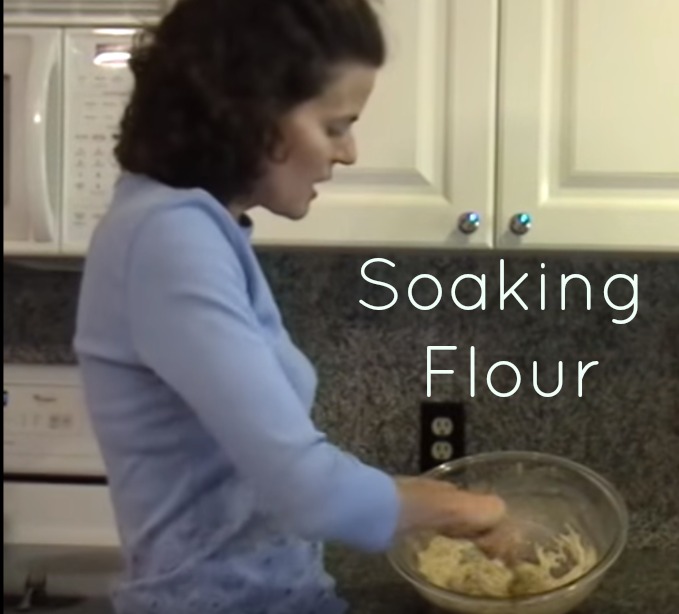

Video Thursday: Soaking Flour for Maximum Digestibility

by Sarah, The Healthy Home Economist on April 22, 2010


Today’s “how to” video features one of the traditional methods of grain preparation:  soaking flour.    For those with milk allergies, please substitute 1 cup of filtered water per cup of flour plus 2 TBL of lemon juice or apple cider vinegar and soak as usual for at least 8 hours or overnight.   For those with more extreme wheat sensitivities, the soaking time can be increased up to 24 hours to further breakdown gluten and other antinutrients.  

The principle of soaking grains can be applied to other grains as well, including your morning oatmeal.    Folks routinely used to soak their oats overnight before cooking back before WWII.   It seems with the modern preference for speed in food preparation, this essential step has been lost and hardly anyone under the age of 70 even knows about it anymore.    Try soaking your oatmeal the night before and see how much more filling it is after you cook and eat it the next morning.   Instead of being hungry again at 10am, you will likely be full right through until lunch!    To soak oatmeal, use 1 cup of warm filtered water per cup of oats plus 2 TBL whey, yogurt, kefir, or buttermilk.   Stir together in the pot you will cook them in, cover with the lid and leave overnight.    Cook as usual the next morning.

Sarah, The Healthy Home Economist


The Healthy Home Economist by E-mail


{ 52 comments… read them below or add one }

Rebecca Pitre April 22, 2010 at 12:59 pm

Hey Sarah,
Great video this morning. I sent it out to all of my nieces as they are all young, stay at home mom's with a desire to feed their families well. I have been thinking recently about getting this type of info to 4-H and youth groups. This would be a good little video to shoot their way!

Reply

Sarah, the Healthy Home Economist April 22, 2010 at 1:11 pm

Fantastic, Rebecca. We really need to reach these young Moms the most. Please send it out to whomever you feel you benefit from the information.

Reply

Dorsey April 22, 2010 at 1:21 pm

Duh Dorsey! I have been soaking my flour but my knowledge is very limited. Thanks so much for showing various ways to accomplish this. I had always done the kefir and water soak but loved the idea of using my soured milk.I never even thought of that. I have always been a bit stressed when my milk goes sour as I don't know the many ways it can be used. Now I see I can just start some flour soaking! Thanks big time.
Also…..maybe some video Thursday you can show us newbies some of the other ways to use raw milk that is past its prime. I would love to see that.

Reply

Sarah, the Healthy Home Economist April 22, 2010 at 5:59 pm

Hi Dorsey, I wrote an article a few years back for Wise Traditions magazine on uses for raw milk that has soured and is no longer drinkable but still highly usable. Here a link to the article:
http://www.westonaprice.org/Learning-to-Maximize-the-Use-of-Your-Real-Milk-and-Cream.html

Reply

Patricia April 22, 2010 at 8:13 pm

Can you make bread in a breadmaker with soaked flour? What would the measurements be? Would I just skip the soaking liquid and continue with the recipe? Very new to this, and also wonder what I do with the liquid if I soaked oatmeal for breakfast the night before, do I drain it or cook the oatmeal in the liquid? Sorry for so many questions but this is so new to me.

Reply

Sarah, the Healthy Home Economist April 22, 2010 at 8:26 pm

Breadmaking machines are really designed to make bread the modern way using yeast .. not for traditionally prepared breads which is why they do not work particularly well for a soaked bread. Better to use a glass loafpan for a soaked bread. The liquid used for soaking the oatmeal overnight is all absorbed by the time you are ready to cook, so no need to pour anything off, just add additional liquid as necessary and cook.

Reply

aprilbcollins April 23, 2010 at 11:12 pm

I am new to all of this. I guess "instant gratification" is my new nemesis. I love that I do not have to "re-pioneer" all of this information. Thanks so much Sarah for being there presenting this information to those of us who want the best for ourselves and our families.

Reply

Anonymous April 24, 2010 at 3:44 am

Thank you so much for your posts. These videos are so extremely helpful. I can't wait to see the others on traditional methods of preparing grains. I'd love to have a segment on grinding your wheat. (Maybe you've already done that and I missed it?)
Teresa Zeller

Reply

Delta7 April 26, 2010 at 11:52 pm

Hi Sarah! I too am new to your blog and am mildly addicted! I have been feeling for a while that I have a grain intolerance, so I am absolutely going to try this method out. I also grind my flour/make bread but with a mixer/loaf pans vs. bread machine. Do you soak your flour before making traditional loaf bread?

Oh, one more thing…..where can I find the info you mentioned about sprouting grains?

Sorry so many questions and thanks again for your time!

Reply

Sarah, the Healthy Home Economist April 27, 2010 at 12:03 am

Here's a good recipe for a soaked loaf bread:
http://kellythekitchenkop.com/2008/10/organic-soaked-homemade-bread-recipe-in.html

I actually buy my loaf bread from the store: Berlin Bakery's Sourdough Spelt. I use soaking flour method in my kitchen more for specialty breads like banana bread, pancakes, waffles, that sort of thing.

Am planning to do the Video Thursday this week on sprouting wheat so stay tuned!

Reply

anna May 17, 2012 at 10:17 pm

Hi Sarah your website is wounderful i wish i discovered it mush sooner. I have an autistic son and determent to do evrething i can for him……anyway i am a bit confused on the amount of ingridients i need to use if i am soking the flower?also this link/recepie has yeast in it, how do i go to do it with out yeast? if you can help i would really appresiate it. thank you, anna

Reply

Anonymous May 13, 2010 at 8:26 pm

I have been sprouting my own wheat for about a month now, dehydrating it, and grinding into flour to make bread in my bread machine. I want to tell you, it is fabulous! For those of you who want a good sandwich bread that is soft and squishy, yet is sturdy enough to make a sandwich that is filling and satisfying, I have a recipe that works, and I use my sprouted wheat flour in this recipe. It is called Marilyn's Famous Whole Wheat Bread, and she gives versions for making it in a mixer and baking in your oven and also for making in a bread machine. I don't use a Zojirushi bread machine like she does, just a standard one with a whole grain setting. You can find the recipe at her website, UrbanHomemaker dot com/index.php?article=83. Where she calls for dough enhancer, I use diastatic malt that I made myself by sprouting wheat until it had 1/4" sprouts, dehydrating, and grinding into powder/flour. You only need a very small amount per loaf, and it makes an amazing difference in the texture of the loaf. The recipe also calls for vital wheat gluten, which I use.

Which brings me to my question: Is vital wheat gluten something we should be using or not? I don't see any references to it in NT book. I'd appreciate any information you can provide.

Naomi
naomiandtom@gmail.com

Reply

Anonymous May 13, 2010 at 8:29 pm

Sorry, I meant also to ask you, have you ever sprouted oat groats and dried and rolled them for cooking/baking? Do you have any info about that?

Naomi
naomiandtom@gmail.com

Reply

David May 14, 2010 at 10:27 pm

I tried soaking steel cut oats, and even after a couple days the oats were still hard, and cooking didn't soften them either. Is there a different way to preparing them properly?

Thanks!!

Reply

Sarah, the Healthy Home Economist May 14, 2010 at 10:37 pm

I've only ever soaked rolled oats like for traditional oatmeal. Not sure about steel cut oats. They might be best for grinding into oat flour and then soaking.

Reply

Anonymous May 25, 2010 at 12:46 am

Actually I just found a site that informs us that only unhulled oats can be sprouted, that hulled oats will not sprout. It sure would be nice to be able to do it myself, but not sure how to get the groats hulled after dehydration. Anyone?

Naomi

Reply

Christy August 22, 2010 at 12:58 pm

I grinded my on organic soft white wheat and then soaked it using the water and apple cider vinegar. It soaked for about 15 hours and was still really runny. Is this still good to use? Or did something go wrong?

Reply

Sarah, the Healthy Home Economist August 22, 2010 at 3:57 pm

Hi Christy, if its too soupy, add some more flour to get the right consistency and keep soaking for the rest of the 24 hour period.

Reply

Christy August 24, 2010 at 12:47 pm

Thank you, my first soaked pancakes were a success!

Reply

Christy December 18, 2010 at 12:47 pm

Can you over soak wheat? I started soaking some wheat about 3 days ago in the water and whey and was unable to make anything with it until now. Is it still okay to use it to make pancakes?

Reply

Sarah, The Healthy Home Economist December 18, 2010 at 1:26 pm

Hi Christy, if it doesn’t have any mold on it, then you can probably take off the hard crust that has probably formed on top and go ahead and make pancakes anyway. They might be kind of sour though. Not sure as I haven’t ever left soaking flour for that long before.

Reply

Lauren February 25, 2011 at 7:17 pm

Hi Sarah,
I am just a little confused on how to use the soaked flour/oats. When preparing the final product (oatmeal, pancakes, etc.) do add the regular amount of water/milk that the recipe calls for? Also, for the flour you grind, how long would you think it keeps in the freezer? I would like to start doing this, but I don’t use a whole lot of flour, and I want to make sure it wouldn’t go bad.

Thanks!!
-Lauren

Reply

Sarah, The Healthy Home Economist February 25, 2011 at 8:06 pm

Hi Lauren, the flour freezes beautifully for several months. I’ve never had it get freezer burn or be not good before I’ve used it all up. Yes, add the regular amount of milk/water that the recipe calls for once you’ve soaked the flour.

Reply

Lauren March 3, 2011 at 12:02 pm

One more question!! Well, two, haha. First, do you recommend soaking buckwheat before using? I know it’s not a “grain” but because it’s so gain-like I didn’t know if that was a good idea. Also, for oatmeal in the morning, I usually use McCann’s Quick and Easy Oats (the ones that take 5 minutes). Should I be soaking these as well? I just wasn’t sure since they’re instant-ish.
Thanks so much!
P.S. I am LOVING your site.. Just got kefir grains, and getting ready to make my first batch of soda tonight :-D sooo excited!

Reply

Sarah, The Healthy Home Economist March 3, 2011 at 2:08 pm

Hi Lauren, yes buckwheat would need to be soaked as well. It is best to buy regular rolled oats and not quick oats. Quick oats need to also be soaked though. Glad you are enjoying the blog! Good luck with the kefir soda!

Reply

Danielle March 11, 2011 at 8:05 am

Thanks for the video! It answered most of my soaking questions. One more though – we are going camping next week and we typically eat pancakes at least one morning. In an effort to reduce my “to do” list while we’re camping I like to prepare things ahead of time. Can soaked grain be stored for any length of time (in the refrigerator or cooler in this case) ?

blessings!
Danielle\’s last post: The Picture Perfect House…or not…

Reply

Sarah, The Healthy Home Economist March 11, 2011 at 8:14 am

Hi Danielle, yes you can store soaked grain for a day or two in a tightly sealed container that is kept cold.
Sarah, The Healthy Home Economist\’s last post: Ode to Bacon Grease

Reply

Jennifer Eloff March 16, 2011 at 2:40 pm

Quick question: With that much liquid – 1 cup liquid per 1 cup flour for soaking, surely that will make a difference to the recipe and how much liquid is required after that. Say, the recipe required only 1 cup of liquid/wet ingredients – does it still require exactly the same amount? It almost defies my understanding to say, yes, as the flour mixture will be quite wet and would have absorbed a cup of liquid already. I’m confused. Thanks for any enlightenment you can give me. I will be posting on this subject soon and would like to give the right information. I will link to you in my post. Thanks again.

Reply

Sarah, The Healthy Home Economist March 16, 2011 at 2:47 pm

Hi Jennifer, after the soaking is complete, if you have any residual liquid you can pour it off and then add the remaining ingredients. Sometimes I have residual liquid and sometimes I don’t. It is the inherent unpredictability of cooking from scratch I suppose! I have never reduced any liquids in the main recipe to compensate for the soaking liquid and everything always seems to turn out fine! :)

Reply

Jennifer Eloff March 17, 2011 at 12:10 am

Thanks so much! I’m working with a delicate Gluten-Free Low-Carb Bake Mix, so this will be an interesting experiment.
Jennifer Eloff\’s last post: Shhhh! Eureka I think I Have It Finally – My Splendid GF Bake Mix

Reply

Luisa Lowe March 23, 2011 at 6:26 am

Hi Sarah,
I have been enjoying your videos and blogs. I am thankful for your wealth of information. I saw your soaking flour video, but I can’t find the rest of the recipe for the pancakes. Could you send it to me or tell me where it is?
Thanks! Luisa

Reply

Sharla May 23, 2011 at 10:20 pm

After I make butter the buttermilk doesn’t seem to last long. Can I use soured buttermilk to soak the wheat for pancakes?

Reply

Heidi June 9, 2011 at 11:17 am

Thank you for this wonderful video! My mom made sour milk every time we brought home too much milk from our uncle’s cows. It tasted really good (we ate it with a spoon) and I now make sour milk when I have milk left over from my yoghurt making. We drink whatever liquid doesn’t ‘solidify’ during the sour milk making ‘process’.

Reply

Nicole June 13, 2011 at 7:20 pm

HI Sarah,

Have you seen new information about not soaking rains with dairy? http://purehomemaking.com/2011/05/hot-off-the-press-dairy-is-out-for-soaking-grains/

Just wondering your thoughts

Reply

Natalie July 10, 2011 at 10:25 am

I would also love to have the recipe for making pancakes! Thank You!

Reply

Anonymous August 14, 2011 at 10:36 am

Can skimmed raw milk and regular raw milk be used to soask? Thanks for the great video!!

Reply

Anonymous August 22, 2011 at 8:52 am
Tanya Drescher November 8, 2011 at 2:07 pm

So a friend told me about an article she saw that soaking with whey causes the calcium to break down the phytic acid? Any info on this?

Reply

Kristi November 15, 2011 at 6:47 pm

THANKS so much for all you do. I have a group called Crunchy Momma’s on FB that me and a friend head up. We are constantly posting your videos. We have so many momma’s adding kefir and kombucha to their diets already!!! So exciting! I just got my mill in the mail. I am so excited.

Reply

Brianne December 14, 2011 at 5:52 pm

I’m a little confused about spouting and soaking. Is the flour that you are soaking for the pancakes from wheat that was sprouted, and then grinded and then soaked, of wheat that was just grinded and soaked? Thanks.

Reply

Sonia February 22, 2012 at 12:05 am

Hi Sarah
At the moment I am still trying to source a good supply of spelt grain, in my area to sprout, dehydrate then grind. In the interim what do you think of soaking the flour I have, dehydrating, grinding up and then using to cook like flour. I have soaked flour before but my dilema is that soaked flour does not always cook up as well in some of my favourite recipes. From a taste and texture point of view I can compromise but my children are 11 & 7 and not always so keen to compromise. Thanks

Reply

Diane March 30, 2012 at 9:00 am

Hi Sarah,
I am planning to bake a cake and want to soak my flour. You said not to use pasturized milk, but can I use pasturized cultured buttermilk to soak the flour overnight. Thanks, Diane

Reply

Kamila July 10, 2012 at 11:20 pm

Sarah, not sure if anyone asked this already but what do you use to mill your flour? I just tried my first home made flour using the VitaMix. It’s not completely “fine” but I don’t really care.

Tnx,

Reply

Althea July 13, 2012 at 7:49 am

Thanks for all the great videos, they really make it seem less difficult to attempt the traditional way of preparing food. I’ve tried the crispy nuts and they turned out really well.

My family are gluten free, would you recommend soaking gluten free grains and flours too. I generally use Brown Rice Flour, Sorghum Flour, Tapioca Flour, Glutinous (Sweet) Rice Flour, Besan (Chickpea) Flour, Amaranth Flour and Coconut Flour.
Thanks again

Reply

Lynn July 26, 2012 at 4:33 pm

I just soaked my flour for the first time today. I covered it with apple cider vinegar and water, as recommended and when I took it out after eight hours, it was indeed very glue like. However, I then went to make the rest of the recipe as usual (it calls for a pint of milk) and even adding only 1/2 a pint of milk has turned it into a batter. Normally it goes into the oven as a dry round dough. Soaking has totally changed this. Please help! I thought I was supposed to use the same recipe as normal.

Reply

Missina July 31, 2012 at 3:28 am

Lynn, the same thing is happening to me, and I came here to inquire about it, as it’s no different than just adding extra cups of water to whatever I’m making which of course is going to throw off the ratios. I am soaking sprouted gluten free flour, so I’m not even getting the glue like texture from the gluten in wheat. My baking is not turning out well! It’s all runny and double the liquid content it should be. I had to add 3 more cups of just sprouted flour to my pancake mixture because it was pure liquid, and my oatmeal was a watery soup instead of creamy milky oats.

I am soaking flour right now for muffins tomorrow morning, and I am going to try straining the liquid through a cheesecloth first. I will let you know how it goes, as I’m hoping it’ll be able to separate enough out to “dry” the flour a bit before adding it to my recipe. And for pancakes and oatmeal, I think I will try soaking the grains in the milk that is already called for in the recipe + the lemon juice or ACV and not adding more liquid, just the baking soda and all that. It will turn the milk into “buttermilk” which is what I do anyway for pancakes. Anyway, I will let you know! Hopefully straining the water out with cheesecloth can be an easy solution.

Reply

Missina July 31, 2012 at 7:34 pm

Lynn, I’m just reporting back. Apparently my cloth was too loose, as I woke up to the cloth being soaked after absorbing a lot of the liquid because it had fallen into the soaking flour a bit. I tried to strain what was left through a cheesecloth, but it was no use. Too runny to use in a recipe but too thick to actually strain and separate the water. I made my muffins anyway and added an additional two cups of flour because they didn’t cook at all with that much liquid and am giving up. I’ll just keep on sprouting but no soaking. A shame, but better than nothing. I don’t understand how to make it work unless maybe using a tiny bit of water to soak instead of the one to one ratio.

Reply

Lynn August 6, 2012 at 6:26 pm

Missina

I’ve made the recipe three times now, with the soaking beforehand and have used 1/2 a pint of milk rather than one pint. I have also given up expecting it to be a dough. Instead, I pour it into a pie dish and cook it as a batter.

It has actually ended up turning out nicer than the original recipe and it stays softer longer. It now tastes like what I imagine sourdough does.

I’ve just recently bought Nourishing Traditions and hope it also details more explicitly how to adjust recipes that have been soaked.

Reply

Ruth November 4, 2012 at 10:31 pm

If I am using apple cider vinegar, how much vinegar to water do I use to soak flour? Is it the same as soaking oats?

Ruth

Reply

Guisella January 30, 2013 at 11:30 am

Is it necessary to soak sprouted flour? I’m just curious if it furthers digestibility in any way.

Reply

Paul March 25, 2013 at 11:51 am

Should I soak flour when making a 5 minute artesan bread? Will it still work? Do I stll add the water according to the recipe after soaking? Can I use whey and water for the soaking? Thanks for the help.

Reply

Vivi March 30, 2013 at 8:26 pm

I left about a quart of raw milk in plastic gal. out on counter 3 days! Some solidified but, most stayed very liquid. When I poured out onto cloth the white liquid flooded the bowl. I scooped out the little bit of solids and used the liquid to soak my wheat flour for pancakes. Was this OK?

I would appreciate some suggestions on why milk didn’t klabber.

Reply

Leave a Comment

CommentLuv badge

{ 2 trackbacks }

Previous post:

Next post: