

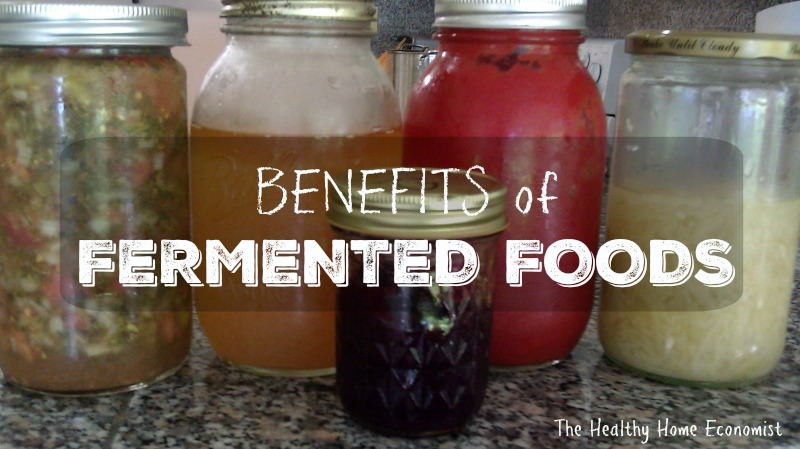
Video: Fermented Foods and Drinks

by Sarah, The Healthy Home Economist on October 13, 2011


The benefits of fermented foods consumed on a regular basis are many.

Consequently, over the past 18 months, 20 of the well over 50 Traditional Cooking how-to videos filmed for this blog specifically address the topic of fermented foods and beverages.

I’ve never filmed an overview of this topic for beginners, however.

At least until now.

Today’s video covers all the reasons why you should be fermenting foods and beverages in your home on a regular basis and why this traditional practice was so key to the extraordinary health of indigenous cultures.

It’s also key to your health as well.

If you are like most Westerners, the concept of home fermentation may at first seem crazy as it basically involves cultivation of bacteria in your own kitchen!

You need to get over that feeling immediately as avoidance of everything bacterial in nature will get you nothing but sick and riddled with autoimmune problems over time.

Your Body is Crawling with Bacteria All the Time!

Being a GermaPhobe is a surefire way to put a pathogenic bacterial bulls-eye on your forehead.

I’m not in any way saying don’t wash your hands or maintain a clean atmosphere in your home!

I’m simply trying to to drive home the point that bacteria, like everything else, come in a good and a bad variety.

Home fermentation involves cultivation of the many strains of good bacteria, or probiotics, so that these foods when consumed will line your gut from start to finish with these amazing little critters that are the gatekeepers of vibrant health.

Without them, you are at the mercy of any pathogen that comes your way and trying to avoid the pathogens by being addicted to hand sanitizer won’t work.

There are actually 10 times more bacterial cells in your body than human cells!    Our skin and every tissue of the body is crawling with bacteria all the time.

Learning to cultivate the bacteria that are beneficial to your health by eating the foods that encourage their growth is absolutely essential to keeping disease and infections at bay or recovering quickly when you do fall ill.

Every tissue of your body both inside and out is going to be dominated by bacteria one way or the other.

The question is, do you want your body to be dominated by good bacteria or bad bacteria?

If you want it to be good bacteria, then Welcome to the Wild and Crazy World of Lacto-Fermentation!   It’s a Fun Ride, so hop on board!

For a complete transcript of this video, filmed for the Weston A. Price Foundation, click here.

Sarah, TheHealthyHomeEconomist.com

Source: Humans Carry More Bacterial Cells Than Human Ones, Scientific American


The Healthy Home Economist by E-mail


{ 60 comments… read them below or add one }

HealthyHomeEconomist (@HealthyHomeEcon) (@HealthyHomeEcon) (@HealthyHomeEcon) (@HealthyHomeEcon) October 13, 2011 at 9:48 am

Video: Fermented Foods and Drinks — The Healthy Home Economist http://t.co/PPIG5U5E

Reply

Jennifer Eldred Sinclair via Facebook October 13, 2011 at 9:52 am

How did you know, Sarah? Thank you!

Reply

Lauren Sturm via Facebook October 13, 2011 at 10:16 am

Very good video. Im excited to try the salsa.

Reply

Alyssa Pilat via Facebook October 13, 2011 at 11:27 am

thank you!!!!!

Reply

Alina October 13, 2011 at 11:39 am

Hi Sarah,
I do not have sucanat. Can I use organic sugar instead in the ginger drink recipe? Anything else that can replace sucanat?
Thank you.

Reply

Sarah, TheHealthyHomeEconomist October 13, 2011 at 11:54 am

Yes, you can use organic sugar but stir in a bit of molasses to it first before adding to the ginger ale recipe as organic sugar has had some of the molasses removed through processing and is not completely intact like sucanat is.
Sarah, TheHealthyHomeEconomist\’s last post: Video: Fermented Foods and Drinks

Reply

Sarah October 13, 2011 at 11:40 am

Hi Sarah,
Thank you for all of your information. Can you freeze lacto fermented berry preserves and still maintain the enzymes?
Sarah R

Reply

Sarah, TheHealthyHomeEconomist October 13, 2011 at 11:53 am

Hi Sarah, yes most of the enzymes do survive freezing.
Sarah, TheHealthyHomeEconomist\’s last post: Video: Fermented Foods and Drinks

Reply

Amy Love@Real Food Whole Health October 13, 2011 at 11:48 am

Excellent video-thanks! I am going to try the ginger ale…that’s one I have never made and I love ginger. Have a great weekend :)
Amy Love@Real Food Whole Health\’s last post: Overview of the GMO problem- and an infographic

Reply

KL October 13, 2011 at 12:00 pm

I just started on the Fermentation wagon –let me just say I am having a BALL!! And your website is soooo awesome. Thank you and keep up the great articles!

Reply

Jenny Wagner via Facebook October 13, 2011 at 12:05 pm

Excellent! My first ginger ale batch was like fire water. I think there is a BIG difference between 3/4 cup of ginger, grated… and 3/4 cup of grated ginger! Sometimes less is more. ;) Looking forward to trying that again. Also have some beets for kvass. Thanks for the inspiration!

Reply

thehealthyhomeeconomist via Facebook October 13, 2011 at 12:38 pm

@Jenny you can always dilute if too strong.

Reply

Mike Lieberman October 13, 2011 at 12:58 pm

I’ve wanting to ferment my foods for a while. Thanks for the video. Now I needs to get started on this.
Mike Lieberman\’s last post: Judge Says Our Food Choice Is Not a Fundamental Right

Reply

Keria October 13, 2011 at 1:55 pm

I’m curious, because I live in Ohio where there is little to no access to raw milk and cream (I’m feeling very deprived after having them for so long in California), what is the best way to make a proper whey at home? Would it still be acceptable if I used say, pasteurized yogurt since it has some of the bacteria and enzymes replaced? I can’t think of any other alternatives at the moment unless you have some ideas. Thanks!

Reply

Sarah, TheHealthyHomeEconomist October 13, 2011 at 2:32 pm

Yes, use pasteurized yogurt to get your whey if necessary. That will work absolutely fine.
Sarah, TheHealthyHomeEconomist\’s last post: Video: Fermented Foods and Drinks

Reply

Marfa October 13, 2011 at 4:14 pm

I live in Ohio and get raw milk weekly…you just have to make friends with some farmers…or get a milk “share.” There are lots of farms here, once you start looking: http://www.realmilk.com/where4.html#oh is just the start…I get mine from: http://andersonfarmersmarket.org/backacresfarm1.htm

Reply

Lisa B. October 14, 2011 at 12:49 pm

I was curious about finding raw milk here in Arizona since both my children and myself have a milk intolerance. (I used to live next to a dairy farm too so sad!!). Anyway I found an actual dairy online that sells it for $10 per gallon! Ten dollars!!! I will look into using yogurt from the HF store.

Reply

Paul Hardiman via Facebook October 13, 2011 at 2:02 pm

Did someone say ‘fire water’? Bottle it, and sale it frat houses :)

Reply

Scott Reasoner October 13, 2011 at 3:19 pm

Love your articles. This is in response to the caffeine causing back problems article. What are alternatives to help give you a boost of energy without drinking caffeine?

Reply

Sarah, TheHealthyHomeEconomist October 13, 2011 at 4:49 pm

You’re not going to like my answer .. raw liver. I hate liver but I get good quality grassfed liver, chop into little pieces and swallow them without chewing. I feel like I could climb Mt. Everest within a few minutes. HUGE energy surge even with just a few small pieces consumed.

I have some folks who swear by a dose of virgin coconut oil off the spoon chased with water or herbal tea helps with the energy in the morning too.
Sarah, TheHealthyHomeEconomist\’s last post: Video: Fermented Foods and Drinks

Reply

Dana Solof (@rungranolarun) (@rungranolarun) October 13, 2011 at 3:32 pm

Video: Fermented Foods and Drinks — The Healthy Home Economist http://t.co/psq9MPiN

Reply

Patricia October 13, 2011 at 4:19 pm

I made the ginger ale with organic powdered ginger like in your recipe. I really didn’t like the salt in it. Is the salt necessary? I’d like to leave it out completely but otherwise I will put in less.

Reply

Sarah, TheHealthyHomeEconomist October 13, 2011 at 4:46 pm

Try less … everyone’s salt taste is different so play with what works for you.
Sarah, TheHealthyHomeEconomist\’s last post: Video: Fermented Foods and Drinks

Reply

emily mascarenhas October 13, 2011 at 4:47 pm

love the video cant wait to try out both recipes, Just to double check I am in the UK. Is it ok to buy a pot of standard organic plain probiotic yoghurt to make the whey? I am on the hunt for raw yoghurt and milk at the mo but as yet havent found any so wondered if this is still ok?
Emily x

Reply

Sarah, TheHealthyHomeEconomist October 13, 2011 at 5:22 pm

Hi Emily, yes the organic plain yogurt will work fine.
Sarah, TheHealthyHomeEconomist\’s last post: Video: Fermented Foods and Drinks

Reply

Anna October 13, 2011 at 5:26 pm

When I went to London last summer for a month, I found a raw milk delivery service on this website: http://www.realmilk.com/where-other.html#uk hope this helps!

Reply

Amanda October 13, 2011 at 4:50 pm

Funny thing, I’ve never tried the ginger ale either and I’ve been fermenting for years. I should give it a try. :)
Amanda\’s last post: Annatto Seed: Nature’s Food Coloring

Reply

Sarah, TheHealthyHomeEconomist October 13, 2011 at 5:22 pm

You are in for a treat when you give it a try! :)
Sarah, TheHealthyHomeEconomist\’s last post: Video: Fermented Foods and Drinks

Reply

Isa October 13, 2011 at 5:04 pm

Thank you so very much. I love the video segments and have been eagerly waiting for a new one to come. I listen to them over and over again to fully understand since all this is so new to me. Please keep them coming.
Will much gratitude
isa

Reply

Sarah, TheHealthyHomeEconomist October 13, 2011 at 5:23 pm

Isa, so glad you are finding the videos helpful. I have 5 more coming that are completed (with the exception of 1 that needs a bit more editing) and will be posting all of those in the coming weeks.
Sarah, TheHealthyHomeEconomist\’s last post: Video: Fermented Foods and Drinks

Reply

Aimee October 13, 2011 at 9:09 pm

Can’t wait to watch this video when I get home! I actually just signed up for a Fermented Foods class that is a 3 hour small intimate workshop being run in Perth, Western Australia by the Weston A Price chapter. I am so excited, after that they’re running a fermented beverages class. I think between your videos and the classes I’m soon going to be a pro !!!

I just had another question though, is there things you can put around your home to promote good bacteria?? I dont know how this kind of thing works outside of food, but as you say good & bad bacteria are all around us – do people make their homes bacteria friendly – breathing wise?? Just a thought, I’d love if you did an article on earthing in the future too, really excited to learn more about that world :) Love your blog!

Reply

Cindy October 13, 2011 at 9:44 pm

Can the ginger ale be made without carbonated water?

Reply

Sarah, TheHealthyHomeEconomist October 13, 2011 at 9:48 pm

The recipe calls for filtered water. You can add some carbonated water later after fermentation is complete to add more fizz but that is not necessary.
Sarah, TheHealthyHomeEconomist\’s last post: Video: Fermented Foods and Drinks

Reply

Rosann October 14, 2011 at 8:29 am

For the salsa recipe on this video, does the water play a role in the lacto-fermentation process or is it ok to just leave it out? I would instead like to include the juices and seeds of the tomatoes.

Reply

Sarah, TheHealthyHomeEconomist October 14, 2011 at 11:10 am

It’s fine as long as there is enough liquid to cover all the veggies.
Sarah, TheHealthyHomeEconomist\’s last post: Fall Fitness Challenge and Giveaway ($225 Value)

Reply

Hannah October 14, 2011 at 10:43 am

I’ve fallen in love with ferments! Actually I found it surprising but sometimes I prefer the drinks to the foods. Fermented sauerkraut is still wonderful on top of my Mom’s pork roast recipe. Yum!
Hannah\’s last post: Weston A. Price London Conference DVD Set

Reply

Linda October 14, 2011 at 12:02 pm

I made the ginger drink recipe in the NT cookbook a good while ago. Nobody liked it. I think your is a bit different so I will try this one. I’ve been buying the gingerale kombucha (still not making my own yet) and we like that. Your gingerale sounds really good. I also want to add that I I find your videos very helpful.

Reply

Marcy October 14, 2011 at 1:30 pm

I am having yeast issues-can I still have fermented foods?

Reply

Sarah, TheHealthyHomeEconomist October 14, 2011 at 5:53 pm

Yes, fermented foods help balance the gut and resolve yeast problems. You might find that the yeast issues get a bit worse at first before getting better as the pathogenic yeasts die off and cause an increase in symptoms temporarily.
Sarah, TheHealthyHomeEconomist\’s last post: Fall Fitness Challenge and Giveaway ($225 Value)

Reply

Homebirth Mama October 14, 2011 at 4:03 pm

Awesome. Thanks Sarah! I am looking forward to watching this with my 5 year old. She loves your video logs. They are a great springboard for us. My attempts to make my own have failed miserably, so I am very excited to try again, with your guidance. We all love Bubbies sauerkraut, but it gets a little spendy when we can go through a jar a day.
Homebirth Mama\’s last post: The Story of Stuff

Reply

Cindy Landskron via Facebook October 18, 2011 at 11:05 am

Just got a book about preserving food traditionally, using LF methods, among others. It includes methods of soaking/rinsing repeatedly in just plain water, then sealing and cool storage. Have you ever tried this — without salt?? It shows this method for several veggies, incl green beans and Swiss chard. It’s a French book using ‘recipes’ from farmers, that was translated to English.

It shows that even in ‘modern’ times, traditional methods have been used. I got the book because it talked about preserving without water bath canning, which I despise. I use a pressure canner, but of course the high heat destroys the enzymes in the food.

Would love your feedback, Sarah.

Reply

Adela October 18, 2011 at 4:01 pm

Hi Sarah,
I just made liquid whey using whole milk organic yogurt, and the color of mine is yellow but I noticed yours is more white. Does the color make a difference? Is it still good?
Thanks,
Adela

Reply

Danielle October 19, 2011 at 9:46 am

Question on fermenting – if I ferment salsa, pickles, sourkraut, etc does that mean it does not need to be canned in a hot water bath? I tried sourkraut and it they never sealed .
thanks!
Danielle\’s last post: Another Week of Food

Reply

Rhenda October 19, 2011 at 5:29 pm

I made kimchi and sauerkraut from the recipes in Nourishing Traditions. I did not know that dried whey is not good, until I watched your video. Should I throw out the stuff I fermented with dried whey from the store? (I’m headed out tomorrow to get raw milk and do it right)

Reply

Heather October 19, 2011 at 6:09 pm

Hi Sarah,
I am really enjoying learning on your blog! I separated the cream cheese and whey, but I am concerned because the whey still has a thin white layer on top that I have not been able to get rid of. Is the whey still safe to use? Thanks for sharing your time and talents with us!

Reply

Leah October 21, 2011 at 11:16 am

I LOVE your blog and I get a ton of useful information from you. Could you clarify one thing that you said for me?

“Every tissue of your body both inside and out is going to be dominated by bacteria one way or the other.”

This is not true to my understanding. I understand that bacteria is very important and that we have a ton of it (etc…) but I don’t think it’s in every tissue of your body, unless I am misunderstanding something. There are places in our body where we should have bacteria (GI tract (mouth, stomach, gut, etc), skin) but there are also places that we should definitely not have bacteria, of any kind. The brain and CSF come to mind, as well as other muscle tissues (such as heart) and bones.

Do you have other information about this?

Thank you so much for all of the information that you share!

Reply

Brenda November 4, 2011 at 2:47 pm

I’m sold on the benefits of fermenting foods and beverages, but I’m allergic to milk and milk products. Is there something I can use as a substitute for the whey?

Reply

robyn December 28, 2011 at 6:50 pm

we too have milk (and milk product allergies) where you able to find an alternative? we’ve yet to begin fermenting in our house because whey is the only thing i’ve seen.

Reply

Susan November 9, 2011 at 10:25 am

I am very interested in starting to ferment my own foods. I have made sauerkraut already once but with out using whey. I have dairy goats and make vinegar cheese once a week. I bring a gallon and a half of milk to 186 and then take off from heat and add white vinegar to it. It clabbers right away. I then strain thru cheese cloth and use the vinegar cheese as ricotta in casseroles. But I always have a half gallon of whey left over. I give it to the chickens or pour it on my rose bush roots once cooled. Even though this whey has vinegar in it….could it be used as the whey to lacto-ferment the foods just as you say in your videos. Thank you for your time, and for all the helpful and encouraging videos. I am tired of buying expensive enzymes and probiotics. And feel confident enough to try some of these recipes now.

Reply

Trisha April 29, 2012 at 4:51 pm

Susan,
Once you heat the milk to such a high temp (186) it kills all the good bacteria. So your whey left from that is great for feeding the rose bushes and chickens, but not so much for fermenting. What happens when you add vinegar to hot milk is more of a curdling than clabbering as clabbering happens at low temps due to bacteria growth.
Try some low temp cheeses and use that whey.

Reply

Alexa July 31, 2012 at 4:12 am

I have a following up question about temperature. I make lebneh (which is just strained yogurt) at home and I always have a lot of whey left over. But, the yogurt I make is pasteurized boiled milk cooled down to lukewarm to which the yogurt culture is added. The culture I use has “thermophilic bacteria” …meaning it requires warm temperatures to grow. Everyone says that you can use the whey from strained yogurt to ferment veggies, and the recipes usually involve leaving the foods out at room temperature to ferment. If the bacteria in the whey are thermophilic, don’t I have to keep the foods I want to ferment warm for the bacteria to grow?

Reply

Maggie April 29, 2012 at 11:14 pm

Oh Sarah, this video it is awesome and I love the way you explained it, it is 11.00pm here in ormond beach, sunday, I just finish my raw goat milk kefir and i separate already my whey,the thing that I don’t know was that I can use that whey in my lactofermentation for my cabbage,i put a whole cabbagewith carrots and zuchini and yellow squash but I only used celtic sea salt, but I think it not work this time, ( I don’t like the texture and smell a little ) tomorrow i will put it in the garbage,i think was the yellow squash and zuchini,couples weeks ago I did the sauerkraut and it was perfect,but the whey I use it to drink before I eat, but now after your awesome video I will used it for all that, I’m exited to do it, specially now the gingerale, my sixteen old son love juices I never buy it, only Org apple juice,I do ferment the skin of my pineapple a liitle maple syrup he love it, but uuh,wait that when I make this new one,thank you so much you are awesome, I though I know a lot,but you are ahead of me,thanks a milllon,maggie

Reply

Tamara May 25, 2012 at 12:56 pm

Sarah,
I’m just starting on this process and very excited. My husband and I make this amazing roasted tomato salsa. Would you be able to do this with cooked veggies?
Thanks

Reply

Sarah June 9, 2012 at 3:26 am

Hi, just wondered whether you had any thoughts on the claim that fermented foods are linked to the high incidence of throat cancer in Asia? Love to know if any research has been done that counters this – I have always thought fermented veg to be so healthful! Thanks

Reply

Carol June 11, 2012 at 11:42 am

Hi! Wondering about shelf life of the saurkraut? And did I hear that it takes 6 months to actually ferment before its ready to eat? I’m NEW at this, so bear with my stupid questions
Thanks

Reply

Iris July 28, 2012 at 12:47 pm

I have gluten issues as well as Lactose issues. So can I use the whey from goat yogurt to ferment food. It is generally pasteurized and I do not know if raw is attainable. So how do I adjust these ideas to what I can presently have?

Reply

Mrs. Madel September 11, 2012 at 12:52 pm

What can I use to ferment things if I can’t use milk? I battle multiple sclerosis, and have a severe dairy sensitivity….would really love to try fermenting, but can’t use the whey. :(

Reply

anne December 27, 2012 at 11:25 am

I made beet kvass – it stood on the counter for two days – how do I know when it is done? It just seems to be beet juice with no “punch” to it. I followed Sara’s video for homemade whey and kvass.

Reply

Lei May 7, 2013 at 7:18 am

Please help…my husband is a naval officer and we just received orders to oahu, hawaii. Although i was born and raised on Kauai, I have lived in TX and currently in CA and have raised our family on raw milk…I am therefore devastated to be moving to a state where raw milk is illegal and pastured foods are non-existent. I just read in the comments section that you stated that using whey from pasteurized yogurt can be used to ferment foods. Really? Does that work for lacto-fermenting grains and Beet Kvass? Do i just pour the whey from off the top of the yogurt or do i strain through a flour towel? Can i mail order raw milk whey? Do you have any other ideas for feeding my family as we transition? I know that I won’t be able to make my milk kefir anymore (sniff), but will begin to make coconut kefir, and continue with kombucha. Thanks for your help….I am devastated!!

Reply

Lei May 7, 2013 at 7:26 am

Oops, one more quick question…my kids can’t yet swallow pills and take their FCLO in yogurt….is there a liquid vit k2 that I should start giving them and do you recommend any other supplements to replace the raw milk (though we know raw milk is irreplaceable)? Also, because your website may be monitored and because my husband is in the military, is there a way you can answer my question then erase it? I don’t have your email, but maybe you could email your response to me then erase my question? My name is in my email and I hope it doesn’t post…thanks…

Reply

Leave a Comment

CommentLuv badge

{ 4 trackbacks }

Previous post:

Next post: