

With only a few good quality, raw apple cider vinegar brands available these days and the risk of even organic brands using Apeel-coated apples, making your own ACV is a smart as well as thrifty addition to your fermentation routine.
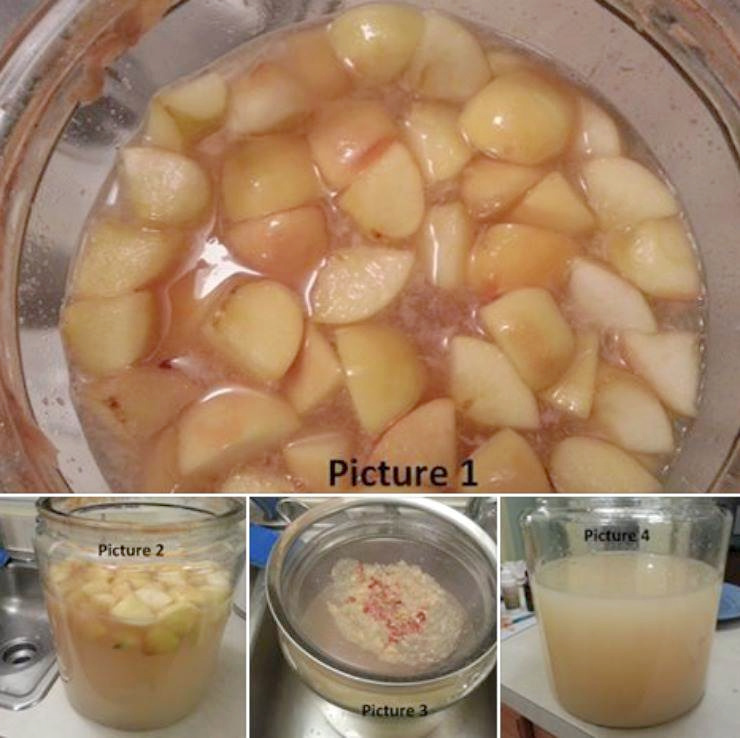
You can brew an entire gallon at home for what the typical quart of properly made, organic, raw apple cider vinegar will cost.
It will cost even less if you use apple scraps that you were going to throw out or use for composting anyway.
Which Apples Make the Best Vinegar?
A mixture of apples produces the best tasting and most healthful raw apple cider vinegar. Making it is very similar to kombucha. If you’ve made this or other fermented beverages before, you will find the process simple.
If homebrewing is new to you, try these approximate ratios for your first batch or two and then change it up from there to your own personal liking:
- 50% sweet apples (Golden Delicious, Fuji (my fave), Gala, Red Delicious)
- 35% sharp tasting apples (McIntosh, Liberty, Winesap, Northern Spy, Gravenstein)
- 15% bitter tasting apples (Dolgo crabapples, Newtown, Foxwhelp, Porter’s Perfection, Cortland)
In my neck of the woods, bitter-tasting apples are hard to find. If this is your predicament as well, simply increase the proportion of sweet apples to 60% and the sharp-tasting apples to 40%. While the flavor of this mixture won’t be as complex as with the inclusion of some bitter apples, it will still taste fine.
If all you have is a single apple tree in the backyard, however, feel free to use just that one variety to make your raw apple cider vinegar!
Uses and Benefits
The uses for raw apple cider vinegar are seemingly endless. It’s widely used in homemade tonics, recipes and even for cleaning. I like to use it for detox bathing (1 quart to a tubful of warm water). Friends of mine use it as a hair rinse or for a natural, at-home hair detox.
The well known Master Tonic, a natural flu anti-viral, uses raw apple cider vinegar as the fermenting medium. It’s also an essential ingredient in all types of bone broth made at home.
Pasteurized versions don’t have the same benefits as raw apple cider vinegar. Valuable vitamins, probiotics, and enzymes are destroyed by the heating process. Another problem with pasteurized ACV in the store is that it is frequently packaged in plastic.
The acidic ACV leaches chemicals and microplastics into the vinegar! If you must buy apple cider vinegar, always buy it packed in glass (among other important things to look for).
If you are going to go to the trouble of making apple cider vinegar, always make it raw for maximum benefits.
How to Make Raw Apple Cider Vinegar
The recipe below outlines step-by-step instructions on how to make apple cider vinegar that is potent enough to use for all your medicinal, detoxification, cleaning and cooking needs.
It is no doubt the most beneficial vinegar to have in your home, followed by traditional balsamic vinegar.
Please always store any type of vinegar in glass containers. Storing in plastic risks leaching contaminants!
3 Medicinal Uses
Your homemade apple cider vinegar can be used not only in the kitchen and for cleaning. Try it in a vinegar bath (2 cups per tubful) to greatly aid detoxification.
It works much better than a skin-damaging bleach bath for relieving eczema symptoms too.
To ease acid reflux symptoms and for a natural cal/mag supplement, soak crushed eggshells in your homemade ACV to make a simple eggshell and apple cider vinegar remedy. 1 teaspoon in 8 oz of water up to 3 times a day works wonders.
DIY ACV can also be used to make a vinegar compress for sprains and bruises. This is what people used before ice was readily available, and believe it or not, raw vinegar works extremely well!
How to Use the ACV Mother
After you’ve made a few batches of ACV at home, you may notice that you have a number of vinegar mothers stacking up! What to do with them?
First of all, know that these are living cultures that have a number of beneficial uses around the home. Here are some suggested ideas instead of just throwing them out:
- Share them with friends so that they can make their own apple cider vinegar too!
- Use them as a gentle, rejuvenating face mask.
- Add them to the compost bin for fertilizing the garden.
- Dry them out at a low temperature (less than 150 °F/ 65 °C) in a food dehydrator or a warm oven. The low temperature will preserve any food enzymes as well as the probiotics. After drying, cut them into strips and eat them like fruit leather. Store in an airtight container in a cool pantry or the refrigerator.
Preparation Tips
Cane sugar may be substituted for raw honey if desired. Using raw honey will result in the healthiest apple cider vinegar, however.
Be sure to use the cleanest type of raw honey you can find in your area.
Raw apple cider vinegar doesn’t go bad, but if you leave it for a long time, another mother culture will likely form on top. This is fine, just strain it again if desired and dilute with a bit of water if the taste has become too strong.
Homemade Raw Apple Cider Vinegar
Step by step instructions on how to make apple cider vinegar that is raw, enzyme and probiotic rich for all your detoxification, cooking, and medicinal needs.
Ingredients
- 5 large apples or scraps of 10 apples, preferably organic
- filtered water
- 1 cup raw honey preferably local and organic
Instructions
-
Before you can make your raw apple cider vinegar, you must first make hard apple cider. The alcohol in the hard cider is what transforms via fermentation into acetic acid, which is the beneficial organic compound that gives apple cider vinegar its sour taste. Nature is amazing!
-
Wash the apples and coarsely chop into pieces no smaller than 1 inch. Cores, stems and seeds may be included.
-
Put the chopped apples into a 1 gallon, clean, wide mouth, glass jar. Please do not brew your apple cider vinegar in stainless steel pots, as the acidic vinegar will causing leaching of heavy metals such as carcinogenic nickel.
-
The chopped apples should at least fill half the container and maybe a bit more. If at least half the container is not filled, add additional apple scraps until you achieve this level as a minimum.
-
Pour in room temperature filtered water until the chopped apples are completely covered and the container is just about full leaving a couple of inches at the top.
-
Stir in the raw honey or cane sugar until fully dissolved.
-
Cover the top of the glass jar with cheesecloth, a thin white dishtowel or floursack cloth and secure with a large rubber band.
-
Leave on the counter for about 1-2 weeks, gently mixing once or twice a day. Bubbles will begin to form as the sugar ferments into alcohol. You will smell this happening.
-
When the apple scraps no longer float and sink to the bottom of the jar after approximately one week, the hard apple cider is ready. If for some reason, the apple pieces still do not sink to the bottom after 2 weeks but the mixture smells alcoholic, proceed to the next step anyway.
-
Strain out the apple scraps and pour the hard apple cider into a fresh 1 gallon glass jar or smaller sized mason jars of your choosing.
-
Cover with a fresh piece of cheesecloth and secure with a rubberband.
-
Leave on the counter in an out of the way spot for an additional 3-4 weeks to allow the alcohol to transform into acetic acid by the action of acetic acid bacteria (these are the good guys!). A small amount of sediment on the bottom is normal. In addition, a mother culture will form on top, similar to what happens with kombucha.
-
Taste your raw apple cider vinegar to determine if it is ready starting after 3 weeks. If it has the right level of vinegar taste for you, strain it one more time and store in clean, glass mason jars or jugs. After 4 weeks, if the taste still isn’t quite strong enough, leave it for another week and try again. If you accidentally leave it too long and the taste is too strong, just strain and dilute with some water to a level of acidity that pleases you.
-
Use as desired and store in the pantry out of direct sunlight.
References



It’s been two weeks and my apple chunks have still not dropped… should I go ahead and strain anyway?
Yes, I would. Does it smell alcoholic yet?
I was having the same issue and wondering, too. Only, it’s been just over a week…definitely smells alcoholic, but the apples are still floating. I used mostly apple cores and scraps from making apple sauce. Wondering if I should go ahead and strain and move on to the next step.
I’m making this right now for the first time. I did need twice as many apples as it called for to fill the container halfway & had to run to the store for the sweet apples. My apples must be small. I stole some crab apples from the neighbor & have a mass of apples from our own two Liberty trees. My big problem two days into this is the fruit flies drawn to it and landing on top of the covering. I used paper towels instead of cheese cloth which works well for my kombucha tea. You think I could put the whole jar in a cooler or is it better to have it out in the light? It’s already fermenting. I’m vacuuming flies every hour or so.
Don’t you put the lid on the jar at any point? Do you just cover it with the cheese cloth?
Best,
Thomas
Thanks for this. We go through a lot of ACV! We like to make Cinnamon apple drink with ACV and stevia. So refreshing!
Interesting. I use my apple press to make cider, put it in a jar and wait. Easy Peasy
Also a perfect time for me because organic apples just came in season here. I got my first batch the same day your email arrived. I am putting the peels and cores in a glass bowl of sugary water as we’re eating them. I think today we ate at least 8 apples. I used jaggery and I had a little of the spectrum organics raw apple cider with the mother so I put a drop of that in the bowl. As we eat the apples, I’ll keep dropping the peels and cores in. Then with every batch throughout the season I’ll do another batch of vinegar… Very cool! I think with the next load I’ll use white sugar and watch the difference. Thanks for this excellent blog!
My next project after this is to make a ginger bug. I have ginger growing in the garden. I also have very hard whisky type smelling alchohol from a couple of years ago that came from water kefir. It’s also souring up nicely into vinegar. I believe that you can never have too many bottles of vinegar in the house – it’s too useful for so many things… I live in India and no raw vinegar is available readily here – only synthetic white vinegar and even that’s hard to find so these days it’s a necessity for me to make it – once again – thanks!
This comes at a perfect time! Next weekend we’re going to go pick apples at a nearby apple orchard. I like to make apple sauce, butter, and jam. Now the rest of the apples won’t go to waste either. 🙂
Thanks for the great recipe! I’ve read a lot of positive thing about apple cider vinegar. What do you think Sarah, can I use it as a “facial tonic” after makeup removal?
I am so doing this. Was going to do applesauce anyway, this is perfect!