
Table of Contents[Hide][Show]
Common misconceptions and myths surrounding sourdough bread that those who enjoy it need to understand to avoid unreasonable health expectations about this traditional food.
Yeast was first introduced as a substitute for sourdough starter in breadmaking at the court of Louis XIV of France in March 1668.
Scientists at the time already knew that this substitution would harm public health by reducing the digestibility and nutritional value of bread. Their counsel resulted in an initial and vehement rejection of the idea. (1)
Ultimately, the idea slowly took hold anyway due to the increased speed and convenience of using yeast for baking.
This combination of factors proved too strong to resist, particularly as the hustle and bustle of the Industrial Revolution arrived in full force.
Today, almost all bread, no matter if made with wheat or gluten-free flour, is made using baker’s yeast.
Consumption of these modern quick-rise baked goods instead of traditional sourdough bread has indeed resulted in an overall decline in health, as warned centuries ago.
The result has been a widespread backlash against bread, with carb consumption implicated in numerous health woes. The book Life Without Bread summarizes the case.
On the other hand, the realization that modern carbs aren’t healthy has also resulted in a resurgence in popularity of authentic sourdough bread.
Naturally leavened bread made without yeast actually facilitates the body’s absorption of cereal grain nutrients. This compares with yeasted bread, which diminishes or destroys the grain’s nutritional value.
Properly made sourdough bread also eliminates anti-nutrients from the cereal grains. The most notable of these is phytic acid, which blocks mineral absorption and can trigger gastric distress.
Preliminary research also indicates that those with Celiac disease may be able to eat sourdough bread made with wheat.
For those who wish to eat bread without the downside, sourdough bread is definitely the answer!
Unfortunately, the excitement over sourdough bread has spawned some myths about this traditional food that abound as well.
While there are numerous benefits to consuming sourdough bread, watch out because the following is not among them!
Sourdough Starter Probiotics
It is true that a properly made sourdough starter contains Lactobacilli, a friendly form of bacteria.
This is a beneficial strain of bacteria found on the surface of all living things. These microbes are even crawling all over you right now, keeping your skin healthy and in proper pH balance.
These lactic acid-producing probiotics are responsible for the breakdown of anti-nutrients like phytic acid. They also encourage the slow rise of the bread without the addition of any yeast.
The absence of baker’s yeast in a true sourdough loaf permits baking the bread at a lower temperature as well. This protects the integrity of the cereal grain proteins along with their nutritional value.
These benefits are made possible by the fermentation of the bread dough prior to baking using a probiotic-rich sourdough starter.
Here’s where the confusion starts….
Just because sourdough bread dough is fermented, does this make sourdough bread a probiotic food?
NO.
Probiotics Destroyed by Heat
While it is true that sourdough bread dough is indeed fermented and rich in probiotics, the resulting sourdough bread is completely devoid of beneficial bacteria.
How can this be?
The reason there are no probiotics in sourdough bread is that the heat of the baking process destroys them, similar to how pasteurization destroys probiotics in raw milk.
Remember that probiotics are living things and, as such, will perish under similar conditions as food enzymes.
Dr. Mary Enig has this to say on the subject:
All enzymes are deactivated at a wet-heat temperature of 118 degrees Fahrenheit, and a dry-heat temperature of about 150 degrees.
It is one of those happy designs of nature that foods and liquids at 117 degrees can be touched without pain, but liquids over 118 degrees will burn. Thus we have a built-in mechanism for determining whether or not the food we are eating still contains its enzyme content. (2)
Sourdough bread is typically baked at a temperature of at least 300 °F/ 149 °C and sometimes as high as 450 °F/ 232 °C.
In short, there is no enzymatic or probiotic activity remaining in sourdough when you eat it.
Sourdough Bread is NOT a Probiotic Food
In conclusion, the notion that sourdough bread benefits gut health because it contains probiotics is completely false.
Baking in the oven completely destroys the probiotics in the sourdough starter.
Does this mean you shouldn’t eat sourdough bread?
Of course not.
There are many benefits to eating this nutritious traditional food, including enhanced nutrient absorption. It is also gentle on digestion, even for those with gut disorders, unlike modern quick-rise bread made with baker’s yeast, which can inflame the gastrointestinal tract.
Probiotics, however, are not a reason to eat sourdough bread.
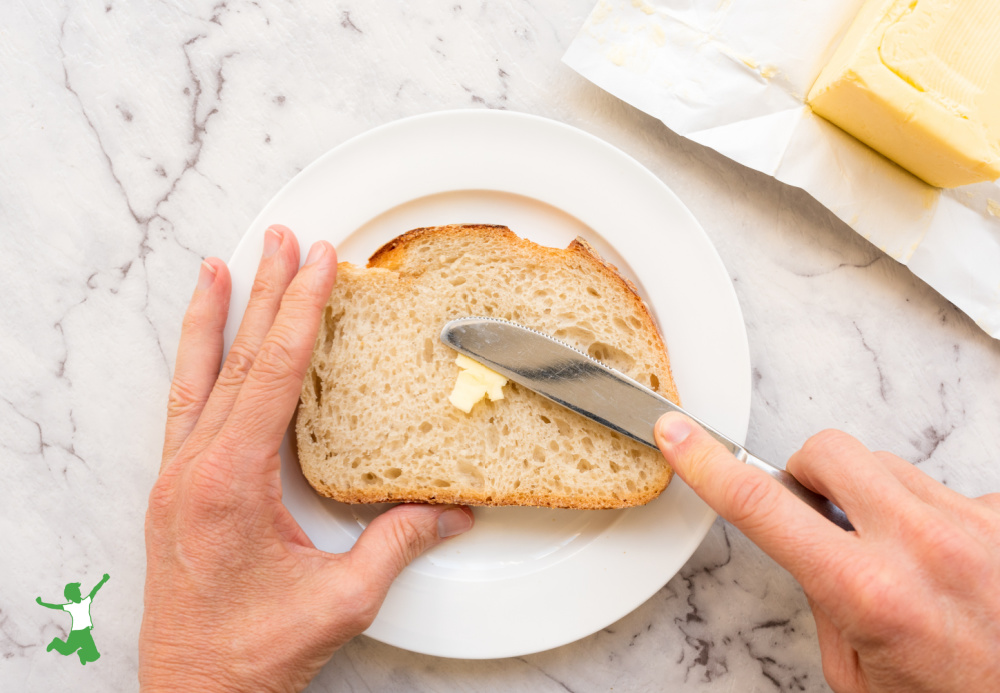
So, slather on some probiotic and enzyme-rich raw butter and local raw honey, and enjoy the real benefits of sourdough without unreasonable expectations!
(1) Nourishing Traditions
(2) Enzymes



Do you think any B vitamins survive the baking of sourdough bread? Assuming whole grain freshly milled, no yeast, etc…. all the best conditions. I’m thinking not likely??? What might the lowest temp be to try to bake sourdough, even if it takes longer?
Don’t plan on baking my own bread, but curious. Very happy with the Bread of Heaven company!
Yes, they do mostly survive the heat of the oven, which is much lower baking sourdough than a modern, quick rise yeasted bread (another reason to bake sourdough!)
Thanks for mentioned that bakery! Here’s the link with their many sourdough offerings in case someone else is interested. https://ovenfreshdelivery.com/collections/sourdough-and-bagels/?ref=37
The carb spike is by far the more interesting myth to me. Is there any truth behind it being less likely to spike glucose?
The insulin spike is going to still be high unless you put plenty of butter on each slice of sourdough before you eat it. Healthy fats consumed with carbs will slow the insulin spike FAR more than the carbs being from sourdough bread.
Yeah, big butter lover here, ghee as well. Neither help bread, sourdough included, be less insulin/glucose spiking, so I can’t get excited about sourdough. Never imagined people thought it came out of a hot oven with probiotics intact though!
Are you suggesting that eating healthy fats with carbs does not lessen the glucose spike? Yes it does and likely the primary reason why traditional desserts knew via observation to always pair plenty of fat with sweet treats (such as strawberry short cake with cream). https://pubmed.ncbi.nlm.nih.gov/6342357/
I switched to fresh milled flour using whole grain wheat varieties that I store and then grind as I use them to insure a more nutrient dense and digestible sourdough bread. The use of synthetic vitamins in “enriched” flour is often what upsets people’s guts, and not the gluten. Specifically folic acid versus folate. I was gluten-free for nine years and I can eat bread to my heart’s content without any issues with my fresh milled flour baked goods.
Bread made with freshly milled flour is great, but if you are using baker’s yeast instead of a sourdough starter, then you won’t absorb all those wonderful minerals in the freshly milled flour! The bread made with baker’s yeast is also VERY hard on the gut and digestion due to the high levels of antinutrients. By comparison, these antinutrients are broken down via fermentation of the loaf using sourdough starter to make the bread. I would never eat homemade bread made with baker’s yeast even if using freshly milled flour. I would be doubled over in pain from the gas/bloating. Even if you don’t have symptoms from it, there is silent damage that accumulates with gut problems assured down the road.
We make our own sourdough bread using organic white flour? Is white flour okay in the case of sourdough? Is it better to make a whole wheat sourdough?
Thanks.
Using white flour to make sourdough is a better choice than making a loaf using baker’s yeast with freshly milled flour.
It would be better to freshly mill the flour for your sourdough and then sift it to remove some of the fiber if you want to make it lighter. Fiber is actually damaging to the intestines of those with leaky gut. People easily get confused into thinking fiber is good because it does help with regularity for those with leaky gut (many who are constipated) … so it SEEMS the fiber is helpful/beneficial, when in fact it is only a band-aid to the actual problem which will only get worse over time if the root cause is not addressed.
I have hashimotos and I actually thought I could tolerate gluten. I tried reintroducing sourdough this year and I noticed after a couple of months I developed terrible brain fog and even worsening fatigue. So sad because it sure is tasty. That said, there are far more micronutrients available to us via fruits and tubers, especially if we’re watching our waistlines.
Hashimoto’s introduces a complexity into the bread choice, no doubt about it. Perhaps sourdough made with einkorn wheat (the only nonhybridized wheat) might make a difference. Spelt, emmer, kamut etc are heritage wheats but they are still hybridized.
I found a gluten free sourdough that uses wild yeast starter but the baker also adds additional packaged yeast for better structure as I spoke with her .No psyllium husk and instead uses xanthan. She also uses white rice flour as a first ingredient which is much easier to digest.Ideas on whether it is ok to use although adding yeast is not ideal.Thanks!Ingredients are pretty nice though.