
Why certified organic milk brands such as Horizon and Organic Valley are toxic despite glowing marketing claims, which falsely lead consumers to believe this type of milk is a healthier alternative to regular supermarket milk.
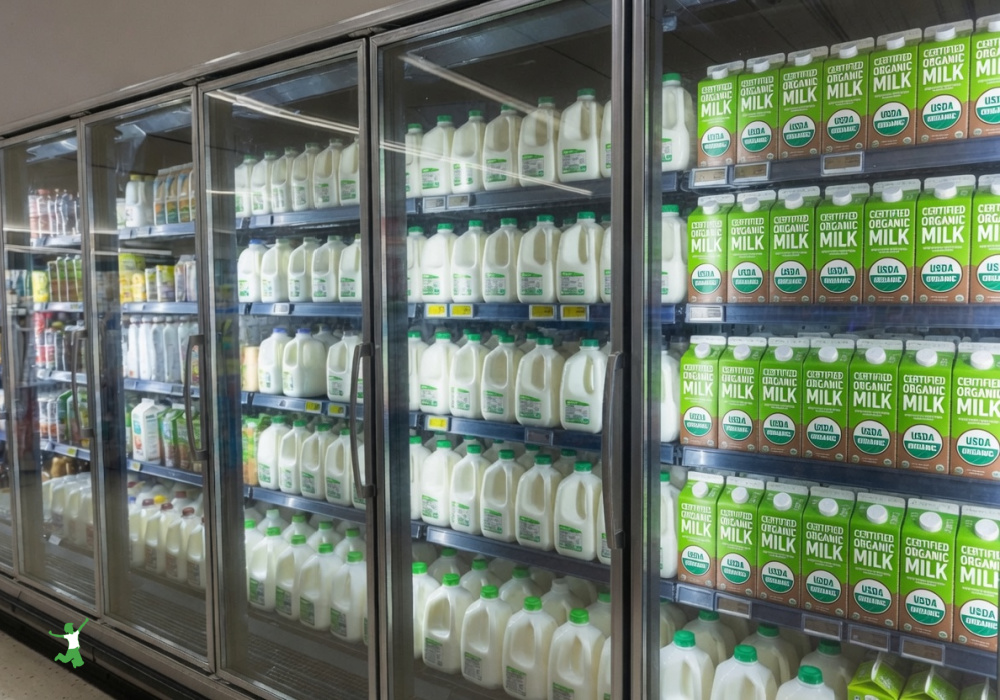
Fact: Organic milk companies such as Horizon and Organic Valley are pulling the wool over the eyes of consumers.
By marketing their ultrapasteurized (UHT) milk as certified USDA Organic, a willing consumer base buys it, thinking it is a better choice than regular pasteurized supermarket milk.
The sad truth is that ultrapasteurized (UHT) organic milk is just as unhealthy as regular, pasteurized store milk.
I’ve often thought if I HAD to choose between them, which milk would I select as being better: regular pasteurized supermarket milk or ultrapasteurized certified organic milk? That’s a toughie. Neither choice is optimal as there is no clear winner.
Both are highly processed milks, and both contribute to poor health and chronic illness in general.
Pasteurized vs Ultrapasteurized Milk
Let’s first consider regular supermarket milk.
The dairy cows producing this type of milk are injected with hormones and other drugs.
They consume unnatural, GMO, pesticide, and antibiotic-laced feed with no access to fresh air or green grass.
To add insult to injury, these abused animals stand on cement floors their entire lives. No surprise that they usually die within about 18 months. Incidentally, the true lifespan for a healthy dairy cow should approach 15 years.
Milk from confined cows NEEDS to be pasteurized. It is dirty, nasty stuff loaded with pus and pathogens because of the filth and chronic mastitis the cows endure.
Now let’s consider certified organic (UHT) milk. A consumer with only partial knowledge of how milk is processed is easily lured into buying this milk.
On the surface, it seems so much healthier.
After all, the cows don’t get any antibiotics, steroids, or hormones, right?
It’s certified USDA Organic. Doesn’t that mean something?
While the cows producing organic milk may not be subjected to the drugs and antibiotics used on conventional dairy operations, the milk coming from the Organic Industrial Complex is even more highly processed.
For example, ultrapasteurized (UHT) organic milk is subjected to the insanely high temperature of 275–302°F/ 135–150°C for 1–10 seconds (most commonly 2–5 seconds).
This is waaaay over the boiling point!
For reference, the boiling point of milk is 212.4–212.9°F/ 100.2–100.5°C.
Excessively high UHT processing, far above the boiling point, results in a destroyed product (it isn’t really even food anymore), but dairy corporations love it because it has a much extended shelf life compared to regular pasteurization.
The dirty little secret is that certified organic UHT milk can actually remain unrefrigerated for up to 6 months when packaged in aseptic cartons!
Yet, it is placed in the refrigerated section nonetheless because US consumers won’t readily buy cartons of milk from an unrefrigerated shelf. It goes against intuition and just doesn’t seem very natural, does it?
I don’t know about you, but I find this practice outrageous!
To show the disconnect, consider that Moms often buy individually sized aseptic packages of organically certified milk and put them in their children’s lunchboxes….with ice packs that aren’t even needed!
If they only knew that this milk is so dead that it doesn’t require refrigeration, then they might rethink their choice of beverage.
Auto-Immune Disorders
Why is ultrapasteurization so bad?
The high temperature (far above boiling point) necessary to ultrapasteurize organic milk greatly damages the fragile milk proteins. The same thing happens when sweetened condensed milk is manufactured too.
This violent industrial process results in a “food” that the body no longer recognizes when it is consumed.
The enzymes produced during digestion do not “fit together” like puzzle pieces with the milk proteins destroyed by UHT processing.
These undigested proteins then make their way into the bloodstream due to “leaky gut” syndrome, which nearly all Westerners suffer from to some degree.
At that point, the body identifies them as foreign proteins and mounts an immune response.
This translates into symptoms such as allergies, asthma, eczema, reflux, bloating, and other symptoms of autoimmunity.
People who drink this type of certified organic milk often think they have a “milk allergy”. In reality, they have an allergy to the processing, not the milk itself!
Ultrapasteurized milk is so completely sterilized that sometimes it is difficult to culture into homemade kefir or 24 hour yogurt.
In short, ultrapasteurized milk is dead, dead, DEAD.
There is no way that it can be considered healthy, even if it is labeled USDA organic and comes from grassfed cows.
I remember when my first child was nursing, I drank a lot of Organic Valley ultrapasteurized milk.
My baby spit up so badly during that time that there was some concern that he had a reflux disorder.
Remarkably (but not surprisingly), when I stopped drinking the Organic Valley milk, his reflux problem completely resolved. No treatment was required.
I have no doubt that if I had continued drinking this milk while nursing and he drank it as a toddler, that a likely “milk allergy” would be the result today.
Fortunately, I wised up in time to get off the industrialized poison otherwise known as certified organic milk!
Pick Your Poison
While a consumer may be reducing his/her exposure to antibiotic and pesticide residues by choosing Organic Valley milk, this is by no means a guarantee to less chemical exposure.
Processors of organic milk frequently boil the milk to the required 275–302°F/ 135–150°C after the milk is in the plastic or plastic-lined aseptic carton packaging.
Another method (just as toxic), is to fill the package or jug with sterilized hot milk that has not yet cooled down!
Either of these industrialized processes release high levels of endocrine-disrupting phthalates from the plastic or plastic lining into the milk!
Most everyone now knows never to heat food in a microwave with plastic wrap on top for this very reason.
It’s a shame more people aren’t aware of the tremendous endocrine-disrupting potential of drinking all forms of pasteurized milk, even certified organic that is falsely perceived as safer.
Never Buy Certified Organic Milk from the Store!
As you can see, it is an extremely hard decision to pick which milk is more unhealthy: regular pasteurized store milk or certified organic milk.
It is best not to have to make the decision at all!
Seek out fresh raw grassfed milk straight from the cow (or goat) from a farmer in your local area.
And, if you are fortunate enough to have a source for this truly healthy milk, don’t run out and buy a half-gallon of ultrapasteurized organic milk if you temporarily run out of the fresh-from-the-farm variety.
In those situations, it is best to simply go without.
The risks from consuming certified organic milk even on occasion are simply too enormous to ignore.
Another option is to make healthy milk substitutes like this recipe for coconut milk tonic or homemade sprouted oat milk until the next local dairy delivery.
More Information
101 Uses for Raw Soured Milk
Tips for Freezing Milk and other Dairy Products
A1 and A2 Milk: Do Cow Genetics Even Matter?



I am very displeased with the very dogmatic attitudes presented here towards milk. The author is basically saying that raw milk is the only tolerable milk, which is simply not true. Many people can tolerate UHT and ultrapasturized milk way better than raw milk, let alone regular pasteurized milk. Many people can tolerate raw milk better than pasteurized milk. The point of my argument is to tell the author to stop being so dogmatic and manipulating viewers. We are all bioindividually different, and some people (including myself) are very sensitive to bacteria, which in the case of milk, varies seasonally, and depends on what the cow is eating. People like me tolerate UHT/ultrapasteurized way better than raw. Am I saying that UHT is the only way? NO, because I am not being dogmatic as the author is and making blanket statements about food and people. I tried raw milk only for two years, and my acne and allergies were still present, despite what all the “milk experts” were saying about how raw milk would cure allergies, etc… That’s a very idiotic claim, and people reading and listening to nutrition advice should take it all with a grain of salt. Its our responsibility as consumers to follow advice responsibly.
No one is stating that everyone’s allergies disappear with raw milk. There have been many cases where that’s true, but it’s not true 100% of the time. I suppose it has to do with the root cause of a person’s allergies, their age, etc. etc. etc.
Also, I’m not sure people’s bodies tolerate UHT and UP milk better than raw milk. Warped protein enzymes and other missing elements from pasteurized milk can absolutely create a lack of lactase in a person’s digestive system (which is why my wife that absolutely cannot drink pasteurized milk can drink a huge glass of raw milk every day), creating intolerence. It may not be for everyone, but raw milk is certainly a source that can only better the balance within that system.
I have many allergies and don’t tolerate cow dairy. We cannot legally buy raw milk in Virginia so I haven’t tried it. I do tolerate goat milk if it is UHT or if it is pasteurized AND then heated to a simmer..
One author (with a PhD) claims that milk contains bacteria even after pasteurization and should be cooked. I don’t know if this is the issue or it is simply a matter of breaking down the proteins via processing so that they don’t cause bloating.
Linja,
An unstated fact about this is that the FDA rules are that only a percentage, not all, of a batch needs to be pasteurized to qualify. This is to limit, not totally eradicatebacteria. Thus, yes, there may be some, but unless it’s a lot our systems are fine with that, and ruining it with more heat is not a good answer.
I’m curious to hear what you mean exactly by stating you tolerate pasteurized better than raw. Were you just disappointed that it didn’t help your allergies or you actually had adverse reactions? I’ve never heard of anyone not tolerating it raw so I’m interested to hear…
Organic Valley treated us very badly. We joined them in 2000 and sold milk. We are a very small farm and have a tiny yard that slopes toward an old-fashioned bank barn (barn built into the side of a hill). According to OV propaganda, we are among the types of farm they support and give life to–they continue to brag about this to this day. We milked 20 cows.
In about 2004, they started sending in very LARGE tanker semis to our farm. These semis were a disaster for us. They are enormously heavy and yet because of how they are constructed, have very poor (zero, almost) traction in mud and snow while working on sloping ground. They caused me personally, a great deal of hard work and extreme frustration that was non-existent when smaller trucks with traction were used. The semis ended up doing thousands of dollars in damage to our farm. I complained vehemently about this to Organic Valley and they cancelled our contract, rather than admit to the harm done to us and/or work to correct the problem. We were devastated and forced out of the dairy ‘business’ in 2009 as a result. Maybe many people think small farmers have no right to exist anymore, but I would disagree, I believe we NEED many more small farms. Organic Valley used us. They continue to peddle themselves as family farmer’s friends as part of their promotional gimmickry. It is a lie.
I have continued, since this disaster, to attempt to collect some sort of compensation from them, but in all correspondence they ignore me.
I cannot begin to tell you how much I despise Organic Valley and George Siemon, their CEO.
nedlud
Nedlud,
Thank you for sharing your story. There seems to be greed in all industries, including the “organic” industry where conscious (perhaps semi-conscious) consumers are trying to do the right thing for their bodies and the land. I hope that you have in the end found resolve in your circumstance and that hopefully if it is in your path to continue to be a much valued farmer perhaps small scale for those that will appreciate and value your service. I wish that small farmers were honoured in America the way that service people from the military are so revered. To me that would show that the country has it’s priorities in balance (no disrespect to anyone intended), but a commitment to growing sustainable healthy food is the only way we are going to secure the future of all on this planet. I will now have to discontinue Organic Valley from my options.
This is very interesting but very discouraging….my son (3) has a severe dairy allergy, as well as asthma and eczema. Right now he get’s nothing but breastmilk, but once he weans, I will not be able to give him raw milk. I live in Canada and our milk is pretty different than the States: it is illegal to use growth hormone in cows here, so our milk is hormone free, and my organic milk is just pasteurized, rather than ultra-pasteurized, which is the good news. 🙂 However, it is also illegal to buy or sell unpasteurized milk here.
I agree with everything you said here but I would like to point out that your claim that UHT milk cannot be cultured into yogurt is not true. I have done it many times (before I knew better) using both freeze-dried cultures and existing yogurt (several different kinds, so different bacteria were being used). I have even made yogurt out of reconstituted powdered milk.
Hi Sarah,
I recently found your site and am trying to incorporate a lot of your ideas into my family’s diet. Thank you!!! I have a question for you. My friend who is a homeopath told me that I should not consider raw cow’s milk as an option because cows have been tampered with so much and even if the cow in question doesn’t get any antibiotics or growth hormones, it’s parents probably did. She also said that over 80% of US cows have bovine AIDS and that the molecules in cow’s milk are too large for our system. She said that goats milk is a better alternative because no one tampers with goats and the molecules in goat’s milk are the right size for our systems. Also, when I told my aunt that we were trying raw milk she was alarmed and told me that the reason for pasteurization was because of TB. Do you know if farms that sell raw cow’s milk have to test for TB or bovine AIDS? Any information you have would be greatly appreciated as I am trying to sort out what is the best for my family!!! I’m very confused! Thank you so much for your time!!!!
I’m very late to this discussion but…
I’m surprised that in so many places the OV milk is ultra pasteurized. Until a couple of months ago we were buying Organic Vally non-homogenized low temp pasteurized whole milk. It was our compromise as we didn’t have a source for raw milk. Then a couple of months ago our local source of the OV non-homogenized stopped carrying it and said that OV was discontinuing it. Since then we’ve been using regular OV which, at least in our area, isn’t ultra pasteurized but still isn’t raw milk. We’re lucky that our OV milk comes from dairies we actually drive by on a regular basis. It’s bottled in Portland which is about 60miles away but we at least know that the cows are outside eating grass most of the time. We did finally find a source for raw milk and will start being able to get a gallon a week from them. We’re really excited! You couldn’t pay me to go back to conventional milk.
Sarah what is you’re opinion on almond or soy milk as an alternative?
Oh Sarah….I’m always searching for answers on your blog. My newborn is exclusively breastfeeding and she is 8 weeks old. She is having some reflux issues which I thought was rare with breastfeeding. I DO drink a glass of chocolate milk a day (as a treat for myself). I didn’t realize there is an autoimmune response with the ultra pasteurized milk 🙁 I quit drinking raw milk when I was pregnant because I was so scared something would happen :-/ If I start again, can my newborn get sick if I ingest a bug from the milk?
Thank you as always Sarah 🙂
xoxo
My husband works for Organic Valley, and this thought came over me very recently. Im making my bread and butter from milk I wont even feed to my children! The farmers arent the problem, it s the government making the good raw milk they produce illegal. thats lame!