

Why certified organic milk brands such as Horizon and Organic Valley are toxic despite glowing marketing claims, which falsely lead consumers to believe this type of milk is a healthier alternative to regular supermarket milk.
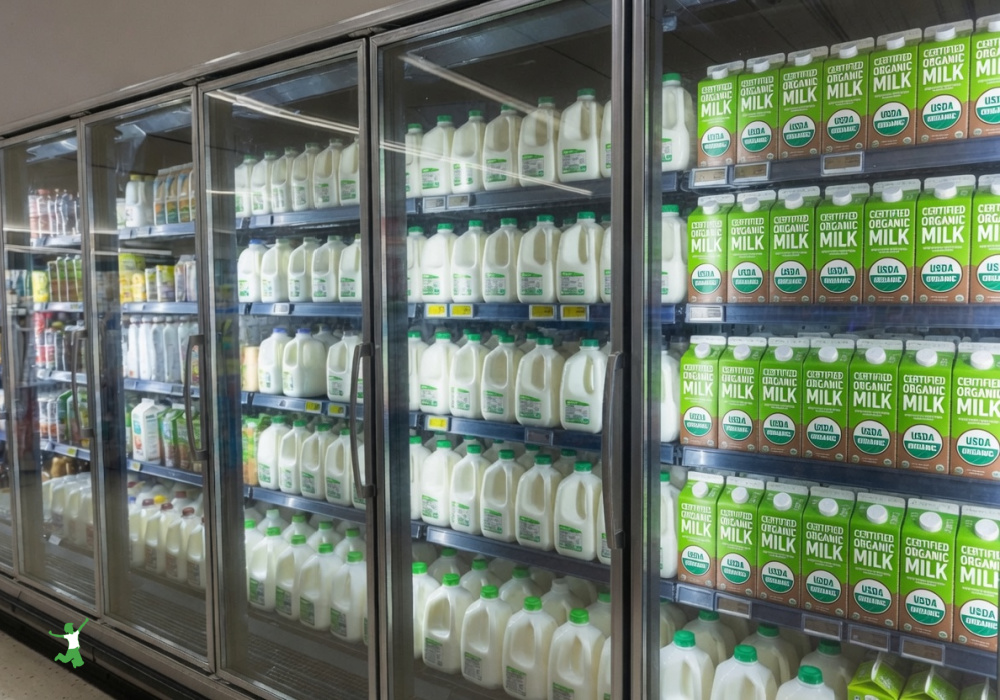
Fact: Organic milk companies such as Horizon and Organic Valley are pulling the wool over the eyes of consumers.
By marketing their ultrapasteurized (UHT) milk as certified USDA Organic, a willing consumer base buys it, thinking it is a better choice than regular pasteurized supermarket milk.
The sad truth is that ultrapasteurized (UHT) organic milk is just as unhealthy as regular, pasteurized store milk.
I’ve often thought if I HAD to choose between them, which milk would I select as being better: regular pasteurized supermarket milk or ultrapasteurized certified organic milk? That’s a toughie. Neither choice is optimal as there is no clear winner.
Both are highly processed milks, and both contribute to poor health and chronic illness in general.
Pasteurized vs Ultrapasteurized Milk
Let’s first consider regular supermarket milk.
The dairy cows producing this type of milk are injected with hormones and other drugs.
They consume unnatural, GMO, pesticide, and antibiotic-laced feed with no access to fresh air or green grass.
To add insult to injury, these abused animals stand on cement floors their entire lives. No surprise that they usually die within about 18 months. Incidentally, the true lifespan for a healthy dairy cow should approach 15 years.
Milk from confined cows NEEDS to be pasteurized. It is dirty, nasty stuff loaded with pus and pathogens because of the filth and chronic mastitis the cows endure.
Now let’s consider certified organic (UHT) milk. A consumer with only partial knowledge of how milk is processed is easily lured into buying this milk.
On the surface, it seems so much healthier.
After all, the cows don’t get any antibiotics, steroids, or hormones, right?
It’s certified USDA Organic. Doesn’t that mean something?
While the cows producing organic milk may not be subjected to the drugs and antibiotics used on conventional dairy operations, the milk coming from the Organic Industrial Complex is even more highly processed.
For example, ultrapasteurized (UHT) organic milk is subjected to the insanely high temperature of 275–302°F/ 135–150°C for 1–10 seconds (most commonly 2–5 seconds).
This is waaaay over the boiling point!
For reference, the boiling point of milk is 212.4–212.9°F/ 100.2–100.5°C.
Excessively high UHT processing, far above the boiling point, results in a destroyed product (it isn’t really even food anymore), but dairy corporations love it because it has a much extended shelf life compared to regular pasteurization.
The dirty little secret is that certified organic UHT milk can actually remain unrefrigerated for up to 6 months when packaged in aseptic cartons!
Yet, it is placed in the refrigerated section nonetheless because US consumers won’t readily buy cartons of milk from an unrefrigerated shelf. It goes against intuition and just doesn’t seem very natural, does it?
I don’t know about you, but I find this practice outrageous!
To show the disconnect, consider that Moms often buy individually sized aseptic packages of organically certified milk and put them in their children’s lunchboxes….with ice packs that aren’t even needed!
If they only knew that this milk is so dead that it doesn’t require refrigeration, then they might rethink their choice of beverage.
Auto-Immune Disorders
Why is ultrapasteurization so bad?
The high temperature (far above boiling point) necessary to ultrapasteurize organic milk greatly damages the fragile milk proteins. The same thing happens when sweetened condensed milk is manufactured too.
This violent industrial process results in a “food” that the body no longer recognizes when it is consumed.
The enzymes produced during digestion do not “fit together” like puzzle pieces with the milk proteins destroyed by UHT processing.
These undigested proteins then make their way into the bloodstream due to “leaky gut” syndrome, which nearly all Westerners suffer from to some degree.
At that point, the body identifies them as foreign proteins and mounts an immune response.
This translates into symptoms such as allergies, asthma, eczema, reflux, bloating, and other symptoms of autoimmunity.
People who drink this type of certified organic milk often think they have a “milk allergy”. In reality, they have an allergy to the processing, not the milk itself!
Ultrapasteurized milk is so completely sterilized that sometimes it is difficult to culture into homemade kefir or 24 hour yogurt.
In short, ultrapasteurized milk is dead, dead, DEAD.
There is no way that it can be considered healthy, even if it is labeled USDA organic and comes from grassfed cows.
I remember when my first child was nursing, I drank a lot of Organic Valley ultrapasteurized milk.
My baby spit up so badly during that time that there was some concern that he had a reflux disorder.
Remarkably (but not surprisingly), when I stopped drinking the Organic Valley milk, his reflux problem completely resolved. No treatment was required.
I have no doubt that if I had continued drinking this milk while nursing and he drank it as a toddler, that a likely “milk allergy” would be the result today.
Fortunately, I wised up in time to get off the industrialized poison otherwise known as certified organic milk!
Pick Your Poison
While a consumer may be reducing his/her exposure to antibiotic and pesticide residues by choosing Organic Valley milk, this is by no means a guarantee to less chemical exposure.
Processors of organic milk frequently boil the milk to the required 275–302°F/ 135–150°C after the milk is in the plastic or plastic-lined aseptic carton packaging.
Another method (just as toxic), is to fill the package or jug with sterilized hot milk that has not yet cooled down!
Either of these industrialized processes release high levels of endocrine-disrupting phthalates from the plastic or plastic lining into the milk!
Most everyone now knows never to heat food in a microwave with plastic wrap on top for this very reason.
It’s a shame more people aren’t aware of the tremendous endocrine-disrupting potential of drinking all forms of pasteurized milk, even certified organic that is falsely perceived as safer.
Never Buy Certified Organic Milk from the Store!
As you can see, it is an extremely hard decision to pick which milk is more unhealthy: regular pasteurized store milk or certified organic milk.
It is best not to have to make the decision at all!
Seek out fresh raw grassfed milk straight from the cow (or goat) from a farmer in your local area.
And, if you are fortunate enough to have a source for this truly healthy milk, don’t run out and buy a half-gallon of ultrapasteurized organic milk if you temporarily run out of the fresh-from-the-farm variety.
In those situations, it is best to simply go without.
The risks from consuming certified organic milk even on occasion are simply too enormous to ignore.
Another option is to make healthy milk substitutes like this recipe for coconut milk tonic or homemade sprouted oat milk until the next local dairy delivery.
More Information
101 Uses for Raw Soured Milk
Tips for Freezing Milk and other Dairy Products
A1 and A2 Milk: Do Cow Genetics Even Matter?



well what if i cant get my hands on fresh grass grown cows milk? i love in the city and there is no way ill find a cow near buy. so u saying there is no organic brands that i should drink @ all?
Hello, I know this is an older comment but if you’re still wondering about this I have a suggestion. 🙂 I live in the Dallas area and we’re part of a raw milk co-op. Every other week a few people in the group take turns driving an hour to a dairy farm and then everyone in the group comes to that person’s home to pickup their milk from the driveway (everything is in big coolers). They also usually have certain grassfed meats and pastured eggs available. So I only have to drive 10-20 minutes to get my milk every other week. If I want to purchase less often, sometimes I buy a bunch at once and freeze what we don’t need yet.
Hi All,
Great discussion. Living in Oregon, buying raw milk is not an option. But, I have found Organic Valley’s Grassmilk to be quite good. It is minimally pasteurized, not homogenized, and is very flavorful. I can’t get it at all stores, but there are enough who carry it to make it fairly easy to find. Their Grassfed butter is good, too. Unfortunately, these products are only available in Oregon, Washington, California, Utah and Colorado (I just checked the website). If you want it in your area, it can’t hurt to make a request. As awareness increases, these products will become easier to find.
Keep up the good work on getting the words out!
Cheri
I beg to differ on the availability of raw milk in Oregon. I’ve been there and you just have to find a dairy farmer, small time farmer, or a family with some cows who will sell their milk. I drank the raw milk up there for my entire visit and too, a ton back to CA with me and I still miss that rich creamy milk. Of course, do be sure to check out their methods and sanitation procedures. Also, if you cross over into Washington, say, from Portland into Vancouver, we also found raw milk in the health food store, along with other raw products. Check into it. Ask around.
I live in Oregon and buy two gallons of raw milk a week. You have to get on a wait list for most farms as Oregon law only allows 2 to 4 cows which isn’t a ton of milk to go around. If you are close to Washington, they sell it in stores there I believe. I haven’t bought any as knowing my farmer is key. Weston A Price website has a list of local chapter leaders that will help you find a farm. That is how I found my awesome farmer.
No facts here whatsoever. In most countries in Europe (like Germany and France) UHT milk is standard. If we believe you people there should have more allergies which I have never heard of.
Also think about this. The milk is heated to 280F for 2 sec. That kind of temperature is easily reached for an extended period of time when cooking. So even if you get your fresh milk, if you use it to cook something you’ll end up with the same poisonous dead milk.
Answer to Skeptic:
I don’t know where you got this info from…..!
I used to live in italy and no one there would ever think of drinking UHT there, people mostly drink HTST which is second best, if opened it would last 4days in my fridge, normal right!. It scares me to drink in the US milk that doesn’t go bad….
The UHT ( not kept in the fridge compartment in italy) is called sterilized milk and the HTST is called pasteurized. No one would like to drink anything sterile.
Just wanted to point his out.
I lived in Germany and none of their milk was refrigerated at all.
I know this is old but I still wanted to comment. 🙂 Cooking with milk isn’t a problem if you consume healthier foods a majority of the time. You just don’t want your dairy consumption to always be these dead foods because we need the probiotics and other nutrients found in fresh dairy. Additionally, there’s more to fresh milk than it being raw. If you’re careful about where you source from you get a much, much cleaner product and from cows that are treated better and that get fresh air, sunlight and are able to forage. When I bake and so forth I always use my raw milk even though I realize it will be heated…
Also, cooked milk is gently heated to a high temperature unlike violent UHT milk where it is brought to just below boiling within a split second.
There is Not a single Paper, article, science journal, or proof in this article. Absurd stuff without any scientific proof.
Hello, i think that i saw you visited my site so i came to “return the
favor”.I’m attempting to find things to enhance my web site!I suppose its ok to
use some of your ideas!!
This kind of thing has been going on for years in the UK, and is a particular bug-bear of mine.
It’s kind of heart-breaking when you see how capitalism moves inn on every area of life, to the point where it even controls what once were ‘alternative’ systems.
Reminds me of that movie The Blob, where the monster just consumes everything and moves on.
Like I say, heart-breaking, when you think about it.
I try to avoid UHT when I can (mostly due to the flavor). However, if it’s what I have in the house I do use it to make yogurt and it works just fine!
Read your blog and got freaked out about the Horizon milk I’ve started supplementing with my almost 1 year old’s formula. Thankfully we have this alternative available locally and is even sold at our specialty grocers now too:
It’s now in the fridge and aside from being a healthy milk for my little guy to drink, I’m hoping it will cure my recent development of lactose intolerance!
You do not develop lactose intolerance, it is genetic. If you are experiencing problems since switching the milk you drink that is the cause of your discomfort. I would NEVER give my child raw milk! It is not advised by any Doctor just as you do not give a baby honey. Raw milk has not been heated to kill bacteria. My grandparents had a dairy in the 50s and they did pasteurize all milk they sold. There is a reason the scientist who invented pasteurization is celebrated.
Read “The Untold Story of Milk”. Your view of the history of milk and pasteurization is incorrect.
I have read so many articles or reviews regarding the blogger lovers however this piece of writing is really a pleasant post, keep it up.