

Table of Contents[Hide][Show]
Comparison of fresh milk from cows versus goats, including important nutritional differences that could affect your personal choice.
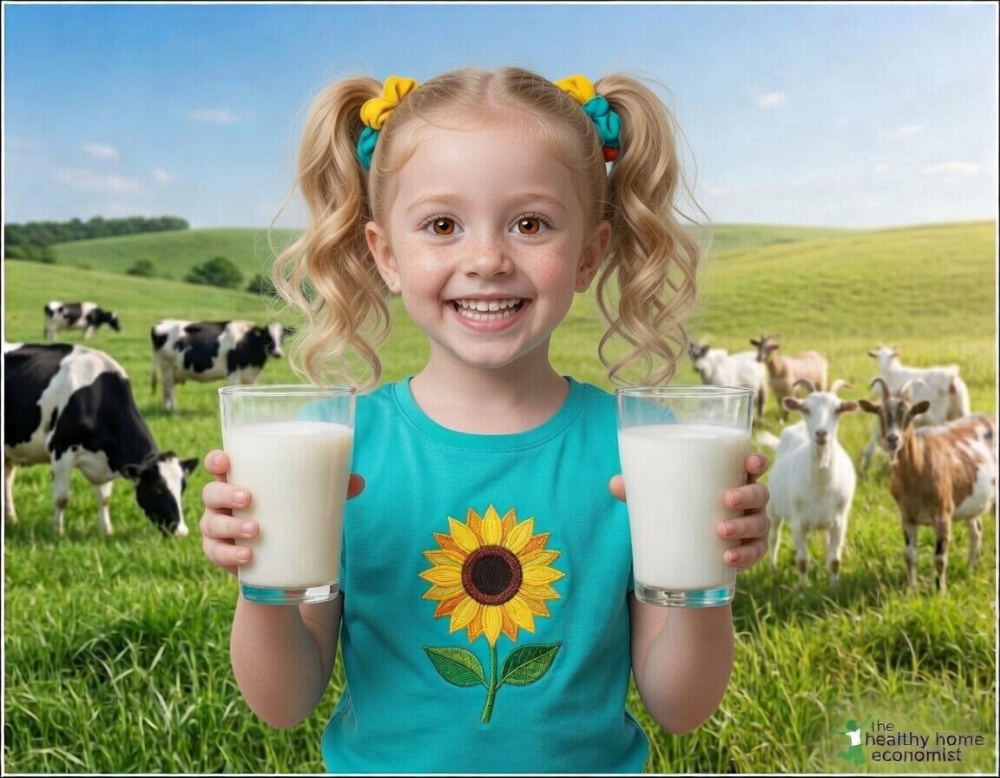
I am fortunate where I live to have convenient access to high quality, farm fresh milk from both cows and goats for reasonable prices.
While my children prefer cow milk, I do buy goat milk now and then for variety.
One of my kids asked me the other day about goat milk versus cow milk and which was better than the other.
Great question!
Goat Milk Advantages
The most significant difference between goat milk and cow milk is that fresh, unpasteurized cow milk forms a distinct creamline at the top and goat milk does not.
The reason is that goat milk is naturally homogenized, which means the fat molecules are smaller than in cow milk and so remain evenly dispersed throughout the milk. Incidentally, sheep milk is also naturally homogenized.
The smaller size of the fat globules seems to make goat milk more digestible for some people but not all. I personally find no difference in digestibility between the two.
While the protein structure of cow and goat milk is fairly similar, goat milk is missing an alpha casein present in cow’s milk.
In addition, when you drink a glass of goat milk, and it reacts with the acid in your stomach, the protein curds that precipitate are smaller in size and a bit softer than the ones that form with cow’s milk.
This is another reason some folks find goat milk to be more easily digested than cow milk.
Cow Milk Advantages
Cow milk is higher in Vitamin B12, which many people are severely deficient in.
Goat milk also lacks folate, which makes cow milk more suitable for homemade infant formula in the event the mother cannot breastfeed.
If homemade goat milk baby formula is preferred due to local dairy availability, it is best to add a bit of desiccated liver powder or grated fresh liver (see specifics below) to compensate for this important nutritional difference.
Cow milk is also higher in Vitamin B6, making it a better choice for pregnant mothers who have morning sickness.
I myself suffered from B6 deficiency morning sickness and so found sipping fresh cow milk during the first trimester to bring immediate and welcome relief.
Incidentally, B6 is destroyed by pasteurization, so any sort of heat-treated or pasteurized milk will not help in this regard. The milk must be farm fresh and preferably grassfed.
The Weston A. Price Foundation recommends adding 2 teaspoons organic raw chicken liver, frozen for 14 days, finely grated to each batch of the goat milk-based formula if goat milk is used and encourages egg yolk feeding for babies to begin no later than four months old.
If cow milk is used, egg yolk feeding can be started later at 6 months.
Cow milk is usually more readily available than goat milk and is typically a lower cost per gallon making it more suitable for tighter budgets.
Sometimes I’ve heard folks say that they prefer the taste of cow milk because goat milk tastes goat-y, but in my experience, goat-y tasting goat milk is more a result of quality than anything.
The goat milk I buy doesn’t taste goat-y unless it is more than a week old and is generally very similar in taste to cow milk.
Goat vs Cow Milk? Which is the Best Choice?
Ultimately, the choice of whether to drink fresh cow or goat milk is a personal preference. The exception would be homemade formula, where cow milk should be the first choice due to the lack of vitamin B12 and folate in goat milk.
For straight drinking, my husband prefers goat milk as the naturally homogenized fat molecules make it a bit more digestible for him. However, he loves homemade kefir “ice cream” made with 50-50 heavy cow cream and milk.
My children prefer cow milk, although my oldest doesn’t mind a glass of goat milk when it is really fresh.
So what did I answer my child when he asked whether one milk was better than the other?
I told him that it was kind of like the difference between turkey and chicken or beef and lamb.
They are both yummy and healthy, and it’s perfectly okay to prefer one over the other or even drink both if you want to!



We have a few dairy goats and I was skeptical about the flavor of their milk before I tried it (we bought them before I ever drank goats milk) and it doesn’t taste any different than cows milk. Our goats are on pasture during the day and hay at night. They are dry now because we put them with the meat goats and buck to breed and rest during winter. I totally agree diet plays a role in flavor.
Goat all the way!!!! 😀
To those who don’t like the taste of goats milk, the taste will vary depending on what the goat is eating. If the goats are eating the right stuff the milk won’t be bitter.
..i only have a source for goat milk here in raleigh nc & it never tastes “goaty”. it has a very fresh taste with a hint of sweetness. i see the goats every time i pick up & they are very well cared for & allowed out to get fresh grass & romp around. they are a type of dwarf goat & they say the milk has more cream than regular goats.
Good quality goat milk (free range) should taste very similar to cow’s milk
Rebecca: I’d love to see the article about raw milk and mucus.
We have goats so, raw goat milk 🙂
An old dairyman from the 30’s told me that raw goat’s milk would help TB patients get better and that if it didn’t after 30 days then he gave it to them for free.
Omgosh! We pay $7/gallon for raw milk down here. $2.50 is a great deal! #WeAreMoving
prefer raw carabao milk in my country. Great taste and if i may say, really organic.