
How to identify healthy soup brands at the store that don’t come packaged in cans, cartons, or shelf-stable tetra paks.
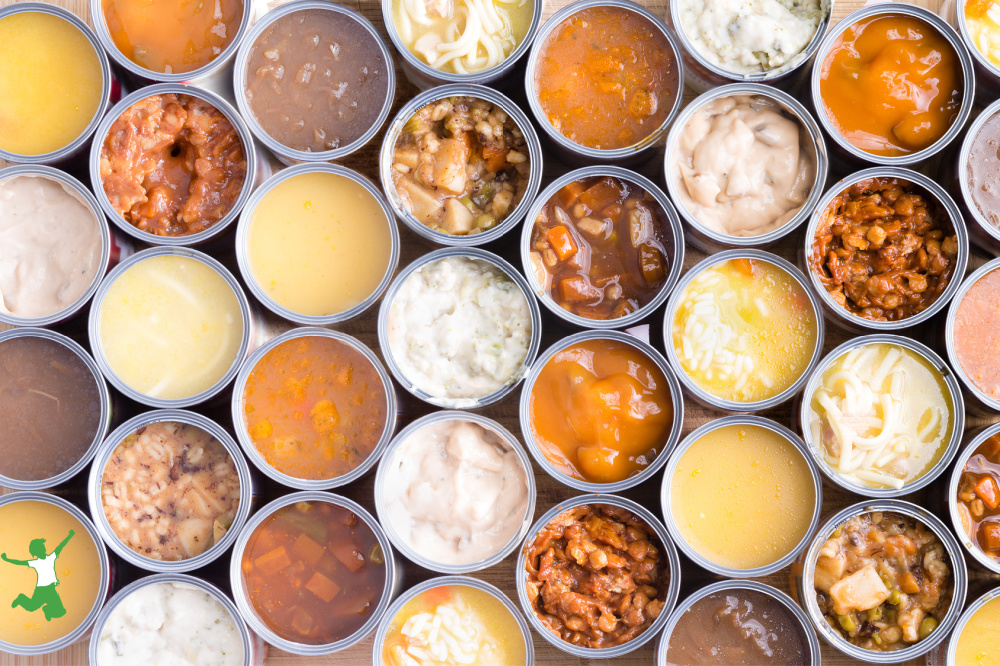
When the essential life decision to eat healthy is made, commercial soups are arguably some of the most important processed foods to leave permanently behind.
The news about Campbell’s Soup containing bioengineered, fake chicken meat is yet another example of how these Big Food brands deceive the public with their processed slop that is anything but nutritious, let alone safe! (1)
Surprisingly, a simple switch to a line of healthy soups made with organic bone broth is not as easy as it might seem.
Whether you buy from the supermarket or the health food store, soups in shelf-stable packaging or cans (including bouillon cubes) are unhealthy choices even if organic.
Worse, the vast majority of commercial soups contain neurotoxic MSG and other dangerous additives.
They are hidden under benign-sounding names such as “spices”, “natural flavors”, “seasonings”, “stock”, and “hydrolyzed protein” among dozens of others. (2)
Soup Ingredients and Packaging
Just as consumers catch on to the tricks behind one ingredient pseudonym, food manufacturers change it, resulting in a never-ending game of cat and mouse.
It can be a real challenge for label-reading shoppers to keep up with the many confusing aliases.
When I first realized how nutritionless and toxic canned soup really is back in 2002, I found it challenging to quickly make the transition to homemade versions.
It seems that when you most need a bowl of healthy soup, you open the freezer to find you are out of broth!
Even if you have good broth or stock on hand, perhaps the necessary ingredients needed to make soup are not available in the vegetable bin.
Making a run to the store to get soup ingredients when you are running a fever or already down with an illness is not wise or even within the realm of possibility in most cases.
Aren’t there any brands of healthy soup to have in the pantry in a pinch?
Let’s take a look.
Brands of Healthy Soup
Currently, the only place I am currently able to find quality soups the same as I make myself at home is my independently-owned health food store deli.
The chef makes them with real bone broth or meat stock and organic ingredients.
Yay! So thankful for this option, I can tell you!
If you have any locally owned restaurants or health food delis in your community, ask the chef how the soup is made. You might be pleasantly surprised and find a good source of ready-made soup when you need it.
Another option is to seek out traditionally made pho from a locally owned Vietnamese restaurant.
Cans and Cartons
Sadly, I cannot recommend any brands of soup in cans or cartons. This includes popular organic brands like Amy’s.
The packaging is just too toxic even if the ingredients are acceptable.
This includes BPA-free cans, which is a marketing gimmick. Manufacturers simply substitute another similarly toxic chemical such as BPS.
Eating toxic processed food when you are not feeling well is not the best approach for a fast recovery!
Whole Foods Hot Bar
After examining the ingredients of the soups featured at the Whole Foods hot bar (and other health food store mega-chain), it seems wise to avoid them.
These concoctions are typically just commercial soups in disguise. Check the ingredients carefully!
Most have GMOs, hydrolyzed protein, and unhealthy fats like canola oil in them.
Glass Jars
What about Rao’s line of soups in glass jars?
While the packaging is excellent, this brand does not appear to use authentic chicken stock as the base even though the marketing says it is “slow-cooked”.
There are also sketchy ingredients such as GMO corn starch for thickening.
5-Minute Soup
If you simply don’t have time to make your own soup or are in a location without kitchen access, it is definitely worth it to at least buy authentic bone broth.
You can make this easy and delicious 5-minute soup by adding just a few spices to the basic broth.
Best Bone Broth
After trying numerous brands and carefully vetting the packaging processes used, I recommend only a few frozen brands of bone broth.
This broth brand and this broth brand (ONLY frozen) are what I buy when I am out of homemade meat stock (my preference … more on this below). These brands are both excellent, high quality, and widely available across the US.
If neither of these brands are available to you, I suggest getting a copy of the Weston Price Foundation’s annual Shopping Guide. There are over two dozen brands listed in the current guide, several of them from regional companies.
**Never buy bone broth packaged in cartons or tetrapaks even if the broth itself is made properly.
The bone broth is boiling hot when it is poured into the tetrapaks aseptic cartons lined with thin plastic. This virtually guarantees a leaching risk of toxins from the plastic into the bone broth.
When it comes to healthy soup and broth brands, it’s not just about ingredients and preparation.
The packaging process is also important to vet before buying!
What About Meat Stock?
I personally prefer meat stock to bone broth.
It’s not that bone broth is “bad”; it’s that meat stock is considered safer and more therapeutic for those with any sort of autoimmune disease or gut issues. In my case, my husband was on GAPS for many years, so I got into the habit of meat stock instead of broth.
It was also inconvenient to make long cooked broth for the family and short cooked stock for him, so I got into the habit of using meat stock for everyone.
Note that the terms are interchangeable in many situations, but the real distinction comes in how long each is cooked and the proportion of meat to bones.
Meat stock is short cooked with roughly 50-50 raw meat to bones.
Bone broth is long simmered with less meat (you can use a carcass from a cooked turkey or chicken to make broth too).
Broth has more flavor than stock, but little to no usable collagen for tissue repair, according to Dr. Natasha Campbell-McBride.
Bone broth is also high in glutamate which is contraindicated for the GAPS Intro Diet and even the full GAPS diet for those who do not tolerate broth.
Meat stock has loads of usable collagen for healing/sealing the gut wall, which is why it is a must for GAPS and those who are working to recover their gut health.
Unfortunately, there are no companies I’ve come across that make authentic meat stock. You must make it yourself.
(1) Attorney General of Florida launches investigation into Campbell’s illegal use of bioengineered chicken
(2) Truth in Labeling



These look really delicious and would undoubtedly taste much higher quality than what other companies are offering. It should be expected that you have to pay more for better quality stuff. Having some of these on hand would be convenient, thanks!
Yay!!! Something I can buy and not always have to make myself. I’ll be ordering some for the occasional treat.
I would love to see gluten and dairy free! Then I would for sure keep some on hand.
I would absolutely love to have something like this in my freezer, but there is no way in the world I can afford that. Yes, it is top quality, but considering we can’t afford dining out and the cost of this is comparable, it wouldn’t happen. I’ll end up being the one making soup even when I’m sick and the days I don’t feel like it. 🙂 Sigh.
Welcome to my world! You will be a better woman for it. And really, even though it sometimes feels like it, those days don’t last forever! Starting to wish they did sometimes:-)
WHOA. You get colds 🙂
You guys need to pay attention to Sarah’s disclosure policies. They are the tiny little links at the bottom of the posts where she is reviewing products. Like most bloggers, Sarah is being compensated for featuring these products on her blog, so a proverbial grain of salt is needed when following her advice on purchasing products.
I do my own research and make my purchase after investing time and effort in extensive research using the Trivium Method and I also source all my consumption. I vote with my dollar with the basic understanding that real foods that are nutrient dense and good for me and my environment require the right language to acquire. Of course money is that simple language, a language of numbers to engage in commerce. I am the creator of the conditions I find myself in, conditions created from the choices I make. I find Sarah consistently recommends products that I deem worth investing in. I listen to all and follow none, and I am grateful to have a resource in Sarah, how cool that she has found a way to increase her language of commerce by being reimbursed for her valuable time and effort she spends in doing the research and sharing it with us who pay attention. Time is really a spiritual currency, my friend and a wonderful philosopher, Mark Passio says: you use your spiritual currency, Time, two ways, with what you spend your time doing, and what you pay attention to. Thanks Sarah, you rock, and it is women like you who show the rest of us how to do it right so the conditions of health, happiness and wealth or met with right choice.
I am so impressed with all of the inquiries, the likes and the comments being made regarding our soups. I love the opportunity to dialogue and explain they “why” behind our product line “Real True Foods”.
As a clinical nutritionist my advice is to always prepare your food at home to ensure the best possible nourishment. However there are times when I simply do not want to cook. In my quest to find a food line that offered all of my nutritional concerns as a Weston A. Price member and Paleo movement supporter, I came up empty handed. Our ingredients in our foods are ingredients that the average American family does not use in their home. They are ingredients that I tell my clients to use in their quest for good health.
Comparing our soup line to a “Trader Joes, low sodium stock” would be similar to comparing commercial eggs to Pasture eggs. They are both eggs, but the result and nutritional component pales in comparison.
Our bone broth is “Traditional Bone broth”. Before we even begin making our soups our bone broth has been cooked for 24 hours. We do not use just organic bones. We use GRASS FED organic bones. There is a considerable cost difference between organic and Grass-Fed. While there are many cheap, imitation Celtic salts on the market, we only use Selina Brand Celtic sea salt. This salt has over 80 minerals in it, is sun-dried and harvested naturally. A ½ pd bag retails for $11.00. Our water is triple filtered, and our dairy is not just organic dairy. Our dairy is PASTURE dairy. The cream we use is one of the only creams available that doesn’t use guar gum or carrageen. Our organic produce is LOCALLY sourced produce and is never supplied from Mexico or China. The chicken we use is organic, free range, pastured chicken. Again, the price is $11.99 per pound retail for this type of chicken as opposed to organic chicken. The oil we use to cook with is Coconut oil, as olive oil can become rancid when cooking at high temperatures. Our coconut oil is raw, organic and cold pressed. $16.00 retail for a 22 oz jar.
Our consumer is a consumer who understand real food, and the cost of preparing it. Many people question why someone would buy a $5.00 cappuccino from Starbucks when you can make it at home. I agree! . Suja is the fastest growing juice company in the Nation and a bottle of their juice will cost you $8.00 for a 16oz bottle of juice. You can make it for pennies at home Hail Mary’s tarts will cost $4.50 for a 3 oz tart. These are companies that provide convenience to consumers.
There is a cost to having the convenience of Real True Foods that follow the teachings of Dr. Price and the Paleo movement. As we grow, we will be passing our savings on to our consumers. We are happy to be there for those who need us when in a pinch or in need of a break. We do however, always encourage you to cook your meals from home and applaud you for doing so.
In Health and wellness,
Sharon Brown, CN, Certified GAPS Practitioner
At that kind of price, I can make 4 GALLONS of soup, portion it out and freeze it myself, and I usually do, a couple of times a year. This is ridiculous and out of reach for the average American family.
As mentioned in the post, you should obviously continue to make it yourself as you’ve always done (and which I will continue to do). This is an insurance policy when you can’t make it or are out and need something in the freezer in a pinch. Also, at $19.95 per 24 oz. container, it is very reasonably priced … about the same price as the authentic French onion soup at a local restaurant here in my community (which is $10 per bowl).
What about Real Bone Broth stocks listed in the WAPF 2014 Shopping Guide? Has anyone tried them? Are they any good?
YUM! and Hurray!