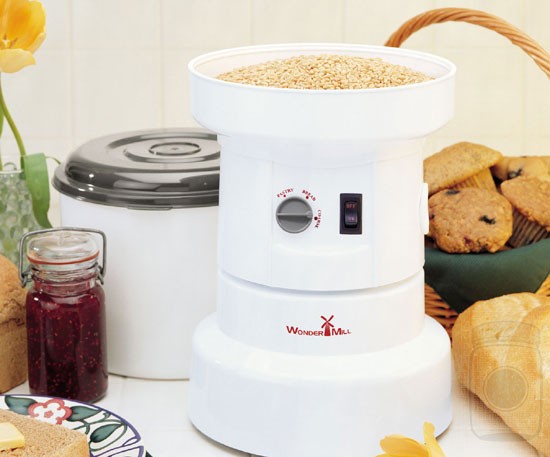

Video: Grain Grinding 101

by Sarah, The Healthy Home Economist on August 12, 2010


Many readers have emailed me over recent weeks with questions regarding the grain grinding routine in my kitchen.   I realized that I needed to take a step back and show you the basics of selecting a grain grinder and other tasks related to making fresh flour to help you determine a routine that works best for you.

Remember that starting to grind fresh grain in your home should only be started after you have started cooking with the right fats!    Getting the fats right is the most important change you can make in your kitchen.

Using fresh flour is a wonderful addition to your cooking repertoire as even the organic flours from the healthfood store or the ones shipped to your door are nutritionless and not worth the money.    Once you grind flour, the nutrition is gone in about 3 days in an unrefrigerated situation.   Freezing your flour right after grinding will preserve this nutrition for weeks, which is why you really need to do it yourself.   As you can see from the video, flour can be used immediately right out of the freezer, so there is no disadvantage to freezing.
Sarah, The Healthy Home Economist

This post is shared at Pennywise Platter and Foodie Friday.


The Healthy Home Economist by E-mail


{ 41 comments… read them below or add one }

Dr. Laura Aridgides August 12, 2010 at 2:44 pm

Sarah,
I couldn't understand the name of the company where you buy your grains. Could you post it?
Laura

Reply

Melissa August 12, 2010 at 3:01 pm

Thank you! I have been wondering what type of grain to use… By the way, I bought a nice grain grinder from ebay just a couple months ago and they still have some good deals. I would recommend an electric over the manual grinder, also- I have both, and the manual is such a pain! Thanks for another great video.

Reply

Kate @ Modern Alternative Mama August 12, 2010 at 3:11 pm

I've been grinding grain for awhile now. Use my Vitamix for that (and so much more). Love it! I usually just grind it as I need it. It's pretty awesome. :)

Reply

Sarah, the Healthy Home Economist August 12, 2010 at 7:20 pm

Hi Dr. Laura, check out breadbeckers.com This is where I get my grain from in 6 gallon buckets.

Reply

WordVixen August 12, 2010 at 7:24 pm

I've wanted a grain mill for a while now, but I don't bake often enough to justify it yet. Come winter things might be different.

Do you know approximately how many cups of grains equals how many cups of flour? And does your flour settle much while in the freezer? I've heard that fresh ground flour isn't as compacted as store bought, so recipes would be adjusted accordingly. Also, do you know if there's a difference in amounts between sprouted and unsprouted flour?

Reply

Sarah, the Healthy Home Economist August 12, 2010 at 7:58 pm

Not exactly sure how many cups of grain equals cups of flour as I grind large amounts at once and don't grind for a specific recipe typically. I think I heard once that it is nearly a 1:1 or a 1:1.5 ratio. I have never noticed a difference between sprouted and unsprouted flour – I substitute 1:1. Same with using fresh flour – I don't use any more or less if the recipe is assuming store bought flour.

Reply

Sarah, the Healthy Home Economist August 12, 2010 at 9:41 pm

I had an email today from someone asking for a reference on the 3 days and flour is nutritionless when unrefrigerated comment I made in the blog. I have read this in a number of places over the years, here is one ref: http://articles.urbanhomemaker.com/index.php?article=3

Another is Nourishing Traditions cookbook which states that grains quickly go rancid after grinding which is why home grinding is a must.

Reply

karen August 13, 2010 at 2:34 am

i thought you always "prepared" your grains before you ate them. i presumed you soaked then dried them before grinding.

Reply

karen August 13, 2010 at 2:37 am

i thought you "prepared" your grains by soaking them before you ground them. do you use the flour without preparing it any further.

Reply

Michael Fisher December 13, 2010 at 10:59 am

You can still ‘prepare’ the grains after they’re ground by soaking the flour. Problem is, you can’t drain the soak water and rinse, but the phytic acid can be neutralized by seaweed. Kombu holds up real well, so if you soak your batter with seaweed in it, or seaweed soak/cook water, it neutralizes the acids. This is improved even more by fermenting, in the case of sourdough bread.

The other option, is to soak (you can sprout too) and then dehydrate, and THEN grind. This is probably the best option.

Reply

Sarah, the Healthy Home Economist August 13, 2010 at 2:40 am

One of the methods to properly prepare grains can involve soaking the flour – not the wheat berries. You can also SPROUT the wheat berries and then dry them before grinding into sprouted flour (this is another method). But if you are using the soaking method, you don't soak the berries – you soak the flour.

Reply

Sarah, the Healthy Home Economist August 13, 2010 at 2:43 am

Yes – I do prepare the flour before baking – please see my soaking flour video. The video next week will also explore this topic further.

Reply

Janet August 14, 2010 at 7:38 pm

I thought you only used sprouted flour. So what is best to use, sprouted flour or soaked flour, or does it matter or is there different uses for each?

Reply

Sarah, the Healthy Home Economist August 14, 2010 at 7:45 pm

Hi Janet, I use both. I prefer freshly ground flour soaked in yogurt, kefir, or clabbered milk for pancakes, waffles and the like over sprouted flour as the texture is much softer.

Reply

amanda August 19, 2010 at 1:50 am

just wondering about the grain mill attachment for the Champion and heating the flour. I have read heating while grinding will damage the proteins and that the vitamix, for example, gets too hot. i assume the champion is fairly cool? any ideas on which other grinders would keep the flour cool enough? thanks!

Reply

Sarah, the Healthy Home Economist August 19, 2010 at 2:02 am

Hi Amanda, the grain attachment for the Champion does get warm but not hot. Certainly, it is not nearly hot enough to damage the proteins in the grains. The grains would get much much hotter baking in an oven and baking does not damage the grains either. I have never considered the heat generated by a grinder to be much of an issue for these reasons.

Reply

Anonymous August 23, 2010 at 2:23 am

Can I use my Vitamix for Grinding grains?

Reply

Sarah, the Healthy Home Economist August 23, 2010 at 3:12 am

Yes, I know a number of folks who use the Vitamix and love it.

Reply

Thursday's Child August 28, 2010 at 5:13 pm

I've heard of Vitamix but don't really know what it is. Is it just a really good quality food processor or blender? I have an Osterizer that I used to grind whole oats and rice for the twins' baby food. It did a great job. Could I use it to grind wheat as well? I don't have anything else, except a Cuisinart food processor and very small coffee grinder, and we're watching our expenses right now.

Reply

Sarah, the Healthy Home Economist August 28, 2010 at 10:54 pm

I really don't know if an osterizer would work. Give it a try and see.

Reply

Chris September 30, 2010 at 3:47 pm

Hi Sarah, I love your post and especially enjoy all of the information you share with us novices. After researching your blog I became inspired and decided to purchase the Champion and maximize its use for the benefit of my family's health. I also purchased the wheat from Bread Beckers (soft red) and am now looking forward to a new way of home baking.

I used to be an avid baker in my "spare time" and enjoyed making cakes, pies, pastries, cookies, etc., for family and co-workers, with unbleached all purpose King Arthur Flour and I always had great results. However, since my bold move to purchasing my wheat and grinding my own flour, I've noticed a huge difference in the density of my baked goods. The taste is a bit too heavy and the texture is a lot different than what I envisioned -am I doing something wrong? Should I be soaking the flour (I just watched several of your videos) in the same manner you soak it before making pancakes? I'd like to make some muffins, quick breads and cookies, now that the holidays a vastly approaching, and I don't want to use my freshly ground flour if they don't come out a bit lighter and airy -it will be a costly mistake and I'd like to avoid this.

Can you provide some advise ? How do you prepare your home baked goodies (cookies, cup cakes, etc.) with the freshly ground flour? Thanks in advance and keep up the great work you're doing!
Sincerely,
a fan from NJ

Reply

Sarah, the Healthy Home Economist September 30, 2010 at 5:25 pm

Hi Chris, soft white wheat is best for baking and yes, you need to soak the flour for pancakes. Soaking makes the whole wheat much softer almost like white flour. Red wheat is quite dense and has a flavor some do not really prefer, my family is one of these. I do not use red wheat for really anything. I use soft white wheat and spelt flour only.

Reply

Danielle March 4, 2011 at 5:13 pm

Sarah,
I’ve sourced spelt at a great price locally and I’m ready to give grain grinding a try! Do you need to soak freshly ground spelt flour before baking bread or cookies? I assume you do for things like pancakes and waffles. Am I right?

Thanks!

Reply

Ingrid March 6, 2011 at 4:29 pm

Hi Sarah,
I’ve watched several of your videos now, and most recently the one about making your own cold breakfast cereal. My real question is about soured raw milk (clabbered milk). Once raw milk has soured, how long does that last in the refrigerator? Does it ever go so sour that it becomes unhealthy or dangerous to consume? I have some that has been in the refrigerator for 9 months. Also, in the first month that it had soured – it really didn’t taste good at all. Is this the way it is supposed to be or should this delicious raw milk taste ‘good’ even though it has clabbered. I know that pasteruized milk goes ‘bad’ (not fit for consumption), but honestly this clabbered milk just doesn’t taste good either. Will it leave a bad flavor on the homemade breakfast cereal if used for soaking?
Thank you – I’ve been wondering this for a long time now.
Ingrid

Reply

Sarah, The Healthy Home Economist March 6, 2011 at 8:04 pm

Hi Ingrid, clabbered milk is quite sour – like plain yogurt or kefir in taste. It lasts several months in the refrigerator. Toss it when it becomes too sour to even use for cooking. It will be fine for soaking flour as long as it is not too sour.

Reply

Ranjani Krishnan March 13, 2011 at 4:35 pm

Hi Sarah,

What a gem this video is! I am wondering how one would clean one’s grains before grinding them. If I wash them in water, then I have to find an effective way to dry them before grinding them and can’t think of any efficient way to dry them. Thanks again for continuing to educate us.

Ranjani.

Reply

Sarah, The Healthy Home Economist March 13, 2011 at 9:32 pm

Hi Ranjani, I’ve never washed my grains before grinding. I buy organic grains in a 6 gallon bucket and they do not need cleaning beforehand. If you want to rinse them, that is fine. Just dry in a warm (150F) oven or dehydrator before grinding.

Reply

Irene September 2, 2011 at 12:28 pm

Sarah,

I just started the whole sprouting grains process and followed the steps you described. My only question is, my oven doesn’t go lower than 170F and I was wondering if that was ok? Could I still dehydrate the grains at this temperature or is it too hot?

Reply

Deanna November 3, 2011 at 3:02 pm

Hi Sarah,

First of all I just wanted to thank you for taking the time to do these videos. They are really helpful! You mentioned that you buy Berlin Natural Bakery Sour Dough Spelt Bread. I do not have any local stores that carry it but I can buy it online in bulk and save shipping. Do you freeze yours until ready to use? If so does it alter the taste of the bread?

Deanna

Reply

Erika December 10, 2011 at 4:56 pm

Hi ! I was wondering what kind & size of bags you use to store the flour in.. and if you think it will be okay to store it in a freezer safe glass storage container (if I can make space for one).. I’m just worried about the plastic leaching.

Do you re-use the bags for your flour ? If you do, do you rinse it out first in warm soapy water and let it air dry?

Last but not least, I’ve started asking traditional food bloggers if they would make an article about cookware/bakeware/serving plates & cups to show which they prefer.

I’ve heard stainless steel leaches nickel and other chemicals esp. with acidic foods, ceramic cookware/bakeware plates,mugs, cups, and crockpot inserts (a lot of them) have lead, aluminum & copper are out for obvious reasons, glass items might contain lead and the glass bakeware doesn’t cook food evenly and some of the light sensitive nutrients in food can be destroyed by the light of the flames in the oven ?), cast iron (some ppl claim that the iron bits that might flake onto food aren’t the safe digestible healthy iron people thought it was and you may get too much iron from it. I’m at a loss as to what brands of cookware, safe plates and cups and mugs to drink from (hot and cold) and the whole crockpot/slow cooker problem.. not to mention items deemed safe to soak items in acidic medium)..

I think there’s so much confusion and am asking traditional food expert bloggers what their opinions are because I am at a loss and I’m sure plenty of people are if they know about the above mentioned potential problems. Please consider possibly posting about this topic if you have some time. I value the opinions of different knowledgable bloggers who care enough about traditional foods and getting the word out to internet users about living a healthier life.

Thank you so much for taking the time to read this :)

Sincerely,
~Erika

Reply

Wimpy January 26, 2012 at 1:04 am

Your’s is the itlneligent approach to this issue.

Reply

exqrzrb January 26, 2012 at 12:13 pm
ylztthpxgv January 29, 2012 at 12:46 pm
Julie April 19, 2012 at 1:25 am

Can you make handmade pasta from flour that has been ground from sprouted wheat? I don’t think I can completely live without pasta.

Thanks Sarah! :-)

Reply

Blair May 7, 2012 at 12:01 pm

Hi Sarah:

I am wondering if the following is possible for storing sprouted grains: to increase the shelf life of my dehydrated items I place them in a glass jar, put in a canning lid and remove the air with a FoodSaver attachment. I don’t do this with raw seeds, wheat and other raw grains because I know that the lack of oxygen will kill them. But once the grain is sprouted and dehydrated, is it still fragile? I have no information on this so I thought I would ask you. Also, do you grind your sprouted wheat right away and then freeze it? Is that necessary? I am wondering if it is possible to do a large batch and then store it in jars with the air removed. I would love to know you thoughts on this.

Reply

Lorraine June 27, 2012 at 3:31 pm

Hi, I found a champion w/ grinder attachment on Craigslist for $125.I’ve been consindering a grain grinder for a long time, so I’m thinking this is the one.I was doing some research on it, & found this on http://www.ultimate-weight-products.com/Q-012-185.html?gclid=CMiT0oCP77ACFYeo4AodtW8PwQ . Not Recommended for:
Nut Meats, Dried Beans (other than what is recommended above), Garbanzo Beans (chick peas), dried herbs, sesame seeds, popcorn, amaranth, lima beans, soft wheat berries or other types of seeds with soft centers. Running any material containing soft centers will gum up the grinding blades and cause the unit to overheat.
I’m assuming you haven’t had any problems w/ soft wheat berries since that’s what you use all the time, but I didn’t know if there’s a cleaning technique you use???
Thanks so much & for all your information on healthy living!:)

Reply

Tierney Tramontozzi July 24, 2012 at 11:49 am

Hi Sarah,

I love your videos. Thank you so much for posting these. I recently started to attempt a more Traditional Diet for my family of 7, but it is hard to find the time and I’m overwhelmed. Question: is it better/healthier to buy sprouted grains to grind into flour (found a company from your resource page) or to buy the organic grains you mention here from bread beckers? Thank you, Tierney

Reply

Tierney Tramontozzi July 24, 2012 at 12:01 pm

P.S. do you have to soak sprouted grains that are ground into flour?

Reply

wendell September 7, 2012 at 11:28 am

Does it make any difference whether the grain is medium ground or fine ground? Are those lids you talked about available at the same place you buy your wheat? I used to buy whole wheat flour from a nurse about 50 miles from my home, but I lost her contact information and would like to start buying my own wheat and grinding it myself.
My late stepfather ran a grist mill that was over 100 hundred years old and it was water ground mill with the stones and he always ground his corn meal very fine and it made the best hoecake and pone bread I’ve ever eaten. He dressed the stones every so often to ensure they were working right and when he passed away in 1985, the meal has never been the same. He had gave up his lease on this mill and worked there until 1985, The state of Ga. moved it to the Ga. Agrirama, an old village from the 1800′s in Tifton, Ga and the mill is still there and running, but nobody knows how to grind the mill like he did.
It sometimes only takes one generation to lose the old ways and skills that existed for centuries.

Reply

wendell September 7, 2012 at 11:30 am

What about those Einkorn wheat berries I’ve read about. Are they supposed to be low gluten and better for you than the hybrid wheats on the market?

Reply

wendell September 7, 2012 at 11:32 am

Have you ever had weevils or other bugs in your wheat after long storage of 18 months?
Would you need to put it in the freezer for 48 hours before you put it in storage and ground it as needed?

Reply

Leave a Comment

CommentLuv badge

{ 1 trackback }

Previous post:

Next post: