

Table of Contents[Hide][Show]
How cows grazing on rapidly growing spring grass results in a beige color for the milk and cream along with deep yellow butter containing the elusive animal form of Vitamin K2 crucial for longevity, fertility, and overall vibrant health.
If you are a pastured raw dairy enthusiast as I am, Spring is probably one of your favorite times of the year.
The reason has everything to do with the rapidly growing spring grass in the unsprayed pastures of local dairy farms.
Here, old-fashioned Jersey, Devon, or Guernsey (A2) cows are contentedly roaming and grazing.
Spring grass has nothing short of a magical quality to it.
Cows that graze on this type of grass produce the most nutrient-dense dairy of the entire year.
The cream and butter from this milk contain the critically important fat-soluble vitamins A, D, and K2 (Activator X).
What is “Activator X”?
Activator X, now known to be the MK4 animal form of Vitamin K2, is perhaps the most elusive nutrient in the human diet today.
It was extensively described by Dr. Weston A. Price in his groundbreaking book Nutrition and Physical Degeneration.
By comparison, synthetic Vitamins A and D are artificially added to processed, commercial milk that is devoid of Vitamin K2.
Pastured dairy contains Vitamins A, D, and K2 in their natural, nontoxic form.
There is no need for synthetic fortification in this type of dairy.
This compares to the watery store milk coming from modern Holstein A1 cows who are confined and forced to consume unnatural feed, treated with antibiotics/hormones, and have no access to pasture.
At my local dairy pickups, I immediately know the spring grass with all its nutrient-dense magic has returned.
As soon as the crates begin to be unloaded, you quickly notice that something is different.
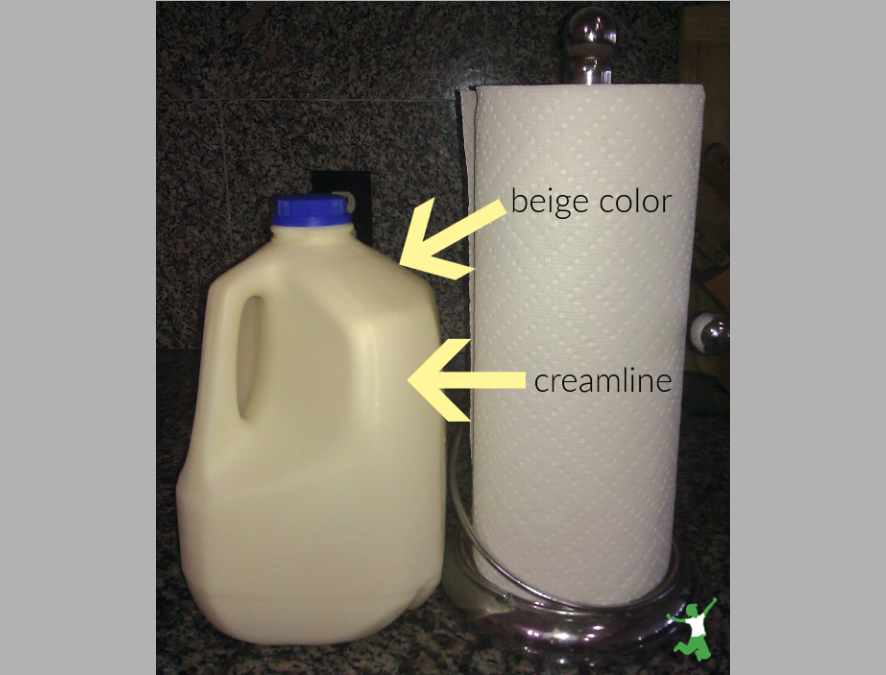
The milk, which has been an off-white color since the first Autumn frost is suddenly beige!
I wasn’t the only one who noticed…
Within moments, a Mom asked the farmer if there were any extra gallons available. This is in addition to the 19 she was already picking up for herself and two other families. She got lucky and snagged 3 additional gallons.
Of course, the large creamline is also beige from spring-fed milk.
Deep Yellow Butter
Butter churned from the cream separated from the milk of cows eating spring grass is a deep yellow unmatched by any “grassfed” brands at the store!
Some brands have such pale butter that manufacturers add “all natural” annatto food coloring. This makes the butter an unnatural yellow which can fool consumers.
Real Butter contains natural, fat-soluble activators including the elusive K2 that supercharges mineral absorption and synergizes the body’s utilization of Vitamins A and D.
This is the same type of butter that people living in isolated Swiss villages prior to World War II revered. They placed wicks in it and burned it on Church alters as a grateful offering for the healthy, cheerful, and intelligent children that were born to parents that consumed it.
I myself make homemade raw butter from spring cream and stock my freezer so it’s available year-round for my family.
A friend texted me just yesterday to tell me she had finally taken the plunge and made her own raw spring butter for the very first time and that she “couldn’t stop eating it” 😋.
These musings about spring butter don’t mean to suggest that fully pastured butter the rest of the year isn’t fantastic too. It’s just extra special in the spring!
So find yourself a local farm and sample the flavors and nutrient density of spring grass for yourself.
Has the wonder of rapidly growing spring grass returned to your farmer’s pastures yet? If not, it probably will be very soon!
More Information
Why “100% Grassfed” Doesn’t Always Produce the Safest, Most Nutritious Raw Milk



Hi Sarah,
What do you use for a cream separator? And what do you do with the leftover skim milk?
Thanks,
Jackie
A turkey baster works very well. A2 milk from cows on grass has so much cream, that even if you take some off, it still has more cream than the A1 Holstein milk in the stores. In other words, taking some cream off A2 milk doesn’t really make it skim at all. It is still whole milk by comparison to A1 milk which has almost no cream at all.
Hi Sarah,
I actually invested in a cream separator. It made sense because in one week it’ll pay for itself. So now the only thing I can think to do with the milk is making cottage cheese with it. Do you have any other suggestions?
Thank you,
Jackie
how long does raw butter last in the fridge?
Do you know of any farmers who would ship their butter from grass-fed cows? I’d love to stock up!
Thank you!
Hi Karen, contact the Weston Price Foundation (westonaprice.org) and have them send you a copy of their 2011 Shopping Guide. There are MANY small farms that would love to mail order you some fantastic, dark yellow grassfed butter! Alternatively, if you join the Weston A. Price Foundation as a member, you will get a quarterly copy of Wise Traditions Journal which also lists small farms that mail order in the back section.
I recently found a source for raw jersey milk 🙂 I was questioning the farmer about their feeding practices and was surprised by the answer. The cows are on pasture (except winter) and are predominantly grass fed, however the cows do get some grains during milking as apparently the protein improves the milk quality and the cream is richer. The farmer also said that when the grass starts to grow in spring, because of it’s high water content, it decreases the milk quality or yield. This seems to be the opposite of what wapf teach. So I’m a bit confused. Any insight??
I will be getting some more milk in a couple of weeks so I look forward to seeing the difference 🙂
Also, I can’t get raw butter but do get cream. I don’t really have time to be making butter but would eating the cream give the same benefits, just in less concentrated amounts?
Hi Sarah,
I do not have access to raw (the law prohibits it here), grassfed butter. Only organic, cultured. Is it still good and should I eat a lot of it or should I not bother?
Thank you
Alina
We are eagerly awaiting for our grass to grow a bit more. The cattle are finding something out here, but I haven’t noticed it yet in our milk. Last year’s butter was a crazy deep yellow color. People were amazed by it. So can’t wait for the warmer weather and grass growing season.
I’m so jealous of all of you! In Iowa, it’s still illegal to sell raw milk. I do get milk that’s vat pasturized, grass-fed cows, non-homogenized but I would LOVE to be able to get raw milk! Sigh! I know the subject was supposed to be debated here recently but it got pushed aside. I’d also LOVE to live close to some Amish folks. Maybe someday!! Love your webiste!
The Amish farm where I get my fresh milk and butter (and sometimes other goodies- their cottage cheese tastes like mild cheddar!) freezes their butter and sells it that way with the date marked on the lid. I think it’s wonderful, because I only found them in late autumn, but I still have a decently steady supply of gorgeous dark yellow butter.
They also have a table in the shop that displays flyers from the Weston A Price Foundation and a (beat up) copy of Nourishing Traditions. There’s a self pubbed cookbook written by two Amish families that has recipes such as sourdough pasta, and they sell their own kefir, sauerkraut (made with the NT recipe), beet kvass, and so on.
This will be my first spring drinking raw milk, and I’m so excited! 🙂