
Soy a Big Fat Zero for Menopause Symptoms

by Sarah, The Healthy Home Economist on November 26, 2011


Are you a woman who eats soy, drinks soy milk, or takes soy isoflavones as a supplement thinking it will help you with hot flashes, night sweats and other inconvenient and uncomfortable menopausal or perimenopausal symptoms?

As it turns out, the risks of soy to your hormone health are significant.   It is not the middle aged health panacea for women that is is promoted to be – not by a long shot.

Studies show that even small amounts of unfermented soy (45 mg isoflavones – a bit more than a single cup of soy milk) have the potential to disrupt female hormonal balance.

“Women taking soy isoflavone tablets to alleviate hot flashes and prevent bone loss at the time of menopause might want to reconsider,” says Silvina Levis, M.D., the director of the osteoporosis center at the University of Miami’s Miller School of Medicine.

A recent study published in the August 2011 issue of the Archives of Internal Medicine examined 248 menopausal women over a 2 year period to see if 200 mg of isoflavones per day were a help in alleviating the symptoms of menopause including bone loss.

200 mg per day is equivalent to twice the highest intake through food sources in typical Asian diets.

At the end of the 2 year period, women taking a placebo versus women taking the isoflavone supplement showed no differences in bone loss or menopausal symptoms such as hot flashes and night sweats.

In fact, nearly half (48%) of the women taking isoflavones experienced hot flashes compared with just 31% of women who took the placebo!

Yes, you read that right.  Soy actually makes hormonal problems worse, ladies!

Studies Showing That Soy Messes Up Your Hormones

Soy Wake Up Call #1:

A 1991 study found that eating only 2 TBL/day of roasted and pickled soybeans for 3 months to healthy adults who were receiving adequate iodine in their diet caused thyroid suppression with symptoms of malaise, constipation, sleepiness, and goiters (Nippon Naibunpi Gakkai Zasshi 1991, 767: 622-629)!

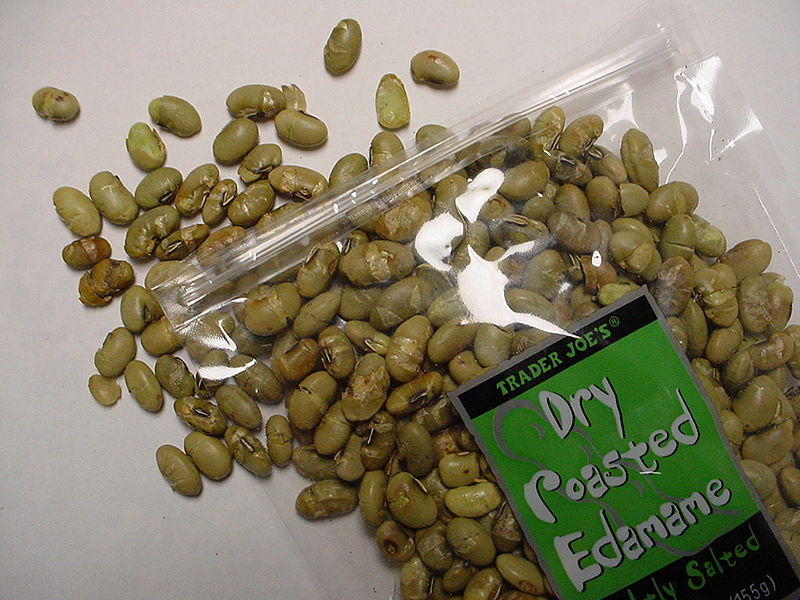
Still think munching on edamame is a healthy habit?

Soy Wake Up Call #2:

Six premenopausal women with normal menstrual cycles were given 45 mg of soy isoflavones per day.  This is equivalent to only 1-2 cups of soy milk or 1/2 cup of soy flour!   After only one month, all of the women experienced delayed menstruation with the effects similar to tamoxifen, the anti-estrogen drug given to women with breast cancer (American Journal of Clinical Nutrition 1994 Sep;60(3):333-340).

Soy Wake Up Call #3:

Dietary estrogens in the form of soy foods were found to have the potential to disrupt the endocrine system with the effects in women similar to taking the breast cancer drug tamoxifen (Proceedings of the Society for Experimental Biology and Medicine 1995 Jan;208(1):51-9).

Soy Wake Up Call #4:

Estrogens consumed in the diet at low concentrations were found to stimulate breast cells much like DDT to increase enzymatic activity which leads to breast cancer (Environmental Health Perspectives 1997 Apr;105 (Suppl 3):633-636).

Soy Wake Up Call #5:

The soy isoflavones genistein and daidzein appear to stimulate existing breast cancer growth indicating risk in consuming soy products if a woman has breast cancer. (Annals of Pharmacotherapy 2001 Sep;35(9):118-21).

Soy Wake Up Call #6:

Direct evidence that soy isoflavones genistein and daidzein suppress the pituitary-thyroid axis in middle-aged rats fed 10 mg soy isoflavones per kilo after only 3 weeks as compared with rats eating regular rat chow (Experimental Biology and Medicine 2010 May;235(5):590-8).

Soy Bottom Line

In conclusion, soy messes with your thyroid and disrupts the delicate balance of breast tissue and it doesn’t take very much soy at all to start the snowball down the hill to hormone imbalance with only a cup or so of soymilk per day representing a significant risk.

Think you don’t eat much soy?

Next time you go shopping, just for grins check the label on everything you buy.

Surprise! Soy is in EVERYTHING!

If you eat processed foods, you are eating soy, and probably a lot of it even if you don’t drink soymilk or eat soy protein bars.

If you want to avoid soy and the hormonal problems it inevitably brings, avoidance of processed foods is the crucial step you must take.

If you are still unconvinced and need more information, click here to view the over 170 studies on the adverse effects of soy isoflavones from 1950-2010.


Sarah, The Healthy Home Economist

Source: Soy No Help for Hot Flashes, Bone Loss

Studies Showing Adverse Effects of Soy Isoflavones

Picture Credit


The Healthy Home Economist by E-mail


{ 61 comments… read them below or add one }

HealthyHomeEconomist (@HealthyHomeEcon) (@HealthyHomeEcon) (@HealthyHomeEcon) (@HealthyHomeEcon) (@HealthyHomeEcon) November 26, 2011 at 11:47 am

Soy a Big Fat Zero for Menopause Symptoms — The Healthy Home Economist http://t.co/HvhxUH1x

Reply

Robyn March 2, 2013 at 11:19 am

Great article! So, just to clarify, soy in its pure form of raw edamame, is BAD, and Only forms of soy that are fermented, are GOOD?

The reason I ask, is because I was told that just processed soy was bad, so that meant that I could still eat soy that was NOT processed (or so I thought).

Please help! I have a freezer full of edamame that claims to be non gmo. Should I toss it?

Reply

Sarah November 26, 2011 at 11:56 am

I don’t understand how something proven so many time to be bad for you can be so prevalent in the food supply. Is soy easy to grow in bad soil therefore greater profits?

Reply

Sarah, TheHealthyHomeEconomist November 26, 2011 at 12:04 pm

It’s cheap, cheap, cheap. Soy protein is also the discarded, garbage byproduct of producing soy oil which is used in fast foods and processed foods galore. Why throw it away when you can convince people that it’s healthy and put it in everything and make boatloads of corporate profits doing so?
Sarah, TheHealthyHomeEconomist\’s last post: Soy a Big Fat Zero for Menopause Symptoms

Reply

Heather November 26, 2011 at 12:39 pm

It’s also a big market for Monsanto. I don’t remember exactly but I believe over 90% of the soybeans grown in the US were GMO.

Reply

Lori @ Laurel of Leaves November 26, 2011 at 2:54 pm

I believe I learned recently that there are NO non-GMO soy crops left in the States. For that reason alone I would want to avoid it!
Lori @ Laurel of Leaves\’s last post: Eggs & Greens: A Fast, Easy, & Nourishing Breakfast

Reply

Erin Bennett via Facebook November 26, 2011 at 1:04 pm

This is completely wrong. I have been taking and using soy for about 10 years and it has completely gotten rid of my menopause symptoms. I no longer have night sweats or hot flashes. But let me be off soy for a week and they come back with a vengeance. My understanding has always been that soy only works for 1 in 4 woman and I thank God that it works for me.

Reply

thehealthyhomeeconomist via Facebook November 26, 2011 at 2:00 pm

Soy doesn’t work for anyone. Are you going to argue with 170 studies? Buddhist monks have used soy for centuries to reduce testosterone levels to reduce libido. The hormone disrupting effects of soy have long been known for centuries. I would really be concerned about your long term health given what you are doing.

Reply

Gabriella Iacobone via Facebook November 26, 2011 at 2:18 pm

It may “work” to reduce your symptoms, but it’s not good for your body (unless the soy you’re consuming is miso and soy sauce.)

Reply

Lori @ Laurel of Leaves November 26, 2011 at 2:57 pm

Good point Gabriella. Just like synthetic medications may “work” to relieve symptoms, but they are taking a much bigger, long-term toll on the body.
Lori @ Laurel of Leaves\’s last post: Eggs & Greens: A Fast, Easy, & Nourishing Breakfast

Reply

Erin Bennett via Facebook November 26, 2011 at 4:00 pm

It works for me because every time I go without it, the symptoms flare up. I don’t need a study to tell me that. And I’ve known too many “studies” to be lies pulled together to get people to do something that the corps want them to do instead of what they are doing.

Reply

Judy Lumbardy Keller via Facebook November 26, 2011 at 5:19 pm

Soy that has been genetically modified and chemically processed is not safe but like all products there is no truth that it is not a wonderful healthy food when processed and grown the right way – supported by thousands of studies. Know your company and product through research – an amazing health food myself, family and friends could not live without!

Reply

thehealthyhomeeconomist via Facebook November 26, 2011 at 6:29 pm

@Gabriella – yes fermented soy (miso, tempeh, natto and traditionally brewed soy sauce) in small amounts is fine. But “small” being the operative word here – unless of course being hypothyroid is your goal.

Reply

Barbara LaRosa via Facebook November 26, 2011 at 8:50 pm

Studies are too conventional for me-internal medicine usually promotes the pharmaco mafia. Hot flashes are caused from a variety of reasons, using only soy is too simplistic.

Reply

Barbara LaRosa via Facebook November 26, 2011 at 8:55 pm

Every home needs a boimat, FDA registered medical device.check my FB info for my web-site.

Reply

Kelli November 26, 2011 at 9:24 pm

Also most soy is genetically-modified so it should be avoided anyways.

Reply

Jess November 26, 2011 at 11:40 pm

Can you wirte ab article like this on the impacts of soy consumption for men so I can show my Dad? He eats so healthy, but he loves soy milk in his tea. I have no idea how to explain to him that it’s not a healthy option!

Reply

Sarah, TheHealthyHomeEconomist November 27, 2011 at 9:09 am

Yes, I need to do this! I wanted to cover the dangers of soy for boys/men in this article but it would have been way too long.
Sarah, TheHealthyHomeEconomist\’s last post: Soy a Big Fat Zero for Menopause Symptoms

Reply

Beth November 27, 2011 at 12:23 pm

And for young girls too please. I know folks giving children soy milk and even soy peanut butter to replace peanut butter due to peanut allergies. Thanks for all the great info Sarah!

Reply

Julie November 27, 2011 at 12:34 pm

What do you recommend for hot flashes and night sweats?

Reply

Jill November 28, 2011 at 9:13 am

Maca root (I use powder, but it is also available in other forms) is used by many people with good results. I started using it a couple years ago when I started having hot flashes and either it was a coincidence, or it really worked because I haven’t had any since. Maca root is supportive to the endocrine system in general, so it helps with things beyond menopause symptoms, such as fatigue.

Reply

Jenn November 27, 2011 at 1:47 pm

While I’m generally a fan of your newsletter and articles, I find your evaluation of soy a bit sensationalist. For instance, numerous studies have found NO effect on serum thyroxine levels, and the most studies examining the “hormonal” effects of soy have found that risks for estrogen-sensitive conditions are DECREASED with soy. I completely agree that GM soy should be avoided, but soy IS a healthy food when consumed in food-like amounts. While some early studies did suggest that soy was thyrosuppressive and may increase the risks of breast cancer, etc., these findings were not replicated. The only caution is that iodine intake must be adequate.

What are your thoughts on these studies?

http://www.ajcn.org/content/93/2/356.short
http://ebm.bmj.com/content/15/2/55.extract
http://www.ncbi.nlm.nih.gov/pubmed/16571087

Reply

Sarah, The Healthy Home Economist November 27, 2011 at 3:08 pm

If you call 170 studies sensationalist, then I would suppose that there is no convincing you! LOL

Reply

Jenn November 27, 2011 at 4:30 pm

Do you have a list of these 170 studies? Are they in-vitro or in-vivo? I’ve extensively reviewed soy research, and most well designed research does not support claims that it is dangerous. Phytoestrogens, like those found in soy, are estrogen modulators. In other words they will reduce estrogen dominance in high estrogen environments, and help to reduce estrogen deficiency when receptors are empty. I don’t advocate for using processed soy products like TVP, but I certainly haven’t seen any compelling research that would convince me that soy, as a FOOD in moderation, is unhealthy.

I understand that we are on opposite sides of a fence here, but there are many more studies in favour of soy than there are against. If you’re going to cite studies arguing that soy is unhealthy, you owe it to your readers to present the other side of the story as well.

Reply

Sarah, The Healthy Home Economist November 27, 2011 at 4:46 pm

Yes, see the link at the end of the post to click through.

Reply

Jenn November 27, 2011 at 7:24 pm

Yes, but that’s not representative of the bulk of research. It’s very selective, and very biased. Did you look at the links I posted? Any thoughts? I would be curious to hear them.

As for the research cited on the WAP site…

1. Much of it is animal research, not human research. And, the doses used were much higher than what one would consume with food.
2. Some studies are simply stating the presence of phytoestrogens in urine and/or blood. That doesn’t mean much, especially since soy increases SHBG. Just because you can measure something doesn’t mean it’s biologically active. In fact, it may be more likely to be inert due to the SHBG effect.
3. Most human research looking at food doses of phytoestrogens have NOT shown any measurable biological activity. Sure, undesirable effects can be induced, but that can be said for almost any substance.

What are your thoughts on the phytoestrogen content of flax, lentils and other beans?

Denise Burnsbu November 27, 2011 at 2:31 pm

@Julie, I started last spring experiencing hot flashes and night sweats with insomnia added in for all around fun. Probably 3 months of the nighttime issues, 6 weeks of hot flashes. In June, I started to take moringa olifera via Zija International. Dr. Russ Bianchi formulated the product; he spoke at the Weston A Price conference earlier in November. (Knowing that the Foundation had vetted him before inviting him to speak was what pushed me into taking the product.) I noticed about 4 weeks into my daily consumption of Zija that my menopause symptoms were all gone. I ran out of powder mix in August and went for a week w/o taking a daily dose and the hot flashes returned. Back on the product, they were gone and I will not run out again!

I did not anticipate the moringa would affect my menopause symptoms at all; I was taking it more for some wrist joint pain that has bothered me since the birth of my last child four years ago. Realizing the hot flashes were gone was literally like the “light bulb” moment for me. Such a welcome surprise and relief. The joint pain disappeared, too. Bonus!
Denise Burnsbu\’s last post: Happy New Year!

Reply

Julie November 27, 2011 at 4:47 pm

Thanks Denise. I plan to read up on the moringa Olivera which you mentioned. I had not heard of it before.

Reply

Erin Romero via Facebook November 27, 2011 at 2:40 pm

@Erin Bennet, you might believe that it is working for you but I’d be weary of what else it is doing to your body. Soy contains high levels of aluminum that is toxic to your body. About 90% of soy is genetically modified today in our world and if you do not know the effects of GMO’s, I’d suggest that you research it for yourself and not from Monsanto’s own website. Soybeans are also very high in phytic acid and can block the absorption of many beneficial vitamins and minerals to you body. It also hampers your digestive system and if you didn’t know, our digestive system controls about 80% of our immune system. I would also recommend getting your Vitamin D levels checked, your thyroid checked and your B12 levels b/c soy affects all of these areas of health as well. I could go on but to summarize, I would pay attention to your whole self and not just the fact that you believe the soy has taken away your hot flashes. What else has it been doing to your body?

Reply

Erin Romero via Facebook November 27, 2011 at 2:41 pm

Oh, and yes, soy also causes men to have manboobs! Thats a fact!

Reply

Jill November 27, 2011 at 2:57 pm

I have a soy story to tell. Last year there was a new MLM that a lot of people were getting into. It was a company that sold long term food storage. For $3.00 shipping they sent you 6 servings of food to try out. When I got them they had soy textured veg. protein in them. I had one serving, just one. Two days later I started getting PMS symptoms and a week later I started my period! You might not think that strange except because of menopause I hadn’t had a period for 6 years! It was terrible, I knew soy was bad for you but I didn’t think one serving would mess me up that bad! I am very careful about eating soy now, thank goodness I only had a period the one time.

Reply

Sarah, The Healthy Home Economist November 27, 2011 at 3:14 pm

It doesn’t take much soy to induce hormonal imbalance particularly in children. It’s amazing to me how many people continue to cling to the industry propaganda on this despite overwhelming evidence to the contrary.

Reply

Erin Romero November 27, 2011 at 3:21 pm

I’m going to repost here what I posted on FB:
@Erin Bennet, you might believe that it is working for you but I’d be weary of what else it is doing to your body. Soy contains high levels of aluminum that is toxic to your body. About 90% of soy is genetically modified today in our world and if you do not know the effects of GMO’s, I’d suggest that you research it for yourself and not from Monsanto’s own website. Soybeans are also very high in phytic acid and can block the absorption of many beneficial vitamins and minerals to you body. It also hampers your digestive system and if you didn’t know, our digestive system controls about 80% of our immune system. I would also recommend getting your Vitamin D levels checked, your thyroid checked and your B12 levels b/c soy affects all of these areas of health as well. I could go on but to summarize, I would pay attention to your whole self and not just the fact that you believe the soy has taken away your hot flashes. What else has it been doing to your body?

Oh, and yes, soy also causes men to have manboobs! Thats a fact!

Thanks Sarah for continuing to provide great information that will not only impact our health immediately but our long term health as well!

Reply

Sarah, TheHealthyHomeEconomist November 27, 2011 at 4:52 pm

This blog is a no man-boobs zone! Thanks for posting Erin!
Sarah, TheHealthyHomeEconomist\’s last post: Farmstead Meatsmith Releases First Instructional Video

Reply

Denise Burns November 27, 2011 at 3:26 pm

Here’s a website with independent third party research into the nutrient density of moringa:

http://www.researchmoringa.com

When the body receives pure and true nutrition, all sorts of problems correct themselves.
Denise Burns\’s last post: Happy New Year!

Reply

Indygrl (@indygrl4u) November 27, 2011 at 3:30 pm

Soy a Big Fat Zero for Menopause Symptoms — The Healthy Home Economist http://t.co/hugDqScU

Reply

Annette K. Scott November 27, 2011 at 5:55 pm

Thank you Sarah for gathering so much evidence from so many sources! I will be re-posting and sending this forward to a couple vegetarians friends so that they too can see why they want to drop the soymilk…thanks again.
Annette K. Scott\’s last post: Before You Eat that Chicken or its Egg…

Reply

Jill Nienhiser (@farmfoodblog) (@farmfoodblog) November 27, 2011 at 6:25 pm

Soy a Big Fat Zero for Menopause Symptoms — The Healthy Home Economist http://t.co/1gmvz7Nh

Reply

Mikki November 27, 2011 at 7:20 pm

I did the whole soy thing during my 40′s and early 50′s for perimenopause and menopause symptoms. Can’t say that it really helped but it was what we were told to do. Now I am taking thyroid meds for the hypothyroidism I developed. Any link here? Maybe. I’m off all soy now except the occasional miso soup and other goitergens like raw cruciferous veggies. Cook your cruciferous veggies girls! Guys too!

Reply

Suzanne November 27, 2011 at 8:43 pm

Also read Kaayla Daniels’ great book, The Whole Soy Story and check out her blog, http://blog.wholesoystory.com/

Reply

Bonny November 28, 2011 at 1:39 am

Hi Sarah,
I understand that Sally Fallon does not recommend prenatal vitamins, but what is your thought on prenatal vitamins made from cultured organic whole foods and probiotics that also contain fermented soy? Do you think the soy would be dangerous?

Reply

Sarah, TheHealthyHomeEconomist November 28, 2011 at 9:49 am

I never took prenatal vitamins for any of my 3 pregnancies. I just relied on whole foods. I did take cod liver oil with 2 of my pregnancies. I wouldn’t take any soy at all while pregnant, just my opinion. Pregnancy is very very hard on the thyroid which is one reason why women have all kinds of weight issues after having a baby where they never did before. Soy is goitrogenic even if fermented so I wouldn’t be going near that with a 10 foot pole.
Sarah, TheHealthyHomeEconomist\’s last post: Monday Mania 11/28/2011

Reply

Inherent Organics (@InherentOrganic) November 28, 2011 at 6:41 am

Is Soy the health product you think it is?http://t.co/a5lFzzum

Reply

Emily November 28, 2011 at 1:45 pm

Amen, amen, and amen. I have even heard that Asian people don’t consume nearly as much soy – and usually it is fermented, like miso – as the vegan crowd believes.
Emily\’s last post: Homeschooling

Reply

BH2 Austin (@BH2atx) November 28, 2011 at 4:42 pm

Soy a Big Fat Zero for Menopause Symptoms — The Healthy Home Economist http://t.co/zFibKk7U

Reply

WordVixen November 28, 2011 at 8:16 pm

My aunt and uncle came up to visit from out of state a few months ago. I was listing the problems with soy to my mother, and in the middle of my list, my aunt’s jaw dropped and she asked me to repeat myself. Turns out she’d been taking soy for her hormones (post menopausal) and had begun experiencing hot flashes again. I don’t know if she stopped taking it or not, but I know she started thinking about it.
WordVixen\’s last post: Disney World Resort Refillable Mugs

Reply

Anonymous December 28, 2011 at 12:16 am

Wow.. we live in a crazy world.

Reply

Jen January 23, 2012 at 4:34 pm

Thanks for the excellent post on soy and the dangers therein.
I am estrogen dominant and recently quit taking microgestin, which was being used as an HRT. I am now using natural Progesterone cream and have been for the past two months. Do you have further recommendations regarding balancing my hormones and getting through it successfully? (without caving and running back to the allopath that put me on them in the first place) Also, how long would you imagine it may take to become regulated and what tests should I have done?
Thanks so much for taking time to read this, for your great blog and for sharing your opinion on my query.

Best,
Jen

Reply

Queenie February 7, 2012 at 10:14 pm

Just like what this certain woman had said on her comment that soy had worked on her menopause symptoms and she barely no longer feel hot flashes during night time and she even thinks of it that only works on 1 out of 4 woman who’s been taking soy. You can’t expect that it’ll be effective as it was on other people.
Queenie\’s last post: hair loss in women thyroid

Reply

Irene March 9, 2012 at 4:50 pm

Just trying to understand. I’m not a huge consumer of soy but will eat/drink it occasionally. If soy is so bad for you, why is everyone always saying that women in Asia are so healthy because one of the things their diet includes is soy?

Reply

Ashley April 11, 2012 at 10:26 am

I was heavily into soy in me late 20′s early 30′s. I ended up with menstrual problems and infertility. By the time I realized I was dealing with infertility I had stopped eating soyt but the effects were ongoing. I slowly gravitated to a very WAPF (though I had not heard of WAPF at the time) making my own food but I was still eating lowfat. My menstrual problems lessened with the changes in my diet. I realized that I had gotten underweight and started on a very high (traditional) fat diet. Exactly one month after starting that high fat diet to my great surprise I got pregnant. I continued to eat that way through my pregnancy and had a super healthy and smart little boy.

Ashley

Reply

Diana June 10, 2012 at 6:22 pm

Hi Sara,
I enjoy your articles very much, thank-you for doing so much research on important subjects that I am concerned about but just don’t have the time. This article interests me very much right now because I have recently entered menopause and have to deal with the hot flashs. I have figured out that sugar will generaly bring on a hot sweaty flash very quickly, so even though I have been trying to keep my sugar intake to a minimum, I watch it even closer now. Is there anything else that you would recommend in dealing with the symptoms of menopause? How about an entire article? or do you have one that I may have missed?
Thank-you very much. Diana

Reply

Getting lower back pain relief September 22, 2012 at 3:38 am

great post darling! i especially like the farmer’s market suggestion. it’s one of the few ways to really find out how and where and by whom your food is being grown/raised – small scale, organic, seasonal, pastured.. it’s great! of course, none of this stuff is a given, but like you said – talk to the vendors! and if you’re lucky, you can still have the convenience of getting your veggies, fruit, bread, eggs, meat, and dairy in one place!

Reply

Sherri Miller December 18, 2012 at 10:45 am

Sarah, What do you recommend for hot flashes? I have been having them for about three years now and have tried everything and nothing seems to work! What about tofu is that bad for you?

Reply

Paxton December 28, 2012 at 4:05 pm

Is soy milk bad for someone who is 19 yr old female

Reply

Ashley December 28, 2012 at 4:09 pm

If you ever want to have kids stop drinking soy milk now. Soy is usually GM and GM foods in lab animals cause birth defects and infertility. I suffered infertility for many years. Fortunately I was wise enough to get off of it but it still took many years for my body to heal enough to conceive.

Reply

Paxton December 28, 2012 at 4:36 pm

Okay so soy is bad but what about almond milk

Reply

Ashley December 28, 2012 at 4:51 pm

Soy is the worst because of the GM aspect but almond is not great because of the sugar and other additatives. Try raw milk from grass fed cows or make your own coconut milk (super easy and cheap). Real Food What to Eat and Why by Nina Planck is a great resource on nutrition! I highly recommend it. It is a lot of fun to read and your local library may have it. The key is to eat only what your great grandmother(s) ate. New foods such as imitation milks are generally bad for you.

Reply

Fraidycat December 30, 2012 at 9:03 pm

I think when we use the words always and never we run a risk of making a big mistake. And while you don’t really use those words, and, while I’m sure you wrote this with nothing but the best of intentions – to make blanket statements such as you do, “Soy a big fat 0…) without specifying conventional soy versus organic (non-gmo) soy – fermented versus non-fermented, etc. in the title, is a bit misleading to those skimming headlines. Yes, we’d like everyone to read everything we write, but informational article headlines should not be like those of the Nat’l Enquirer. Nor should one have to delve into the comments to find details that should have been included in the original copy.

Why would you would want to mis-lead anyone on such a subject is beyond me, You don’t seem to be offering any alternative to the soy – just blacklisting most of it outright. One has to go to the comments to find the 1 in 4 women are helped data as well as the fermented info about miso and tofu being helpful.

The book “Estrogen – The Natural Way” is a very well written book and cookbook, backed by doctors (who you wouldn’t think would even TOUCH the subject of non rx for symptoms of anything), and very sound advice as well as the author’s own testimony.

I myself find relief in monthly menses symptoms by dropping sugar and including 1/4 block of tofu and/or miso in my daily diet the week before it starts. I’ve tried just dropping the sugar, and while it helps, it doesn’t seem to be as effective as doing both. Considering many of the symptoms are linked to the drop in estrogen upon the beginning of menses, replacing it naturally just makes sense to alleviate those symptoms.

So, as I begin to enter my late 40′s and peri-menopause, you can be sure I’ll be looking up some of those 250 recipes; incorporating into them my raw dairy (in lieu of the soy milk just b/c I think raw milk is probably a better bang for my buck and I love the taste; and trying to reduce more sugar as I go – in order to avoid the HRT route so many before me took; keep my great health, figure and keep the symptoms to at least a minimum.

You might better serve your regular readers, and anyone just skimming headlines, to be a bit more diplomatic or risk being mistaken for someone with an axe to grind or alternative motives.

Reply

diet plan to lose weight February 4, 2013 at 3:08 pm

Wow, awesome blog format! How long have you been running a blog for?
you make blogging look easy. The total glance of your web site is fantastic,
let alone the content material!
diet plan to lose weight\’s last post: diet plan to lose weight

Reply

Sarah, The Healthy Home Economist November 27, 2011 at 10:33 pm

Mostly animal research? I guess you didn’t look very closely at all at those 170+ studies. Most of the ones I reviewed were human .. and how are they biased? Because they weren’t funded by the soy industry?

Reply

Leave a Comment

CommentLuv badge

{ 1 trackback }

Previous post:

Next post: