
Organic Milk: Healthfood Trojan Horse

by Sarah, The Healthy Home Economist on May 19, 2010


I have a bone to pick with Organic Valley and Horizon.    These companies are pulling to wool over the eyes of the consumer.   By marketing their milk as certified USDA Organic, an ever increasing consumer base willingly buys it paying roughly double the price per gallon of regular, pasteurized store milk.    The truth is, Organic Valley and Horizon’s ultrapasteurized organic milk is really just as unhealthy as regular, pasteurized store milk.

I’ve often thought if I HAD to choose between them, which milk would I select as being better:   regular, pasteurized milk from the store or ultrapasteurized organic milk?    That’s a toughie.   Kind of like choosing to die by lethal injection or by firing squad.    Neither choice is optimal as there is no clear winner.    Both are highly processed milks, both contribute to poor health and chronic illness in general.


Pasteurized Store Milk:  Clearly Not Good for You


On the one hand you have regular, pasteurized store milk that comes from sick, confined cows that are injected with hormones and other drugs.   They are fed unnatural, GMO, pesticide and antibiotic laced feed with no access to fresh green grass.    These cows stand on cement floors their entire lives and usually die within about a year and half.   Incidentally, the true lifespan for a healthy dairy cow should approach 15 years.    Milk from these confined cows NEEDS to be pasteurized as it is loaded with pus and pathogens because of the filth and chronic mastitis they endure.

Ultrapasteurized Organic Milk:   Still Bad for You!
On the other hand, you have ultrapasteurized, organic milk.  A consumer with only partial knowledge of how milk is processed is easily lured into buying this milk because on the surface, it seems so much healthier.  After all, the cows don’t get any antibiotics, steroids or hormones, right?    It’s certified USDA Organic.   Doesn’t that mean something?

While the cows producing organic milk may not be subjected to the drugs and antibiotics used on conventional dairy operations, the milk coming from an organic-industrial complex is even more highly processed.    For example, ultrapasteurized (UHT) organic milk must be subjected to a temperature of 280F for at least 2 seconds  (this compares with standard pasteurization temperature of about 161F).    Such a high temperature results in a product that has extended shelf life and can remain unrefrigerated for up to 6 months in aseptic packaging.

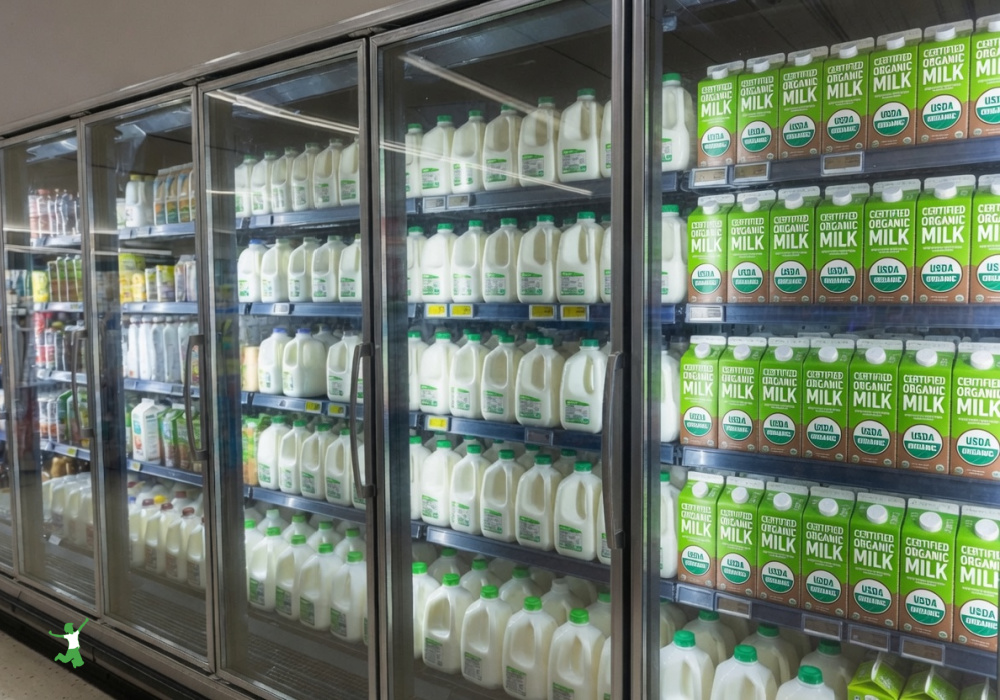
I find it outrageous that Organic Valley and Horizon frequently display their aseptically packaged, organic dairy in the refrigerated section of the healthfood store!   Turns out that consumers (particularly those in the US) are much more likely to be duped into buying organic milk if it is displayed in the refrigerated section.  Buying organic milk unrefrigerated on the shelf goes against intuition and just doesn’t seem very natural, does it?    Moms buy individually sized aseptic packages of Organic Valley milk and put them in their children’s lunchboxes with ice packs!   If they only knew that this milk is so dead that it doesn’t even require refrigeration they might rethink their choice of beverage.

Ultrapasteurization/Auto Immune Disorder Link

Why is ultrapasteurization so bad?  The high temperatures used to ultrapasteurize organic milk damage the fragile milk proteins so completely that the enzymes the body produces to digest them do not work as they no longer  ”fit together” like puzzle pieces.  These undigested proteins then make their way into the bloodstream due to “leaky gut” syndrome, which nearly all Westerners suffer from to some degree.   At that point, the body identifies them as foreign proteins and mounts an immune response, better known as allergies, asthma, eczema and other symptoms of auto immune disorders!  Ultrapasteurized milk cannot even be cultured into yogurt in your own home using a standard yogurt culture and yogurt machine.
This stuff is dead, dead, dead folks.  There is no way that it can be considered healthy even if it is labeled USDA organic.
The enhanced immune response that occurs from drinking ultrapasteurized milk has the potential to lead to milk and dairy allergies pretty quickly.  I remember when my first child was nursing, I drank a lot of  Organic Valley ultrapasteurized milk.  My son spit up so badly during that time that there was some concern that he had a reflux disorder.   Remarkably but not surprisingly, when I stopped drinking the Organic Valley milk, his reflux problem resolved.    I have no doubt that if I had continued drinking this milk and had weaned my son onto it  that he would undoubtedly have a milk allergy today.  Fortunately, I wised up in time to get off that poison!

Trading Drug/Pesticide Residues for Estrogen Mimickers

While a consumer may be reducing his/her exposure to antibiotic and pesticide residues by choosing Organic Valley milk, this is by no means a guarantee to less chemical exposure.  Processors of organic milk frequently heat the milk to the required 270F AFTER the milk is in the aseptic package or plastic jug!

Another option, just as bad, is to fill the package or jug with boiling hot milk that has not yet cooled down! This releases high levels of endocrine disrupting phthalates (the notorious BPA as well as several others) used in the packaging into the milk! Most everyone now knows never to heat food in a microwave with plastic wrap on top for this very reason.    It’s a shame more people aren’t aware of the tremendous endocrine disrupting potential of drinking ultrapasteurized, organic milk!

So, Which Milk to Drink?

As you can see, it is an extremely hard, if not impossible decision to pick which milk is more unhealthy:   regular pasteurized store milk or ultrapasteurized organic milk.   Better not to have to make the decision at all and seek out fresh, safe, healthy whole milk from a grassbased farmer in your local area.    And, if you are fortunate enough to have a source for this type of health giving milk, don’t run out and buy a half gallon of ultrapasteurized organic milk from the store if you temporarily run out of the fresh from the farm variety.    In those situations, it is best to simply go without.   The risks from consuming ultrapasteurized store milk even on occasion are simply too enormous to ignore.


Sarah, TheHealthyHomeEconomist.com

Photo Credit


The Healthy Home Economist by E-mail


{ 94 comments… read them below or add one }

Anonymous May 19, 2010 at 1:02 pm

My kids are living proof that raw whole milk from grass fed cows is much better for you than the junk sold in stores. All my life I was told I had a milk allergy. Asthma and allergies run in my husband's family. I thought for sure my kids were doomed by genetics. I found out about raw milk when my boys were still babies so once they were weaned off breastmilk that is the only kind of milk they have ever had. No sign of asthma or ANY type of allergies even though it supposedly runs in the family. In fact they have never even had an ear infection. All of my brother's and sister's kids, on the other hand, who drink gallons of pasteurized milk because "milk does a body good" have constant problems with asthma, seasonal allergies, eczma, and ear infections.

Reply

Anonymous May 19, 2010 at 2:59 pm

Hi Sarah! I am really enjoying your blog! What do you do if you run out of raw milk for your milk kefir grains? Would you ever use pasturized milk to keep them going until you can get more raw? I have access to a biweekly delivery of raw milk, but often we run out a few days before the next shipment. I often wonder if using store bought milk will compromise my kefir grains. What are your thoughts? Thanks so much! -Clare S.

Reply

SM February 19, 2012 at 1:22 pm

I have sucessfully made Kefir many times from pasteurized milk- both the cheap stuff and the organic variety. All I used was the kefir grains and the so called “dead” milk. It tasted fabulous also. I assume the author has never actually attempted to make kefir from pasteurized milk to make the false statement.

Reply

KW February 28, 2012 at 2:56 pm

The author was clearly talking about ULTRAPASTURIZED milk, not PASTURIZED milk. You are the one who should check your facts.

Reply

SKY February 15, 2013 at 1:56 pm

Being unable to obtain raw, organic milk in my area, I have cultured and am culturing yogurt and kefir on a daily basis using UHT Milk. It has been and is still providing consistently good results.

Reply

Cynthia's Traditionals May 19, 2010 at 3:36 pm

Sarah,
This a great story to SCREAM from the mountaintops. Thank you for making it so clear. I always advise to avoid store milk if fresh, raw is not available. Now I can explain it so much better. Well written with facts and not too much emotion which I know is so hard to do.
Thanks again,
Cynthia in Sarasota

Reply

Rick May 19, 2010 at 4:37 pm

GREAT write-up Sarah!!

Reply

Lana May 19, 2010 at 4:37 pm

You only mentioned Organic Valley and Horizon Organic milk… what about Stonyfield Organic milk? http://www.stonyfield.com/stonyfield/milk/half_gallon/whole_milk/index.jsp

And for that matter their yogurt, etc.?

Reply

Sarah, the Healthy Home Economist May 19, 2010 at 4:43 pm

Hi Lana, the healthfood stores in my area do not carry Stonyfield organic milk .. Horizon and Organic Valley have most of the market share for this type of product. If the Stonyfield organic milk is ultrapasteurized, then yes, avoid it like the plague. Their yogurt is ok .. not as good as what you would make yourself at home with fresh from the farm, grassfed milk but something ok to use in a pinch.

Reply

Sarah, the Healthy Home Economist May 19, 2010 at 5:21 pm

Cynthia, thanks so much for commenting! Yes, this ultrapasteurization thing is so infuriating and so many people have been caught in its web of deception. Hope you can use some of this info with your gang down south of the Bay!

Reply

lou May 19, 2010 at 7:13 pm

ahem sister! great post! it drives me crazy when i see people buying horizon milk at target and think their getting something healthful. you can't trust your government with your health. you must research yourself… ALWAYS. as i heard once…. "uncle sam is not your uncle" :)

Reply

kitchenkungfu May 20, 2010 at 1:46 am

I can't even buy regular pasteurized milk at my local grocery store. Everything is ultrapasteurized. Luckily, I have a source for real milk and can avoid the whole grocery store milk issue!

Reply

Anonymous May 20, 2010 at 4:12 pm

Not all Organic Valley milk is ultra-pasteurized. In our area, the half gallon cartons are, but the gallon bottles are pasteurized. It might be a good idea to check with the company to understand their distribution decisions and look carefully at the labeling before deciding not to drink their milk. We have started to incorporate raw milk from a local dairy into our household, but not all family members are willing to go that route and we rely on Organic Valley to fill in the gaps.

Reply

Sarah, the Healthy Home Economist May 20, 2010 at 6:11 pm

That is great to know that some Organic Valley milk is regular pasteurized now. Perhaps the company is responding to consumer pressure? One can always hope! Thanks for sharing this information.

Reply

Anonymous May 21, 2010 at 3:23 pm

Trader Joe's organic milk is not ultrapasteurized, and I think same can be said of Whole Food's milk. Thank you for your post! It explains why I have problems every time I run out of milk and use the parmalat I keep in cupboard as backup (no longer). Very useful information.

Reply

chaylife May 22, 2010 at 12:46 am

Ultra Pasturized is the ONLY option we have in this area. I was one of those who bought Horizons and Organic Valley because they were "organic". I guess I'll just quit buying milk . . . Not sure what else to do.

Reply

Sarah, the Healthy Home Economist May 22, 2010 at 1:13 am

If ultrapasteurized is the only thing you can get, then yes, it is better to not drink milk! Do you have a healthfood store in your area? Then, ask them to start stocking Natural by Nature low temp pasteurized, nonhomogenized grassfed whole milk. You can also mail order Organic Pastures raw milk from CA. It is quite pricey, to do this, so it would be best to get your local healthfood store to stock a decent alternative.

Reply

Anasthasia April 26, 2011 at 2:59 am
Anonymous May 22, 2010 at 9:05 pm

Hi Sarah, how do you make yogurt at home using raw milk? I have a little yogurt maker… Thanks!

Reply

danielle May 26, 2010 at 1:34 pm

Hi there, this is my first time reading your blogs
We buy milk from a local dairy that is pasturized but not homogonized grassfed cows. It's not "certified" organic b/c the people that run the place said the process the government make you go through to get "certified" is long and expensive. The cows graze – you can see them when you drive to the dairy and the milk is in glass bottles. Even my husband, a skepic of "natural" "organic", etc said it's the best milk he's tasted in years – since childhood.
We drink the 1 1/2% variety, mainly b/c I cannot stomach whole milk. Is that better than the Horion brand from the store?

Reply

Sarah, the Healthy Home Economist May 26, 2010 at 1:36 pm

Yes, yes, yes, Danielle. What you are buying from the farm is infinitely better than Horizon. Probably your farmer is low temp pasteurizing (vat pasteurizing) which is much less damaging to the fragile milk proteins than even regular pasteurization.

Reply

Sam May 26, 2010 at 3:00 pm

This is my first time reading your blog and I find this post very interesting and disappointing since my toddler loves his milk.
We use Meyenberg Goats Milk so taking this away from my 2 year old who drinks two bottles a day will be tough. However it is ultra pasteurized. Would you provide links to research and studies that have shown that pasteurization renders foods dead and has adverse health effects? It seems to make sense but I'd like to read up on this myself to get fully education in my choices for my family. It's such a complex info landscape out here in blog-world. Thank you!

Reply

Sarah, the Healthy Home Economist May 26, 2010 at 4:29 pm

Hi Sam, you can test the deadness of ultrapasteurized milk in your own kitchen. Try culturing it into yogurt with a basic yogurt machine. It doesn't work. If the beneficial cultures in yogurt starter can't do anything with the ultrapasteurized milk to ferment it into yogurt then your body most certainly can't digest it either.

Reply

esther May 6, 2012 at 11:10 pm

I don’t disagree with you that farm fresh is the way to go, but that’s not an option where I live and I make yogurt with organic ultra-pasteurized milk all the time and it turns out great.

Reply

Nicole April 5, 2013 at 11:59 am

Hi Sarah! I too loved your article, but I would like hard facts. You wrote that our bodies have a hard time with the proteins in the ultra pasteurized milk. Do you have a link to any studies for that? Where did you get this information?

Reply

Anonymous May 27, 2010 at 2:56 am

I love informing the public on the government's lack of caring when it comes to food. Another part of the equation is what the cows are feed. I have been looking into milk products for over 1 year because my son has a high gluten intolerance. The cows in the commercial farms are all grain feed and it seems as if those grains are getting into the milk making him sick. Almost 1 out of 100 Americans have a gluten intolerance and don't know it. The gluten intolerance leads to the leaky gut unless they are allergic to the milk itself from the start. Certified organic milk only needs to be 10% grass feed which in turn causes a problem that there is no regulation on how much grain the cows get leading to gluten in the milk making it unhealthy.
That being said my son is highly intolerant to all grains and the only milk he can tolerate is Horizon 2% from our local market because their processing and feeding seem to be totally grain free.
One final comment is I am not sure what you mean by aseptic containers since the word aseptic means to be germ and contaminate free. I am sure the local farmer cleans his containers by placing boiling water in and around them 100 °C (212 °F) which in Fahrenheit is only a few degrees shy of what you said the pasteurization process is.

Reply

Jaime Kae June 8, 2010 at 4:57 pm

Organic Valley offers traditionally-pasteurized milk, but stores seem to stock only the UHT version, probably due to shelf life/consumer demand.

All of Organic Valley one-gallon containers of milk are non-UHT, and they also have half-gallon non-UHT milk. In one part of the country, they sell non-homogenized milk as well.

If you can find full gallon sizes of organic milk brands, they are likely to be traditionally-pasteurized. It seems the half-gallon cartons and single-serve ones are the main culprits.

Reply

Kelsey June 29, 2010 at 11:46 pm

I whole-heartedly agree with this post, although I'm a little dismayed at how unhealthy even organic milk is! I knew it wasn't optimal, and we've been trying to purchase a goat share from a local farmer but it's taking longer than I had hoped, so I thought drinking organic milk in the meantime was okay but I guess I was wrong! We've been purchasing Organic Valley whole milk, and I will stop doing that now and look for a better alternative. I have never been a milk drinker, because since I was an infant I haven't been able to tolerate it, not even my mother's milk. So I grew up not drinking it and not being much of a dairy fan in general, and then when I got married I started cooking with cheese a lot more because of my husband and quickly developed an allergy, which spread to all dairy products! So now unfortunately I am unable to eat much dairy at all (I get hives and with some things my throat swells – yikes!), which led me to my search for raw milk. I hope to start being able to consume it soon and make homemade kefir and yogurt – for now I guess I'll just try to find the least harmful alternative. Thanks so much for all the info on your blog! – Kelsey

Reply

Andrea June 30, 2010 at 5:26 am

Does anyone have any ideas for a milk replacement for my 16 month old? I have had a hard time getting him to gain weight and there are few things he will het, milk being one thing he really loves. We purchase horizon and shamrock organic milk now.

Reply

Sarah, the Healthy Home Economist June 30, 2010 at 9:04 pm

Try to get low temp pasteurized/nonhomogenized whole milk from Natural by Nature if you don't have access to fresh from the farm. Healthfood stores will order Natural by Nature for you if you ask.

Reply

Anonymous August 19, 2010 at 3:39 am

I consistently find ultra pasteurized to go bad extremely quickly. I noticed quickly what the issue was so I quit buying it. I wondered about these choices myself and had come to the same conclusions. Great blogs and site!

Reply

Anonymous August 24, 2010 at 5:26 am

I used to make yogurt with Horizon's ultra pasteurized 1/2 and 1/2 and never had a problem with it turning into super thick yogurt. However, I've read enough bad about Horizon that I made the switch to Trader Joe's organic milk and 1/2 and 1/2.

Reply

Anonymous September 18, 2010 at 4:24 pm

KELSEY, can you give us an update as to how you're doing with raw milk? I know someone with a lifelong dairy allergy as severe as yours (throwing up, hives, potential for throat swelling), and would love to know if there is any hope.

Also, if it's true that any person with allergies has gut dysbiosis, leading to leaky gut syndrome and all the issues that result from that, I wonder if a diligent program of gut healing would ever eliminate a severe dairy allergy. I'm referring to the type of gut healing with GAPS, Body Ecology, etc., with plenty of lacto-fermented foods, bone broth, easily digestible foods, protective fats, and, eventually, ghee or cultured dairy such as kefir.

Is this possible??

Thanks!
Beth

Reply

Sarah, the Healthy Home Economist September 19, 2010 at 12:42 am

Hi Beth, of course you can recover from allergies and yes they indicate gut based immune disfunction. My husband used to be allergic to everything and has the allergy tests from the doctor taken years ago to prove it. He is now allergic to nothing .. how did he heal? Traditional eating for nearly 10 years now and his allergies disappeared one by one until they are now all gone!

Reply

Steph January 8, 2011 at 2:16 pm

Hey Sarah thank you so much for that inspiring story about your husband. My three kids have severe food allergies and my husband and I have been trying for yrs to help their bodies heal.
What did you mean by traditional eating? Also..did he take a probiotic or just drink raw milk? Do you have suggestions for me? Thank you.

Reply

Sarah, The Healthy Home Economist January 8, 2011 at 2:34 pm

Hi Steph, pick up a copy of Nourishing Traditions cookbook. It is a mandatory primer for anyone wanting to learn the traditional preparation methods for cooking. WHOLE FOODS EATING IS NOT ENOUGH. You must prepare your foods traditionally too. Selecting the right food and preparing it wrong (like with grains) can be just as harmful as picking the wrong food from the get go. A probiotic is a great way to go. Our favorite most reliable supplier of BioKult is under the Resources tab at the top of the blog.

Here’s the link to the book:
http://astore.amazon.com/theheahomec0a-20/detail/0967089735

Reply

Steph January 8, 2011 at 4:03 pm

Thank you so much! I really appreciate it.

Reply

Anonymous September 26, 2010 at 10:31 pm

Also, Organic Valley just stopped allowing farmers who believe in raw milk into their consortium. That's sick, IMHO! Raw milk from grass fed cows is the only cow milk that is safe to drink. Otherwise, it's raw goat milk or raw sheep's milk from grass fed goats and sheep.

As much as I like almond milk and coconut milk, they just don't make hot drinks like organic decaf look like it has cream in it.

Reply

Anonymous October 19, 2010 at 11:49 pm

There are enough really good food clubs now in most cities that deliver fresh (raw) milk weekly. If you really dig in to the bowels of research on milk v. pasteurization and how it got started (by the New York City Sanitation Dept.), you will see that it was never justified but something that the Powers that Be simply wanted done. Any pasteurization kills almost all of the good health providing agents in milk…….ultra-pasteurization is even worse. Not only, industrial milk is deleterious to your health due to all of the bad things they add. So none is better. Drink raw, or not at all. If I run out of milk, I use coconut milk. – MM

Reply

Anonymous October 31, 2010 at 8:45 pm

Does these same issues occur with organic butter? Thanks for any info you can give on that.

Reply

Sarah, the Healthy Home Economist November 1, 2010 at 1:28 am

Organic butter should be ok .. I still do not buy Organic Valley or Horizon butter though just for the sake of principle, though.

Reply

sara December 4, 2010 at 4:11 am

There is a brand that our local vegetarian store stocks called KAlona supernatural. I have tried the milk (low-temp pasteurized non-homogenized) and they make an awesome yogurt!

Reply

Sarah December 9, 2010 at 4:58 pm

This is so frustrating. I have been searching for a healthier milk for my family. I want the best for my 4 and 1 year old. Raw milk is illegal in Wyoming, so my choices are limited. There are some locals trying to get cow shares but the ranch is 1.5 hours away. In the winter especially it is not a good choice. Not sure what to do. I don’t like the feeling I’m poisoning us every time I pour a glass of milk.

Reply

Sarah, The Healthy Home Economist December 9, 2010 at 5:02 pm

HI Sarah, can you ask your local healthfood store to order Natural by Nature nonhomogenized, low temp pasteurized whole milk in glass bottles? Usually, if you make a request, they will honor it particularly if you have several families that all ask together and the store knows there is a ready market for this product and it won’t sit on the shelves unsold.
Sarah, The Healthy Home Economist\’s last post: FDA- American Gestapo

Reply

Melanie December 11, 2010 at 1:21 am

Wow – this answers I question I have been wondering for for months! I noticed in the grocery store that the organic half & half has a sell by date is six weeks out, whereas the regular half & half ‘s sell by date is only 10 days out. I tried searching online to figure out why, but I couldn’t find anything. Thank you!!

Reply

David December 15, 2010 at 11:55 am

http://www.kalonasupernatural.com
” Kalona SuperNatural™ uses a process called VAT pasteurization, where a fixed volume of milk in a vat is slowly agitated at 145 degrees Fahrenheit—this process has a uniquely negligible effect on the pure flavor of the milk. Our end product is as close as pasteurized milk can get to farm fresh flavor. “

Reply

Michelle January 11, 2011 at 5:27 pm

It’s sad to hear what my parents do so often misrepresented: my parents own a small dairy farm, and they raise their animals conventionally.

There are twenty-four stalls in their barn and another handful of heifers and dry cows running around in the pasture. Yes, I said pasture. Milk from the store sometimes comes from cows who have seen grass. Apparently, this is shocking news.

Our cows all have names. They all have personalities; we know the personalities because we work with, pet, feed, and even play with these animals on a daily basis. And the oldest in the barn is over twelve with several right behind her.

And yes, they occasionally get treated with antibiotics. Then again, when my aunt was breastfeeding and got mastitis, she got treated with antibiotics, too, because the pain was horrible and the issue needed to be resolved. Surely no one would begrudge her for doing so, but if a cow is treated and her milk is kept from the milk supply, she’s still labeled as a bad, conventional, out-to-kill-small-children cow, just like her owners.

Oh, and one more thing: my parents both work full-time off the farm so that they can afford to run the farm. Which runs at a loss every year. But they–and every other farm family I know–do it because they love it and they believe in the product that they produce.

But thanks for making us look like monsters.

Reply

Anasthasia April 26, 2011 at 3:14 am

I don’t think they are attacking small dairy farms like the one you speak of.
The ones we are trying to avoid are the huge cafo like places that treat the cows badly , where cows don’t see grass, where they stand in their own feces etc. Milk does not need to be ultra pasteurized. That must be a marketing thing b/c I can’t think of why else they would do that.

Reply

Jodee May 30, 2012 at 12:31 pm

Anasthasia,

Please educate yourself. Many large dairies are just as safe and healthy for people and animals and are conventionally run. Our society has removed itself so much from the farm that many people that comment on stories like this only believe and know what has been force-fed to them by media extremists.

Conventional milk and food products are safe and healthy, and the animals are treated very well. It’s always the few “bad apples” that get the majority of press coverage, so consumers tend to automatically group those into a category that covers all conventional production.

And FYI, organic, large or small, confined or allowed to roam anywhere, cows are cows. They don’t care about walking in feces. They are ANIMALS and it’s NATURE. Animals are not human, nor should they be treated as such.

Take a look: http://www.dairyfarmingtoday.org/Caring-For-The-Environment/Pages/CaringForTheEnvironment.aspx

Reply

Sarah, The Healthy Home Economist January 11, 2011 at 5:49 pm

Hi Michelle, your parents are in no way the problem. Hard working families like yours are to be commended and are worthy of great respect. Let’s put the blame where it belongs: with the Organic Valley ultrapasteurization processing. This is what turns the milk from your parent’s farm into such an indigestible allergenic food. Processing is the problem, not the milk from your parent’s farm!

Reply

linda January 13, 2011 at 12:08 am

I live in Japan and have searched and searched for healthy milk. These are the best ones I have found:
1. Raw milk from almost 100% pasture-fed Holsteins — $10 for 720ml (about 3 cups!)
2. Milk from Brown Swiss cows grazed on non-sprayed pasture, pasteurized at 75C (higher than Vat. Pasteurization) — $5 for 1L (4 cups)
3. Milk from Holsteins, partially pastured + fed non GMO grains (not organic though), vat pasteurized at 65C for 30 minutes –$3 for 1 L

I truly can’t afford the raw milk. :( Bought it for my son for a year when he was 2, but had to give it up after cleaning out my bank account! The Brown Swiss milk is almost 100% pastured, but the pasteurization temperature is higher than the Holstein milk, which is only partially pastured. Sigh! WWYD? Giving up milk is out of the question!

Reply

Sarah, The Healthy Home Economist January 13, 2011 at 8:31 am

Hi Linda, Japan is indeed very expensive. I traveled there back in the late 80′s when the exchange rate was something like 200 yen to one US dollar. Do the best you can … cut out every single junk food item in your pantry. An alternative is coconut milk tonic .. 1 quart filtered water, 14 oz whole coconut milk, 1 tsp vanilla, 1-3 TBL maple syrup or coconut sugar. I know you can get whole coconut milk pretty reasonably in Japan so perhaps this would be a way to go some of the time.

Reply

Andree January 24, 2011 at 10:09 pm

Sarah,
I will be weening my 11 month old off of breast milk next month. Would you recommend raw goat’s milk or cow’s milk to take my place? Why? Thanks so much.

Reply

Sarah, The Healthy Home Economist January 24, 2011 at 10:21 pm

I prefer cow’s milk to goat’s milk as goat milk is low in B12 and lacks folic acid. Some say that goat’s milk is easier to digest, but I have not found this to be the case for most people.

Reply

Brittany Lane March 15, 2011 at 1:13 pm

I just looked for raw milk in my area of TN, but have had no luck. I did find two local farms that sell organic free range meat and egss, but at $6 a lb for lean ground beef we cant afford that. :( Really disapointed. I am a stay at home mom so my family lives on one income and this is not affordable for us. I had been giving my son Horizon milk because I was worried about antibiotics, steriods, and the animals being abused. Too bad the milk turns out to be worthless! Now I guess my only option is to decide which horrible milk I want my kid to drink?!? This is so ridicolous that the value and nutritonal content of our food has diminshed to nothing. Very disapointed right now.

Reply

Sarah, The Healthy Home Economist March 15, 2011 at 2:29 pm

Hi Brittany, go through your pantry and figure out where you can cut to afford the good quality dairy and beef. It is worth it!!! You will reap the benefits in way lower medical bills and no need for antibiotics as you and your family will be strong enough to get well with no drugs when you get sick. Get rid of all the processed foods that are in boxes and you will be amazed at what you can save and put toward the great food!

Reply

Nelly March 18, 2011 at 1:49 am

I just discovered this blog and LOVE IT! In our house my husband and I have always been die-hard butter, whole milk, and lard eaters, no apologies. We didn’t know the research, but just felt instinctually that real foods were better than fake foods.

We have been drinking Horizon whole milk for about 10 years. My husband does have a much easier time digesting it than conventional milk. But I am unclear about Horizon being ultrapasturized. My gallon jug says “pasturized.” So am I hurting my family by buying Horizon?

We live two hours away from the nearest health food store, and I simply don’t have access to the natural grass-fed meat, milk etc. that you talk about. My local grocery store has only a few organic products. (I buy them all.) I long for my own milk cow, but farm animals are not allowed in my town:) Sigh. Keep up the great work.

Reply

Sarah, The Healthy Home Economist March 18, 2011 at 9:39 am

Hi Nelly, you may have some milk that is not ultrapasteurized . . I was under the impression that all Horizon organic milk was ultrapasteurized but perhaps they do have a line that is regular pasteurized .. I would call the company to find out.

Even if it is regular pasteurized, it is still homogenized and homogenization oxidizes the cholesterol in the milkfats and oxidized cholesterol is the baddie that is linked to heart disease. I would not drink the Horizon milk regardless. Try to find low temp pasteurized, nonhomogenized milk in your area and ask for your store to order some in if you can’t get it elsewhere. You can always offer to buy the whole case and then freeze it at home. If you offer to buy the whole case, most stores are find with special orders.

Reply

Nelly March 20, 2011 at 2:05 pm

Thanks. One more thing — does freezing change the milk? Will the flavor be the same?

Reply

Sarah, The Healthy Home Economist March 20, 2011 at 2:31 pm

The flavor is the same if you freeze/thaw milk. You should shake it up really well before putting in the freezer to mix the cream up well. Sometimes the cream will not thaw perfectly smooth, but the flavor is most definitely the same.
Sarah, The Healthy Home Economist\’s last post: Video- How to Make Ghee Butter Oil

Reply

Amber March 29, 2011 at 9:10 pm

Where can I get raw milk? My parents used to buy directly from a church member when we were kids but I don’t know any dairy farmers.

Reply

Ron April 19, 2011 at 9:33 pm

I think you should visit a real dairy before you make the comment about sick cows living a year and a half. IT’s just a bald faced lie. Which would I rather have–Rush Limbaugh and Fox News or
articles not researched by people that have never been on a farm.. Death by firing squad–I hope that’s your choice.

Reply

Richard April 20, 2011 at 11:00 am

Living in NYC…what’s a guy to do? My neighbor’s don’t have cows….and raw milk isn’t available in health stores….so I guess no milk for me.

Reply

michael April 22, 2011 at 8:24 am

I didn’t notice any references for this article?

Reply

Rachel May 12, 2011 at 7:54 pm

Canada is great for store bought milk if that is your only option. However, there is no raw milk here as it is illegal. No cow shares allowed either. It is fairly easy for me to get pasteurized non-homogonized grass fed cow milk though. But it costs $12 for 3L as opposed to $4 for the regular kind. In Canada antibiotics in milk is screened and milk containing it can not be sold. Same with growth hormones. There is less estrogen in our milk than in a head of cabbage. I don’t believe many brands are ultra-pasteurized either…

I am curious though, about potential illnesses caused by raw milk and whether the risks outweigh the benefits? Especially if you get grass fed, pasteurized milk?

Reply

carrie May 19, 2011 at 1:59 pm

Thanks for the information! Our 1 year old has a dairy allergy and I’m thinking it is likely correlated to how much milk I had while pregnant (and continue to drink while nursin her). We are planning to try raw milk and I just found a store that provides it. However, in the meantime, I’m wondering if you can comment on Grass Point Farms dairy products from Wisconsin. They are strong about their cows being grass fed, yet I think it has a long shelf life. Please let me know if you have any thoughts.

Reply

Sarah in Portland May 24, 2011 at 2:31 pm

Hi Sarah,
Thank you so much for this article. I am one of those mom’s who buys the refrigerated organic milk at costco. I just checked it & yes indeed it is ultrapasteurized. I know a great source for raw milk – but this is my thing – and please help me out with some advice…. I am a single mom of one & we RARELY drink milk. I personally don’t like the thickness of milk – never had. Within the last couple months, I went to my friends farm & bought a half gallon of raw milk. Our problem was, we didn’t even make it through a 1/3 of it by the time it started turning sour. What would you recommend the best option be for people like us?…
Sincerely,
Sarah in Portland

Reply

Sarah, The Healthy Home Economist May 24, 2011 at 6:58 pm

Hi Sarah, buy the raw milk and put into smaller containers and freeze what you won’t use before it sours. Raw milk is fine frozen and then thawed.

Reply

erica May 29, 2011 at 9:31 am

Richard, I live in upstate NY and there is a farm nearby, Ronnybrook Farm, that sells unhomoginized, low temp pasteurized milk locally. They are supplied in 1 qt glass bottles. I know they sell in NYC at farmer’s markets year round, not sure where, but check their website out: ronnybrook.com. Best milk I’ve EVER had!

Reply

Hilda June 1, 2011 at 10:23 pm

We’ve been buying the Organic whole milk for our kids, but it’s Naturally Preferred brand and just pasteurized. Is that ok or should I be looking for something better?

Reply

Sarah, The Healthy Home Economist June 1, 2011 at 10:25 pm

Plain pasteurized is certainly much much better than ultra-pasteurized … try to find some that is also nonhomogenized and that would be an acceptable compromise.
Sarah, The Healthy Home Economist\’s last post: Monday Mania 5-30-2011

Reply

Hilda June 1, 2011 at 10:56 pm

Thank you for the prompt reply!

Reply

Janet Bravo June 13, 2011 at 12:36 pm

I have Eczema and I am running to the store now to buy raw milk. I’ve always known that food was a direct correlation to my symptoms but I never knew what to eat or how to replace foods. Thanks for “showing me the way” regarding milk.

Reply

Sarah, TheHealthyHomeEconomist June 13, 2011 at 2:08 pm

Hi Janet … you are very welcome! We all have to hang together and help each other as individuals as this stuff is never going to be covered in health magazines or on TV that’s for sure! There’s way too much money to be made with these processed foods!
Sarah, TheHealthyHomeEconomist\’s last post: The Weekly Comment Spotlight

Reply

Natschultz July 15, 2011 at 5:49 pm

Sadly, Stonyfield milk IS Ultrapasteurized! :( Sad, since they are from the Northeast.

Unfortunately, if you live in any urban / suburban area of the US your are basically being force-fed POISON due to government regulations / Big Ag lobbying efforts.

I live on Long Island, NY and in NY Raw Milk is ILLEGAL! So illegal that buying Heroin is easier than finding Raw Milk! (Sadly, I’m NOT kidding).

My local Target has a new “Fresh food market” and their prices are HALF that of the grocery store right next to it. They carry a LARGE assortment of milk – both regular and organic, as well as Rice, Soy, Almond and Coconut. Annoyingly, they sell-out of ALL their Half-and-Half and Organic Milk EVERY DAY! They carry Horizon, but also their own brand of Organic Milk, both regular and with added DHA (Do NOT use the added Omega-3 products – it is made with chemically processed algae).

Honestly, I didn’t look at if their Organic Whole Milk was Ultrapasteurized or not, but based on the use-by date (about a week from purchase), I doubt it. I ran out and they are usually sold out when I get there :( My mother shops at BJ’s Wholesale Club, and normally buys Land-O-Lakes 2% milk and Half-and-Half. L-O-L is LOADED with antibiotics and hormones!!! She has been having sertious heart problems lately, so I convinced her to start eating like me – whole eggs and WHOLE milk, so the other day she purchased “Organic” Whole milk at BJ’s by Earth’s Pride. At first I was excited (no need for separate milk containers in the fridge), but then I saw ULTRApasteurized! EEK!!! It was purchased July 14, and the use-by date is Sept. 3. My NON-Organic Tuscan Whole Milk (made from cows NOT treated with growth hormones / antibiotics) is good until July 19 (purchased July 7).

So, if you live in the Northeast, I have some advice – if you CANNOT get RAW Milk, purchase milk from a LOCAL Northeast Dairy Co-op that says NOT TREATED with Artificial Growth Hormones. Tuscan Dairy Farmers DO NOT use these hormones! Also, Chobani Greek Yogurt comes from Upstate NY dairy cows NOT TREATED with rBST. If there is an FDA disclaimer on the product that says “No significant difference has been found between milk derived from rBST-treated and non-rBST-treated cows” then the product is PROBABLY safe. The FDA is nothing more than a propaganda arm of Big Ag – the FDA has MANDATED that NATURAL products must include a disclaimer that GMO and drugged products are “Not bad.” This is a direct violation of the First Amendment, but Big Ag (Monsanto in particular) has bankrupted MANY farmers and sued states like Vermont and Pennsylvania for trying to regulate and label products containing GMO seeds and hormones / antibiotics.

I’m from the Northeast, and I can assure you that there are VERY FEW INDUSTRIAL FARMS around here! Although the USDA has DECIMATED many rural communities over the past 50 years by “Buying out” local farmers so they would not compete against Big Ag, the few farms still remaining are mostly FAMILY farms that have been in the same families for generations. Just drive around Upstate NY, Vermont, NH and Maine and you will be hard-pressed to find a dairy farm bigger than 250 acres (mostly wooded) and most farmers average about 100 cows – and you can see those cows roaming the pastures EVERY SINGLE DAY! Honestly, the high cost of real estate and extremely HIGH TAXES has actually helped to preserve traditional ways of farming up here – the farmers barely break even, the barns average 200+ years old and many are in poor condition – the farmers survive by joining co-ops with other small farmers and their milk is pooled and distributed throughout the Northeast. Most farmers could never afford to convert their pastures into concrete industrial wastelands and pump the cows full of drugs. It’s more economical for them to keep doing things the way they have been done since before the American Revolution! And, now that people are realizing the negative effects of Factory Faming, I cannot see how the FDA / USDA is going to convince many of these farmers to go the way of Big Ag. Also, under Governor Pataki, a LOT of farmland has been saved and preserved via legislation and tax breaks and such farms must follow very strict environmental regulations, so it doesn’t make sense to go the GMO, polluting direction.

Of course, this ONLY applies to farms in the Northeast, as this land was subdivided and cleared during colonial times (my old house actually had the original stone wall from an old farm running through the woods). Most farmland has now been turned into cookie-cutter developments, but the few farms that remain are still on the same land cleared by the original Settlers. Most Milk from the Midwest (Land-O-Lakes) and California is a WHOLE OTHER STORY! Those farms are giant INDUSTRIAL WASTELANDS as far as “Agriculture” goes! The good thing out West though, is that there are still some small farms, and the laws regarding RAW Milk are not nearly as INSANE as here in NY, so you will have a much easier time getting milk direct from a small farmer out west than if you live in Downstate NY.

Reply

Deceived american July 27, 2011 at 12:14 pm

What? Organic milk doesn’t need to be refridgerated?! The news in this article is APPALLING!!! I recently learned and am still learning of the atrocious practices used by food manufacturing companies for the sake of profit. I switched to organic foods believing that there has to be some good in the world and end up coming across information like this. My head is spinning!! The fact that poison is permitted in our food supplies and vaccines and given to our children with fraudulant, minimal or no testing is outrageous. I’m sad. =( I thought we’d come a long way in America and as humans. I can’t believe that raw milk is illegal. I don’t know what to do. All my life I’ve felt sick and lethargic. Allergies, asthma, ibs, lactose intolerance, appendicitis, stunted growth… My whole family is sick with diabetes 2, hypothyroidism, autism, manic depression, alzheimers, etc. We’re a latin family and msg was a huge part of our diets as well. Now it all makes even more sense. Think I’ll go have me one big good cry. It’s all our fault. I guess vigilance is truly a price we all must pay to move forward. There’s no room for lazy-mindedness where health and survival is concerned if we want the best. Thank you for your great insight and educational information. You’ve truly been a blessing.

Reply

Heather Z. in Cali August 16, 2011 at 5:20 pm

I like articles such as this that give out “information” (quotes because I am only beginning my research and do not take personal articles/stories as fact). What I don’t like about this article is that it is clearly pointed at the authors clear hatred of two companies-Horizon and Organic Valley. Even if all that is said is true, when it comes to something being about one (or two) particular companies vs a whole (and especially when you don’t even do the bare minimum of checking to see what products a company sells and, as you stated, assume they carry only one-UHT milk), I tend to then be skeptic of all “research” and wonder exactly what else was/is assumed. Both companies sell both UHT and regular organic milk. The information about the lack of healthyful benefits of such may or may not be true, but your personal feelings about the two companies came across loud and clear, negating any other facts for me. On to other research….

Reply

Daniel October 11, 2011 at 3:14 am

Where I live (overseas), I only have the choice of local pasturized milk or non-local UHT milk. Until recently I was using the non-local New Zealand milk and French cream because, even though both are UHT, they are from pastured, grass-fed cows. I always ferment both the milk and the cream with no problem, so I am surprised to read the claim that it cannot be fermented. While I may switch to the local pasturized product, I still wonder whether by fermenting the UHT product, I am avoiding most of the problem, particularly because I have not been able to find out much about the locally produced milk (diet, etc.).

Reply

sara in n.cal. October 17, 2011 at 11:23 pm

In northern california, if you would like a good source of milk for making kefir than check out Strauss creamery website. They offer a pasteurized, non homogenized ‘cream top’ organic milk. I do not drink it alone but use it for making kefir and it turns out well. Lot of info. about their pasturization and raising of their cows on website. Of course also available is Organic Pastures raw milk but you will pay twice the amount. I think $ worth it if you drink it alone or for growing children. Happy culturing!

Reply

Amanda December 8, 2011 at 6:58 pm

(I’m reposting my question here because this topic seems more applicable)

I’m probably really late to the conversation here, but I had a question about low-temperature pasteurized (non-homogenized) milk… is it still a big NO-NO? The closest raw milk farms are over an hour one way from where I live, and I’m trying to work out a way to afford buying healthier-than-organic milk without spending a lot on gas too. VERY tight budget these days! Thanks!

Reply

Sarah, TheHealthyHomeEconomist December 8, 2011 at 7:48 pm

I would buy the low temp pasteurized, non homogenized milk and culture into kefir and then drink it. I personally will not drink even low temp pasteurized milk.
Sarah, TheHealthyHomeEconomist\’s last post: Baked Chips as Bad or Worse Than Fried

Reply

S.Marie January 15, 2012 at 10:00 pm

My husband works for Organic Valley, and this thought came over me very recently. Im making my bread and butter from milk I wont even feed to my children! The farmers arent the problem, it s the government making the good raw milk they produce illegal. thats lame!

Reply

amy January 24, 2012 at 2:06 pm

Oh Sarah….I’m always searching for answers on your blog. My newborn is exclusively breastfeeding and she is 8 weeks old. She is having some reflux issues which I thought was rare with breastfeeding. I DO drink a glass of chocolate milk a day (as a treat for myself). I didn’t realize there is an autoimmune response with the ultra pasteurized milk :( I quit drinking raw milk when I was pregnant because I was so scared something would happen :-/ If I start again, can my newborn get sick if I ingest a bug from the milk?
Thank you as always Sarah :)
xoxo

Reply

Catrina February 18, 2012 at 12:03 am

Sarah what is you’re opinion on almond or soy milk as an alternative?

Reply

Heather in Oregon February 18, 2012 at 7:02 pm

I’m very late to this discussion but…
I’m surprised that in so many places the OV milk is ultra pasteurized. Until a couple of months ago we were buying Organic Vally non-homogenized low temp pasteurized whole milk. It was our compromise as we didn’t have a source for raw milk. Then a couple of months ago our local source of the OV non-homogenized stopped carrying it and said that OV was discontinuing it. Since then we’ve been using regular OV which, at least in our area, isn’t ultra pasteurized but still isn’t raw milk. We’re lucky that our OV milk comes from dairies we actually drive by on a regular basis. It’s bottled in Portland which is about 60miles away but we at least know that the cows are outside eating grass most of the time. We did finally find a source for raw milk and will start being able to get a gallon a week from them. We’re really excited! You couldn’t pay me to go back to conventional milk.

Reply

Noahla March 7, 2012 at 5:58 pm

Hi Sarah,
I recently found your site and am trying to incorporate a lot of your ideas into my family’s diet. Thank you!!! I have a question for you. My friend who is a homeopath told me that I should not consider raw cow’s milk as an option because cows have been tampered with so much and even if the cow in question doesn’t get any antibiotics or growth hormones, it’s parents probably did. She also said that over 80% of US cows have bovine AIDS and that the molecules in cow’s milk are too large for our system. She said that goats milk is a better alternative because no one tampers with goats and the molecules in goat’s milk are the right size for our systems. Also, when I told my aunt that we were trying raw milk she was alarmed and told me that the reason for pasteurization was because of TB. Do you know if farms that sell raw cow’s milk have to test for TB or bovine AIDS? Any information you have would be greatly appreciated as I am trying to sort out what is the best for my family!!! I’m very confused! Thank you so much for your time!!!!

Reply

SarahM March 19, 2012 at 11:37 pm

I agree with everything you said here but I would like to point out that your claim that UHT milk cannot be cultured into yogurt is not true. I have done it many times (before I knew better) using both freeze-dried cultures and existing yogurt (several different kinds, so different bacteria were being used). I have even made yogurt out of reconstituted powdered milk.

Reply

Krystal July 4, 2012 at 1:04 am

This is very interesting but very discouraging….my son (3) has a severe dairy allergy, as well as asthma and eczema. Right now he get’s nothing but breastmilk, but once he weans, I will not be able to give him raw milk. I live in Canada and our milk is pretty different than the States: it is illegal to use growth hormone in cows here, so our milk is hormone free, and my organic milk is just pasteurized, rather than ultra-pasteurized, which is the good news. :) However, it is also illegal to buy or sell unpasteurized milk here.

Reply

Lewis July 20, 2012 at 10:35 am

Right on ultra pasteurization is much worse than normal pasteurization. The homogenization is also very bad. It involves pressing the fat through very tiny openings, thus damaging the fats and making them harmful to consume.

I do not trust Organic Valley products at all anymore. They like to market a cheese labelled as ‘raw’, when, in fact, on their own web site, they admit it is actually made with sub-pasteurized milk. I don’t know how they figure sub-pasteurized qualifies to be labelled raw. Other sources I’ve read indicate that even the ‘organic’ milk is often from cows raised in confinement on concrete floors.
Lewis\’s last post: LewisWerner’s Profile

Reply

nedlud July 31, 2012 at 7:49 pm

Organic Valley treated us very badly. We joined them in 2000 and sold milk. We are a very small farm and have a tiny yard that slopes toward an old-fashioned bank barn (barn built into the side of a hill). According to OV propaganda, we are among the types of farm they support and give life to–they continue to brag about this to this day. We milked 20 cows.

In about 2004, they started sending in very LARGE tanker semis to our farm. These semis were a disaster for us. They are enormously heavy and yet because of how they are constructed, have very poor (zero, almost) traction in mud and snow while working on sloping ground. They caused me personally, a great deal of hard work and extreme frustration that was non-existent when smaller trucks with traction were used. The semis ended up doing thousands of dollars in damage to our farm. I complained vehemently about this to Organic Valley and they cancelled our contract, rather than admit to the harm done to us and/or work to correct the problem. We were devastated and forced out of the dairy ‘business’ in 2009 as a result. Maybe many people think small farmers have no right to exist anymore, but I would disagree, I believe we NEED many more small farms. Organic Valley used us. They continue to peddle themselves as family farmer’s friends as part of their promotional gimmickry. It is a lie.

I have continued, since this disaster, to attempt to collect some sort of compensation from them, but in all correspondence they ignore me.

I cannot begin to tell you how much I despise Organic Valley and George Siemon, their CEO.

nedlud

Reply

Steven October 10, 2012 at 4:55 pm

I am very displeased with the very dogmatic attitudes presented here towards milk. The author is basically saying that raw milk is the only tolerable milk, which is simply not true. Many people can tolerate UHT and ultrapasturized milk way better than raw milk, let alone regular pasteurized milk. Many people can tolerate raw milk better than pasteurized milk. The point of my argument is to tell the author to stop being so dogmatic and manipulating viewers. We are all bioindividually different, and some people (including myself) are very sensitive to bacteria, which in the case of milk, varies seasonally, and depends on what the cow is eating. People like me tolerate UHT/ultrapasteurized way better than raw. Am I saying that UHT is the only way? NO, because I am not being dogmatic as the author is and making blanket statements about food and people. I tried raw milk only for two years, and my acne and allergies were still present, despite what all the “milk experts” were saying about how raw milk would cure allergies, etc… That’s a very idiotic claim, and people reading and listening to nutrition advice should take it all with a grain of salt. Its our responsibility as consumers to follow advice responsibly.

Reply

Anthony January 29, 2013 at 11:56 am

No one is stating that everyone’s allergies disappear with raw milk. There have been many cases where that’s true, but it’s not true 100% of the time. I suppose it has to do with the root cause of a person’s allergies, their age, etc. etc. etc.

Also, I’m not sure people’s bodies tolerate UHT and UP milk better than raw milk. Warped protein enzymes and other missing elements from pasteurized milk can absolutely create a lack of lactase in a person’s digestive system (which is why my wife that absolutely cannot drink pasteurized milk can drink a huge glass of raw milk every day), creating intolerence. It may not be for everyone, but raw milk is certainly a source that can only better the balance within that system.

Reply

schlampen October 14, 2012 at 8:57 pm

I have read so many articles or reviews regarding the blogger lovers however this piece of writing is really a pleasant post, keep it up.
schlampen\’s last post: schlampen

Reply

nikiZ February 4, 2013 at 11:50 am

Read your blog and got freaked out about the Horizon milk I’ve started supplementing with my almost 1 year old’s formula. Thankfully we have this alternative available locally and is even sold at our specialty grocers now too: http://www.happycowcreamery.com/About.htm

It’s now in the fridge and aside from being a healthy milk for my little guy to drink, I’m hoping it will cure my recent development of lactose intolerance!

Reply

Leave a Comment

CommentLuv badge

{ 2 trackbacks }

Previous post:

Next post: