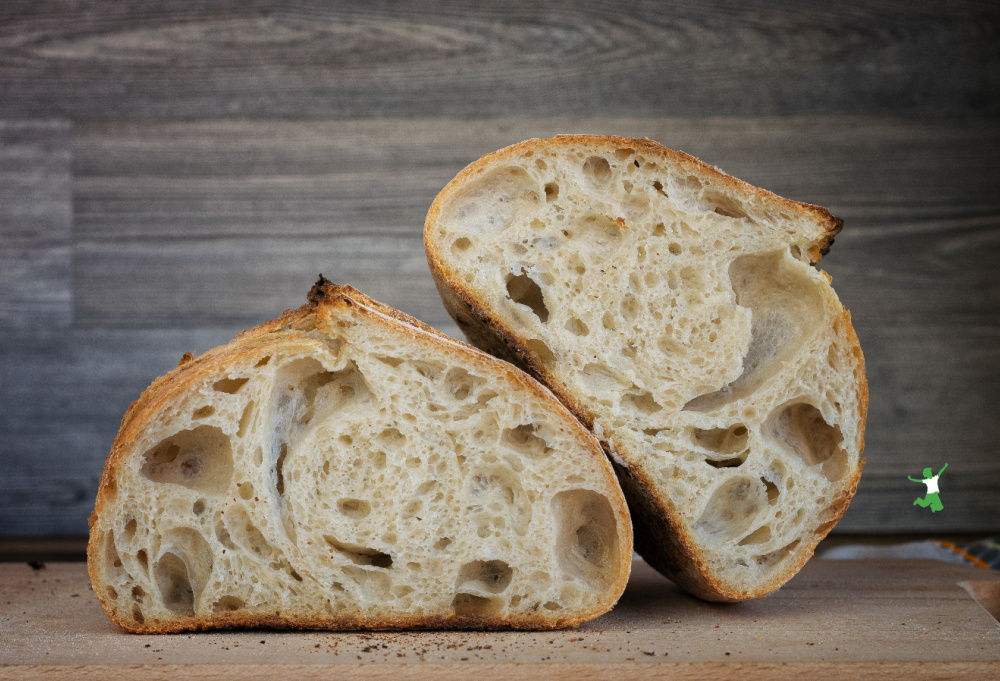

Most breads labeled as “sourdough” on the market today are anything but.
These breads typically contain yeast which is the giveaway clue that the bread is a fake sourdough and should be avoided if one seeks a traditionally baked loaf.
True sourdough bread does not contain yeast and instead utilizes a lactobacilli based starter culture. True sourdough bread is also baked at a lower temperature for a longer period of time which protects the integrity of the cereal grains and preserves the nutritional value. Not only is the nutritional value maintained, but antinutrients such as phytic acid are eliminated and gluten, that very difficult to digest plant protein, is broken down.
When baker’s yeast was first introduced as an alternative to sourdough starters in 1668 in France, it was strongly rejected because scientists at the time already knew that it would negatively impact people’s health.
While yeast is used almost universally for baking breads anymore, the skyrocketing cases of gluten intolerance and celiac disease are causing many to look backwards at how nonindustrialized peoples consumed gluten containing breads with no digestive difficulty.
One study that examined how celiacs tolerate true sourdough bread was conducted in Europe. 17 people suffering from celiac disease were given 2 grams of gluten containing bread risen with either baker’s yeast or a normal lactobacilli culture. 13 of the 17 showed negative changes in intestinal permeability consistent with celiac disease. 4 people did not show any negative changes.
Then, the 17 study participants were given true sourdough bread risen with a special lactobacilli culture able to hydrolyze the 33-mer peptide which is the primary amino acid building block that causes an immune response in people with celiac disease. None showed any negative changes in their intestinal permeability after consuming the bread which was made up of 30% wheat flour and a mix of oat, millet, and buckwheat flours.
The researchers’ conclusions were summarized as follows:
These results showed that a bread biotechnology that uses selected lactobacilli, nontoxic flours, and a long fermentation time is a novel tool for decreasing the level of gluten intolerance in humans.
What I find interesting about the study is that even when the people who consumed the gluten containing bread risen with either baker’s yeast or a normal lactobacilli culture, 4 did not show any negative changes to their baseline values of intestinal permeability. Did these 4 consume bread raised with a normal lactobacilli culture? If so, perhaps even a normal sourdough culture would be sufficient for many celiacs to consume.
Certainly, most with simple gluten intolerance would find true sourdough bread to be easily consumed with no digestive distress.
Clearly, more study on this needs to be done, but the results are incredibly promising.
It seems that the noblemen in the court of Louis XIV of France back in 1668 had it right all along. Abandoning the traditional methods of bread preparation in favor of baker’s yeast would have disastrous effects on people’s health. Little did they know that their wisdom several centuries later would be termed “novel” by scientists in the biotechnology industry!
Sarah, TheHealthyHomeEconomist.com
Source: Study Finds Wheat-based Sourdough Bread Tolerated by Celiac Patients
|
|

{ 60 comments… read them below or add one }
I love sourdough but have never had good success with baking it myself. And as stated in your article, most sourdough bread you buy is not real sourdough. Anyone out there have a good recipe for sourdough dummies like me?
I need this, too!
You should check out the GNOWFGLINS blog! Wardeh just held a webinar about a week ago addressing how to fix common problems in sourdough baking! I registered for it but missed it, so now I have the link to watch it, I just haven’t yet. I believe the blog also has online classes you can pay to take at any time, though. It’s a great resource!
I had problems also. Try this link and his simple sour dough recipe. The main thing I found out about real sour dough is the time. Since using this sites tips and recipes I have never had a sour dough recipe of any kind not turn out perfect. Good luck.
http://www.sourdoughhome.com/index.html
I love the sourdough bread I buy at my local farm though I’d still like to attempt to make it myself.
Can Celiacs Eat True Sourdough Bread? — The Healthy Home Economist http://t.co/9NPG7gH
Thank you for posting this! My daughter is having some issues, and she is currently dairy free (but it doesn’t seem to be helping). She has some symptoms of celiac (praying not!) and her doctor said removing gluten is the next step.
Sarah, I would SO APPRECIATE a recipe of the kind of Sourdough that Celiacs can eat! I MISS my sourdough!!! <3
I always make it a point to confront “artisan” bakers and question how they make sourdough (or any bread for that matter).
check this out: http://www.instructables.com/id/Sourdough-Bread/
I’ve made this sourdough many times,and it always turns out great! It’s a true artisan bread, but can be made into loaves, also
Enjoy!
Sorry- I noticed that the original recipe does ask for yeast- I just leave it out, and my sourdough is fantastic
I also halve the recipe:
1/2 c sourdough starter
1 1/2 c water
3 c flour
1 t salt
Mix and let sit overnight 12-15 hours, covered with damp cloth.
Flip with floury hands in morning, then let rise another 2-4 hours in a greased bowl.
Pour into pre-heated baking dish with lid (400 degrees F) and bake for 30 min with lid ON
Bake for additional 15 min with lid OFF.
Done!
I’m such a scatterbrain… 450 degrees, not 400
Hi Melissa, love the recipe. Have you tried baking it at 350F for about an hour instead of the higher temp 450F for a shorter period of time? This would preserve more nutrients and damage the cereal grains far less.
This sounds easy and simple. I will try this one! Do you mix it first by hand or mixer. i have a Bosch and would love to use it more esp for breads like sourdough. Also what kind of flour do you use for this? Have you tried the 100% hard whole wheat? What is the texture like?
Spelt works great, but whole wheat gives a really dense loaf! Thanks for the advice, Sarah, I’ll give it a try and see how the finished product compares.
I mix it by hand using a wooden spoon. There really isn’t much mixing to do! For the second mixing/flipping, you just use your hands
Oh, if you do make it with a mixer, be prepared for the clean-up- it’s really sticky!
Okay, so I have a question–as I’ve researched breadmaking throughout history, the sourdough that I’ve found (this is only going back to the 1700′s, mind you) is created from wild caught yeast from the environment, rather than any lactobaccilli cultures. So, the question: Where can I find some info on the history of this “true sourdough” that you’re talking about? I’m extremely interested!
This point confused me as well… “didn’t sourdoughs use natural yeasts?”
Indeed: “Sourdough is a dough containing a lactobacillus culture, usually in symbiotic combination with yeasts.” What’s important is giving the lactobacillus time to deactivate the nasties.
You can buy “San Francisco Sourdough Starter” online, which is a powder with lactobacillus and San Francisco’s native yeasts, or just make your own starter using whatever’s in the air. I think /Nourishing Traditions/ has directions.
-james
Lactobacilli is in the air everywhere and on all living things even our skin. So if you make a sourdough culture, it will have lactobacilli in it as well as natural yeasts.
I’ve had a difficult time maintaining a sourdough culture — seems the recipes always call for all of my starter and I have a hard time continuing after that. Like others have said — I’d love a recipe for starter and bread.
True sourdough bread starter does not use yeast. You can catch the wild yeast by using a starter made from whole wheat flour and water. There are some great recipes for both starters and bread online just be sure the recipes do not use yeast
can anyone send me a recipe on how to make this sourdough bread?
I would love to try it.
Thanks
This is a very interesting article because I follow the Know the Cause (Doug Kaufmann, The Fungus Link) diet to eliminate fungus and yeast as the cause of inflammation/disease in the body. The first phase eliminates ALL grain, but eventually you can have true sourdough bread. I’d always wondered why that type specifically was recommended and how to know if it was “true” sourdough or not. This article really clarifies it for me! I’m with all the previous comments that are asking for a recipe for how to make this. If anyone can share this, I’d be most grateful!
Yay! I’m working toward this!
Fascinating to learn that traditional sourdough does not include yeast. It seems the further we get from the traditional food wisdom of our ancestors, the more trouble we get in.
The natural, traditional foods are the best.
Nourishing Traditions has a sourdough recipe in it. But I haven’t tried it yet.
I found out last summer that I am sensitive to gluten AND yeast, so sourdough seems to be a win-win option, I just haven’t had the guts to try it yet. I am planning on ordering a starter, though, and trying it with spelt. Luckily my hubby loves sourdough, so he doesn’t need convincing. Thanks for the post!
I have never been diagnosed but have gluten isseus quite badly. I eat sourdough without issues.
nder if that goes foe Sourdough Pretzels too ??
Tested and didn’t work for me (mental health issues with gluten consumption – not confirmed celiac). I didn’t make it myself though, so perhaps… perhaps. I do better without eating “bread” on a daily basis though, so I’m not too eager to leap into it. One of these days maybe. Options are nice to have…
Yes, we’d love a good, trusted sourdough starter/recipe as well. You’re full of wonderful information Sarah, continual thanks!
I think it’s important to point out that the bread that caused no reaction was made with special culture that I’m assuming isn’t easily available and only contained 30% wheat, which was combined with gluten-free grains. This is great and a very positive finding for those who suffer with celiac or gluten intolerance, but it is NOT a green light to safely start eating gluten-containing sourdough bread. For those with gluten damage, even a small amount causes more damage and for those who have healed, they may not see side affects of damage for a while. I guess while this is exciting news, I’m also cautioning those who have been concerned about possible gluten sensitivities of one form or another (and if you have a compromised gut, gluten is going to be harmful whether you have the genes for celiac or not) to not rush out and start making or buying sourdough without first carefully considering the risks.
Sounds like we all want a “real deal” recipe! For starting a culture AND for making the bread!
I second the cautious approach that Rachel mentions. However, I’m celiac and I personally have been able to eat true sourdough (meaning traditionally prepared, not with yeast) SPELT bread; even though that contains gluten, it’s not wheat and is an older grain. Now, I have only eaten a couple of pieces at a time, and only on a couple of occasions (once was at the WAPF conference) but did not notice any troubles at all with it. No digestive upset, pain, autoimmune issues, etc. I have done a lot of work on my gut, though, and do tolerate more foods than I used to. I still think most grains need to be avoided for a while to allow the gut to heal (a la GAPS) but that traditionally prepared (soaked, soured, fermented) grains CAN be a part of a healthy diet for most people. (Modern grains that lack proper preparation are NEVER a healthy part of anyone’s diet in my opinion)
Amy, thank you for sharing this testimonial!
Now I am searching…how can I become a Sourdough bread purest!
There is no recipe for sourdough starter. It’s flour and water. Period. It sets on the counter until it bubbles and then you feed it again, and it sets for a while longer and then you feed it again. I keep mine in the fridge when I know I’m not going to be using it for a while and I’ve never had a problem yet. It is sometimes in there for two-three weeks between feedings. I never throw away starter either – I use it for biscuits or pancakes or something.
Here’s a web site with some good information, although it is not the one I usually refer people to. I can’t find my information on that other one right now! If I find it, I’ll post it later. But this one has pretty decent advice: http://123basics.com/bread/starter.htm
*Hint: Sometimes I take advice from one site and combine it with info from another site, too. Such as take the recipe from one site and then the storage and use information from another. Make good use of all those blogs out there, ladies!
The sourdough starter looks like a variation of soaked flour. Wonder what would happen using whey and flour?
Ciao, Pavil
My mom has gluten issues and recently began making sourdough. She can only eat it without trouble if she kneads the dough for at least 20 minutes. It has something to do with developing the gluten. I’m sorry I don’t have a reference but she read an online article about it.
Very interesting! Thanks for sharing this tip!
I’m lazy and don’t want to bake my own bread. I’ve been eating Berlin Bakery’s Old Fashioned Sourdough Spelt Bread. The only ingredients are whole spelt flour, water, and sea salt. Sarah, do you think this qualifies as a true sourdough?
I’ve used this one in the past and I really like it.
My sourdough bread recipe is to mix 1 cup of sourdough starter with 1 cup of water. In another bowl combine 2 teaspoons of salt with 3 cups of flour. Combine the two. Cover the bowl and let rise for 8 – 12 hours. Preheat a covered pot in a 350 oven. Grease pot and add dough. Bake for 30 minutes covered and then 30 minutes uncovered.
I learned how to make a starter and bread from a great online course at GNOWFGLINS.com. The subscription is good for a year and she really explained everything in detail with video demonstrations and the science behind it. You have to pour off some starter in the beginning so that the colony of yeast get’s stronger and the yeasts proliferate. I just divided mine and kept a few going at the same time. There were great recipes on the website for using your starter to make cakes and potpies, traditional pita, cookies, etc… There are also other lessons on traditional food prep. That you have access to with the subscription. It really helped me hone my kitchen skills. I bake fresh sourdough bread every week now. It’s delicious!
Good luck out there. It’s worth the effort to figure it out.
Can Celiacs Eat True Sourdough Bread? — The Healthy Home Economist
http://ow.ly/6aE5Y
Thank you for this article, Sarah! I used to make the Nourishing Traditions sourdough with Rye and Spelt ages ago. For about 2 years, I only made that bread, it was so easy. Then I transferred to all spelt. I wanted variety so began sprouting and making regular breads. Since then I have become gluten intolerant and never even thought about trying sourdough again! The key with sourdough is to make sure you wait until the starter is bubbly to use it in your baking. Timing is so key. Do not let it bubble and then go flat again. If you do, you need to feed it again, but don’t make bread with flat starter or else it will not rise. I got rid of all my wheat grains but I still have a huge bucket of spelt so I will incorporate this again! If anything, I remember sourdough being so easy, and I am the only GF one in the family, so at least so the family can have “normal” bread again!
Nickole
Hi Sarah,
Is it ok to eat sourdough if it is made with white flour?
Thanks so much,
Mary
Every line of content is nice and helpful. thanks to Sarah.
I”m sorry to say that this piece is dangerous. From the comments it already appears that people are going to try eating sourdough bread if they have celiac.
I can’t say this clearly enough: even if made by a sourdough starter, bread made from wheat flour still contains wheat. It contains gluten. Sourdough bread will make someone with celiac sick.
A study of 17 people (17 people?!) is not nearly big enough to be statistically accurate for anything. Please, please don’t post something like this unless there is solid science.
Christy, you said that kneading the dough for 20 minutes “develops the gluten.” You’re right. It develops the gluten. Gluten.
It’s possible that those who are gluten intolerant or gluten sensitive might have fewer reactions to bread that is made from sourdough. However, for those who have celiac, only 1/8 of a teaspoon of gluten is enough to damage the intestines and set off the autoimmune reaction. And there are many with celiac who don’t have big outward symptoms. They could now go out and buy sourdough and be making themselves sick after reading this article.
I would love to believe that sourdough gluten bread is safe but, as a celiac myself, I’m not sure I want to find out the hard way. Some celiacs have silent symptoms that don’t affect the bowel but create severe fatigue over time and I don’t want to go back there. :0)
Thanks for all you do Sarah in educating people about real foods.
This is an interesting article, and of course, many of us that are gluten free would love to go back to eating crusty sourdough bread… but is trying it worth the risk? Thomas O’Bryan, MD (thedr.com) describes cases where people who were gluten-free went back onto gluten just to be officially tested for Celiac and then had major health setbacks with irreversible damage.
A big problem is that wheat has been hybridized to contain a LOT more gluten than it did 2000 years ago.
Gluten “intolerance” is not milder than Celiac or less sensitive to gluten, it is just manifesting in other ways. The immune system might not be attacking the gut, it might be attacking the thyroid, the brain, or the skin. And many Celiac’s do not have gut symptoms. For more info, check out the web site I mentioned above. Dr. O’Bryan is gluten intolerant.
Whoops, my fingers slipped! Dr. O’Bryan is a DC, not an MD.
Check out “wheat belly ” on Facebook, Dr. Davis claims it’s wheat that is causing all our health issues, I just purchased his book, looks good:)
One thing to remember here is that the research shows that the bread contains only 25-30% wheat. Using other grains cuts down on the amount of gluten involved. The other part to remember is that the bread needs to sit on the counter to rise for at least 12 hours to allow the Lactobacilli to build up do it’s digesting work. This is also what gives sourdough it’s sour taste.
Spelt could be a good option as it is much lower in gluten than wheat.
Jessie Hawkins at Vintage Remedies will be coming out with a bread book next spring that focuses on sourdough and it’s history. It will discuss the gluten intolerance/Celiac issue and include gluten and gluten-free sourdough recipes.
Thanks for the article, it’s not dangerous to publish these findings, I think it’s dangerous not to, as you said, more work needs to be done, but it’s encouraging – we need hope and solutions beyond the grocery store or the M.D’s. I believe there’s a nutritious way to consume grains because God told Joseph to store grains for 7 years of famine – which saved their lives. Hopefully, we can heal our guts and again enjoy grains in some manner, yes, processed grains have in part devasted peoples health, but perhaps with brave studies like this, we will uncover lost knowledge and learn a way they actually contribute to our healing. Times are tough, getting tougher. Our bodies are resilliant and God gives many ways to nourish them, if even for a limited time -
One thing I’m not clear on from the article is the difference between the bread raised with normal lactobacilli culture and that raised with the ‘special’ lactobacilli culture. It does not explain the difference. We make our own sourdough bread just with flour and water, having made our own starter. Does this mean we have the ‘normal’ or the ‘special’ culture???
HI
Can you please tell me where i can buy sourdough bread made without yeast.
Thanks
Johnny
I tried a fermented sourdough by a baker specializing in long fermentation to eliminate the gluten problems. He has been written about in many publications and blogs, including Mark’s Daily Apple, where I read about the bread. Nice man, he warns that this bread won’t work for everyone (and nobody should use raw flour to dust pan, boards, hands, anything…).
The bread tasted good, I was fine for about an hour and happy to be able to eat true sourdough, but then I spent the next 18 hours with severe diarrhea. So be very careful.
Sarah, If you ever find it possible, please consider making a sourdough video. Please include info. on the best type of sprouted, milled, flour to use (and if we should remove the bran and germ), etc. Thank you! If you already have this and I missed it-sorry, do you have a link? TIA
Just realized the Cultures for Life has great videos on making sourdough, but I am still wondering what type of flour you recommend and if I have to use a bag of Bob’s Red Mill, should I sift out the germ and bran, if possible?
{ 3 trackbacks }