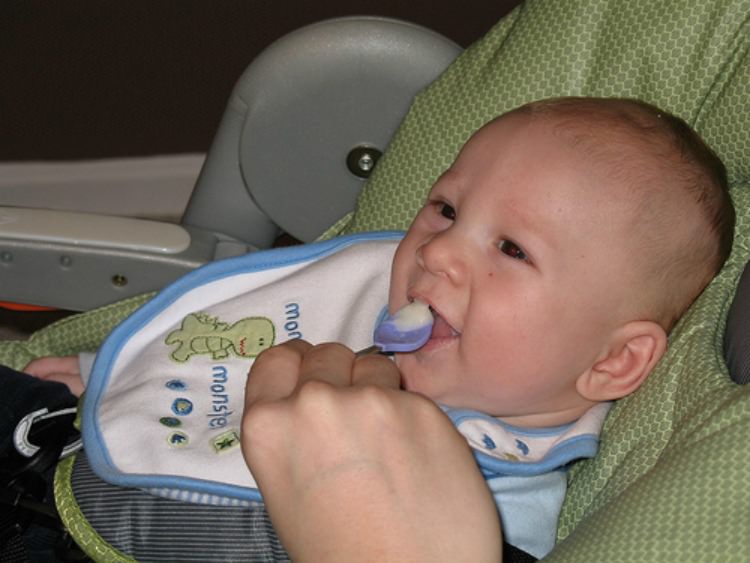

One of most misguided and damaging pieces of advice coming from the vast majority of pediatricians, dieticians, and other “experts” is to give baby rice cereal as the first food around the age of 4-6 months. This advice is extremely harmful to the long term health of the child, contributing greatly to the epidemic of fat toddlers and the exploding problem of childhood obesity.
Rice cereal is never a healthy first food for babies. Not only is it an extremely high glycemic food when eaten alone (spikes the blood sugar) but it also contains ample amounts of double sugar (disaccharide) molecules, which are extremely hard for such an immature digestive system to digest. The small intestine of a baby mostly produces only one carbohydrate enzyme, lactase, for digestion of the lactose in milk. It produces little to no amylase, the enzyme needed for grain digestion until around age one.
Now, at least one governmental body is waking up to the harmful notion of feeding baby cereal grains as the “ideal” first food.
Health Canada in collaboration with the Canadian Pediatric Society, Dietitians of Canada and Breastfeeding Committee for Canada recently issued new guidelines for transitioning a baby to solid food and two of the first weaning foods recommended?
Meat and eggs!
While these new guidelines are certain to rile vegetarian and vegan groups, the fact is that meat and eggs are indeed perfect first foods for a baby. Not only are these animal foods extremely easy to digest compared with cereal grains, but they also supply iron right at the time when a baby’s iron stores from birth start to run low.
The inclusion of meat in these guidelines is in line with the wisdom of Ancestral Cultures which frequently utilized animal foods for weaning. A traditional first food in African cultures is actually raw liver which the mother would pre-chew in small amounts and then feed to her child.
The new guidelines specifically note the role that ancient wisdom played in the decision to no longer recommend cereal grains and instead suggest meat:
“While meat and fish are traditional first foods for some Aboriginal groups, the common practice in North America has been to introduce infant cereal, vegetables, and fruit as first complementary foods.”
Soft boiled egg yolks are also an ideal choice as a weaning food as they supply ample iron as well as choline and arachidonic acid which are both critical for optimal development of the baby’s brain which grows as its most rapid rate the first year of life.
Unfortunately, while the suggestion of meat and eggs is a good one, the joint statement from Health Canada also inexplicably includes tofu and legumes as well which are terrible choices as first foods. The starch in legumes would cause the same digestive problems as rice cereal and the endocrine disrupting isoflavones in tofu would be a disaster for baby’s delicate and developing hormonal system.
But, let’s give credit where credit is due. At least meat and eggs are appropriately included on the list. Good on you Health Canada! Perhaps your neighbor country to the South will wake up and get a clue about how to properly feed babies based on your lead.
I’m not holding my breath.
Sarah, The Healthy Home Economist
Source: Meat, tofu among recommended iron rich foods for Canadian babies

|
|


{ 105 comments… read them below or add one }
With my fourth daughter I was unable to breast feed after 4 months so I was extremely careful about making homemade formula. At around six months I began adding a bright orange raw egg yolk from a pastured hen to her bottle every single day. Now at 11 months she is eating bits of meat and raw cheese (no grain, whatsoever) and some fruits and veggies, usually cooked with butter, as well as her bottle. She is BY FAR my earliest developed mentally. She takes commands and responds to questions with both intelligible words and signs and interacts with people on a greater level of understanding for her age compared to my other three. I credit the egg yolks!
My first 3 babies had quite a rough start with allergies, severe eczema, etc. I started them all on rice cereal because I didn’t know any better then. I was also a vegetarian part of that time and very restricted in what I could eat while breastfeeding; seemed like everything bothered my babies. All 3 of my sons have had ongoing health struggles that are only now starting to resolve on GAPS, years later.
Soon after my twins (2nd and 3rd babies) were born, I discovered WAPF and gradually changed our family’s diet. When the twins were 5, I gave birth to a much healthier son who still had allergies (my gut is not 100% healed yet), but did a whole lot better than his big brothers. I also had learned by then that rice cereal was a bad first food, so I fed him mostly liver (he couldn’t tolerate eggs at first) for many months, with some muscle meat added in occasionally. He also got FCLO every day, from my milk and then directly, and plenty of bone broth and healthy fats.
This boy is now two years old, enjoys abundant health, and is far more intelligent and aware than his older brothers were at this age (and his brothers are/were not dummies). He is already able to read a lot of words and is eagerly learning more words each day … since when can a 2yo READ? I am in awe, and I’m certain that his diet has everything to do with this.
I can’t wait to have another sweet baby to nourish like this.
Fantastic testimonial Caitlin. My three children were also all speaking sentences before age one even my 2 boys who are typically slower to learn to speak than girls. My first child I did feed rice cereal early unfortunately as I didn’t know better at the time, but I was still breastfeeding and eating lots of fat even though it was pasteurized organic dairy (blech!). Now we only do raw dairy which is so much better and more digestible.
My next two children got egg yolks and bits of grated raw liver (frozen for 14 days prior to ensure safety) as their first foods and they did speak even earlier than my first.
Sarah, TheHealthyHomeEconomist\’s last post: New Health Canada Guidelines Advise Meat as Baby First Food
Speaking sentences before they even turned one? That sounds completely impossible.
I think she must mean before age 2.
I’ve known babies who can speak *short* sentences before age one… it’s not impossible, just uncommon.
My now 22 years old daughter sang the happy birthday song to herself the day she turned one!
And of course she spoke in sentences, living people around impressed.
I spoke in sentences before I was one. Just simple, two word sentences usually, but sentences none the less.
I eat plenty of healthy fats and my little began eating egg yolk at 6 months. She is almost 13 months and is not speaking. She started at 4 lb. 9 oz. 18.5″ (no known reason). She is now in the 90th percentile for height and about 20% for weight. She just does not seem as far along as my first two were by age 1. Maybe it went to making up lost ground? I don’t know.
Wow, I’m impressed with with your children speaking full sentences prior to 1. I have an 11 month old who can barely get dada down appropriately. But I’ve never given cereal or grains to him. I tried baby led weaning and he’s just not that interested in food (we still breastfeed.) It’s a celebration when he actually swallows something, and that doesn’t happen but every few days. But as they say “food for fun until one”, I keep having to remind myself this.
Anyway, I have a question on how to feed meat to him. Do you puree it or just hand him a chunk. I’ve just handed him chuncks of meat and he sucks on them and tries to mess with them but never swallows anything. I’ve just recently tried a soft boiled egg yolk. Which btw, I’ll also take tips on how to handle that a little easier. It’s been a mess. And I just recently bought a frozen liver (will let freeze for 14 days just to be sure) to start giving him. So I guess my question is, how to you give the baby meat?
Thank you!
Sara has a video on how to do this, you should check it out! In short you grate the frozen liver with a cheese grater. I grated the whole frozen liver with a food processor and re-solidified in ice cube trays. This made serving it a matter of leaving a cube in the fridge to thaw the night before.
Shaniqua, as per food safety rules it is NOT safe to refreeze raw meat or other food once it has already been defrosted.
I feel like the tides are turning for quality food advice and traditional cooking/nutrition. Maybe it’s just in my mind, but when I hear that my sister bought a pasture-raised side-of-beef, I feel hope. Blogs like yours, Sarah, are making a difference. I read it frequently and have learn a lot. Thanks.
I fed my first 2 vege’s and meat. I had tried rice cereal with the first but he always spat it out. I didn’t learn about better nutrition until I had my 3rd, and he had raw egg yolks from 6 months. All 3 ate huge amounts of avocado too, they could never get enough of it. I wonder, is this a good first food too? I always thought it to be. We had moved overseas to the netherlands before our 3rd was born, and I am constantly astounded by the nutritional advice given to parents here. From 6 months, parents are pushed to give brown bread with margarine as a first food. I was often asked why I was not giving my son bread, as it is important fibre that the baby needs for digestion! margarine is also pushed by child nutritionists, to give children the vitamin a & d they need. What a shame! there is so much beautiful grass fed butter here!
The reason for giving babies butter (I don’t know if I’d give margarine, it’s usually synthetic) is that fats in foods help to better absorb fat soluable vitamins. Complex carbohydrates are very good for digestion.
margarine is usually synthetic? I thought it was always synthetic – or are there genetically modified margarine producing cows now? I give my kids heaps of butter, I know its importance for absorbing the fat soluable vitamins. I merely was stating the advice given to parents here by the dutch children’s health network. They advise to give margarine so that children will get the vit A & synthetic vit D that is added to it. No thanks.
Sounds like the meat industry has powerful lobbyists there too…
My grandmother told me to feed my first smashed up boiled egg yoke, I did. Years later I found out that egg yoke has great enzymes for baby’s tummy… I think I’ll stick with grandmas advice…
Grandma knows best!
AWESOME!
Some fall apart pot roast sounds delicious right now lol.
That’s great! I’m Canadian but have been living in the States for 7 years now. I get excited when I see Canada make strides like this and can only hope that the States will follow! HOPE…
I’m so interested in getting to the bottom of some contrasting information I’ve heard. On the one hand, some call animal foods “easy to digest” and grains as “hard to digest.” On the other hand, some point to “bowel transit time” as an indicator of the relative ease/difficulty of digestion, and say that short bowel transit time is indication of ease of digestion. My INSTINCT (given what I know about the relative nutrient levels of animal vs. plant foods) would say that if it is true that animal foods take longer to get through the digestive system it could be because there are far more nutrients to digest, and so in that regard the longer bowel transit time would be a good thing.
What do you know about the idea of “bowel transit time” and whether short or long transit time means anything regarding nutrition and health?
Thanks for another great post!
Jill Nienhiser\’s last post: Curried Chicken Salad
bowel transit time is a hard thing to go by, because food as a whole can take up to 48 hours to be fully digested. Some keys to digestion – easy to digest is not necessarily a good thing. Simple sugars as opposed to complex carbohydrates are easy to digest, because it is already broken down to 1 sugar molecule. This is why if you eat a sugar packed meal or white breads, rices, etc. you tend to be hungrier sooner. Complex carbs are made up of more than one chain of sugar so they need to be broken down and then broken down a second time into sucralose (table sugar). This is a longer process which leaves you feeling fuller longer and helps to boost metabolism as well. I can’t quite remember now how it works out for meats, which are mainly fats and proteins. Fat digestion starts as early as your mouth, as saliva begins to breakdown the fat molecules. Monounsaturated and polyunsaturated are the better fats. Saturated fats have no double carbon bonds hence the carbon is fully “saturated” with hydrogen. Fats are an essential part of the diet because they provide the body with energy. I do believe that fats move slowly through the digestive system, as do proteins
I also forgot about fiber – soluable and insoluable. Insoluable fibers do not get digested (good example is corn skin) soluable fiber like what you find in oatmeal is very good for cholesterol because it binds to bile and make the liver produce more bile which the body uses cholesterol to help the liver produce bile.
We started giving our baby some pureed venison around that age and she loved it!
my mom started me on liver & hard boiled egg yolks as a first food- of course she started it when I was 7 days old but aside from that I guess she knew what she was doing
Sally Fallon has a recipe for baby formula for those that can not breastfeed that includes liver.
good meat, fish, eggs and veggies are far better for a growing baby than crappy flour/rice gruel that baby can´t digest -so awesome
The thing is, you could probably ask any grandmother im sure meat or non-gerber food was the menu for any baby:)
My baby just turned 6 months old and loooves egg yolk with liver and is starting meat, it’s been great. I never considered rice cereal thanks to Sarah.
Actually, Grandma use to let the babies gnaw on big fat pieces of bacon and stake.
just because they “recommend” it doesn’t make it gospel. i see that chip on your shoulder over veganism is still nipping away at you. We need more love and acceptance in this world. Regardless if we agree on all matters one thing is for sure, staying divided rather than banning together to resolve planetary issues isn’t going to do anyone any good.
ELoah, what are you talking about? “Love and acceptance”. What do you mean? Sarah is giving nutritional advice based on research. If you love eating plants, it’s your choice. I want to read her articles because they give me great information. I am pretty sure Sarah loves you, vegans, very much, but it will not make her a lier to be political correct. She will tell you that what you do with your diet is unhealthy period. There are too many others who would sing to your ear.
Shannon eggs cause the red blood cells to stack 30 minutes after consumption which is not good. Wonders if you missed the memo, eggs are chicken menstrum
This is a blood condition that can be caused by poor protein digestion or too much protein in the body, not just by eggs.
Other known causes are stresses caused by coffee(caffeine) cigarettes as well as being dehydrated.
Well you’re just dumber than dirt, do you ever think to at least check Wikipedia before you rebroadcast your accumulated ignorance?
“Rouleaux (stacks of red blood cells) formation is retarded by albumin proteins.”
ALBUMIN! Ring a bell? No? Didn’t think so, I’ll give you a clue, as in EGG WHITES. Is it starting to make sense? This is why eggs are a Super Food.
My advice is that you keep on avoiding them, the sooner people like you go extinct the better life will be for the rest of us.
It’s pretty ignorant of you to not know the difference between ALBUMIN and ALBUMEN Albumin is produced in the liver and found in the blood!!! It’s the main protein in blood plasma. High Albumin levels in the blood are almost always caused by DEHYDRATION.
ALBUMEN is the name for an egg white – it contains ALBUMIN proteins. Egg white contains almost every amino acid required for life – Which makes sense considering an egg is the building block for a life.
Sorry conrack – I misread your post as a snap at me, and got a little defensive!
Well you’re just dumber than dirt, do you ever think to at least check Wikipedia before… wait, I already said that.
And my comment was for ELoah, I should have put that in the comment.
While all of the information on egg whites is true, you don’t feed the whites to a baby, only the yolks. After they are a year old they may have the whites, but that is the portion of an egg which will produce an allergic reaction if they’re going to have a reaction at all.
And never rely on wikipedia for information. Not a reliable source for anything. Neither are web sites from the dot gov or the dot edu or the dot medical sites. Maybe mayo clinic occasionally, but otherwise keep going before relying on “searched web info” for your bottom line advice. Take advice from people who have been there, done that. Anecdotal, yes, but much more reliable in real life.
D – yes egg whites are introduced later, but you can introduce scrambled eggs as soon as 9 months – sometimes even sooner if you have a food tolerant family. Egg white intolerence isn’t overly common. And even those intolerent of egg whites can sometimes handle them in small amounts. As for an egg allergy (about 1% of babies), babies can be allergic to both the whites and the yolks. Those who are allergic to yolks can usually tolerate whites and the other way around too. And most babies that are allergic to eggs don’t overcome this allergy until around 5 years old, and some are allergic for life. (though this article isn’t really about the whites!)
@ Jennifer: I never gave my kids scrambled eggs until they were older than 1 year, so I don’t know about all that information you gave, I only know what I was told by my elders, who never failed me on anything else. We only fed yolks, with added butter (real butter usually homemade) and sea salt. We didn’t go by science or percentages!
as for the last part – who cares? they’re tasty! we eat them fried, scrambled, boiled, raw, sunny side up. you may choose not to, more for those who do! (not to mention seeds are a kind of aborted life, too, if you snatch them out of nature before they can sprout and grow. you can’t get away from the fact that you must eat living things in order to survive.)
Don’t forget though, many people’s elders tell them to use rice cereal. Did your family have an egg allergy? Because the theory of an egg allergy must have come from somewhere…
How I feel about it – the instance of food allergies in children has risen by over 300% – and the regulations on food have gotten stricter before that. In generations before mine is a little absurd to wait 6 months to start solids and then once they started pretty much everything was fair game.
D – your elders were wise! As long as your kids are healthy now, then you did things right. Every family is different with different beliefs and ideals.
@ Jennifer: My elders didn’t even know about rice cereal. There was no such thing, but they did know about eggs.
I’m almost 60 y/o and just had my fourth grandchild on Wed. October 3rd, 2012. So even my Mom and mother-in-law didn’t know about rice cereal. When my oldest sister had her first baby in 1962, they had a product on the market called Pablum but my gramma’s told her it wasn’t necessary and to stay with real foods. We also didn’t feed our babies fruit until they were a year old, on the advice of elders, as well. I guess they knew about sugar problems! They always told us that the nutrients available in fruits were also available in other, less sweet foods. Their motto, more or less, was that you could get any child to eat something sweet, it’s just more appealing. So we were told to try to develop their palate to want other foods first. So that’s what we did. I don’t think the word allergy even entered the picture for my gramma’s generations, or even my Mom’s generation. In my family, I do not believe I was exposed to the word allergy until my third child was born in 1987 and even then it wasn’t a common issue with children. Convenience foods have made allergy a common word as well as a common issue because now every kid from birth through high school is allergic to at least five different things and needs this pill or that shot. It’s malarkey most of the time, and if they would change their dietary habits from boxed/convenience foods to real foods all of those allergies would most likely be taken care of – naturally.
D – I completely agree with convenience foods being a problem. Very insightful post, thank you very much for sharing that history!!
I do believe that many allergies and illnesses are food industry related (at least here in the united states) it’s all part of the effort to push prescription drugs in my opinion!
You really like to use statistics when it supports your arguments!
oops, forgot to click the box to notify me of follow up comments…
Jill Nienhiser\’s last post: Curried Chicken Salad
#3′s first food was a nectarine he attacked while I was holding him and having a snack. After that day I pretty much fed him whatever I was eating with the exception of shellfish, chocolate & peanuts. Avocado, black beans & salmon are among his current favorites.
Just read this article in my daily newsletter from the academy of nutrition & dietetics: http://www.sciencedaily.com/releases/2012/10/121003195122.htm
Real food holler!
My baby is 9.5 months old and her favorite food is gelled organic grass fed beef stock.
thats gross! can’t trust them..
Thank you for your informative posts. I really enjoy reading them and have learned a lot. I have a lot of health problems and have been trying to change my diet. My husband and I are in the clumbsy stages of trying to get to the GAPs diet by at least trying to be gluten free and trying to get to grain free and incorporating the diet over time. I’d like to get to GAPs or a paleo diet by the end of the year. Your recent posts about fats and oils have been really helpful. We are hoping to have kids in the near future so this post was great to read. It really does make sense, especially to someone who is knowledgeable about healthy foods and what is really good for you to eat. Thanks again!
My girls have been eating eggs, meat, nuts, cheese and whatever else I eat since they were 5-6 mos. at that age id just Smash it up for them.They also breastfed at that age too. They don’t have any food allergies!
My granddaughter started eating meat at 6 months. She loves it!! Nothing gross about giving your baby the nutrition he/she needs.
@Eloah…where do you get your medical info from? I’ve never heard any such thing about eggs causing blood cells to stack? I’ve been eating eggs since I was a baby, I fed my daughters eggs when they were babies and now my 8 month old granddaughter enjoys poached eggs. None of us have heart disease or high blood pressure or high cholesterol. I HAD high cholesterol when I fell for the low fat high carb diet that conventional medicine is pushing on everyone, but I dropped my cholesterol by eating grass fed full fat meats, eggs, cheese, butter, lard and bacon and cutting the supposedly healthy whole grains and vegetable oils.
Woot! That’s how we’re going with the little man. None of this rice cereal crap for us! Egg yolks from our Amish friends and he can gnaw on whatever we’re eating.
He is exclusively breastfed right now, and he can’t handle it when I eat wheat, so we’re not introducing grains to him till he is well over a year old, maybe closer to 2.
I was going to share this on Facebook until I saw the MOX NEWS logo at the end… is this a real story or some sort of parody?
I saw that too. “Unreal and Biased”?
Yep…we found an Amish farmer who pastures his animals and we get our grass fed raw milk, cheese, cream, butter, eggs and meats from him. We have to travel an hour each way, but it’s worth the trip.
Processed eggs might cause problems in the blood .. like Egg Beaters or something like that. Like most information, you have to be very careful how it is interpreted and who conducted the study.
Well, egg beaters have NEVER been an option in my house..LOL
meat lobbyists score again.
Children, parents and human beings in general win when they eat the meat they were designed to eat.
how ridiculous.. putting something dead into your babies mouth.. something murdered.. how repulsive.
Then tell me why vegans crave for meat and eat meatless burgers and things like that to fool their bodies of what their bodies need? I guess it is your inside voice tells you: “You are starving me. I need nourishment not a constant body cleanse.” I always hear vegans talk about how they miss meat the most (notice, not sugar, the most addictive food) and they never stop this craving while sugar takes about 2 weeks to overcome.
And a word about murder. Don’t you kill plant to eat it? What all vegans consider to be alive is enzymes in food that makes food alive vs. cooked food and not literally alive, kicking, and moving. Raw meat and eggs plus raw dairy have enzymes as well, so it is alive food too. Also, while we need to kill an animal in order to eat it or cut a plant from it’s roots, eggs and dairy are not get “murdered” at all. Plants die when you cut them of. You can prolong their freshness with moisture and refrigeration. But don’t we put meat in a fridge and a freezer to prolong it’s freshness as well? Oh boy, we should all be ashamed of killing and eating animals and plants. We can’t stop eating, right?
So my baby gets the best, full of enzymes and richest live food available in form of egg yoke.
Common, check an egg at least, there are no live chicks in it, I promise.
Love this comment.
that poor pile of murdered soybeans you ate for lunch. how heartless to not let them sprout and produce their own little sproutlings. cut down at their prime of life. they never had a chance. all so you could not starve to death.
And what about all the insects killed by the insecticides, so vegans can have all their soy??
ummmm….plants are alive, too and often have to be killed in order to be consumed. Just because they aren’t “cute” and don’t tug your heart strings doesn’t mean they aren’t living, too. Maybe we should eat rocks.
Health Canada promotes e-coli meats……find a local farmer and don’t buy e-coli beef from any stores.
Oh my, the vegans are out in force. My 6 month old loves his “dead” yolk and begs for more. He sure isn’t repulsed.
For the “against-meat” people… I guess you consider placenta eating gross as well? What would vegans recommend as the first food respecting the development of different enzymes at different times, please?
???? i’m not against meat, but this is shocking, from a physiological perspective. people aren’t necessarily designed for it. but i like @Maria Szucsova’s point.
On the contrary, it’s not shocking at all. It’s a return to ancient wisdom.
Good to know Health Canada is finally promoting actual health advice…now if only they would legalize raw milk…..
Maria Carolina\’s last post: Quick Hello and Giveaway Winner!
BTW here in Australia, the guideline is to feed the baby rice ceral OR meat (as if there was anything in common in them…) My baby enjoyed chewing on meat since 5 months of age.
To all the vegans…we don’t go on vegan Facebook pages to knock you, so please refrain from saying how disgusting you think we are because we eat meat. Go eat some tofu and leave us to eat our juicy, grass fed steaks dripping with grease and blood, topped with portabella mushrooms sauteed in grassfed butter with garlic and onions. There ya go…run to the bathroom to puke…LOL
Thanks for that I’m 8 months pregnant and now I’m starving. Throw a baked potato and some carrots on that plate for me too yum.
My 2nd son’s first food: t-bone steak (he loved it!)
One of the few things I remember from high school bio is that amylace is primarily present in saliva (and the pancrease too). The only real evidence presented in this article is the second small paragraph referring to the lack of amylace in the small intestine as proof. Knowing that amylace is present elsewhere, this doesn’t make a good argument to me, plus, I’d like to see how the spike in blood sugar from cereal compares to breast milk. …in short, where is the science??
(on a side note, how could the detoxifying organ, liver, be good to feed to your baby!?)
@ Kate: It’s not amylace it’s amylase, and there are two types alpha and beta. Look them up and study them.
Lots of people eat liver so why shouldn’t it be given to a baby? Science??? Why would you trust science? Trust your instincts and watch the development of your baby for the science. If it was damaging to babies to feed these foods, do you think others would have been doing it for centuries? I’d rather see people feed their kids liver than formula any day of the week.
As to your question about breastmilk – - well, it shows your lack of education in food matters and the human body, too.
The spike in blood sugar from cereal is because it is a simple carbohydrate. It is not a complex carb. Complex carbs are broken down into simple carbs which take longer to digest and therefore keep your blood glucose levels at an even keel. Are you serious in wondering how it compares to breast milk? Though breast milk is sweet, it has far more nutrients than cereal could ever have. Naturally occuring nutrients and antibodies too, not fortified crap.
Liver, though a detoxifying organ, is high in iron. It also filters the blood, those toxins leave the body.
Liver is one of the world’s great superfoods. Check out this baby who is thriving on natural baby formula that includes liver, and he loved it from the start! http://www.youtube.com/watch?v=54OGGE6zdXk
This is a great article! I will share it on my blog for parents about the motor milestones. Recently they found high levels of arsenic in rice in the US as well. Another reason to avoid feeding it to baby.
My grandma’s “going home from the hospital’ directions for my mom were to feed pureed meat at 2 weeks!!!! (She’s a vegetarian now. Coincidence?) She thinks I’m a weirdo for giving my baby broth and meat before 1 year. I guess the vegetarian ‘instinct’ didn’t pass to me.
Hi Sarah,
Thanks for the post. Could you say something about when to give an infant who is not on breast milk soaked oats. When and how to introduce other grains?
The answer is never. Grains are only appropriate if starvation is the alternative.
and what about giving quinoa to an infant? Should it be soaked? when to introduce it?
I wish some of you ladies lived in my area of the country and could help me to educate young mom’s about first foods for babies. I have been providing infant day care for eight years, and before that I provided all-age day care, and I can assure you I have trouble trying to un-do the damage the pediatricians have done, insofar as first foods, vaccinations and breastfeeding vs formula. It’s astounding how really uninformed most of these people are, and the sad part is – - – they don’t want to learn anything new and they think I’m off my nut when I suggest no rice cereal (only oatmeal if they think they must give a baby cereal) and they REALLY think I’m in left field when I suggest soft egg yolks or mashed avocado, both with a little butter and sea salt; but they think I’m from the moon when I suggest pureed meats. They are just in horror and all of them say to me “I’ll talk to my doctor about it”. Well, I know right then that I’ve lost them.
I really don’t know how to turn it around but in all my years of providing care I think I’ve maybe had three successes in getting people to at least look into it or give these foods a try. The only food some will even consider trying without asking their doctor is yogurt, but then they go to the grocery store and buy Yoplait that’s loaded with sugar and has absolutely NO fat in it, even though I explain to them NOT to do that. I’ve printed out articles to send home, but I think they use them to line the birdcages or something because they surely don’t read it or pay much attention. They listen and politely nod their heads while I’m talking to them, but you can see the disengagement and the lack of interest, and the continue to stuff their babies with cereals and then they wonder why their babies are constipated about 90% of the time.
It’s very frustrating but I do keep trying.
*** I should add, all together I’ve been providing day care for a total of 23 years, and my own children are 37, 35 and 25. So it’s not like I have no experience with feeding these types of food. My kids grew up on real food because I learned all about this from my two gramma’s and my lovely mother and mother-in-law. They were all a bunch of very smart cookies!
The other thing too…these will be the same mom’s that are later on loading their children up with fast food too…
D – It’s sad really. I have many friends who are still going by whatever their doctor says (which is funny because every doctor seems to have a different opinion anyway and most are just concerned with the pharmacuetical industry so they can make money). My first food for my 5 month old was avocado and he absolutely loved it! We haven’t done any meats or soft yolks yet, but I will be once we have gone through all of the first fruits and vegetables. I’ve given him oatmeal twice, but I knew from the start I did not want to give him rice. My MIL and other family members kept telling me to give rice, or put rice in the bottle, etc. etc. I kept my ground and said no. I make all of his food myself.
Keep trying – many of the younger mothers seem to be becoming more open minded about things – well at least they are in my area anyway…
Sarah, I am glad you talked about rice as baby first food. Given what we know about arsenic in rice, it isn’t a great idea for any children to get any rice based products until this whole mess is straighten out.
I started a petition over on change org to warn parents about the dangers of arsenic in rice.
Anna@Green Talk\’s last post: Roasting Sunflower Seeds. The Ultimate Treat
This might not be perfect, but it’s a great start and I’m glad to see the Canadian government doing something right. The dietary habits of future Canadian adults might be off on a better foot now.
The only food my baby currently likes is bacon. He isn’t much into egg yolks, but he did eat some once or twice.
Did you try feeding your baby the warm egg yolk with a little butter and sea salt added? Try it off your finger rather than a spoon for the first few times. That’s how I did it to begin with and they loved it. Also, if your baby will drink from a bottle, mix a little soft-cooked egg yolk with your breastmilk in a bottle, and at least baby will get the nutrition from the yolk, even if it is a slow process to begin with. There are all kinds of tricky ways to get babies interested in real foods.
This is my first time on this page and i have to say, pretty disappointed in the attacks and sarcasm. There are many studies advocating varying approaches to diet ( both for and against meat/animal consumption) and i have a half vegan/ meat eating family. Some people asked about digesting red meat, here’s an article i found interesting. http://www.livestrong.com/article/500353-can-the-human-body-digest-red-meat/. Either way, be tolerant of one another and leave the name calling for your kids in the schoolyard.
Dr. Carey Reams, who created RBTI, Reams Biological Theory of Ionization, a health program, did not recommend children to consume meat until they were 12 years of age.
“I also discovered that babies’ gastric juices are so diluted, so weak they cannot digest the foods that adults eat. By mathematical calculations I worked out the foods that a baby could digest from the very earliest time that it could take food until its gastric juices became strong enough to digest the foods of an adult. Consequently, my children did not get any nut, or nut meats, or nut butters (coconut being the exception) until they were eight years old. (Or, unless the nuts are steamed soft in a pressure cooker, or boiled until soft. … I also discovered children could not digest meats until they were 12 years old … Besides meats and nuts the children should not eat shell fish, oysters, clams, lobster, or any soups with meat or meat broth in them. Children cannot digest chocolate, iced tea or coffee. Our children never tasted coke, or carbonated drinks. We always had fresh fruit drink” (Choose Life Or Death, P. 59,60).
Basically, he recommended a WAPF type diet for children less than 12 without meat or fish. He allowed FCLO, dairy, eggs, etc. At 12 years of age, he would slowly start to introduce meats.
According to RBTI practitioner Michael Olszta, “children under 12 get more energy from a dilute source, that is, they run on a lower octane gasoline. This is why so many children are sick, that is, they are being fed the diet of an adult and thus are getting too much higher octane fuel when that fuel should be lower octane. They not only are minerally deficient because of a wrong diet, their bodies have to deal with getting rid of the heavier foods which they cannot digest.”
According to RBTI, the body’s digestive system under normal health starts to work at its best around 18-20 years of age. Adults require a a heavier diet.
Curiously enough, Carey Reams created RBTI at a time when Weston Price already indicated soil depletion started to show up as a problem in modern society. Incidentally, RBTI focuses on addressing the lack of nutrition in our foods because of exhausted soils. I am trying to reconcile traditional suggestions to feed children meat versus RBTI. Can it be that depleted soils have caused weak digestion in children? Weston Price noted in his book that as soil declines, so does the health of a society.
Although, Reams seemed unperturbed giving non-GM0 soybeans to his kids, which I consider questionable, he raised kids that never had a cavity or misdeed a day of school due to illness. With that said, as anyone observed their children doing better before 12 on going without meats and fish that with these items?
This article is a complete work of fiction. The comments supporting are fantasy.
” the epidemic of fat toddlers” That’s even more news. For two children in a row we were given orders to keep babies chubby to support brain growth.
Why does this article need to end with a slam on the U.S.?
{ 15 trackbacks }