

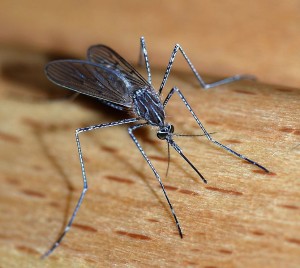
The war against genetically modified organisms expands to include animals as the private firm Oxitec readies a planned release of GE mosquitoes in the Florida Keys as early as January 2012.
The mutant mosquitoes are genetically modified to contain a gene that will kill them unless they come in contact with the antibiotic tetracycline.
This lethal gene is passed on to any mutant offspring when the GE mosquitoes mate with wild mosquitoes. Any offspring born with this gene will then die before adulthood. The theory is that over time, the mosquito population will decline due to the lethal gene becoming more widespread.
Residents of the Florida Keys have not been asked to approve this release despite the fact that they would be potential bite victims given that .5% of the to be released mutants are female (the female mosquito is the one that bites).
Two previous releases of the GE mosquitoes (aedes aegypti) occurred in the Cayman Islands and Malaysia. The Cayman release, performed without residents’ permission, resulted in an 80% drop in the mosquito population compared with neighboring areas that did not have a release. The success of this release was discussed in a scientific paper in the journal Nature Biotechnology.
Many unanswered questions about the impending release in Florida remain including what will happen with a reduction in the mosquito population in the release area? Will the void be filled by another insect species inadvertently creating new, unforeseen and perhaps irreversible problems?
What will happen to the balance of the local ecosystem? Florida bats, for example, depend on mosquitoes for food. Would such a release have unintended consequences and potentially threaten this fragile mammalian species already in alarming decline?
Who is responsible financially or otherwise if complications with the release develop?
Hopefully, residents of the Florida Keys will demand an open discussion of this impending release in a public forum and that no such experiments be allowed to proceed without their permission.
As with the haphazard and unpredictable spread of GM crops around the globe (feral GM canola growing in ditches in Japan, for example), there is no doubt that the release of GE animals particularly one like the mosquito that has the ability to hitch a ride and move unrestrained into any uncontained area will have far reaching consequences that the scientific mind can only feebly begin to comprehend.
Sarah, The Healthy Home Economist
Source: Genetically Modified Mosquitoes to be Released in US for the First Time

|
|


{ 36 comments… read them below or add one }
“When one tugs at a single thing in nature, he finds it attached to the rest of the world.”
Indeed, the current science does not know the consequences of this new GE organism being released into the environment. If the mosquito dies off its possible that a new and worst organism takes its place in the upset ecosystem.
Kelli\’s last post: How Not To Over Eat During The Holidays ( and Crouton Recipe)
What’s incredible is that I live in Florida and the regular news outlets aren’t reporting about this AT ALL. How could this not be all over the local Florida news? Because this would cause such an outrage that the plan to release these mutants would be nixed.
Hopefully, alternative news sources such as this blog can spread the word so the public can stop this before it happens.l
Sarah, TheHealthyHomeEconomist\’s last post: Mutant Mosquitoes Planned for Release in Florida
Bats are crucial pollinators, just like bees. There are food crops which are only pollinated by bat. This release is troubling. Part of me wonders if this new species could eventually become the insects described in Revelation 9.
Peggy\’s last post: Liver Pâté for One
Mutant Mosquitoes Planned for Release in Florida http://t.co/z3gwtm7W
This goes right along with all the other ways we have screwed up Florida from a wildlife standpoint. That state is already so far gone, starting with the construction of canals and the channelization of the natural sheet flow that used to occur across the state before we decided we needed Miami. Then you have the introduction of invasive species which outcompete, and in some cases eliminate, native wildlife populations.
Now we have genetically modified mosquitos. I guess they figure, since Florida is already so messed up, why not start there? It would be a HUGE detriment not only to bats, but to the thousands of other creatures (insects, spiders, frogs, etc.) that also eat mosquitos. They are food for a lot of things. Since bats are so specialized, it would be especially detrimental to them, as well as insectivorous birds.
The only thing that surprises me about this is that it proves that we haven’t learned from our mistakes. What is the point of learning any kind of history if we don’t take any lessons from it?
What could possibly go wrong? Oh, my.
I’m far from Florida, but there is no way at all to control the spread of these mosquitoes. What affects one, affects all.
It sounds like the plot of the kind of movie I wouldn’t want to watch.
Ruth @ Ruth’s Real Food\’s last post: Real Food 101: Dec. 26, 2011
Has Jurassic Park disaster written all over it. “@realfoodmedia: Mutant Mosquitoes Planned for Release in Florida http://t.co/0dOrU9o0”
unbelievable….seriously?!? if you don’t like the mosquitoes in Florida….MOVE!! I live in SW Florida, you just deal with the mosquitoes. No one likes mosquitoes, but again, seriously?!? Thinking themselves wise, these scientists will destroy the world.
This is crazy ~ I worry about the bats!
Florida had another GM bug disaster. Do any of you remember the LOVE BUG in the 1970s and 1980s? It was a GM insect created in the labs of the University of Florida. The insect they created was supposed to be a predator of mosquitoes and gobble them up. Instead the bug mated constantly and flew around and died. It didn’t have time to eat anything. I remember driving through Florida highways and the windshield and headlights would be COVERED with millions of the black, mating bugs. People had to put LOVE BUG shields on the cars. If that wasn’t bad enough they had some kind of chemical composition that took the paint off your car wherever they landed. I assume they eventually died off as you don’t see them anymore.
Although I would love to blame lovebugs on scientists, it seems that they migrated to Florida and it is a myth that UF had anything to do with it.
http://en.wikipedia.org/wiki/Lovebug#Folklore
Actually, we were at Disney World this past September and they were everywhere! Not coating the windshields or anything, but constantly landing on your clothes, in your hair, and making polka-dots all over the cars.
Once I realized that they wouldn’t bite or sting, I didn’t mind so much, but it was scary at first since they kind of look like mean bugs.
WordVixen\’s last post: September 2011 Walt Disney World Trip Report
Love bugs are FAR from gone here in North Central Florida, they come back twice a year and still do the same damage! I wonder how long it will take the mosquitoes to make it up to this part of Florida? They’re opening another Pandora’s Box, with no knowledge of the outcome.
How much Tax money is going to this?
What will our government think of next?
Tara McMillan\’s last post: Progress
I’m not impressed! The beginning of something bad… what happens to all the insects and animals depending on the mosquitos for food? What happens to the chickens that have eaten bugs who before have eaten the mosquitos? Sounds like a good way to interfere with the eco system, and another way of people trying to better a situation only to make something worse to deal with in the long run.
I generally have a great deal of respect for scientists except when they mess with our food and do stupid sh*t like this.
I agree, sounds foolish!
And who knows what will happen to humans when the mosquitos “inject”/bite! Reminds me of the Bill Gates plan to create “flying syringes” that will vaccinate the masses.
http://cryptogon.com/?p=4601
I hope the whole population of people there are protesting and threatening to sue for mega millions
oh yes!! just what we need…MUTANT MOSQUITOES! Are they completely stupid?!
My question: are these GE mosquitoes of the native genus of mosquito found in Florida, or do they represent a non-native? Male mosquitoes are natural pollinators, and this adds big questions as to what this bio-control release could do to the ecosystem at large.
I appreciated a reader’s quote, ““When one tugs at a single thing in nature, he finds it attached to the rest of the world.” Genetic modification of any part of nature should never be allowed. Life has it’s own natural flow for a reason!
Unbelievable. Is there no limit on the measures human beings will go to to increase their comfort in the now with no thought for tomorrow?
So…this is extremely disturbing!
Andrea @ Frugally Sustainable\’s last post: Non-Greasy Homemade Moisturizing Lotion
Life will find a way around that gene and who knows what it will think of next!
The repeated attempts by science to “one up” Mother Nature are always doomed to failure.
Sarah, TheHealthyHomeEconomist\’s last post: Mutant Mosquitoes Planned for Release in Florida
What a stupid thing to do!!!!
So we are going to be bitten by a GE insect that leaves behind “stuff” in our bodies–what will that do to us?
I may not like the blood suckers, but this is going a bit too far imho.
And the loss of other species that depend on the mosquitoes for survival…………..
what..? errrr….
Whenever we mess with Mother Nature, there will always, always be consequences and these consequences are never good for us, our ecosystem or the future or our planet.
Instead of spending millions working against Mother Nature, why don’t we look towards working with Mother Nature to sort our ‘so called problems”. Just look at the fabulous things Biomimicry is doing.
Very interesting. As a scientist I would be worried about disturbing the ecosystem. Just yesterday I learned that some scientists at Harvard are trying to engineer some spermless mosquitos. It would probably have the same ultimate effect as these epigentic mosquitoes.
I sent your story to Prison Planet TV, he post stories that don’t make it to main stream TV or the paper. Hopefully this will get the word out.
Thank you Dena. I hope the folks in the Keys get word in time to stop this madness from happening in their backyard.
Sarah, TheHealthyHomeEconomist\’s last post: Gouda: The Nutrient Dense Cheese of Choice
It always amazes me that so much science and educated effort goes into these things and so little common sense.
Joshua @ Deliberate Web Solutions\’s last post: Why & how to submit to DMOZ’s open directory
I am wondering if the fish eat the larva, will it change their genes as well and start to die off before adulthood? What about us humans that eat fish, will it change our genes as well? Everything works in a chain reaction, why wouldn’t this?
I live in central Florida and have killed two of these mutants in the past week.
As a biologist, I understand the lifecycle of mosquitos, their place in the food web, and the domino effect that occurs when you remove one species or lower its numbers. The number of birds and bats that feed on mosquitos would also decline in number, move to an area with more mosquitos or have to adapt and develop a different niche. My “feeble scientific mind” also questions the effect upon the birds and bats that eat the GM mosquitos. I do find it odd that Sarah decided to refer to scientists as “feeble” minded when it was scientists that came up with all the information she uses in her blog about mosquitos. If Sarah really thinks that scientists are not thinking about the ramifications that this type of mosquito release would cause then she is the one with the feeble mind. I am sure choosing the Florida Keys as the release site was done after a long scientific investigation into the best site for this study. I highly doubt that they pulled the site out of a hat. If you are going to be outraged about releasing GM mosquitos in the Florida Keys, why are you not outraged about the other GM foods and organisms you come into contact with on a daily basis? Do you realize that humans have been manipulating organisms for almost as long as humans have inhabited the Earth? Humans have been selectively breeding organisms to obtain the desired traits for thousands of years, in the end they can achieve similar results, it just takes hundreds of generations to get there.
{ 1 trackback }