
Does the snack aisle at your local healthfood store sometimes paralyze you? Do you look at the ingredients labels trying to decide exactly which cookies are the best ones to buy and yet feel overwhelmed by the numerous choices available all beckoning with the labels “all natural” or “organic”?
If so, you are not alone. This happens to me all the time.
Granted, I try my best to avoid the snack aisle at the healthfood store as much as possible and I don’t even go down the snack aisle at the supermarket because there are zero offerings there of any value. As much as is humanly possible, I prefer to make my own snacks for my family as this is always the most nutritious not to mention budget conscious way to go.
But let’s face it. Life happens and sometimes things just don’t go as scheduled.
All sorts of things from flat tires to your child’s badly scraped knee can occur to mess up your plans for baking an afternoon batch of cookies for school lunches the next day.
What to do then?
I thought it might be fun to analyze two different brands of cookies that I might consider buying when I am in search of a decent after lunch treat for my kids and far behind in my cookie baking duties.
Ginger snaps are one of my favorite store cookies as they are typically lower in sugar per serving than most other types of processed cookies. They also taste similar to the grain free ginger snaps I make myself, so buying a boxed version made with wheat flour on occasion is not going to all of a sudden cause my children to prefer the processed cookies over my own.
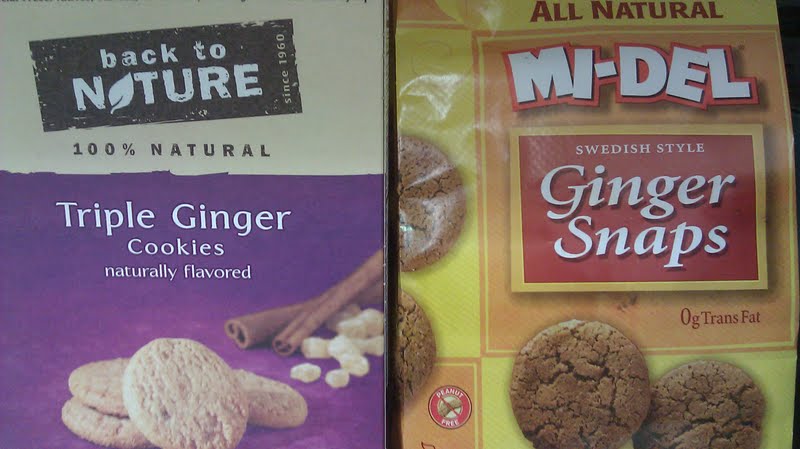
The picture at the top of this post is of the two brands of ginger snaps available at my local healthfood store.
Let’s analyze the ingredients labels of each and see if one of them is the clear winner over the other.
The Front of the Cookie Packages
From the front of the packages, you can’t really discern much if any difference. They both say “all natural” or “naturally flavored”.
The Mi-del brand says “Swedish Style” which I admit would draw me in as I like anything that suggests that the cookies are based on some traditional recipe. Of course, this may or may not be true. It’s all just marketing on the front of the package after all!
From a visual standpoint, the colors of the Back to Nature brand are far more appealing than the Mi-Del brand which are a bit harsh on the eye. Then again, purple is my favorite color so maybe that’s just my personal preference.
Ingredients Label Comparison
With the front of the packages not really telling us much, it is necessary to examine the ingredients labels to get the full story.
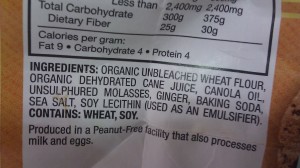
The first ingredient label to the right is of the Mi-Del Ginger Snaps.
I like that the wheat used is organic. That is a definite plus. In addition, the sweetener is organic dehydrated cane juice which is acceptable.
I don’t like that canola oil is used for the shortening as this is very potentially GM canola as it is not organic. In addition, canola oil is a polyunsaturated vegetable oil which almost certainly means that it is rancid.
Canola contains high amounts of omega 3 fats which are very delicate and can never be heated. You most certainly cannot bake cookies with it!. Use of canola in a boxed snackfood virtually ensures a rancid, health robbing product even if the ingredients are all organic.
Another item I don’t like is the use of soy lecithin. It is not organic soy lecithin, so the odds are good that it is GM soy given that over 90% of the soy in the the United States is genetically modified at present.
The second ingredient label to the right is of the Back to Nature Triple Ginger Cookies.
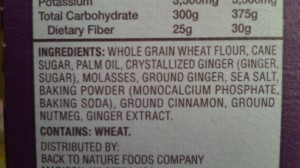
You’ll notice right away that the wheat flour used is not organic. The sweetener is also not as good quality because it is listed simply as cane sugar. It is not organic and it is not clear whether it is from dehydrated cane juice. It could easily be plain white sugar and probably is.
Not good.
So far, the Mi-Del Ginger Snaps are way in the lead.
However, the next ingredient changes the game entirely as palm oil is listed as the shortening.
This is very good as palm oil is a much healthier choice that the rancid canola oil used in the Mi-Del Ginger Snaps. Palm oil is acceptable for use in cookies and crackers. While coconut oil or butter would be best, palm oil can most definitely be considered a healthy fat.
Continuing down the ingredients label, all the other ingredients are excellent as well with no ominous “soy lecithin” listed.
Which Brand Did I Choose?
After analyzing the ingredients labels for these two boxes of ginger cookies, which brand did I ultimately choose?
If you guessed the Back to Nature Triple Ginger Cookies, you are correct!
The fact that the Mi-Del cookies are made with organic wheat flour and organic evaporated cane juice is insignificant compared with the fact that the Back To nature cookies use the much higher quality palm oil and no soy lecithin.
If you ever find yourself torn between two different brands of snack foods, always choose the one with the healthy fat like palm oil. The fat that is used is much more important than whether the flour or sugar used is organic.
In addition, go for the brand that clearly has no GMOs in it and that would be the Back to Nature brand as well.
Do all Back to Nature cookies get the thumbs up? Not necessarily.
I haven’t checked the labels on all the different cookies offered by this company, so don’t go and buy them without checking closely for yourself.
For that occasional need for a decent box of cookies from the store, though, the Triple Ginger Cookies pass with flying colors.
Sarah, The Healthy Home Economist

|
|


{ 91 comments… read them below or add one }
thanks for this. i find myself reading the ingredient box of various brands all the time if i happen to be shopping in the snack aisle. there are so many choices that i get so overwhelmed trying to make the best decision.
prasti\’s last post: getting off the fence – part 2
As I was reading your article and came to the canola oil in first box, I said “oh no” Sarah is not going to pick this and after reading the entire article- I too would have chosen the non organic flours over the canola oil. Hey! I am on the right track and I am a newbie. Sarah, this article is a great help for us. Thank you for pointing out this important piece of information! Life does happen and we should be prepared.
We always need a Plan B. And maybe a Plan C and a Plan D too
Sarah, TheHealthyHomeEconomist\’s last post: A Tale of Two Cookies
Good info Sarah! I have become obsessed with reading ingredient labels! I was wondering if you could shed some light on ‘citric acid’ that is listed in what seems like everything. I thought I recalled reading somewhere that is a code name for MSG?
Allison\’s last post: Weekly Meal Plan [plan for leftovers!]
I would love to know the answer to this too..
Yes, citric acid as an additive almost always comes from corn, which means it is a) a form of MSG, and b) probably GMO.
If citric acid comes from fruit, then it is ok. Only if it comes from corn is it a problem for MSG residue.
Sarah, TheHealthyHomeEconomist\’s last post: A Tale of Two Cookies
What about organic products that have citric acid? And how can one know if it is from corn or fruit?
I tried to buy a can of diced tomatoes yesterday and both the organic and non-organic had citric acid. I had read that citric acid was bad, though I couldn’t remember exactly WHY… but when I found it in the organic tomatoes, I was at a bit of a loss.
Thanks for this post… The information will definitely come in handy!
just for extra info, I found out that autolyzed yeast is also a form of msg,which i am allergic to..
Okay, I get into moods sometimes. When I see people eating stuff from the store I have an almost uncontrollable urge to smack that food out of their hands. The shock factor itself would be funny. The reasoning might be lost though. They would just see crazy lady. So thank you for the reminders of every day. Have I ever done that? No. I sure have day dreamed about it on more than one occasion!
Oh, Sarah, you do my heart good. I thought I was the only one that put on a frozen smile, and just repeated to myself, “Keep your mouth shut, keep your mouth shut.” I now see I’m in good company.
Patt\’s last post: A Tale of Two Cookies
thanks for the info!
This is so helpful! Thank you!
Thanks! This was really helpful.
This is very good to know to choose the fat used over some other things! I would of picked the Mi-Del cookies because of the organic flours and better sugar. I usually overlook the Back to Nature brand all together because it’s owned by Kraft and just head straight to the other brands. Now I’ll have to start looking at all the different brands. You never know what you’ll find!
Love BTN products…their crackers are a bit too salty though.
Back to Nature won’t work with the Feingold Association to get their products approved, so I am suspicious of what could be the reason they don’t want to disclose their information. It’s a shame, because their products seem pretty decent.
Feingold approves a lot of products that are just garbage (Boar’s Head deli meats?). I suspect they get payola from companies whom they endorse, and Back to Nature hasn’t the funds.
Good practical advice Sarah. Thanks!
Thanks Rick. I hear your group is going great guns in Safety Harbor. Excellent
Sarah, TheHealthyHomeEconomist\’s last post: A Tale of Two Cookies
what a great article! Ty
I had no idea that canola oil was not a good substitute for vegetable oil! i was always told it was! :/
This is great advice, once again. Unfermented soy and canola oil should be avoided at all costs. GMOs should also be avoided. Unfortunately, some companies, like Whole Foods, add canola or soy to almost all their products.
Anytime I read canola or soy in the ingredients, I put the item back on the shelf. I read ingredients on everything I buy now as one day I brought home a can of albacore tuna in water and when I went to open it I glanced at the ingreadients and saw the water was ‘soy broth.’ I couldn’t believe it! Soy is in everthing and it isn’t mentioned on the front label. I don’t remember the brand of tuna but there are plenty out there without soy. Just be sure to read labels on everything. One month the label might say palm oil and the next month it may change to canola. I call companies and thank them for not using canola or soy whenever I can.
Canola I never make an exception for. If a product has canola or soy oil in it, it is 100% certain I will not buy it regardless of the other ingredients.
Sarah, TheHealthyHomeEconomist\’s last post: A Tale of Two Cookies
Me either Sarah! And just today at our local healthfood store i saw canola oil in their homemade salad dressings that everyone buys thinking its much better because they make it there. I told my sister not to buy their dressings but make it herself. I use to cook with canola oil because I thought it was better before I knew “better” LOL
I like BTN products also. I have only tried one Mi-Del product – their graham crackers. *gag*
Oh definitely. My kids wouldn’t eat them. Also, almost every single one was broken.
After months of abstinence, I recently have been buying crackers again – precisely bcs they use palm oil. Wonder if the word is getting out to the food manufacturers – that transfats, high omega 6, rancid, oxidizing oils are not good for health. I wish restaurants would start tuning in.
Yes, even organic restaurants use that canola/olive oil blend garbage. We have several organic restaurants in my town and I never go there for that reason. I don’t care if all their food is locally sourced (that of course is wonderful). But if the fats that they cook it in are bad, what’s the point?
Sarah, TheHealthyHomeEconomist\’s last post: A Tale of Two Cookies
No point at all. It is a shame that so much good food is ruined by canola oil. I will not touch it, either.
Stanley Fishman\’s last post: Why Grassfed Meat Costs More and Is Worth It
Great Advice!! I must admit I sometimes treat myself to BtoN “oreos. I’m going to once over that label. Do you know if “palm oil” always indicates palm oil that is not fractionated? I haven’t been able to find a clear answer on this.
Mishelle\’s last post: Game Plan 3/25
thanks for the practical side by side analysis. I find it so helpful as I continue my new journey of moving away from processed foods. it’s like learning a new language & these types of ‘how to’ articles really take me from theory to reality. thanks!!!!
“In addition, go for the brand that clearly has no GMOs in it and that would be the Back to Nature brand as well.” I thought GMO Wheat was already out, or is that up next?
I was wondering this as well. Also wondering about it not stating that it is unbleached flour. Is this not a big concern?
THERE IS NO GMO WHEAT. Wheat is only hybridized which is completely different. Nothing wrong with hybrids .. been done for thousands of years. Almost all agricultural plants are hybridized to some extent.
Sarah, TheHealthyHomeEconomist\’s last post: A Tale of Two Cookies
I wish I could take you shopping with me, I am overwhelmed when I go…….
Thanks for the great tips! I spend way too much time reading labels too. This will simplify the whole process for me!
Trish\’s last post: Real Fooding lessons learned
Now you made me want some gingersnaps!
I was going to guess that you chose to make your own instead LOL!
Yes, that is the best solution for sure
I do buy store cookies on occasion though although they pale in comparison with the quality I make at home.
Sarah, TheHealthyHomeEconomist\’s last post: A Tale of Two Cookies
excellent post, sarah! i find that people struggle with label reading and unfortunately it is a much needed skill in these uncertain times. yes, it is always best to make your own but we need to acknowledge that folks are just not going to do that 100% of the time – no one really can. thanks for a clear, well written illustration of how to discern and make an informed decision. as always, you deliver!
emily duff\’s last post: The Art and Joy of the Sandwich
thanks! great info
Thanks for the thoughtful analysis. You convinced me.
Nancy\’s last post: Canary Party?
When you are buying at the store, rarely is a food “perfect”. We have to learn to distinguish and prioritize which ingredients take precedence over others. Best to always make it yourself though, then you know it is indeed “perfect”
Sarah, TheHealthyHomeEconomist\’s last post: A Tale of Two Cookies
My understanding is that the problem with palm oil (or cottonseed oil) is that since a palm tree may not be categorized as “food” it may be treated with pesticides that are not food grade. Am I mistaken? Canola is definitely “out” due to the GMO component. Since fat cells store chemical pesticides, I try to favor organic fats over carbs. Tough subject! Thanks for bringing it up.
Palm trees are no spray in most cases. They can grow in terrible soil (aka sand).
Cottonseed oil is a whole other story. Very heavy spray crop.
Sarah, TheHealthyHomeEconomist\’s last post: A Tale of Two Cookies
I’ve been in this exact situation many times trying to provide a “healthier” version of crap-snacks the rest of the class gets to send to my son’s nursery school (Nothing home-made allowed due to nut-free status!!!!). I’ve done the same trading off and rationalizing. It’s good to see I’m not alone. Thanks!
Thank you for this post! It was really helpful to me. I am a frazzled mommy raising little ones and sometimes don’t have time to bake from scratch, so this was an enlightening lesson.
P.S. I bought organic milk from the store today for the first time in over a year. My little kids don’t like the taste of “spring” milk from the farm (and I agree it does taste different this time of year). I really cringed to buy it and almost just wanted to give them water for a while instead, but they are begging for milk. What to do?
Try goat milk temporarily. It doesn’t have the same strong spring taste as grassfed cow milk for some reason. If you can’t get goat milk, then drink one of the milk substitutes I have blogged about (do a search at the top of the blog for “best milk substitutes”)
Sarah, TheHealthyHomeEconomist\’s last post: A Tale of Two Cookies
I just noticed Bugles are made with coconut oil…though they are probably made with GMO corn too. Still, that’s better than most chips.
Wow! Now that is progress! I still wouldn’t buy them for the non-organic corn, but things are making headway a bit at a time.
Hopefully, food manufacturers read blogs like this one and realize that Moms like me aren’t going to buy their garbage so they might as well fix it.
Sarah, TheHealthyHomeEconomist\’s last post: A Tale of Two Cookies
As a general rule, if buying a manufactured product I have found “back to nature” to be a good choice. Even better from organic grains, freshly milled, properly prepared, etc., but sometimes a made product is very helpful! I also go by how I feel after eating the product to know if there are hidden ingredients. I have traced back a soy or canola “reaction” (after being free of these ingredients I can tell when I have even a trace of them!) to pan sprays. So little of the pan spray is used for a given product that it is not required to be put on the label. Overall, I have not had any problems with their products.
After reading your article I decided to make the homemade ginger cookies. I love the Nourishing Traditions cookbook. Will add an egg as well.
Great post! Followed by an ad for a snickers Easter egg. 1. It’s okay to accept their advertising even if you don’t believe in their products? 2. Funny that they would even choose to place an ad on your site.
Yes, those pesky ads … I have opted out “of all processed foods” You wonder how Snickers got past that filter?????
Sarah, TheHealthyHomeEconomist\’s last post: A Tale of Two Cookies
But how did they taste?
I would enjoy other posts on comparative shopping. I’m one of those that spends a long time shopping because I’m doing so much label-reading. Sometimes I’m not sure which is the lesser evil.
I have more planned
Sarah, TheHealthyHomeEconomist\’s last post: A Tale of Two Cookies
Great post. I’ve been looking for suggestions for a good midmorning snack, so please everyone let me know your thoughts. I was a big fan of Luna bars until my daughter put my onto your site. They contain soy protein and soy lecithin – although they use palm kernel oil. So on the whole does the soy outweigh the good palm kernel oil?
Soy is bad bad bad. If you eat soy, it’s a thyroid problem waiting to happen for most people (small amounts of fermented soy ok for those without thyroid issues). Stay away from it even if the luna bar has palm oil in it.
Hashimoto’s is at epidemic levels in women. Soy in our food everywhere is a big reason why (although there are other contributing factors as well .. fluoridated water etc etc).
Sarah, TheHealthyHomeEconomist\’s last post: A Tale of Two Cookies
Sarah,
I was wondering if you could share other cookie recipes with us. I love chocolate chip cookies but have not had much success with making them healthy.
I don’t use chocolate for baking. I don’t believe caffeine is a good thing to give children unless it is medicinal (for example, a cup of weak organic green tea for a headache).
Sarah, TheHealthyHomeEconomist\’s last post: A Tale of Two Cookies
Sarah – I can understand why you don’t want to use chocolate – but for those of us who are new in this journey to healthier eating it is nice to have some recipes that although they won’t meet your high standards are still a step in the right direction for the rest of us.
Hey Sarah! Between you and Dr. Mercola Ive learned soooo much about nutrition…and the sun lol Im a bartender and I always share everything I learn with all my coworkers and managers and bosses. Ive been in many arguments with my boss because we wont vaccinate our kids and he thinks we’re ridiculous, but thats another topic. One of my coworkers will always run food by me that she brought into eat and have me read the ingredients list and tell her if its ok to eat…I havent said yes yet. One day awhile ago there was palm oil in something and I told her that was good. A couple hours later my manager brought me a print out of all kinds of information about how they get the palm oil and its ruining alot of animals habitats. He went to something in North or South Carolina last year that was like a tiger retreat. You get to pet them and learn all about them. Ever heard of the place? Well while he was there thats when he learned about the dangers of getting Palm Oil and said once he learned that he wont eat anything with Palm Oil in it. Do you know anything about any of this?
I wrote a post on coconut sugar that addresses this. It is possible for palm oil and palm (coconut) sugar to be harvested sustainably.
Sarah, TheHealthyHomeEconomist\’s last post: A Tale of Two Cookies
I’ve eaten both of those cookie brands many times and I can say that the Back To nature brand is superior to Mi-Del. Mi-Del also makes a gluten-free version of finger snaps that is loaded with sugar and additives.
Hello Sarah, Is peanut oil a better fat too? I buy plantain chips cooked in it on occasion.
Peanut oil is ok for a light saute (like olive oil). But, you can’t really fry in it as it would be too damaging. I personally would not buy chips fried in peanut oil or olive oil like some of the brands on the market. Lard, tallow, ghee, coconut oil would be best for this.
Sarah, TheHealthyHomeEconomist\’s last post: A Tale of Two Cookies
Having celiac means that both of the above are disqualified for me, so on the rare occasion that I buy a package of GF cookies, I choose Pamela’s brand, specifically because of the palm oil. I’m very glad this brand exists!
Is there a list somewhere out there that we could print and carry in our wallets of imgredients to avoid while reading labels? And maybe in order of importance? It would make shopping easy. Thanks for this! I learned something new today.
Sonya\’s last post: Call For Healing Recorded Calls
Is Palmolein the same as Palm Oil?
Any sugar is poison. Even the so called natural sweeteners are bad for you.
I’ve been blessed; I’ve lost 155 pounds in the last 24 months and my taste has changed. I no longer like sweet foods or drink. I am not alone in this. I have found that once you put out the poisons like wheat and sweeteners you no longer need or like them.
What FREEDOM this gives you.
Dan Moffett\’s last post: Before and Now
I don’t buy this argument as it does not align with our basic physiology as humans. We have tastebuds that detect sweet. They wouldn’t be there is sweet wasn’t something that was good for us in moderation and in whole, unrefined form.
There is nothing wrong with homemade treats made with whole ingredients and in a pinch a cookie from the store made with a decent fat and no GMOs.
Sarah, TheHealthyHomeEconomist\’s last post: A Tale of Two Cookies
Such a great post, I do this all the time! I think I’ve found the prefect delicious snack food that I buy every now and then as a treat..I can’t fault it with my knowledge but maybe you can! I found these organic beetroot chips.. 3 ingredients listed.. Organic beetroot, organic palm oil, sea salt.
Thoughts? Cos wow theyre amazing
Fantastic! Brand please? Just go easy on them … don’t overdo on anything fried even if a good oil is used as it will still have some acrylamide (carcinogen) that forms when any starch is cooked at high temp.
Yeah I figured deep fried was never going to be great but I buy a pack about once a month to sit down infront of a good movie, they are amazing!
Unfortunately I live in Australia and they are the Wooldworths Macro Organic brand over here
http://www2.woolworthsonline.com.au/Shop/ProductDetails?Stockcode=345202&name=macro-organic-chips-beetroot
Here’s the link.. if you want to try them I’ll gladly ship a few bags over to you, least I can do with all the amazing knowledge you’ve brought me!!
Woolworths in Australia have done amazing to bring a range of organic products to the shelves.. they’re certainly not perfect with lots of products still containing citric acid and the like, but they’re leaps and bounds above any other chain supermarket in Australia in my opinion! I rarely go down the middle isles anyway
I’ve never posted on a blog before, and just want to say this is one blog site I really appreciate! One note I’d like to pass along, that I didn’t see any comments about, is that for a while now manufacturers have been allowed to call white flour “wheat flour” on their labels…so unless it’s actually labeled as “whole wheat” or “whole grain”, it’s not, from my understanding…one more ingredient to scrutinize, unfortunately!
Hi Sarah, I just “found” some egg whites in the frig. They have been in there for 3 weeks or so. Would they still be okay for making macaroons? They are farm fresh eggs. Our refrigerator is really cold. It often freezes milk or other things in there. Thank you!
If they smell ok then go for it.
Sarah, TheHealthyHomeEconomist\’s last post: A Tale of Two Cookies
So true how promising packaging can be but doesn’t always mean they have your best interest at heart!
Love this! Sarah, how do you know the B to N wheat and sugar are not GMO?
Sarah – thank you for doing these comparisons – it is much needed – please keep doing this with products so we finally get the “bottom line” on products we just have to buy once in a while. I sure wish there was a company out there that we could depend on for really good ingredients but guess that’s a pipe dream.
Also…..can you do more articles on GMO’s – explaining what they are, where you can get them, why they are in our food, etc. etc…..
Yes, I would have avoided the cookies with canola oil and soy lecithin because there is more than a 90% likelihood that they are genetically modified/engineered. More than 75 to 95% of corn, soy, cottonseed, sugar beets and canola are GMOs. Right now, LabelGMOs.org is gathering signatures to get the Initiative CALIFORNIA RIGHT TO KNOW GENETICALLY ENGINEERED FOOD ACT on Nov ballot. Whether you believe GMOs are good or bad to eat, we have a right to know what is in our food. By labeling GMOs we could be better consumers. To learn more about GMOs google Jeffrey Smith of Responsible Technology, Organic Consumer Association or watch the free documentary The Future of Food on youtube.
I like the California Almonds from Back to Nature as a compromise as well. They are soaked in sea salt before roasting, with no added oils. Of course they are going to be irradiated and lose a lot of good stuff in the roasting process, but they are inexpensive, and sometimes sourcing good raw almonds, soaking and toasting them myself is just too daunting.
Sarah, I think you should do a post on healthy real food options for kids lunches. I am a single mom and we qualify for free lunch at school so my children get the garbage that’s served for free. I try really hard to make every extra effort at home like raw milk, little sugar, keifer, farm eggs, stocks, sourdough, lacto ferments etc. When it comes to sending something with them for snack or lunch at school I feel so limited. I’d love some great ideas.
While I totally agree with you for the most part, and I too read labels like crazy, I have to admit I freak out a bit when I see Palm oil being used. This is why…
About 88 percent of global palm oil production was in Malaysia and Indonesia in 2007. Although much of this production took place on land long ago established for agriculture, some of it occurred in areas that were newly cleared specifically for oil palm cultivation.
The most threatened ecosystems by expansion of oil palm plantations are rainforests and peatlands. Peatlands are swampy areas where the soils are made of peat — decomposed vegetation. Peat acts as a sponge, soaking up water and helping prevent floods. It also stores large amounts of carbon.
When peatlands are drained, the stored carbon reacts with air to release carbon dioxide into the atmosphere, increasing concentrations of the greenhouse gas. The dry peat then becomes highly flammable, increasing the risk of large-scale fires when plantation developers use fire to clear land and burn agricultural waste.
Greenhouse gas emissions also result when rainforest is cleared for oil palm plantations. Worse, oil palm plantations support very low levels of biodiversity, meaning most of the plants and animals once found in the rainforest must either move or perish. Oil palm plantations are not good for wildlife and endangered species like the orangutan, the Sumatran rhino, the pygmy elephant of Borneo, and the Sumatran tiger are all threatened by development for oil palm.
What are your thoughts? Thanks
Thank you Sarah! I really enjoyed this post. Although I’m a lot healthier—inside and out—because of my conscious decision to eat healthier and more traditional foods, there’s a part of myself that seems to get paranoid every once and a while: “I can’t eat at that restaurant!” or “I wonder if those granola bars will cause a reaction?” I feel it’s so important to emphasize that we all have to do the best we can in the moment, and your tips on which brand of cookie to choose are awesome. I think it’s a great idea to choose a type of food you already make at home and that your family is familiar with. That way, they won’t see them as an unhealthy treat and feel deprived when you’re not buying them. Again Sarah, great info and looking forward to incorporating these tips and tricks with my family.
Very informative!
{ 1 trackback }