

How to identify cow “happy lines” as one important measure of the overall health and well-being of a dairy herd.
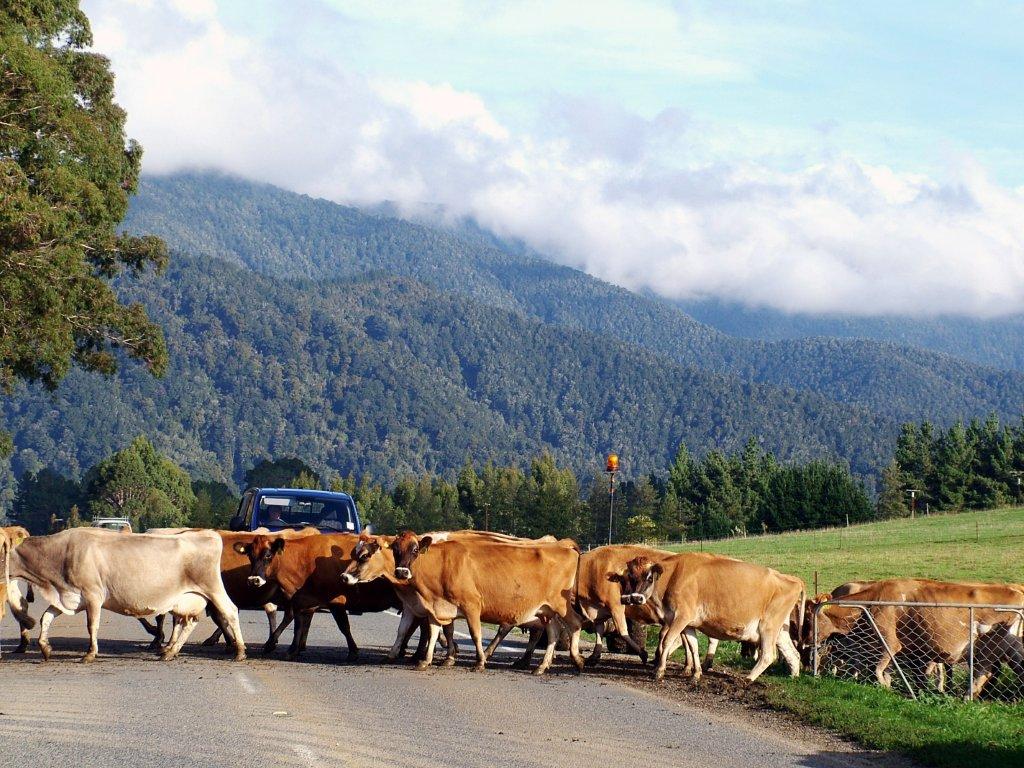
The general health and well-being of cows and dairy animals is something that we human overseers have to interpret through markers usually performed by tests of production, body scores, overall herd health trends, body language, and herd interactions.
The health of calves and calving problems, and general crankiness of herd individuals when approached are also considerations.
As in all relationships, we gain a knowledge base that is built over time and can be referenced to determine those trends that are present.
However, as a dairy consultant walking on a farm for the first time, historical knowledge of the farm and its herd conditions are not readily available.
This same situation presents itself to a consumer attempting to secure a farm-to-consumer relationship for the procurement of nutrient-dense, pastured products.
Here then, are a few pointers to allow you to assess a farm’s potential product quality, aside from taste and eye appeal of the facility or its pretty-eyed milk producers.
We will have to stay with cows in this reference because that’s what I know.
Farm “Curb” Appeal
When driving up to a place of purchase/farm a few things usually stand out for me.
How many puddles are there for the cows to stand in?
What is the general curb appeal?
What is the fence status? Is it up, straight, and respected by the herd? Or, have the inhabitants pushed it over or ignored it completely?
Do the cows look content and if in pasture, can you see their ankles? If so, are they spitting stones to get grass and pushing each other around like a Black Friday sale?
If the cows are in the loafing area in the midday heat or wintertime cold, are they laying around with just a few standing, or are they all standing and stamping their feet?
One must understand what just happened to them or what are they getting ready to do.
Cows crowded up to get milked does not count in this situation. However, post-milking, cows at midday should be lying around, and 75% of the cows should be chewing their cud unless they have just been fed.
Cow Contentment or Agitation?
If cows are agitated, they are stressed and that has hundreds of possible reasons but we will not get into those in this article.
I will only add that the less breeze and the hotter and more crowded it is, the more uncomfortable a milk cow will be.
Think 8.5 months pregnant in mid-August.
That’s a cow if the air temp is over 86 F/30 C degrees and humid with no breeze or there just isn’t enough space.
Let’s Talk Manure!
Manure is another easy thing to judge given that it is a frequent thing with milk cows!
If the manure does not shoot out in a rainbow stream onto a raised tail, that is a good sign that their diet is balanced in relation to protein.
Rainbow manure and manure on the rib cage mean the cow is getting too much protein.
There is a direct correlation between tangy yogurt, milk that won’t clabber, or cream that doesn’t whip, and manure on the ribs of cows.
Pastured Cows: Too Thin or Just Right?
While we are talking about the ribs of a cow, if you can see them as in the above picture of the cows crossing the road, that is how they are supposed to look.
Notice the tail bone. It should be visible, but not too prominent.
A very bony backbone with clearly defined and prominent ribs is likely a cow that is too thin and nutritionally challenged.
Remember that one has to trend the animals and not just pick out the poor individual who milks her heart out and milks off all her weight.
The overall group in the road picture is a nice group of cows, and the ones you can see are all in the same good shape.
Cow Happy Lines
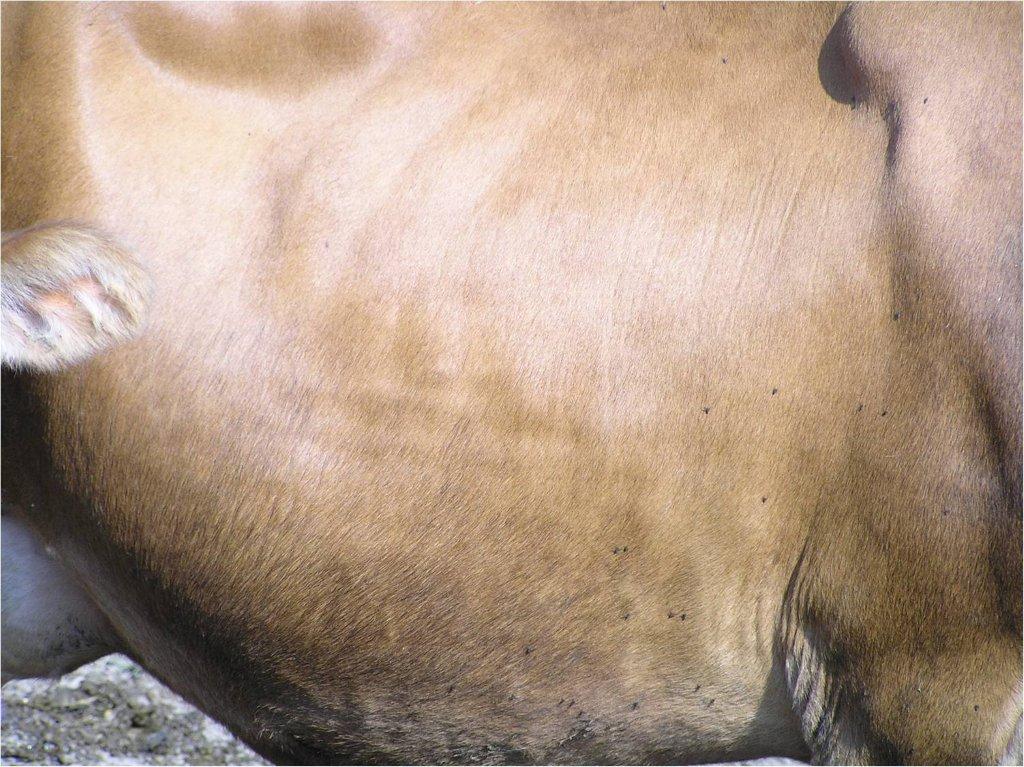
The other aspect of a cow’s rib cage area is to look for “happy lines”.
These can be readily seen in the close-up picture above of a contented, healthy pastured cow’s ribcage area.
“Happy lines” resemble veins and appear at the bottom of the rib cage and run at opposite angles to the rib bones.
Happy lines are a very good indication that a milk cow is getting everything she needs as it relates to trace minerals and a balanced diet of starch to protein, and is comfortable so that she milks well and the milk is of good quality.
While a great sign when you see them, it is not an indication of the lack of a pathogen presence.
A good farm manager will have many cows with happy lines, but will still have a good testing regime as part of that management process.
Summary
In conclusion, before buying local dairy, it is a good idea to drive by the farm and take a peek at the herd.
Healthy dairy cows will, on average, be busy grazing but content, often lying around with a goofy look on their face, half asleep, chewing their cud, and doing what cows do best, making milk.
They won’t be too thin with overly prominent tailbones and ribs, but rather presenting a “just right” look that they are getting all they need nutritionally, such as the herd crossing the road in the picture above.
Happy lines are just one of many indications of a healthy herd, and I have found I can usually trust a person who does well by their herd.



A rancher I know said that one of the biggest factors in the tenderness of grassfed meat is the happiness of the steer. I had a great butcher once who would select a beautiful piece of meat for me, and say” “happy cow”.
Great to see this information spread.
What a beautiful picture! I would love to know where it was taken, the cows look beautiful and the scenery is beautiful!
Somewhere in Southern England I believe.
Since Tim didn’t, I did want to call attention to the Farm to Consumer Legal Defense Fund. We dairy farmers risk a lot getting milk to our shareholders. It’s important to me a member of this organization to help keep your source of good milk around!
I love it! You just shared some very practical advice we should know, but don’t anymore. Most of us cringe when we see food lot cows and cattle, but more often than not, it doesn’t change our purchasing choices. Thanks for educating us on how a cow’s “lifestyle” affects us directly in regards to milk quality.
I’m a total newbie to all of this and found this post enlightening with great humor–thank you!!
Thanks for writing this article- full of great information! 🙂
Very educational. What did you mean by the correlation between tangy yogurt and manure on the ribs of cows?
That, Julie, is a good question. I too was curious about this.
Ciao,
Pavil
Tangy yogurt means that the milk it was made from had a high MUN (Milk Urea Nitrogen). High MUN milk is tangy and bitter tasting.
How does this relate to manure on the rib cage?
If a cow has manure on its ribcage, it likely has very loose manure which gets on the tail and then gets swished onto the ribcage .. high MUN milk would result from such a condition of acidosis which would be evident through loose manure. This is what I am deducing from what Tim wrote.
Whenever I recommend the farm I get my raw milk at to others who are concerned for the cleanliness, I always tell them that the farmer takes very good care of his cows. His cows in the field are always content and look like they’re ready for the fair. Clean. After a good rain, they might be a little muddy, but never covered in manure, like some other dairies I’ve seen. They have plenty of “elbow room” and don’t stand around in grassless pens trying to shoo flies away with their amputated tails (like other conventional dairies I’ve seen.) The farm itself is quiet, content, uncrowded and peaceful. Simple. And the milk? DELISH!