
By Guest Blogger Paula Jager, CSCS
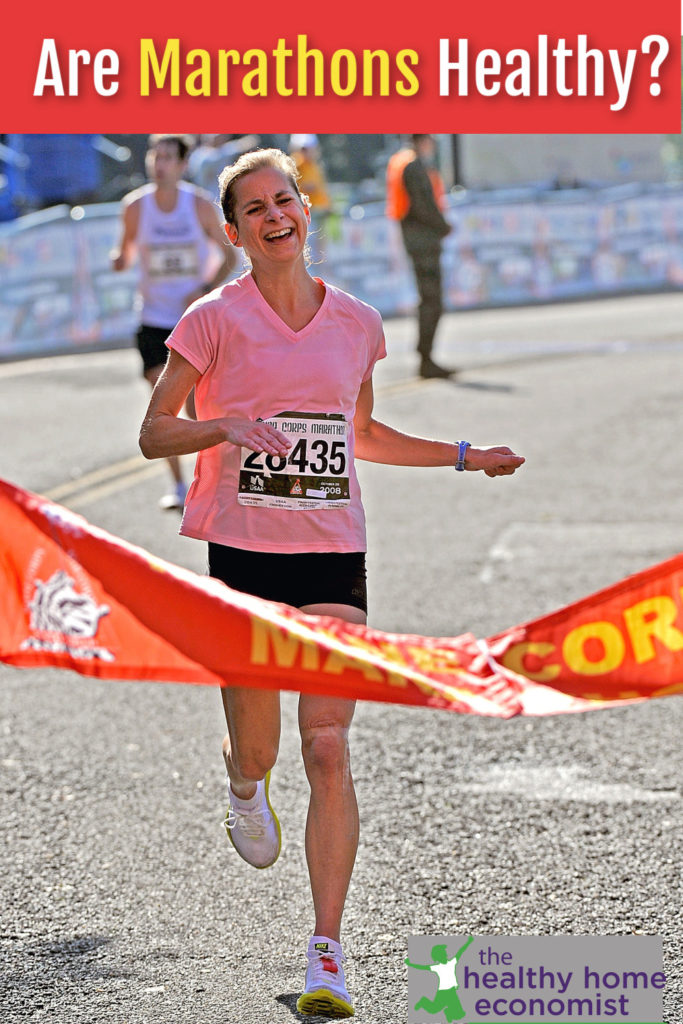
Have you ever noticed that the marathon runners in the Olympics look like concentration camp victims?
Have you ever wondered why marathons are considered “healthy” in our society yet the first man that ever ran one collapsed and died immediately after?
Yeah, and Pheidippides was fit too, likely selected for his job as a herald due to his speed and distance running ability – not some ancient Greek version of the modern couch potato.
While life may be a marathon your training program should not be. Running a half or whole marathon or competing in a triathlon are all admirable goals. But there are many dangers associated with excessive endurance training. Dating as far back as the 1970’s the misconception of mainstream training philosophies of 45 minutes to an hour or more a day of intense aerobic activity has led to an overtrained, unfit, immune-compromised exercising population.
Man was not designed for movement at a chronically sustained high intensity aerobic pace. We’ve all seen it in the local globo gym—day in and day out, week after week Jane and John plod away on the treadmills and ellipticals or pedal themselves into exhaustion in spin classes. It has done nothing to shed the extra fat on their butts and guts let alone tone them. I have never been impressed by any of these results.
What exactly are the problems caused by training for long periods of times at high intensities? Several things. . .
- Debilitating osteoarthritis . . . at young ages
- Tendonitis and other repetitive strain injuries
-
Recurrent upper respiratory infections
-
Increased oxidative damage (free radical production)
-
Decreased fat metabolism
-
Susceptibility to injury
-
Loss of bone density
-
Depletion of lean muscle tissue
-
Coupled with the common high refined carbohydrate intake promotes a dangerous level of continuous systemic inflammation.
Eeek! Sounds like a workout gone very bad to me and the sad part is the intentions of this exercising population are good; they are doing this all in the name of “health.”—they are not out to destroy it.
Aside from the disastrous results mentioned above why is high intensity aerobic pursuit such a dead end? One reason is the high level of carbohydrates consumed needed to sustain this activity leads to chronic inflammation. You’ve all seen it—Sally and Johnny are running a 5 K so they load up on a big bowl of pasta the night before and chow down on bagels and juice immediately after their 36 min 5 K. Type 2 here we come.
But quite simply because man was not designed (evolved) to work like this; we have 2 primary energy systems to power our muscles. The first relies on the slow burning of fats keeping us fueled while at rest yet allowing for continuous low level aerobic activity such as walking, gardening and day to day physical tasks. Fat is a very efficient fuel, stored and burned easily and cleanly when lots of oxygen is present
Our second primary energy system that evolved is an ATP fueled system that allows us to do intense loads of work in shorts bursts. It is our high octane fuel. Think of the woman that lifts a car off her child trapped beneath it. Or the person that sprints after a mugger to get their wallet back. In other words all out effort for fewer than 20 seconds; flight or fight and life or death tasks and situations.
Our energy systems are far more complex than that but it boils to the fact that we were evolved to either move slowly and steadily or briefly and fast and we become both healthier and stronger by exercising and living in this manner.
All being said there are still people out there that want to run a half or whole marathon or a triathlon and there is a better and smarter way to train for it while avoiding the negative risks mentioned above. The days of logging mileage in excess of 20+ a week are rapidly becoming archaic. And so is the weak and skinny appearance of the stereotypical endurance athlete. Many are finding that by incorporating strength and conditioning workouts into their training routine along with shorter more interval based training they are improving speed, power and overall performance along with reducing injury potential. Not to mention having a lot more free time.
This has been hotly debated but well documented in the past several years. Leading the pack in the defense is CF Endurance’s Brian MacKenzie www.crossfitendurance.com His training has many top level endurance athletes setting personal records far above past efforts with a dramatic reduction in training time and mileage.
Several of my clients became interested in an endurance event called the Tough Mudder www.toughmudder.com slated for this December in Tampa and wanted to create a team. We did; stayed tuned for the right way to train for this event, a half marathon, marathon or triathlon should that be your goal. And in the meantime go long and slow or short, hard and fast.
|
|


{ 77 comments… read them below or add one }
How Running a Marathon Can Seriously Harm Your Health — The Healthy Home Economist http://t.co/nOAKSaX
Very interesting. I ran extensively in high school and suffered a few injuries but have not run so intensely since…however many of my friends have done marathons and 1/2 marathons and at this point a 1/2 is the farthest distance I’d consider.
The other night I was watching a TV show on USA and a character was a “marathon runner,” but my husband & I noted that she was not skinny enough to be a typical marathon runner. You could actually see flesh on her body and she wasn’t just skin & bones (not that all marathoners look like that, but it seems many of the professionals do)!
if you compare giving birth to running a marathon, which one is better?
having a baby! It is not as uncomfortable, and the reward is eternal.
Why are so many of these “runners” deathly afraid of pushing themselves with weights? Heck even body weight? I see so many wimps running around & when I question training practices, I get the “stink face” or some snooty remark?
haha stink face
I’m tired of all of this doom and gloom. No longer a fan, Sarah. Sorry.
Agreed! And I literally have almost the same name as you. Weird!
Not a fan of this either. You really need to back this up with evidence. It looks like alot of opinion here.
Some have more difficulties than others when it comes to addressing the truth.
I’ve never run a marathon but running a 10k was one of my dullest afternoons ever. You can’t say that about giving birth!!!
I think Paula is wrong on this one. I think we are definitely “evolved” to run long distances (as in following game for the hunt.) The problem really only comes when we turn it into a race and keep trying to do it faster and faster. It may well be true that professional marathon runners are emaciated, because they are trying to win. However, I know many marathon runners who are not pro’s, and they are the very image of fitness. Strong and sleek and glowing with good health. Sarah is a big fan of the anecdotal evidence, and the anecdotal evidence for running as a healthy form of exercise is abundant. Even running longer distances.
Chasing game was normally done on the back of a horse. Where on earth did you learn your history? I live in buffalo country and believe me, they weren’t hunted on foot. :rolling eyes: We attend (I ride) in the Custer State Park Buffalo Round-Up every September. We aren’t even hunting them and it can be dangerous.
Trapping and fishing were probably the only types of “hunting” not done on horseback because a quick get-away wasn’t usually necessary.
Most of the runners I know are now suffering with joint problems. It’s a fact, not an anecdote. Sarah, this is just one of those things people have to live long enough to experience, I think, because judging from the amount of negativity being posted here, I can see you are dealing with younger, more inexperienced folks. Oh well, live and learn. And they will.
Running is very healthy. It’s when people overdue it and spend excessive time at a high intensity. When man went hunting his “chase” for game was nowhere near the distance covered in a marathon. It didn’t take 26 miles to kill dinner; more like a couple of hundred meters or less. He may have walked quite a distance, getting hours of low level aerobic activity but the intensity was limited to short burts of speed followed by recovery.
Have we forgotten that humans hunted on foot before ever taming horses? Have we forgotten that the glutes are the strongest muscles in the body? Or how about we sweat better than any mammal (most animals with fur must pant to keep cool) in the world and are able to keep our bodies cool with the least amount of effort? Humans are made to run. I do agree though that intensive training in any activity for long periods of time w/o adequate rest and nutrition are damaging. All of us could get out and run 20-30mins a day and be healthier for it. Aerobic activity is a must for optimal health.
Busting myths is part of the goal of this blog, Katie. Busting myths and preconceived ideas gets messy.
Touche!
It certainly does, Sarah! People need to know about these issues. Keep up the great work!
Being an iconoclast can be a lonely road sometimes…..but I’ll run it. Keep up the good work.
I would say that giving birth is definitely NOT like a marathon. There are natural resting phases after every contraction (with a nonmedicated birth at least) which you do not ever have in a marathon.
I remember that with 2 of my births, I actually snoozed in between contractions a couple of times.
Hi Sarah,
Was giving birth very easy since eating a very healthy diet for quite some time?
I like Ms. LeBaron’s points & take it into consideration.
I realize running marathons often are compared with long-distance hunting of animals but from what of seen of animals stalking their prey it’s not usually a continuous trot/run. It’s probably closer to interval training with speed variations and occasional breaks.
Exactly.
I don’t think ancient humans would have run continuously for 25 miles tracking prey. It would have been a run/rest/run type of thing which is very healthy form of exercise.
agreed. not to mention ancient humans were much more muscular and stocky in bone construction so they had very powerful bursts of motion and power.
Hahahahahahha (*inhale*) ahahahhahahaha….. My Dad has run 8 marathons, 2 over the age of 50 (and respectable times to including qualifying for and running in Boston) and I can definitely tell you he looks great and healthy, he also doesn’t carbo load and it would be quite interesting to see the stats on Type 2 Diabetes in marathon runners. *eye roll*
There will always be people who take things to the extreme in ANY case such as those Olympians who look like they could use a hamburger (or five). Is ice skating dangerous? You could be beaten in the legs by a hit man!
What about all the marathon runners that drop dead? Every marathon it seems, at least 1 person dies and several go to the hospital. Many also have permanent scarring to the heart muscle which you couldn’t tell by looking at someone. I seem to remember Mercola had an article on this recently how the heart muscle is permanently scarred by endurance training.
What about all those people who drop dead from sitting on their ass? (!!) People die or have serious injuries because they didn’t train properly or pushed themselves too hard not because of the magical 26.2 miles that they want to run. In this day and age I cannot *believe* someone would be discouraging people from a form of physical activity that CAN be safe and healthy. I just wonder if you have a hat somewhere with a bunch of ideas that 95% of the population things are good things… then draw out of it and set out to prove everyone that they are wrong are you are right. Too hot for me, gotta get out of this kitchen!
Please read the entire post as it doesn’t discourage running. Please see Paul’s comment below which hits the nail on the head.
By the way, plenty of well trained, well coached marathoners drop dead (at young ages too like in their 40′s and 50′s) after running for years with seemingly no problem. Just because most people believe something to be true doesn’t make it true. I like how Paula dismantles the marathon sacred cow in this post. People need to realize that this type of exercise is dangerous and not healthy for the long haul.
Just one of many examples .. one of those who dropped dead was a man who had completed 50 marathons. Only 65 years old but obviously what he was doing was not helping his health:
http://www.newser.com/story/72003/3-runners-drop-dead-in-detroit-marathon.html
Not to mention how wrinkled long distance runners get! Their faces drop from all the force of gravity as they run. This compounded with their typical lowfat, high carb diet makes for a very very wrinkled complexion.
I’ve run several marathons, and done 6 Ironman triathlons – I am far from emaciated, very muscular, and never had health problems from participating in any of them. My doctors credited those activities with my drastic improvement in asthma as well – from very medication dependent with lots of asthma attacks to virtually med free and a much higher lung capacity than normal, let alone normal for an asthmatic. I’ve enjoyed many of your posts, but I’d have to disagree with this one as well.
Have you seen ultramarathon runners? They’re not emaciated in the least for the most part! They’re often quite sturdy-looking … and they *far* exceed the measly *26.2* of a marathoner. (As a note, I recently began my running journey a few months ago. I’ve completed two 5Ks and was working towards a 10K. I don’t think marathon runners are Weenies
). I think a method of running is also important. There is a method called the Galloway method (formulated by Jeff Galloway) that is based on run-walk-run, inserting walking breaks into a run to keep you fresh. This bit of rest makes a lot of sense I think.
Sarah,
Would you share what you do for regular exercise. I think you look amazing! Thin, but not too skinny. Thanks!
Walking, gardening, yard work, biking (bike hard then coast or pedal lightly/rest, repeat … NOT endurance biking which is the same problem as marathons) yoga (push hard then rest then push hard then rest to mimic interval training).
Thanks Sarah,
I think if we would stay busy doing all these daily type activities we would have less weight problems. I am really trying to do this. I will also add the push hard, rest and see what happens. Personally, I can’t exercise to the point of exhaustion anyway. I would be in bed for 2 days. 20 yrs ago I got an autoimmune disease that affected my joints and lost my kidneys 13 yrs ago from it..I agree that too much hard and long exercise (marathon running)can be risky.. So glad I have found the real food “way” of eating. I feel so much better. My joint problems are better. No doubt I caused my problem by the way I ate yrs ago.. the SAD diet. Thanks Sarah so much for helping me with the videos and info you provide.
Hi Teresa, sounds like you are on the right path. Be patient with yourself as a SAD diet for years can take some time to recover from.
People can drop dead during most any activity, I don’t think marathon running causes death. People have heart attacks just sitting on the couch, or driving to work, or playing golf.
I just ran my first marathon this year. I have run several half marathons and 25ks. I am not skinny and I do not look emaciated on any part of my body. I cross train and get regular chiropractic adjustments and I have been injury free. I feel strong physically and mentally when I run regularly. I have not had a cold or flu in many years. I am one of the few runners I know who fuels with high protein and quality fat before and after a run. Unless I’m running for more than 1.5 hours, I rarely need more than plain water and/or coconut water. I stay away from all the sports drinks and artificial stuff.
Body type is going to determine whether you are skinny running marathons. Some folks will never be skinny no matter what. It is very telling that marathoners at the top of their game look horrible and emaciated. Folks who don’t have this body type could never compete in marathons at the highest levels.
Look at other sports that are interval training based rather than endurance training.
Tennis, soccer, short sprints and medium distance runs .. these people look AMAZING at the top of their profession.
I’d have to agree with the article, in my opinion. Of course, that the marathoners coming to the defense of their sport doesn’t surprise me at all, and they have the right to their opinion (even if they have a “don’t confuse me with the fact” attitude). Well, 2 days ago, at the Chicago marathon, another sad death. Typical comment is- Oh , he must have had an “undiagnosed” condition. That’s almost always the response to these type of deaths. The other response might be, well he/she hasn’t trained enough. Well folks, I’d guess that it’s not an undiagnosed condition, AND, in fact, that those that train very heavily are probably in even worse shape- BECAUSE it’s the CHRONIC inflammation of continous training, possibly coupled with the fact of trying to beat your best time, that causes the death on the actual day of the marathon. Relatives of the dead marathoners seem to frequently say- “he/she was in the best shape of their life”… Oh really, how can you be in the best shape of your life and dead at the same time? It’s an INCORRECT assumption, that just because someone can run for a long while without stopping, they are in great shape. All it means is that they’ve trained their body to run for a long while…you can’t assume anything else other than this.
You are absolutely correct My husband is a Sports Nutritionist and endurance athlete coach (cycling & track and field). He believes that nutrition is very important for endurance athletes. Many of these types of athletes read the literature and eat diets that are high in processed carbohydrates. Although these diets work to replenish depleted glycogen storage. They do very little to compensate for the catabolic nature of the oxidative energy system that breaks down fat and muscle proteins for conversion to glucose and subsequently ATP. Furthermore, the body will release cortisol as product of the training stress that breaks down muscle and converts it to glucose in the liver. This is why endurance athletes require high amounts of protein and fat in their diet. Unfortunately most are missing it.
well…. there is a lot of negative talk goin’ on here… I think there is some definite validity to this article and personally know a few people who have had these exact problems.
I appreciate Sarah’s quest for truth and myth busting…
me too.
The article is written by Paula Jager CSCS … fitness trainer and cross-fit devotee but I do definitely agree with her article.
Very interesting! Thank you for sharing! And praise God we are fearfully and wonderfully made by an awesome creator Jesus Christ
!
I hafta tell ya’ll – - one of my clients teaches a spinning class. Now, I’m from a different generation than most of my clients, keep that in mind. When she said spinning, I thought she meant with a spinning wheel – you know, like quilting or sewing type spinning of yarn. :slaps forehead:
But the really funny part is that this girl is quite a bit overweight herself, yet she is “teaching” this class? I can only imagine her clientele. If this spinning idea was so great, how come this girl is still so overweight?? She teaches the class three nights per week. I’ve known this girl for a little over two years and her weight hasn’t budged one bit up or down since I’ve known her.
The other funny thing is that her husband is a marathon type runner (although I don’t think he’s participated in any) and he looks, physically, on par with the guy in the first photo above (from Finland or whatever it says on his shirt). Skinny as a rail, all bones, and looking very anemic and undernourished.
She is short and heavy – he is quite tall and super-skinny. What is supposed to be healthy about either of those body types? Not a dang thing from what I can see just from this one couple.
Me, I eat WAPF as much as possible and I probably have 15 pounds I don’t need, but I am not 20 anymore, and I feel pretty good most of the time considering I had two medical issues to deal with before I ever started WAPF. I grew up eating a very healthy WAPF-type diet (grew up on a farm with little store-bought food) but of course in my 20′s and 30′s I ate low-fat and yada yada because that’s what I thought I was supposed to be doing (thank you Uncle Sam for all the misinformation over the years). When I started feeling crappy I knew it was time to talk to Mom! She told me my body needed nourishment from real foods and I listened because I knew in my heart she was right.
Just because a person looks healthy while excessively running, doesn’t mean their heart is in good health, or other systems like hormones, etc.
Thanks for this article! I will add it to my collection of articles to share with people who do “cardio” and think it is healthy: http://lowcarbbetterhealth.blogspot.com/search/label/Cardio
I say, ditch the cardio and lift weights instead: http://lowcarbbetterhealth.blogspot.com/2011/01/if-youre-smart-youll-skip-cardio-and.html
Funny. Fear has always gotten the best of people – it works in any medium across the world at any time…
Not to mention running can be like an addiction, causing the user to get highs, and be in denial of ill side effects, etc
I am glad that you brought up this intersesting point. I have always been shocked by the appearance of marathon runners. I remember two women crossing the line at the Greek summer Olympics and how they shook and were horribly dehydrated from the heat. This, along with their frightening thin bodies, made sure they looked exactly like concentration camp victims crawling along the ground and I remember being troubled by it. I know this is controversial, but especially in women just a lack of body of fat is contrary to health. While I am not a “fat-vocate” I certainly know that fertility is a function of feminine health and when fat drops too much, women are infertile. This indicates a health problem. Sarah, you are brave and unapologetic and I am glad that you have the platform you do and the courage you show!
Definitely worth a read if you’re thinking long distance running will have you looking your best! http://t.co/tomnYhO
quote from Melissa: “Sarah, you are brave and unapologetic and I am glad that you have the platform you do and the courage you show!”
Here here! I agree. Not all the subjects in the world are warm and fuzzy. But they need discussion and consideration, too.
It seems many of the people here who are arguing against the “overtraining” idea are missing the point. The author is not saying running a marathon or training to run one is ALWAYS BAD. Those of you saying “hey I run marathons but” are actually supporting her point – you mention interval training, not being emaciated, etc. You are training in the way she is saying is the BETTER way. One of you said “I don’t carbo load” – well that’s great, you are already following the author’s advice and hey look…it’s working great for you!
I have to disagree with you, I think the author thinks that marathons are bad for you across the board, because the professionals are too skinny so it must be harming everyone. That is at least the tone that I am picking up.
Paul hit it spot on. While I have no desire to run a marathon some people do; done so with the proper diet and training and not in excess it can be accomplished without ill health effects. While many “professionals” are too skinny, a lot of amateurs are too fat. It’s the lack of strength and interval type training coupled with excessive carboydrate intake.
Obviously this isn’t true for every person who runs a marathon..but it can be for some. I have a friend who I would consider addicted to, not only marathons, but excercising. That’s all she does, she has let go of all her other interests and spends less time with her kids…just so she can excercise. She had a baby 3 weeks ago and is already back into it hard core…and I don’t think that’s quite enough time for your body to recover. I think it just becomes an obsession, and that’s when it’s dangerous.
As a recovering anorexic/bulimic from my younger days, (15 years wasted!) I can attest to the validity of this article. It is HIGHLY addictive to continually over-exercise and live in the “endorphin moment!” It has taken me years to get back to normal, with lots of twists and turns. The real moment of truth came when my sweet little daughters began worrying about their weight. It absolutely repeats itself in the next generation if you aren’t totally honest about why you exercise. Taking care of our bodies is a very good thing, even commanded by God. (He really does want what is best for us!) Moderation is key. I knew there would be some flack about this subject. Many aren’t ready to stop and look at whether or not they are addicted to the highs ( deceptive feelings of power) from this type of behavior. Thanks again Sarah! It is so good to get it out there and talk about it! Helps all of us!
How Running a Marathon Can Seriously Harm Your Health — The Healthy Home Economist
http://ow.ly/67Eav
Please show me real hard data on how marathon training/running causes the following, and I quote:
Debilitating osteoarthritis . . . at young ages
Tendonitis and other repetitive strain injuries
Recurrent upper respiratory infections
Increased oxidative damage (free radical production)
Decreased fat metabolism
Susceptibility to injury
Loss of bone density
Depletion of lean muscle tissue
Coupled with the common high refined carbohydrate intake promotes a dangerous level of continuous systemic inflammation.
Only a portion of your quote is correct. I did not say nor imply that “marathon training/running” causes the above conditions but that “excessive endurance training” or “movement at a chronically sustained high intensity aerobic pace” is well known to lead to those conditions. I am talking about people that are logging 30-90+ miles a week, over and over a period of time. Cumulative damage prevails.
A few quick Google searches should pull you all the “very real hard data” you desire. And as for “high refined carbohydrate intake promoting systemic inflammation”, try reading Taubes book, Good Calories, Bad Calories. Lots of hard data there.
Nice job Paula
Wow, thank you Jade! I am a huge fan of your outstanding articles in On Fitness magazine.
I’m a new runner (okay, more of a jogger) and I just wanted to address this statement made by Paula: “Aside from the disastrous results mentioned above why is high intensity aerobic pursuit such a dead end? One reason is the high level of carbohydrates consumed needed to sustain this activity leads to chronic inflammation. You’ve all seen it—Sally and Johnny are running a 5 K so they load up on a big bowl of pasta the night before and chow down on bagels and juice immediately after their 36 min 5 K. Type 2 here we come.”
I’ve been on the GAPS diet the whole time I’ve been running (and a bit before) and have had no problems whatsoever with energy. I’m only “training” for a 5K so it’s not like I’m running the huge marathons, but it is possible to eat well and still run.
And the ToughMudder looks awesome. I don’t have time to train for the one closest to me, but it looks like something my husband would love to. I’m interested in seeing your training schedule. Maybe we’ll plan for it next year!
Lol this is hilarious. Of course elite runners overtrain to a point that is likely not great for long term health, as do elite athletes in pretty well every sport. However, to the typical recreational runner (even one aiming to run a marathon) she is preaching to the choir and saying nothing new. I am a runner and belong to several running communities online and in real life. We ALL cross train. We ALL use intervals in our runs. We ALL do strength training. Some of us are thin, some fat, some in the middle. The few emancipated looking runners I know I believe look that way because they are prone to that sort of body type or very disciplined dieters/exercisers and would likely get super skinny whatever thier exercise of choice.
Also, nobody except perhaps a non-runner doing it once for fun or charity carb loads before a 5k. That is laughable. If I truly felt carb loading was required before running 5k…I’d be eating pasta almost daily…which I assure you I am not.
I agree with you Momma…
You know what was going to give me diabetes and cause me to drop dead? being 240 pounds. I started running. Now at a healthy 144 for my height and a few half marathons and a full later my doctors couldn’t be more thrilled with how my numbers from blood sugar to blood pressure are stellar.
As far as carb loading – if you consider a little whole wheat pasta with fresh tomato and homemade lean turkey meatballs pre-race or a bowl of oatmeal with blueberries, then, yeah… Guilty as charged.
This is a bold article! We all know that regular exercise is good for us. Not everyone likes the same form of exercise and we all have our own reasons as to why we exercise. Finding something that you enjoy doing on a regular basis is the most important and then the other is that you need to increase your training as your body adapts. If you overdue with any sport or exercise program you are putting yourself at risk for injury. Genetics, nutrition and hydration all play an important role in what we do and how we perform as well. I had a neice tell me she did a “boot camp” class recently and she could barely move for a few days…How healthy is that… ? I also have friends that train on a regular basis to run marathons. These ladies look healthy and most importantly they are doing something they enjoy. This article was too narrowminded and judgmental.
After recently reading the Primal Blueprint by Mark Sisson I have to agree with many of the points Paula makes in the article . Mark was an extreme marathon runner and he suffered from most of the sysmptoms of degeneration due to excessive excercising ( the man experienced eight upper respiratory infections in one year ! ) He thought he was extremely healthy but realized that he was actually killing himself. I know everyone is different but one must analyze if all this working out is really worth it in the long run.
I understand your point about the comparison with concentration camp victims, but not all marathoners look like the one in the photo you chose and if you compare them to photos of real concentration camp victims you will see a marked difference. I think it important to note, as someone who is related to survivors (and those who did not survive), that there is a very, very, very real difference between someone who chooses to run a marathon (however unhealthy and hard on the body) and someone who is forced to live in a concentration camp. It is a sensitive point, which could easily have been avoided in the article.
That said, otherwise this was an interesting article.
How Running a Marathon Can Seriously Harm Your Health — http://ow.ly/68ETD // interesting
How Running a Marathon Can Seriously Harm Your Health (wrong, but entertaining!) http://t.co/0KiqA24
That is why periodization in training is important. Many self coached endurance athletes never take a break. Continued training at high intensity and high volume will lead to overtraining syndrome. A properly periodized training plan with a proper mixture of aerobic, anaerobic, and load bearing exercise is important for athletic success. I would argue also that nutrition plays a big role. Just another argument why endurance athletes should be coached properly.
I am an avid trail runner. I love my trail, I love running alone on my trail. I like slow long runs sometimes, and when I say long I mean 6 miles…because the human body was not meant to do much more than that. All it takes is a little common sense, look at those long distance runners, they look like they’re dying! On top of it all, athletes…often…are not well nourished. They’re all about their protein and sweet electrolyte drinks, but totally don’t understand real nutrition, or how their intense workouts are not just damaging their joints, but every cell in their body with free radical damage. Thanks for the great post!
I don’t agree with everything in the article, but that doesn’t matter since it seems to have been written with intentional exaggeration to make a point, and I think the point is a good one. My anecdotal experience is this: after years of no running I decided to do a relay marathon with my family and am on the hook to run 1/4 of it in a few months. I was running running running at the gym, at home and it was pretty rough, not fun at all. And not much improvement. Then, I sprained my foot playing with the kids in the yard. When I started doing some light running a week later to get back at training I made myself take walk breaks, a lot of them. After a week I noticed a huge difference, I was enjoying running and running faster in between my walk breaks. I have totally moved over to training in an interval training style and I am NOT going back. The run run run tell you drop thing is no fun and probably bad for you too.
{ 2 trackbacks }