
Table of Contents[Hide][Show]
If you are trying to live more sustainably, you probably think about the obvious things. Reusable
bags. Refillable containers. Avoiding single-use plastics. And then one day your dog runs
across the room with a neon nylon bone in their mouth and you realize that while you have been
carefully reducing plastic in your own life, it is still everywhere in your pet’s.
We’ve been there too. You start researching sustainable pet products because you want better
for your furry family member, and suddenly you discover that plastic is woven into toys, beds,
treats, packaging, and even food cans. And you’ve entered the rabbit hole and there’s no
turning back. You realize some plastic is visible. Some of it is marketed as “safe.” Some of it is
so small you cannot see it at all and it’s just so easy to overlook.
Let’s talk about what is really going on, and how to avoid hidden plastics in pet products without
feeling overwhelmed and stuck in that rabbit hole.
The Pet Industry Has A BIG Plastic Problem
According to the Pet Sustainability Coalition, in the United States alone, an estimated 300
million pounds of plastic pet food and treat bags are generated annually, and over 99% of those
bags have no recycling solution and end up in the landfill. (1)
When you think about how often we buy food and treats, that number becomes deeply personal
and troubling.
Toys are another major contributor. Research examining the environmental impact of dog toys
suggests the annual waste burden is enormous with an estimated 634 million pet toys ending up
in U.S. landfills each year, with some comparisons showing discarded dog toys weighing the
equivalent of 77 percent of the Titanic. (2)
We buy toys because we love our pets. We want them to be entertained, happy and healthy.
But most conventional dog toys and cat toys are made from nylon, synthetic rubber blends,
polyester, PVC, and other petroleum-based materials that do not simply disappear once
discarded.
Microplastics in Pet Toys: The Invisible Risk
Beyond visible plastic, we need to talk about microplastics.
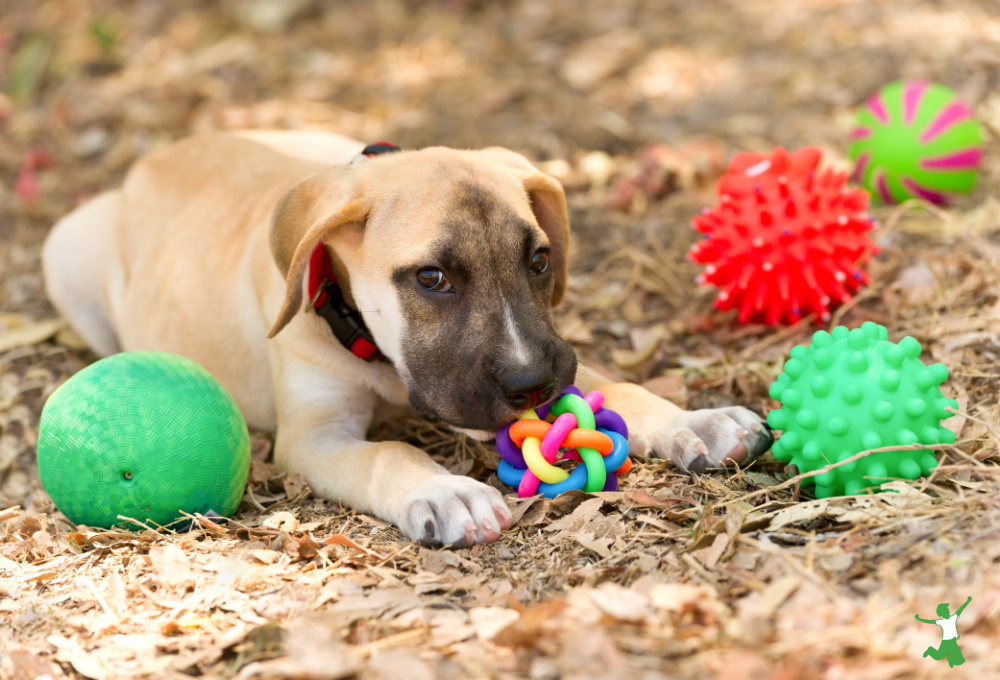
When dogs chew nylon bones or synthetic rubber toys, tiny fragments break off. Polyester beds
and plush toys shed microfibers into your home. Those particles become part of household
dust, which both you and your pet inhale.
But why should you be concerned? Because science is starting to share some startling facts.
- Research has detected microplastics in animal tissues and feces. Animal studies have shown biochemical and structural damage to organs such as the intestine, liver, and reproductive systems following microplastic exposure. (3)
- A 2025 study found that microplastics were associated with male fertility issues in both humans and dogs. (4)
- Scientists have also found that microplastics can carry metals, bacteria, viruses, and persistent organic pollutants, potentially increasing inflammatory responses and immune disruption. (5)
- NOAA has reported that microplastics may cause inflammation, microbial imbalance, oxygen deprivation in tissues, and may serve as pathways for other contaminants. (6)
When you think about your beloved pet innocently chewing on plastic toys intensely and
repeatedly, the issue becomes harder to ignore. They may not know what phthalates or
plasticizers are, but they do simply trust us to keep them safe. But are we?
Phthalates and Plasticizers in Dog Toys
Many dog toys, even your favorite “natural rubber” toys often contain phthalates, which are plasticizers added to make materials more flexible and durable.
These chemicals have been linked to endocrine disruption and reproductive system impacts in animals.Here is the concerning part.
Children’s toys are regulated for certain chemicals. Pet toys are not.
There are virtually no federal or state laws that apply solely to the manufacture and sale of pet toys.
That “indestructible” chew toy your pet loves and you think looks cute, may be durable because of chemical additives that were never evaluated under any health standards.
Greenwashing in Pet Products: When “Eco” Is Still Plastic
You pick up a toy labeled “natural” or “ocean plastic” and think, finally, a better option. You are
trying. You care. And then you learn it is still plastic.
Ocean recovered plastic is still plastic. It may remove waste from waterways, which is
wonderful, but once remolded into a toy, it can still shed microplastics and still sit in a landfill at
end of life.
Recycled, ocean recovered plastic is a good option for use in some forever products,
like park benches. But it’s not a great option for our pet’s health.
“BPA free” usually means a different plastic formulation was used. Sadly, it usually does not
mean plastic free.
“Made with natural rubber” often includes synthetic fillers like plasticizers unless the brand
clearly says otherwise.
Greenwashing relies on comforting language. Transparency relies on specifics. If a product is
truly plastic free, it should clearly say what it is made of and leave nothing to the imagination.
And you have every right to ask questions when materials from a brand are not clear. If they
cannot or will not answer your question, that would certainly be a red flag.
How to Avoid Hidden Plastics in Pet Products
If you’re ready to make changes to reduce plastic in your pet’s life, here are some ideas to get
your started.
- Choose plastic-free pet toys made from hemp, cotton, wool, and clearly disclosed natural materials
- Avoid products that rely on vague terms like BPA free or eco plastic
- Look for brands that are transparent about sourcing and manufacturing
- Replace polyester-filled beds with natural fiber options like cotton or wool
- Repurpose old clothing to stuff pet beds so you know exactly what is inside
- Buy pet food from bulk stores using your own containers or switch to home cooking for your pet
- Support brands advocating for recyclable or compostable packaging systems
Small swaps matter to avoid overwhelm. One toy at a time. One bed at a time. One step at a
time really does matter and can make a difference.
Two Brands Making a Difference
Boba & Vespa Plastic-Free Pet Toys
When co-founders Laura and Jennifer began researching pet toy brands to carry at The Kind Pet, their marketplace for sustainable pet products, they quickly realized how difficult it was to
find truly plastic-free options.
Then they discovered Boba & Vespa, a line of plastic-free, zero waste pet toys made in the USA
from 100% natural materials like organic cotton and hemp. After bringing the brand into their
marketplace, Laura and Jennifer watched it grow. When it later faced closure, they made the
decision to acquire and preserve it, ensuring it could continue as part of The Kind Pet.
Each toy reflects the same values that guide The Kind Pet’s marketplace: transparency, safety,
and lifecycle responsibility. They are designed to be repairable and compostable, with
minimalist plastic-free packaging.
For pet parents who have ever questioned what is really inside a toy labeled “natural,” Boba &
Vespa offers something simple and clear. Honest materials. Thoughtful design. And a
commitment to reducing plastic in the pet industry.
HEVEA Natural Rubber Dog Toys
HEVEA originally built its reputation creating safe products for babies before expanding into pet
products. That foundation matters.
HEVEA’s dog toys are made from plant-based, vegan natural rubber that biodegrades at the
end of life. Their products are PVC free, BPS free, phthalates free, BPA free, and lead free.
Even their color pigments are plant-based and safety tested.
As far as we can tell, their dog toys are the only rubber pet toys that meet EU standard EN1400,
US regulations CPSIA and AUS regulation AS 2432-1991EU safety regulations for toxicity in
baby and children’s products.
For pet parents navigating confusing labels and greenwashed claims, knowing a product has
been independently tested and clearly disclosed can replace uncertainty with reassurance,
making HEVEA a good choice.
Sustainable Pet Care Is About Progress, Not Perfection
Your pet deserves safer materials. Your home deserves fewer microplastics in the dust. And our
planet deserves fewer hidden plastics entering landfills and waterways.
Sustainable pet ownership is not about guilt. It is about awareness followed by thoughtful action
made step by step at your own pace. This is not a competition, it’s about doing what you can,
when you can to make impactful changes you can feel good about.
Let’s keep learning and choosing kinder options together.
(1) Pet Sustainability Coalition
(2) Demonstrating greater sustainability while maintaining desirability of plush dog toys through life cycle assessments and dog owner participation
(3) Harmful effects of the microplastic pollution on animal health: a literature review
(4) Microplastic presence in dog and human testis and its potential association with sperm count and weights of testis and epididymis
(5) Animal exposure to microplastics and health effects: A review
(6) New Research on Microplastics in Marine Mammals and Human Health Risk Assessment Presented



Leave a Reply