
By Guest Authors Will and Susan Revak of OraWellness.com
In order to really discuss and put into perspective how consuming traditionally prepared bone broths supports our oral health in such a foundational way, setting a baseline of understanding just how common oral health issues are and the common ways the breakdown of oral health occurs is necessary.
Letʼs cover the “bad news” first because contained within the “bad news” are clues and gems of wisdom on how to create the “good news” of improved oral health in our own lives and that of loved ones.
Sobering Statistics:
- 9 out of 10 adults at age 30 already have some stage of active gum disease.
- 65% of 15 year olds are already showing beginning signs of gum disease.
- 92% of adults have tooth decay (National Institute of Dental and Cranifacial Research).
The results unfortunately go well beyond a pretty smile.
- Loss of teeth (1 in 3 65 year olds has no natural teeth left in their mouth).
- The breakdown in health which results in the loss of ability to properly chew food.
- Cost of dental industry through the life of an ʻaverageʼ person.
- Huge implications and potential causal factors of oral disease in other systemic diseases including heart disease, cancer, diabetes, arthritis, the list goes on and on.
So, if these sad statistics are correct, which unfortunately they are, most of us are going to personally experience this breakdown in our oral health which will significantly impact our general health and our ability to live a full life.
However, a close look at these issues can illuminate some gems on how we can take the road less traveled and navigate to greater oral health. Before we get into the “good news”, letʼs spend a moment understanding the two main issues here, tooth decay and
gum disease, so we can fully grasp the significance of how bone broths support greater oral health.
Cavities and Periodontal Problems: One and the Same Issue
Tooth decay are gum disease are fundamentally the same issue. Both involve a breakdown and loss of bone tissue and connective tissue. Most people realize that tooth decay is a bone loss issue. However, gum disease also involves bone loss. You see, as gum disease progresses, the bone which acts as a foundation for our teeth breaks down. Lacking a foundation over time, the teeth simply fall out (gum disease is the #1 reason for adult tooth loss).
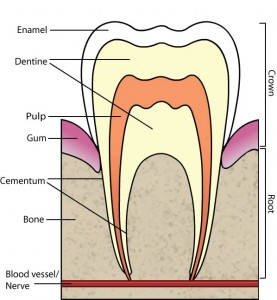
In addition, both tooth decay and gum disease are a breakdown of the connective tissue in the mouth. In the diagram to the right, you can see that the center chamber of each tooth is filled with pulp, which is nerves, blood vessels, and is mostly connective tissue. Moreover, each tooth is anchored to the jaw bone foundation by a ligament (connective tissue). If you think about it, bone never connects to bone in the body.
There has to be connective tissue to connect (redundancy intended) to the bones. The gum tissue really functions as an interface between the teeth and jaw bones as well as the mechanism to support the region by circulating fluids in the area.
With this baseline in place, the question is how to best support and enhance the body to create and maintain greater bone and connective tissue health?
Folk medicine is a really condescending way of referring to how our ancestors successfully organized and kept themselves alive on a planet where the only constant was change. Interestingly, many of our ancestors showed an expression of vitality and vigor that is becoming less and less common in our times. Well, folk medicine has long understood the concept of “like supports like”. In other words, when we consume a specific part of the body of an animal, we support that same part of our body.
Thankfully, we donʼt have to eat cow teeth in order to support our oral health! But the principle that the bone and connective tissues in the body of an animal provide our own bones and connective tissues with the specific nutrients they need to grow strong and maintain health over time rings true. Modern nutritional science substantiates what our ancestors understood through instinct and observation.
Keeping it simple, our bones and therefore teeth are mostly built from calcium and phosphorus, among other minerals. A major component of our connective tissues is collagen. One of the beneficial aspects of collagen are a group of nutrients called glycoaminoglycans (GAGs for short). Anyone who has spent some time in a supplement section knows a few popular GAGs, glucosamine, chrondroitin and hyaluronic acid.
GAGs are crucial for supporting greater connective tissue health. In fact, they are prized as ʻyouth serumsʼ for their ability to help the joints feel soft and the skin remain firm and even in tone (all connective tissue support).
The question is how do we get these beneficial minerals and nutrients into our systems in a highly bio-available form?
Bone Broth Provides the Basic Raw Materials for Oral Health
The answer is traditionally prepared bone broths! It is important to note that organic broth from the store is no substitute.
If you think about it for a moment, slowly cooking bones, particularly joint bones, over the course of 3 days gives the bone and connective tissues in the pot time to breakdown into the stock water. The result is the perfect balance of minerals that are easily absorbed by the body to support bone health combined with lots of collagen for connective tissue health as well as super healthy fats from the marrow to make all the above more bio-available into your system.
Mineral supplements will not provide the same easily absorbed, colloidal minerals as a properly prepared bone broth!
While this may not sound particularly mouth watering described this way, itʼs precisely this process that not only makes any soup way more nutritious but also much more flavorful and delicious. (think grandmaʼs soup, and if you didnʼt have a grandma who made soup like this, all the more reason you have to for the health of your family!
Itʼs so simple!
You can use bones from any animal you feel comfortable eating which can range from beef and chicken to turkey, duck, fish, bison, deer, lamb – you fill in the blank. Wild caught from clean areas would be optimal for their greater diversity in diet. Most of us simply go to our local butcher and ask for meaty joint and marrow bones for stew. Be sure the animals are pasture raised. Again, following the “like supports like” idea, how are we supposed to live healthy lives eating unhealthy animals?
Use bone broth as a base for soups, add it to beans or rice while cooking them, have a warm cup in the morning (really!) – there are so many ways to enjoy this delicious, nutritious bounty from nature that will help keep your teeth and gums strong for your entire life!
The question you are faced with now is if you are willing to take the road less traveled today and follow the path our ancestors clearly showed us was the way to creating and sustaining greater health (including oral health) or continue to follow our modern culture
in its nutritional trainwreck.
Iʼll see you at the butcher!
About The Authors
Will and Susan Revak are the founders of OraWellness. They began their journey into real food, real medicine and real wellness in their early 20s. Their journey creating greater oral health in their own lives started 17 years ago when Susan was diagnosed with advanced gum disease. Here is a link to Susan’s story of how she reversed the damage of advanced gum disease in her own mouth on her own without dental surgery.
|
|

{ 63 comments… read them below or add one }
I had to have gum surgery at 29 years old. It was horrible and I hope to never have to have it again! I have to get my teeth cleaned every 4 months now. I do try to have broth more often and I hope it will help my situation.
I actually know someone whose child had to have gum surgery at age 10 or 11. That’s how young these problems are now cropping up.
Raquel,
Thankfully, alternatives exist! Being in the business of helping folks navigate to greater oral health, we hear plenty of horror stories. The good news is each of us can take actions today to improve our oral health. The path is clear to navigate to greater oral health. The ‘bad’ news is that no one can do it for us. It’s up to each person to decide if they want to create positive change. Once the decision is made, the people, information and tools show up!
We have lots of free video tutorials and downloads on our site to help folks along this path.
i must comment here that DIET IS EVERYTHING – adding bone broth is and *excellent* step – but if you do not address the issues of fats and oils, grains, sugar and carbs in general, you will have very limited success by just adding bone broth!
dental health (as Weston Price’s travel research clearly showed) is a matter of NOT EATING THE WRONG FOODS as much as eating the good things – bone broth, quality meats and seafood, etc.
We stopped our 1 year olds tooth decay in it’s tracks but our immediate success was due to the whole package of changes we made in our diets.
You can read her story here (cut/paste google): Healing Tooth Decay: Cod Liver Oil/Butter, Xylitol, Spry Gel & Tooth Powder
Ravi
Daiasolgaia
Don’t go back to sleep…
We almost completely agree with you that diet is (almost) everything. Clearly, diet plays a crucial, fundamental role in anyone looking to create positive changes in their oral health and overall health for that matter. After all, I’m sure we’d both agree that oral health is simply a mirror of what’s going on in the rest of the body.
Good for you for successfully addressing your child’s needs such that you stopped the decay! Way to go! We are so excited by the number of success storied beginning to pop up now. So beautiful of you to share it so others can benefit…
We agree that health is a two sided issue. First, we must stop putting toxins (including foods that create toxic reactions in our system) into the body. Second, repopulate the gut with healthy ecological environment. Without this in place, there’s simply no chance of really bringing our immunity to a high enough place where we can become ‘unsuitable hosts’ for the opportunistic ‘bad bugs’ that cause tooth decay and gum disease. And third, we must address nutrient deficiencies. From our perspective, we must have all 3 pieces in place. And that’s just the nutritional issue. We also must address stress as the research continues to prove the very real impact of stress on immune function.
Keepin our eyes wide open!
Aloha
YES! Great explanation. I totally agree
If using marrow bones, you want to leave the marrow in, right?
Thanks for the write-up. I’ve only ever made stock once (after reading about it here) but I didn’t keep up the practice – hard to find pasture raised animal bones around here.
Yes, I leave the marrow in while the broth is simmering.
While local options are always preferred (and generally cheaper), thankfully, we can order many quality nutrient dense products, including marrow bones, via mail!
thank you
I agree completely! Bone broth works wonders when prepared right.
LOVE! bone broth. Once you have had this you won’t go back to store bought. I cheat and use the crock-pot over night, but it still comes out delish!
We love it too Susan! I want to point out a difference for the sake of readers who may not know this (I’m sure you know this). Store bought stocks are not bone stocks/broths. They are made from muscle meats, not bones. As such, store bought box stocks are pretty much flavored water compared to hearty, rich, home made bone broths. The flavor is the proof! And we don’t consider using a crock pot cheating!
how long do you guys let it cook?
18-24 hours for chicken.. we do chicken most of the time..
-jason and lisa-
We make mostly beef bone broth and let it cook for 3 days on average. Sometimes we draw from it early if we have a yummy dinner that would be even more delicious with a couple ladles of broth!
we have a lot of bones left over from our own raised pigs and chickens
Yes! The crockpot makes it easy!
I believe that a lot of dental issues are related to fluoride. Get rid of the fluoride.
We completely agree Lauren. However, getting rid of the fluoride is much, much more challenging than many folks realize. As just one example, any processed food (organic or not) made in a city/town that fluoridates its water (74% of US is currently fluoridated) will have pretty high dose in the product (think Wheaties for example).
So, it’s not as simple as just using oral hygiene products that are fluoride free. That said, by all means, we encourage folks to steer clear of oral products containing fluoride.
Your example is perhaps correct, (the Wheaties) but anyone wanting to improve their dental health should also be eliminating virtually ALL packaged/processed foods ESPECIALLY PROCESSED GRAINS!
By designing a diet full of whole, real foods – locally produced veg, fruit – grass fed dairy and meat – there will be very few possible exposures to fluoride.
convience foods are very seldom either food or convenient – stop eating them.
Ravi, Daiasolgaia
Don’t go back to sleep…
Again, we align very strongly with your point here. I don’t want any readers to underestimate the importance of avoiding fluoride and the extreme awareness this active avoidance requires.
For example, even if one is purchasing all organic produce, whether the crops are watered with fluoridated water and even how they are watered plays a role as to whether the plant uptakes the fluoride in the water (naturally occurring or added to municipal water supply).
What about bathing water? It’s been proven that we uptake fluoride through the skin very well.
What about drinking water? The only water purification systems we have found really effective for removing fluoride from water is steam distillation and reverse osmosis. Sure, some filters remove some of the fluoride but the life of the filter media is rather short. We would love to find a drinking water filter we can whole heartedly recommend. Most systems on the market use aluminum to remove the fluoride. Hmm, remove fluoride and put in aluminum?
Keep up the good work!
Eyes wide open!
Keep in mind that 74% of the USA is currently fluoridated (CDC).
this shit is ridiculous
I have a tad bit of this going on, I’m 32 and have always had perfect teeth. I was heartbroken when I found this was happening. My father in law is a dentist too. I look forward to trying this. I use the flippin sonicare twice maybe even three times a day and this still happens to me. =(
Any recipes?
The vegans will be outraged!
It is not worth being a vegan
I was a vegan and vegetarian for the last 10 years but am now following a WAPF type diet inspired by Ramiel Nagel’s “Cure Tooth Decay.”
Dentistry is iatrogenic and traumatic. If you didn’t have good teeth when you were a child, vegetarianism and veganism might not work for you. In the 9 months since I have changed my diet, I have paid overa thousand dollars to a dentist.
If you follow a diet to heal your teeth, imagine what it saves for you, and imagine all medical waste it keeps out of waste stream if you don’t have to get needles stuck into your mouth that then become hypodermic needle garbage.
Any suggested recipes please??
and toothless
loretta:upwards of 13 hours,low heat. michele: pasture raised chicken feet(or beef bones)i use 18-20 of the feet. have the butcher clip the nails. rinse and soak in a stock pot,along with 1 cut in half onion,a carrot,celery,and water up to the lip of the pot(empty it a bit if it goes boiling out)allow the bones to soak in the water along with a tablespoon of apple cider vinegar,which leeches the good stuff,then bring to a strong boil,turn it down,cover and keep on the stove for up to 13 hours. have your jars ready. and above all DO NOT put warm glass in the freezer. make sure the stock has cooled cooled cooled before they go in the freezer. do NOT fill to the top of the jars either,for both of these things will surely cause your jars to shatter. good luck. its awesome stuff. easy to make and you have the luck of stocking it in your freezer for easy use.
love this stuff! my mother grew back her gums and bone density, the dentist was measuring it in case she needed surgery. this stuff is TRUE! she even did it with factory animals. imagine what could be done with the good stuff! i feel so lucky to know early, i’m in my 20s now and hopefully will never a problem with my teeth. brush, floss, and bone broth! also some homemade mouthwash doesn’t hurt. it certainly cleared up my husband’s mouth trouble.
You’re definitely heading in the right direction!
and coconut oil!!
I have a pot of free range chicken that has been simmering for 30 hours on the stove so far
) There is a HUGE difference between farm raised chickens and grocery store- the farm chicken broth is so much richer and more flavourfull. Going to make some butternut squash soup for lunch- yum!
Dove\’s last post: Calgary
I was wondering about any thoughts on eating the bones themselves? I’ve recently begun making stocks & broths the more traditional way (ie. I grew up dropping a bouillion cube for every cup of “broth”called for in recipes) and often find that bones simmered real long are soft enough to eat–specifically chicken drumsticks–they are very flavorful and can still taste that there is marrow not leaching into the broth so am wondering the benefits of eating the bones themselves in addition…..
I think there is some merit to your idea Beth. While I still think that the broth is superior due to minerals, highly beneficial GAGs, and quality fats being in a yummy solution together, given the bones are soft, I’ve nibbled on them before too.
Judith- You put the apple cider vinegar in the water with the bones and vegetables or before hand just in a pot with the bones and water…. And you soak it for how long before putting on the stove…. And if I put everything in the crockpot is it still 13 hours in there…
So I have a question. I have multiple teeth that need fillings as the the cavities are quite old and do not hurt. I hate the dentist. Is there a way to heal these teeth?
Get a copy of Ramiel Nagel’s book “Cure Tooth Decay” and visit the website that goes with the book, http://community.curetoothdecay.com
Christine,
My daughter had some small cavities about 18 months ago. After reading Ramiel Nagel’s book “Cure Tooth Decay” and doing some research online this is what I came up with:
Carlson Vitamin K2-MK4 – 45mg/day – taken with the Cod Liver Oil
Solgar Cod Liver Oil – 4-5 softgels per day – taken with the K2
Calcium, Magnesium and Phosphoros supplement – whatever the label suggests
Vitamin D3 – whatever the label suggests
Now Plant Enzymes – 1-3 per meal
Nature’s Way Ginger 1 per meal – if your tummy feels warm you’re taking too much. Drink some water and reduce your dose.
Nutrition Now PB8 – whatever the label suggests
We changed our diet to include grassfed beef, free range duck eggs and chicken eggs when we could find them. I snuck some grassfed liver into everything I thought possible. If you blend liver up in a food processor, you can freeze it in an ice cube tray. Adding one cube to spaghetti sauce, hamburger, stews, soups, etc isn’t a problem then. It all adds up!
None of my family can tolerate dairy or I would have added grassfed butter. Grassfed Butter and Cod Liver Oil work wonders with the Vitamin K2.
We also quit using regular toothpaste and switched to EcoDent or IPSAB Tooth Powder. Most toothpaste contains glycerin which blocks remineralization.
Now, we eat bone broth but at the time I didn’t know about it.
At my daughter’s next appointment, six months later, her tooth density more than tripled. I did learn a lesson. If you don’t keep it up, your teeth will be back in the same boat they started in. After that appointment, we discontinuted the K2 and switched to Cod Liver Oil because things looked so good. The following appointment, her tooth density was worse than the first appointment. The numbers were twice as bad and the dentist really pushed to drill and fill that day. I resisted and put her back on the Cod Liver Oil and K2. Her tooth density was much better the following appointment.
Hope that helps someone!
Thank you for the testiment, Seana! The most folks who can read real stories like yours, the more we as a culture wake up to the truth that we can create massive positive change in our health at our own hands.
Thank you for your summary of “Cure Tooth Decay”.
I posted a comment on the article as well, but I have multiple teeth that need fillings and I hate the dentist. Can they be healed this way?
There are a lot of ways to heal your cavities. I’ve gotten rid of a cavity 100% & more than half of another one (still working on it). Get yourself a copy of the book – “Cure Tooth Decay” from Amazon.
I know I should refer to Ramiel Nagel’s “Cure Tooth Decay…” but I haven’t finished it yet…My question is, how much broth should we be consuming each day to assist with and repair gum health?
This is a tough question because the number of variables. It really depends on each of our state of immunological health, what other factors in our life are contributing or degrading our health, as well as the quality of the broth, to name a few.
Clearly, we’d be pretty challenged to have too much bone broth. I really don’t think it’s very possible. One can easily enjoy a quart or two everyday in soups and simply by itself in a mug (think warm drink that nourishes rather than takes from our immunity).
I buy my broth from a local butcher who uses pasture raised animals. I don’t think he cooks the broth for longer than a day, but it gels so much it often retains its shape when I dump it out of the container. I’m guessing this means it has all the glycosaminoglycans (love that word) I could want, but could it still be missing something it would have got if cooked longer?
Christine: yes, read that Cure Tooth Decay book! Also, I’m currently experimenting with a supplement called MinCol. People who’ve used that have said their old fillings have fallen out because the tooth built a layer of enamel underneath to heal. Also, silica is important, but not all have the greatest absorbency. Orthosilicic acid is said to be good. Right now I’m using Eidon’s silica. Can’t comment on its effectiveness as I just got it yesterday.
I recently went to a holistic dentist. I am in my 40s and have battled sensative teeth and receding gum lines since I was a teen. This was the first dentist to address the issue, test for bacteria below the gum line, and then explain the cause of the issue. Thankfully, I use food and nutrition to aide in healing. It was just so great to hear more than the standard, “You have receding gum lines. You brush too hard.” Which I do not. My extra gentle toothbrush always looks brand new, I am so gentle.
About bone broth; We raise and process our own pastured poultry so have plenty of carcasses to make into broth. I use ACV as well, but I have found this in the broth does not go well with cream/milk based soups and chowders. I caused my white chili (when adding sour cream and cheese) to separate.
)
I currently have this exact problem–I was yelled at for years by my dentist as a child for not brushing well enough, so I got scared & brushed real well, then when I was in college I was told my gums were receeding because I brushed too hard! I’ve recently begun incorporating broth, supplements and eliminated processed foods–question can you reverse sensitivity and gum recession? My dentist told me the only option would be a gum transplant that is super pricy. He had me purchasing super expensive toothpaste (called MI paste $13/bottle) and $100 on an electric toothbrush. I’ve made my own with baking soda, but it makes the sensitivity difficult because it’s so abrasive….
gum stimulator from the store.. supposed to stimulate blood flow back to the weakened area and help healing.. also, dont brush hard and look at making your own tooth paste..
-jason and lisa-
Beth,
I would personally run out of the office if a dentist ever told me that surgery is the only option. What they aren’t saying, whether they are aware of it or not, is something is the only option that they know of. Options exist. Options exist even to not use products like MI paste which contains ‘questionable at best’ ingredients. Stay tuned here with Sarah for news about an upcoming free online event we are hosting. It will help…
You can read “The Perfect Perscription for Your Teeth” that is sold at the toothsoap.com website, but, honestly, Ramiel Nagel’s book is WAY better, and toothsoap is too expensive. I mention it because that book suggests brushing with soap, and I do to, but I disagree with that book and I prefer “Cure Tooth Decay” and “Nourishing Traditions” and a WAPF diet.
Other things like baking soda may be too abrasive.
My favorite is a coconut oil based soap with nothing else, and one tiny drop of ORAMD’s essential oil blend to give it a pepperminty taste. Coconut oil soaps seem to be more palatable than regular organic soaps if you choose to brush with soap.
Does it affect the efficacy if you use the broth to make, say, a pumpkin soup?
It will make the soup taste better!
This is interesting. I had a lot of gum recession because of extremely agressive orthodontic treatments when I was a teenager. We did some palatte expansion on top and then 3 years of braces. Ouch. Anyway… my dentists over the past 15 years have been trying to get me to get extremely costly gum grafts because they keep warning me that my slightly exposed roots are going to decay. Let me preface this with saying that in all of my childhood and adult life I have NEVER had a cavity. I will ashamedly admit that as a child I had HORRIBLE oral hygiene habits… I barely took care of my teeth and only flossed maybe twice a year (right before dentist appointments) until I turned 13. I remember telling my mom I’d brushed my teeth and flossed often but really hadn’t. We didn’t eat a perfect diet growing up but my parent’s were major foodies so we always had raw european cheeses in the house, often had sourdough, almost always had sprouted wheat bread, fought over who got bigger pieces of liver and shellfish, my dad never bought farmed seafood, I ate copious amounts of raw oysters and ate entire crayfish head to tail at the age of three, my mom bought organic free range chickens and thought canned broth was disgusting so pretty much any dish she and my dad cooked used real stock, and we often bought produce from farmer’s markets. We didn’t have any snack foods in the house either (much to my teenage friend’s chagrin.) I always thought I just got a lucky genetic break, since my dad never had cavities either… he was the original foodie and so was his mother and grandmother. Lo and behold my mother stopped getting cavities in adulthood after she married my father and got turned on to REAL FOOD. I’m almost 30 and I still haven’t got those gum grafts and my teeth are still strong and cavity free. Learning about all this made everything come in to focus for me. Real food and good/diverse bacteria builds a healthy mouth. Nothing else does. I’ve been battling obesity the past 6 years, probably from my high soy vegetarian diet in college and early adulthood. Going back to eating the way I did while growing up feels sooooooo great.
Wow, thanks for sharing! What a beautiful testament! Welcome back to real foods!
Are there any vegan alternatives to your remedies you can suggest?
Theoretically, it’s possible on a vegetarian diet, but I don’t know of any vegan alternatives. At least with a vegetarian diet, one could still eat loads of quality butter, cream and eggs to help make up for the missing nutrition. Coconut oil is wonderful but by itself can’t begin to fill the nutritional needs that concentrated animal products offer.
For example, in order to get sufficient calcium in one’s daily diet (the recommended amount is one gram), we need to consume the equivalent of 3 glasses of fresh whole milk, 6 ounces of hard cheese or 4 cups of cooked greens (not 4 cups of fresh greens, 4 cups of cooked greens – after they have significantly reduced in volume!). So, you see, animals concentrate nutrition. Without consuming animal products, we have to consume very, very large quantities of vegetation. Every friend of mine who is vegan falls short from these nutritional requirements. It’s just very difficult to do everyday.
Knock refined sugar out of your diet and take your dental health into your hands!
This is quite a long quote from William Dufty’s “Sugar Blues,” but it is worth reading if you are serious about your dental health. Dufty is quoted extensively in the sidebars of Sally Fallon’s “Nourishing Traditions.”
From William Dufty Sugar Blues page 198,199
The avant garde of dentistry has rediscovered that the body and the teeth are not two separate entities; the teeth are part of the body. There was an entire period during which the teeth were thought to be “inactive organs”: tooth decay was taken to be a local development on the surface of the teeth. Dentists were considered in the league with the barbers, as mechanics, cosmeticians, tinkerers. If a dentist talked to a patient about anything except cavities or the choice of a filling, he was treading on the jealously guarded terrain of the medical man.
All that is over. Dental researchers have proven that the teeth are subject to the same metabolic processes that affect other organs of the body. The entire body is one.
By adapting a technique originally developed to study movement of fluid within organs like the liver and kidneys, two researchers from the Loma Linda School of Dentistry have found that subtle changes in the internal activity of the teeth, caused by sugar, can be an early sign of later decay.
In their report to a Chicago meeting of the International Association for Dental Research, Doctors R.E. Steinman and John Leonaora showed that the principle change,caused by sugar, is in the movement of fluid within the teeth. Hormonal chemicals are carried from the pulp to the enamel through the channels in the dentin.
Resistance to tooth decay involves the health of the entire body: complex physiological processes are involved in maintaining and protecting the health of the teeth.
The two researchers found that:
– high sugar diet can slow the rate of transport of hormonal chemicals by as much as two thirds even in one week.
– Teeth with sluggish internal activity have a high incidence of decay.
– A hormone released by the hypothalamus stimulates the release by the salivary
gland of a second hormone. The second hormone increases the rate of fluid flow
through the teeth.
– A high sugar diet upsets the hormonal balance and reduces the flow in the
internal system. This weakens the tooth and makes it more susceptible to decay.
- Healthy teeth are normally invulnerable to the microbes that are always present in your mouth.
Who wants to get rid of friendly germs in the mouth except those crazy people selling mouthwash?
Dufty’s source for this information is in an endnote that says “Medical World News”, January 14, 1972, March 16, 1973
(Sally Fallon in Nourishing Traditions quotes this page Dufty : page 417 of NT)
-
I’ve made bone broth for years, cooking it down into a gelatin. I use it in all of my soups, gravies, and sauces. However, I strain and degrease it first. Does it still have its dental-nourishing properties without the fats?
I didn’t read through all of the comments, but I was wondering: Is there any risk of fluoride exposure in bone broth, considering fluoride concentrates in bones and fluoride in water concentrates when boiled? I have a thyroid condidtion and really try to avoid all fluoride exposure. I would be using RO or spring water to make the bone broth.
Aloha Ella,
I think this is an excellent question!!! Thank you for asking. While I agree with your line of thinking, it is our opinion that the benefits of bone broths far outweigh the risks of excessive fluoride exposure from consuming bone broths.
If you are particularly concerned, you could find a butcher who works with veal and ask for these bones. Just like in humans, fluoride accumulates over the years in the bone tissue. Given that most cattle who are raised for pastured meat really aren’t on the planet very long, I discount the risks personally. All that said, I commend you for your forward thinking and agree with all your points you touch on.
Obviously, one determining factor would be if the cattle are given fluoridated water to drink. If so, I would have to weigh it all much more carefully. Clearly, making stock with non fluoridated water would be wiser in general for reasons we don’t need to discuss here.
Holler with any other excellent questions Ella, we’re here to help!
Thank you and Aloha!
Thank you for your kind response and great ideas. I will try these suggestions.
{ 5 trackbacks }