
Slippery Elm: “Go To” Herb for Digestive Relief

by Sarah, The Healthy Home Economist on January 19, 2011


This time of year, tummy aches and stomach bugs seem to run rampant through any group of people where kids are involved!

When someone in my family has a stomach ache or is experiencing any sort of digestive distress (from perhaps eating out or too many sweets at a party), Slippery Elm is by far my favorite herb to use as a soothing tonic.

Slippery Elm is an herb native to North America and is derived from the inner bark of the elm tree.    It has long been used by Traditional Cultures in the New World for a variety of ailments, but its use as a digestive aid is probably the most popular.

Slippery Elm is very soothing to the entire digestive tract as it forms a soothing film over any mucous membrane it comes into contact with.    Not that this matters much (to me at least), but the FDA has even approved Slippery Elm as a safe, demulcent substance, which means that it relieves minor pain and inflammation in mucous membranes such as what lines the digestive system.

The ability to temporarily reduce inflammation and pain makes Slippery Elm especially helpful for conditions such as IBS and colitis.  It can also soften and add bulk to stools, so it is useful for both diarrhea and constipation issues.  Its soothing/coating qualities protect the throat and so can be helpful for persistent reflux problems as well.  Even folks with ulcers and gastritis can find benefit using Slippery Elm.

Slippery Elm is truly the “go to herb” for digestive problems!

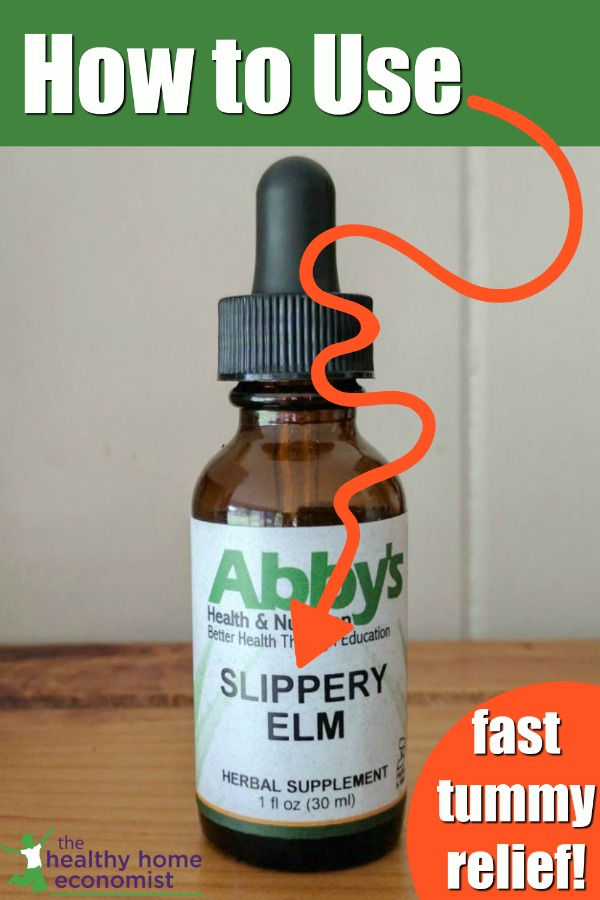
I have found that the most effective way to utilize this herb is as a tincture although you can purchase it in pill or powder form as well.   Used as a tincture, it easily coats all mucous membranes from the mouth right through to the rectum as it passes through the body.     It is easy to take in a swallow or two of water as it tastes great!     My kids ask for it anytime they feel the need and it can safely be used up to 3X per day (28-56 drops in some water each time is what my bottle says – always follow the directions on whatever brand you buy, of course).

Truthfully, I’ve found that you don’t need anywhere near 28-36 drops per dose.   I give myself or my family maybe 10-15 drops in an ounce or so of water and that typically works fine the very first time.   I occasionally need to give another dose a few hours later, but most of the time, one dose works wonders!

So next time you are at the healthfood store, pick up a bottle of Slippery Elm tincture and keep it in your wellness cabinet with your other herbs and whole food supplements.   And, please make sure that whatever brand you choose is sustainably harvested!

And don’t ever forget to take Slippery Elm with you when you travel! This herb is a must to keep tummy aches at bay when eating out on a frequent basis when the quality of the food is lower than what you would serve at home.

*Please note that Slippery Elm should not be used during pregnancy as it can dilate the cervix and/or stimulate uterine contractions.

Sarah, TheHealthyHomeEconomist.com

Source:  The Long, Hollow Tube:  A Primer on Digestive System

Picture Credit


The Healthy Home Economist by E-mail


{ 67 comments… read them below or add one }

Jo at Jo's Health Corner January 19, 2011 at 12:58 pm

We love slippery elm in our family. We are currently using it for our dog’s digestive issues, leaky gut, which is the reason main reason for her respiratory problems.
Jo at Jo’s Health Corner\’s last post: Fitness Monday – A Closer Look At The Metabolic Hormones- Insulin

Reply

Kelsey January 20, 2011 at 5:49 pm

Neat! That’s good to know. Our dog had lots of tummy trouble as a puppy, but seems to be over it now. But I will for sure try this next time before taking him to the vet. Thanks!

Reply

Sarah, The Healthy Home Economist January 19, 2011 at 1:59 pm

Cool! So slippery elm works for all the “pets” in one’s household .. furry or otherwise! :)
Sarah, The Healthy Home Economist\’s last post: Slippery Elm- “Go To” Herb for Digestive Relief

Reply

marina January 19, 2011 at 2:11 pm

what a timely post Sarah!
my daughter has been complaining about stomach ache for 2 days now (usually comes on at night) and I did not know what to do. I have organic tummy chewing tablets with slippery elm, but it has lots of other herbs so I guess it does not have a sufficient dose. I will get the drops for sure.

Reply

Jennifer January 19, 2011 at 4:40 pm

Any input on how (or whether) Slippery Elm would work on reflux problems? I’m trying REALLY HARD to get off my reflux medication. I’ve been using digestive enzymes (Houstons) and Bio-Kult to try and help get things working properly again, but I’m still having really severe reflux at least once a week. Think this might help?

Reply

Sarah, The Healthy Home Economist January 19, 2011 at 4:58 pm

Hi Jennifer, Slippery Elm will sooth the burning of the throat/esophagus greatlly but will not help solve the problem. A tsp of raw apple cider vinegar in a glass of filtered water after meals has helped a number of folks I know with reflux. Ultimately, diet change is what fixes the problem. My husband had severe reflux many years ago and hasn’t had issues in a very very long time. He ate tons of raw cream and severely limited grains/starches to heal.

Reply

Jennifer January 19, 2011 at 7:43 pm

Thanks Sarah. I eat 98% WAP, but I didn’t know about the limiting starches and grains. I’ll definitely look into that. And I have been doing raw cream, but not a lot – less than a quart per week. Did he just drink it, or did he eat it with other things?

Reply

Sarah, The Healthy Home Economist January 19, 2011 at 7:55 pm

Hi Jennifer, his thing with the raw cream was a sliced banana, a bit of raw honey, and a big scoop of raw cream in a bowl. He also made homemade ice cream and made milkshakes with it.

Reply

Sarah, The Healthy Home Economist January 19, 2011 at 7:56 pm

Oh, and I have a video on how to make the raw ice cream. Click on the “Videos” tab at the top of the blog.

Stanley Fishman January 19, 2011 at 5:56 pm

Thank you, Sarah, this in really good to know. I really appreciate your giving us the method to use this remedy, as well as describing it.
Stanley Fishman\’s last post: Weston A Price Diet Means Strong Bones

Reply

Paula January 20, 2011 at 11:43 am

Great! thanks for that info.

Reply

Kate @ Modern Alternative Mama January 20, 2011 at 11:54 am

We discovered this last week when we had stomach flu. Although the most helpful thing for my husband has been reducing the mucus in his throat (cutting dairy and grains and going on GAPS isn’t hurting, either). He keeps losenges with him and just sucks on one every few hours.
Kate @ Modern Alternative Mama\’s last post: Pregnancy Journal- Grain-Free and Pregnant

Reply

Alison January 20, 2011 at 1:03 pm

Do you know if it is contraindicated for breastfeeding? I’m always wary of home remedies as I like to protect my milk supply! :) Also, if you know of any resources (book or otherwise) where I can find out in general about lactation and herbals that would be awesome. Thanks for this post Sarah!
Alison\’s last post: GAPS breakfast

Reply

Sarah, The Healthy Home Economist January 20, 2011 at 2:36 pm

Hi Alison, I have used slippery elm myself while breastfeeding. It is a very mild herb.

My absolute FAVORITE book for herbs during pregnancy/lactation is Wise Woman Herbal for the Childbearing Year. It is awesome. I used it extensively for all 3 of my pregnancies. Here is a link to it:

http://astore.amazon.com/theheahomec0a-20/detail/0961462000

Reply

Rebekah January 26, 2011 at 3:59 pm

I wholeheartedly agree. That is an awesome book.
Rebekah\’s last post: Raising Our Children- Raising Ourselves Naomi Aldort

Reply

Martha January 20, 2011 at 2:24 pm

Glad to have this information and would love to see more posts like it! I learn so much from your blog. Thank you, Sarah!!!

Reply

Sarah, The Healthy Home Economist January 20, 2011 at 2:37 pm

Hi Martha, thanks for the suggestion. I will very much try to do more posts on herbs. I really should do more on them shouldn’t I? :)

Reply

Meg January 20, 2011 at 2:26 pm

I adore your blog, and as a sustainably-minded herbalist who frequently convenes with other herbalists from all over the U.S. (conventions, blogs, workshops), I want to share that slippery elm has been an herb we don’t suggest anymore for general use due to its endangered speciesstatus. (due to unsustainable, large-scale harvesting and dutch elm disease issues) We save it for people who need it very specifically and desperately (wasting diseases, etc.) and definitely don’t promote it anymore as a general-use herb for minor issues, because so many other herbs that are abundant may be substituted.

Rosemary Gladstar, one of the foremost herbalists in the US, started United Plant Savers, a non-profit organization to educate people about these kinds of issues, and more information can be found there.

Marshmallow root is a fine mucilaginous alternative to slippery elm. Slippery elm has its place, but once you find out more about this issue, please consider adding something to your s. elm blog post alerting readers about this issue, and that they should strive to be 100% certain that their supplier harvests sustainably, or learn to do it themselves. That way, we’ll have slippery elm in the future when we really need it.

When harvesting any surviving trees you may find or grow yourself, use bark from the largest branches. Cutting too much of the main trunk may kill this beautiful tree that has been rapidly vanishing for the last few decades.

Note: neither link below is for profit or personal gain

United Plant Savers Link for Herbal Sustainability:
Here’s an informative post from an Edible and Medicinal Plant Forum about this issue entitled, “Save our Slippery Elm”:

And a final source of information is herbalist Henritte Kress’s site for herbal education (again, not for profit):
http://www.henriettesherbal.com/archives/best/2003/slippery-elm.html
http://edibleandmedicinalplants.tribe.net/thread/d438c490-2d07-4d4f-acf2-3e0eafe2aee0

Thanks so much for listening.
Meg
Meg\’s last post: Partnering with Doctors for Better Care- Essential Assertiveness

Reply

Sarah, The Healthy Home Economist January 21, 2011 at 9:48 am

Meg, thank you for this important information. I will add to the post to make sure the source is sustainable for whatever folks end up buying.

Reply

Meg January 21, 2011 at 9:07 pm

Thanks, Sarah! The trees thank you, not to mention all the botanists/herbalists/environmentalists who’ve been working so hard on this education campaign. :-)
Meg\’s last post: Partnering with Doctors for Better Care- Essential Assertiveness

Reply

valleygirl January 30, 2013 at 10:24 am

For me I would have no idea what ‘sustainable harvesting’ means. Just putting that out there…might need to come with what questions to ask, what to look for, oh and what it means? LOL

Reply

Mike Lieberman January 20, 2011 at 2:53 pm

Just bought some slippery elm bark powder from the local co-op. Plan on putting a tablespoon in my smoothies.
Mike Lieberman\’s last post: What You Need To Start Your Urban Container Garden

Reply

Megan January 20, 2011 at 3:04 pm

Hmm…maybe I’ll have to pick this up! Thankfully I don’t get as many stomachaches as I used to, but when we travel I’m always wary of tummy woes for me or my little one; this would be great! Thanks for all the helpful tips as always!
Megan\’s last post: Did Wall Street Journal read my blog

Reply

Melissa January 20, 2011 at 6:32 pm

I’ve always used peppermint for tummy issues including gas pains and digestion problems. I’ll check out this herb, also! For herbs and remedies, check out http://www.bulkherbstore.com- you can also make your own tinctures :)
Thanks,
Melissa

Reply

Terrell January 22, 2011 at 12:58 am

I’m travelling to Egypt and Jordan next month. Do you have any other pointers on herbal remedies that might be good to take along? Definately taking some Slippery Elm.

Reply

Jules January 26, 2011 at 7:51 am

I’ve wanted to try it for a while now, but it’s not sold in Belgium, where I live. You can’t find it anywhere, I’ve been thinking about ordering it online. I do however have psylium husk around and I’ve gotten into the habit of letting it sit in water before I use it in anything, been doing the same with chia seeds…seems more right in a way to let them bulk up a bit before you take them…Love, Jules
Jules\’s last post: The Others mixtape

Reply

pat @digestive enzymes supplement April 29, 2011 at 11:41 pm

Thanks for sharing this information to us. Actually, this is just my first time to hear this slippery elm. It’s glad to know that this herb is also good for digestive relief. Very helpful!
pat @digestive enzymes supplement\’s last post: Digestive Enzymes Supplement Digestive Enzymes Supplements

Reply

Amanda May 18, 2012 at 12:46 pm

In powder form slippery elm is a hit mixed with maple syrup and rolled into one inch balls. My 10 yr old son struggles with eczema and before we knew to change the diet we had him eat one ball per day to try to fix the leaky gut. No complaints and we did see jimprovement even with just that. Just thought I’d mention it in case someone already had powder on hand and was looking for an easy delivery system .

Reply

Rachael Manor via Facebook January 30, 2013 at 10:25 am

Love, love, love slippery elm!

Reply

Dana Moore via Facebook January 30, 2013 at 10:26 am

I wonder if anyone had tried using it for morning sickness?

Reply

Kim Bottoni Thomas via Facebook January 30, 2013 at 10:27 am

I use this all the time!

Reply

Jessica Boyes via Facebook January 30, 2013 at 10:28 am

You can’t use it during pregnancy because it dilates the cervix! Does anyone know where you can find this?!

Reply

Elizabeth Moister-Hitchen via Facebook January 30, 2013 at 10:28 am

Thanks..buying today…

Reply

Clay Carmichael via Facebook January 30, 2013 at 10:32 am

is that just a regular Elm tree that we have in the South?

Reply

Carlene Blyeth Mann via Facebook January 30, 2013 at 10:33 am

My health food store sells powdered slippery elm. Any suggestions how to use it in that form?

Reply

Renae Mcareavey via Facebook January 30, 2013 at 10:38 am

I use it!!

Reply

Soli Zat Johnson via Facebook January 30, 2013 at 10:38 am

I have used the lozenges for coughs, glad to know of another use!

Reply

Elva Roosevelt Aldridge via Facebook January 30, 2013 at 10:39 am

Excellent

Reply

Elva Roosevelt Aldridge via Facebook January 30, 2013 at 10:40 am

Live this website

Reply

Maretta Stiles via Facebook January 30, 2013 at 10:40 am

Carlene, you can make a slurry and eat it. (It’s pleasant enough). Or put it in a gelatin capsule. Or brew an infusion and sip on it.

Reply

Rachel January 30, 2013 at 10:41 am

Thanks! Very timely indeed! I’ll be finding some for what ails my family this week!!

Reply

Elva Roosevelt Aldridge via Facebook January 30, 2013 at 10:41 am

Meant love this website.

Reply

Amy Jo via Facebook January 30, 2013 at 10:42 am

Thank you Sarah!!! This is really helpful to know! I will definitely keep this on hand! And I also don’t really care that the FDA approved it LOL!!! But hey, good to know! Thx again!

Reply

Michelle Raisbeck via Facebook January 30, 2013 at 10:49 am

I make tea out of the powder. You mentioned “drops” in your article. What brand liquid form do you use?

Reply

Jena Crete via Facebook January 30, 2013 at 10:56 am

Traditional medicinals is a line of teas that makes one with slippery Elm Bark, called, “Throat Coat”. I put some apple cider vinegar and local honey in it for the best “singer’s tea” ever. It tastes like lemons and cinnamon if you get the portions perfect.

Reply

Kathy Pilarcik Deutsch via Facebook January 30, 2013 at 10:58 am

thank you-had not thought of that, There are slippery elm throat lozenges, I will try them when I feel discomfort. In the old days, the druggist sold “catnip and fennel” for kid belly problems. I cannot find it any more.

Reply

Heather Chupp via Facebook January 30, 2013 at 11:12 am

Dana Moore – have you tried magnesium for morning sickness?

Reply

Thea Steggall via Facebook January 30, 2013 at 11:14 am

I use this too. I’ve been using the lozenges.

Reply

Claudine Kelly Herlihy via Facebook January 30, 2013 at 11:20 am

Kathy-when my daugther was an infant I tried to find catnip and fennel for her colic/reflux…NO luck. I couldn’t find it ANYWHERE! My mother and grandmother swear by it :)

Reply

Jennifer Smith via Facebook January 30, 2013 at 11:25 am

Another great article, Sarah – thanks!

Reply

Kathryn Nelson via Facebook January 30, 2013 at 11:30 am

My kids love the powder mixed with water. They ask for it when they have a stomach ache. I keep capsule in the car for emergencies. Love it!

Reply

Regina Normandy via Facebook January 30, 2013 at 12:00 pm

Krista Melendez thought of you :)

Reply

Karla Wiersma via Facebook January 30, 2013 at 12:07 pm

Unfortunately also seriously high in oxalates as well. Not something we use.

Reply

Tyra Droegemullr via Facebook January 30, 2013 at 12:21 pm

We always have some slippery Elm on hand. It is good for dogs with a tummy as well! Great stuff!

Reply

Kelly Kindig via Facebook January 30, 2013 at 12:40 pm

Good to know! My kiddos too

Reply

Anita Messenger via Facebook January 30, 2013 at 12:45 pm

Is this something that a person with gout could use?

Reply

Karol-Anne Nicki Sweeney via Facebook January 30, 2013 at 1:03 pm

I have used slippery elm for around 20 years … it is very good for diaper rash also. You can get a big bottle from NOW for next to nothing. It tastes nice and sweet, so you can mix it with all kinds of things.

Reply

Shanna Phillips via Facebook January 30, 2013 at 1:04 pm

My husband and daughter have a problem with acid and this is the only thing that helps. They take them by capsules…where do you get the drops?

Reply

Angela January 30, 2013 at 1:47 pm

Where would I get it from?

Reply

Jessica Fischer Dooley via Facebook January 30, 2013 at 2:41 pm

Thanks needed this info today

Reply

Selena Burke via Facebook January 30, 2013 at 3:31 pm

Papaya enzymes always work wonders for me when my stomach feels “off” or upset.

Reply

Christieann Mathison via Facebook January 30, 2013 at 5:30 pm

Marisa Kiser-Podvin!!! Lol

Reply

Kelsey January 30, 2013 at 5:36 pm

What form (tincture, powder, ect…) do you think has the best results for constipation issues? Also, someone mentioned that it works great for diaper rash? How do you use it for that?

Reply

Marisa Kiser-Podvin via Facebook January 30, 2013 at 7:48 pm

Good to know I’m not the only one singing its praises! It was like a miracle for my infant when relieving his tummy issues from his seizure medications. He has the powdered form mixed in his ketogenic diet meals now. I previously mixed with breastmilk and gave with an oral syringe. He started on it at 5 months of age.

Reply

Melia Woolsey Tackett via Facebook January 30, 2013 at 7:56 pm

To anita messenger. I have read that cherry concentrate mixed in some water is good for gout.

Reply

Pei January 31, 2013 at 1:03 am

Do you have a brand that you can recommend for slippery elm & where to buy it? We have a leaky gut issue and glad to learn about this herb. Thanks!

Reply

Peiwen Lu via Facebook January 31, 2013 at 1:05 am

What brand is reliable and where do find the product?

Reply

Leave a Comment

CommentLuv badge

{ 1 trackback }

Previous post:

Next post: