

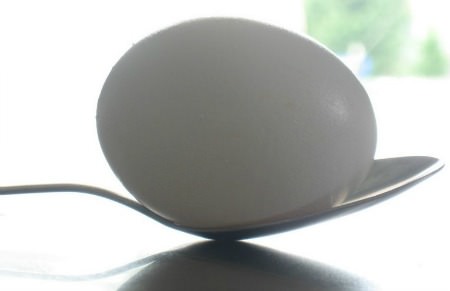
I had to break down and buy a dozen organic eggs from the store recently. I really do not like to do this as I consistently find them to be incredibly lacking in the quality department. I have two wonderful local farmers that I buy pastured eggs from, but both of these farmers have incredible demand for their product, and I had simply not ordered enough and ran out well before the next delivery. Soooo, I had to break down and buy the really expensive organic store eggs.
The eggs I buy from my local farmers are not organically certified, but who cares? The chickens run free outside on unsprayed conservation at one farm and a horse pasture at the other farm and these lucky chickens get plenty of bugs pecking around which is the best and most natural food for them. Chickens that produce the organic store eggs get the “all vegetarian feed” which is code for “lots of hormone disrupting soy isoflavones in your egg yolks“.
The eggs that proudly display the “USDA Organic” label from the store can’t stack up at all with the quality of these local, pastured eggs. In fact, they are downright laughable in comparison. Let me tell you what happened with this dozen organic store eggs once I got them home.
First of all, when I started unpacking my shopping in the kitchen, I quickly noticed that two of the organic eggs were already cracked! At $4.29 per dozen which is quite a bit more than I pay for my superior quality pastured eggs, I was obviously not happy that two had already bit the dust. They were not cracked at the store, mind you. I opened the lid of the egg carton and checked them before I put them in my shopping cart. The fact that two of these eggs so easily cracked before I could even get them in the refrigerator is a prime example of how soft the organic egg shells are. Good quality eggs do not have shells that crack easily. Chickens that eat lots of bugs produce eggs with nice, hard shells – indicating lots of calcium and other minerals present in the egg itself. My family likes to joke that the eggs from my local farmers are so hard you can practically play basketball with them on the kitchen tile! Beware of eggs that have soft shells – the nutrition in them is comparably lacking.
My kids love scrambled eggs for dinner on occasion, so I decided I would use some of these organic eggs for supper that night. Once again, when I cracked them into the bowl, I noticed the softness of the shells and then got the double whammy of how light colored the yolks were! It had been awhile since I had bought any eggs from the store, and you know how we all tend to easily forget poor quality when we are spoiled with superior quality for an extended period of time. Of course, I KNOW that organic store eggs have light colored yolks in comparison with the deep yellow, even orange yolks of pastured eggs, but it still did not lessen the shock when I saw it for the first time in many months.
Sighing, I whipped these pale yellow eggs with some whole milk and scrambled them up. Strike three for the organic store eggs happened shortly after I served dinner up to the hungry mob. One by one, the kids all commented that these eggs didn’t taste good. “Yeah, Mom, they don’t really have any taste at all,” said my oldest.
Right then and there, I decided not to ever buy the organic store eggs again. If I run out, I will just go without, I thought to myself. Of course, the memory of the poor quality eggs will fade over time. I will probably buy them again sometime in the coming months and go through this whole painful rediscovery one more time! Perhaps this occasional experience is valuable because it gives me a fresh appreciation for what my local farmers offer in terms of quality and value for my food dollar.
If you haven’t ever tried local eggs before, you need to. You will be shocked .. with delight!
Sarah, The Healthy Home Economist
|
|
{ 17 comments… read them below or add one }
I absolutely agree with you. I started using pastured eggs couple of months ago after I found "Real Milk". My younger one who did not like to eat eggs that much wants an egg everyday now. And so does my older daughter. I cannot make myself go and buy store eggs anymore (organic or not). I just wait for next delivery if I run out and avoid eggs when we are out visiting relatives.
We have had a small (10 hens and 1 rooster) flock for just a few years now, and I couldn't bear to go back to grocers eggs. Even the "organic" label on them means nothing if they are not able to run around freely! And, after reading and hearing so much about GMO's, I finally bit the bullet and went to all organic feed. Yes, it still has some soy in it, but it is NOT GM soy. I would have to find a place that does organic feed and mixes it specifically for you and there is no place nearby that does that. So, for now I am satisfied with the changes I have made, knowing I am giving them the best I can. Sadly, where I used to give away my extra eggs to a couple of friends, I am forced to sell them for $2 doz. My feed costs tripled when i went all organic! YIKES! They don't mind a bit, knowing they are getting the highest quality eggs available ANYWHERE! Organically fed, free range, and lovin' it!
This is a very interesting blog and so i like to visit your blog again and again. Keep it up.
Sharon
http://www.bukisa.com/articles/278120_10-tips-to-control-cholesterol
I too had an awful experience with organic eggs last week. I purchased them from a local produce stand because I heard they were carrying local pastured eggs. Turns out I was sold commercial organic eggs and they were rotten. The first and ONLY one I cracked smelled so horrible I threw them all out. Never again!
I wish I could find a place where they sell pastured eggs. I just have to do with the commercial ones which are always so disappointing. I'll have to look around harder I guess!
Sarah,
I never liked eggs until I started eating the pastured eggs. It was torture when I was pregnant and on the Brewer Diet eating 2 organic eggs a day. I started getting the pastured eggs for my husband and son. Now I'M the biggest egg eater in the house. Like you, I'll go without if we run out rather than eat the vegetarian fed eggs.
After years of begging and pleading I've finally gotten my husband to switch from a quantity food person to a quality food person. Once you have real eggs, milk and meat for a while you just can't eat processed garbage any longer. Thank you for helping us make it happen!
I used to think "oh how nice" when I read on an egg carton vegetarian fed. Then I got my own flock! Besides eating worms and insects, my sweet little friends were caught one day eating a dead rabbit! Once I actually saw my beautiful , timid , little Gretchen, scoop up a hole mouse that had scurried too close to her. No chickens are not vegetarians!
We love our pastured eggs!!
I had the same experience! I bought a carton of them organic eggs and noticed that the shells were extremely brittle and thin! They were thinner than the regular nonorganic white eggs! I found a local source of pastured eggs but they are not cheap! ($4.25/dozen). Where else can I get them in Tampa?
So Sarah, how about sharing your egg sources with us. I'm getting local eggs now but they are not free range.
Hi Cyndi, I don't post any local sources on the blog as most readers are actually not even from my local area. Also, farmers do not want their info online generally speaking. If you email me directly and tell me where you live, I can send you some sources.
Sarah,
Cornucopia.org has a detailed report on "organic" eggs with a scorecard which rates the egg producer based on how close the producers come to the intent of the original "organic" guidelines. About 80% of "organic eggs" are produced by factory farms where the chickens have no real access to pasture. The Cornucopia scorecard ranks egg producers from zero (ethically deficient) to five (outstanding) eggs. All of the organic eggs sold in local supermarkets are from "ethically deficient" producers.
I have been buying local "farm" eggs which I know do not get organic feed but at least the chickens probably get some daylight. The eggs do not rate very hard on the hardness test.
The report gives the history of the organic movement which started out as a grass roots movement but which lacked consistent standards. In 1990 legislation was passed which charged the USDA with establishing and enforcing standards. This move resulted in total corruption of the organic movement inasmuch as the USDA is closely aligned with big ag.
Cornucopia has a similar report and scorecard on "organic" dairy. The scorecard makes no mention of the type of pasteurization which milk receives. All of the organic milk sold in local supermarkets is ultrapasteurized, even those ranked "very good" or better on the scorecard.
The only "certified organic" dairy in the state of Alabama where I live produces milk that is not ultra-pasteurized or homogenized but it is only sold at small markets throughout the state.
You will find a lot of interesting information on the Cornucopia website.
Jack C.
Wow this is a great resource.. I’m enjoying it.. good article
FINALLY, someone mentioned something I’ve been wondering about. It never made sense to me that egg sellers would BRAG that their chickens were VEGETARIAN FED! Even I knew that chickens were not vegetarians, but needed the little bugs and critters that they nibbled on throughout the day. I also wondered, how could chickens be fed vegetarian AND be free range? Free range chickens would be bound to eat some bugs here and there.
Nelly, to me, “vegetarian feed” is a big red flag! Chickens are not vegetarians! I suppose it’s supposed to make you feel good that the chickens aren’t being fed slaughterhouse scraps, but in fact, chickens that don’t get some meat in their diets are more prone to peck and pick at each other. They need a little animal protein. Insects, mostly, but they also love yogurt, cottage cheese, cat food, dog food, hamburger, cheese, etc. They also eat mice and snakes when they get the chance. (I have seen mine eat mice.) They will even eat each other or chicks or eggs, so it’s better to give them other sources of animal protein so they don’t turn to cannibalism. Of course they love fruits, vegetables, seeds and grains as well, and grass and other greens. If we have salad greens that are slightly wilted for our taste, we give them to the chickens. I grate up a couple of carrots for them from time to time, and chop up broccoli stems etc for them to eat. Yes, mine are pampered!
When our hens’ laying slowed down last winter, I also had to break down and buy some eggs from the store. I found the fertile eggs available at our “better” grocery store were the best quality available from a store, and they were acceptable but not fantastic. Now I have more eggs than we can use and am “scrambling” to find buyers. We don’t have enough production to make it worth the cost to register and rent a booth at the farmers market.
For those who have access to eggs from pastured chickens — those at least able to be outside and spend some part of each day in the grass hunting bugs and eating greens — please support your local egg producers. I do buy organic feed — soy-free (I’m the only client of our local feed store who requests soy-free and they order it just for me and kind of complain about having to do so), and it costs twice as much as regular feed. Our chickens get the soy-free feed plus a big yard during the morning, and by early afternoon we let them out to run around the rest of our large farm yard, where they have access to pasture, our garden, compost piles, etc. They love it. The only reason we don’t let them out in the larger yard earlier is that they lay their eggs here and there and we lose a lot of eggs that way, so we like to let them get most of their laying done before we let them range with total freedom. Even in their chicken yard, they have way more space than most backyard chickens and all industrially farmed chickens, including big organic farms. (I read the Cornucopia Institute report and watched their video, truly eye-opening.)
This is a labor of love. Even though I charge $5 a dozen, it just helps to defray the costs, it doesn’t pay for the chickens. Maybe someday! We wouldn’t trade our eggs for anybody’s though. I feel very fortunate to have the space to keep chickens and just pray we can keep the farm.
Hi Sarah,
What do I do if my local farmer runs out of eggs for a week? Is it ok to go for organic eggs for temporary purposes?
{ 2 trackbacks }