

Without a doubt, KoMo grain mills are among the most exquisite, elegantly designed pieces of kitchen equipment I have ever laid eyes upon. As I’ve been examining all the grain mills on the market of late to replace the nearly worn out mill I currently use, the KoMo grain mills stood out to me as some of the best and most beautiful available.
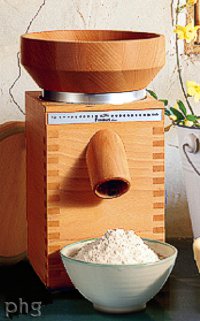 Most grain mills on the market today are constructed using a combination of stainless steel and plastic, but not the KoMo grain mills!
Designed by Wolfgang Mock of Germany, KoMo grain mills are constructed of sustainably sourced, solid native beechwood and finished with organic oils to add not only stylish simplicity to your kitchen counter, but warmth and sophistication as well.
For the traditional cook, KoMo grain mills indeed represent the perfect blend of classic, ancestral function with modern design and convenience.
KoMo: Grain Mills for a Lifetime
The modern trend with appliances is for them to last approximately 5 years which is the average time a family remains in a particular residence.
KoMo grain mills represent a refreshingly different approach to this throw away mentality. The excellence and precision of German engineering and construction with only the finest materials means that your personal KoMo grain mill can be expected to last a lifetime with normal use.
You can even plan to bequeath it to one of your children or grandchildren one day as a treasured family heirloom!
KoMo Millstones Provide Durability with Quiet Performance
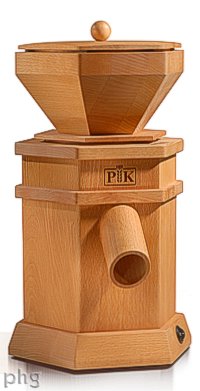 25 years ago, German inventor Wolfgang Mock began experimenting with various combinations of crystal and ceramic to develop an extremely robust new millstone. The resulting stone he created combines corundum and ceramic for an extremely rough surface that barely wears down at all after many years of use. These superior millstones used in all KoMo grain mills not only grind grain quickly but are virtually indestructible.
A patented milling mechanism that features noise dampening suspensions eliminates the loud grinding noise of most other grain mills so that you can grind virtually anything without irritating your ears or your nerves!
- Wheat – both hard and soft
- Oat groats (rolled, steel cut and stone ground)
- Rice, including wild rice
- Triticale
- Kamut, spelt, einkorn
- Buckwheat
- Barley and rye
- Millet and teff
- Quinoa and amaranth
- Sorghum
- Dent (field corn)
- Dry beans and lentils
- Spices
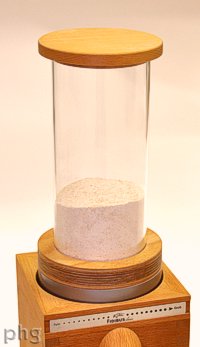 KoMo Grain Mills Feature a Flour Sifting Attachment
One of the most time consuming aspects of grain grinding is sifting the fresh flour either to remove the bran for easier digestion or simply to produce a lighter baking result. The bran that is removed can be fed to your chickens or added to soups, smoothies, and other kitchen creations as desired.
KoMo grain mills eliminate this tiresome and frequently messy task by providing an attachable sifting mechanism which includes interchangeable stainless steel screens in medium, fine and extra fine mesh sizes.
KoMo Grain Mills: Socially Responsible Manufacturing
The most surprising and appealing aspect of KoMo grain mills to me besides the quality craftmanship is the focus of the company on a socially responsible manufacturing process.
For many years, KoMo has partnered with a non-profit workshop program located in western Austria which provides employment to able bodied individuals as well as those with disabilities. An enormous pride of workmanship is present in this organization which employs modern management techniques and the latest precision machinery to manufacture the hardwood housings of all KoMo grain mills.
Where to Find KoMo Grain Mills
As you can imagine, not just any retailer would carry KoMo grain mills which I have dubbed “the Mercedes of grain grinders!”
The best and most comprehensive selection of these gorgeous appliances that I’ve discovered is Pleasant Hill Grain. With loads of detail and pictures about every aspect of the premier grain mills they offer, this is the site to send your sweetie if you have a classic grain mill on your holiday or birthday wish list!
If you are just beginning your research on which grain mill to buy, be sure to like Pleasant Hill Grain on Facebook so that you receive timely updates on any KoMo specials and news that might impact your purchase decision.
I hope you’ve enjoyed my analysis and review of the KoMo line of grain mills as I go on the hunt for one myself. Purchasing a grain mill is a big investment in your health and gathering all relevant information to make the best possible decision is of paramount importance!
The above is a sponsored post, paid for by Pleasant Hill Grain, however, it is clear that I really believe the KoMo grain mills are a cut above and represent some of the most quality mills on the market today!
Hi Sarah! Thanks for all the helpful information! I’m curious which grain mill you ended up with?
Please explain me the normal maintenance, and procedure to import one piece in israel.
Sarah,
Loved your post: KoMo mills really are that good! I use a Classic, and it is absolutely wonderful. I really liked that it was easy to clean without any tools or anything…I’m not the most tool handy person 😛
These guys posted an interesting review of the KoMo grain mills on their blog: apparently the different mills have different sized motors? Is there some benefit to using a bigger motor besides the obvious increased speed?
To those of you who have tried the sifting-attachment from Komo: What kind of extraction rates do you get, when sifting with the attachment? Do you get rid of ALL of the bran with this sifting-attachment or is just part of it?
Branless flour is about 75% extraction or something like that right?
Have some of you(Sarah?) achieved that?
If so, was it time-consuming, hard, easy?
Did you mill the flour coarser before you sifted or something?
Is there a good instruction-video for this process on the internet?
Sarah,
Was just thinking about replacing my grain mill with a Wolfgang. So glad to read your review.
Thank you for the scoop!
Warmly,
Kim
General question here – manual vs electric mill?
I bought a manual grain mill first because someone I’d talked to said they were good to have on hand when the electric mill breaks down and is sent in for repairs. That was over two years ago. This past year I’ve only bought three 5lb bags of flour and I ground the rest manually. I didn’t do near as much baking and take out pizza was a regular because manual grinding is so time consuming. I finally bought an electric mill last month and oh, what a difference in the quality of foods we eat. Last night I made homemade flatbread pizzas, so although the electric mill was an expense I’m saving on take out food and my family is eating better.
I tried the drill bit attachment for the Wonder Mill Jr. It takes an expensive drill with variable speeds (that I’m sure would quickly be snatched up by one of my boys and covered in grease for every use).
I had been trying to decide which brand and what kind (manual or electric) of grain mill to buy for months. I was so sick and tired of buying whole wheat flour and opening the bag and it was rancid! I first bought a manual Wondermill Junior and found it to be a whole lot of work, no place to set it up, store it, etc. I finally just bit the bullet and went for the KoMo Fidibus Classic even though it was twice as much as I had budgeted. I am SO GLAD I bought it. There it sits on my counter, too beautiful to put in a cupboard, it is gorgeous. It doesn’t take any more space than my blender. It does a wonderful job of milling all my grains. I cannot see this thing breaking down in 1-3 years the way most appliances seem to do. This unit is going to last a long, long time. It is very simple. I am so happy with this grain mill!
I am so lucky I bought one 5 years ago & I used all the time to grind every thing
Yes,
Thank you Sarah for posting this message. I was going to buy one of these mills, but I was not sure they are in a good quality, and worth the money.
So, now I know! 🙂
I wrote a long post about the benefits and design features of the KOMO, from my ‘smart’ phone, which apparently ‘dropped the call’! And so I see no post here from me.
Paid ad or not, Pleasant Hill Grain is an authorized servicer of this product. They have REAL people to give REAL answers to your questions. Best customer support I’ve ever experienced.
I would highly recommend making your purchase through them. But if not, their site has the most comprehensive info about the KOMO mills of any other I’ve found. You can do side by side comparisons of cost, feature, capacity, size, etc.
Be aware you can’t grind popcorn or oily seeds or nuts. But all else is listed on PHG’s website. I make my own organic grits. It is sweet and nutty and chewy. The grind is infinitely adjustable — ie, it doesn’t have a set position of specific choices. You just turn the top for the desired consistency…
The flour does get warm, but no worse than with any other mill I’ve used. The benefit of feeding into an open container is that the flour stays a little cooler and you can just keep going, pour off what you need, and grind some more –no container to detach and clean out and reseal. Such a timesaver.
Another plus is you can buy another set of stones and spout, if you have someone with gluten sensitivities and cannot have even the slightest dust from gluten grains mixed in. You can change out the stones and spout cup to keep separately for gluten-free grinding.
For cleanup of the unit, an occasional shopvacuuming is recommended to keep dust from building up under the motor. You just hold the nozzle over the stones. The general consumer wouldn’t open anything up for maintenance. To get buildup off the stones, you just ocasionally run a small amount of rice through the mill at medium grind.
This is an amazing machine. Its worth saving for! Hope these tips help. Sorry for any ‘unsmart’ typos from the ‘smart’ phone!
I want to second what Cindy L. wrote. I have a NutriMill (love it) and I bought it from Pleasant Hill Grain several years ago. I was so, so impressed by what kind and caring service they gave me. Just down to earth, friendly people that seemed to genuinely care about my making the right purchase.
This KoMo mill sounds pretty neat. I might look into if I needed a grain mill. But I don’t. It’s easy to get caught up in wanting the latest thing you hear about and, let’s face it, that’s part of the fun of all of the experimental cooking that many of us do. So if you need a new mill, by all means check this out. Especially if you need the gluten free grinding aspects part of the time. What a cool feature! If you already have a grain mill, count yourself blessed.
Thank you, Sarah, for a lovely blog and super fantastic teaching videos. I just made my first beet kvass. I think I need less salt next time! But, hey, that’s part of the fun of experimenting. You are a gem of an educator.