

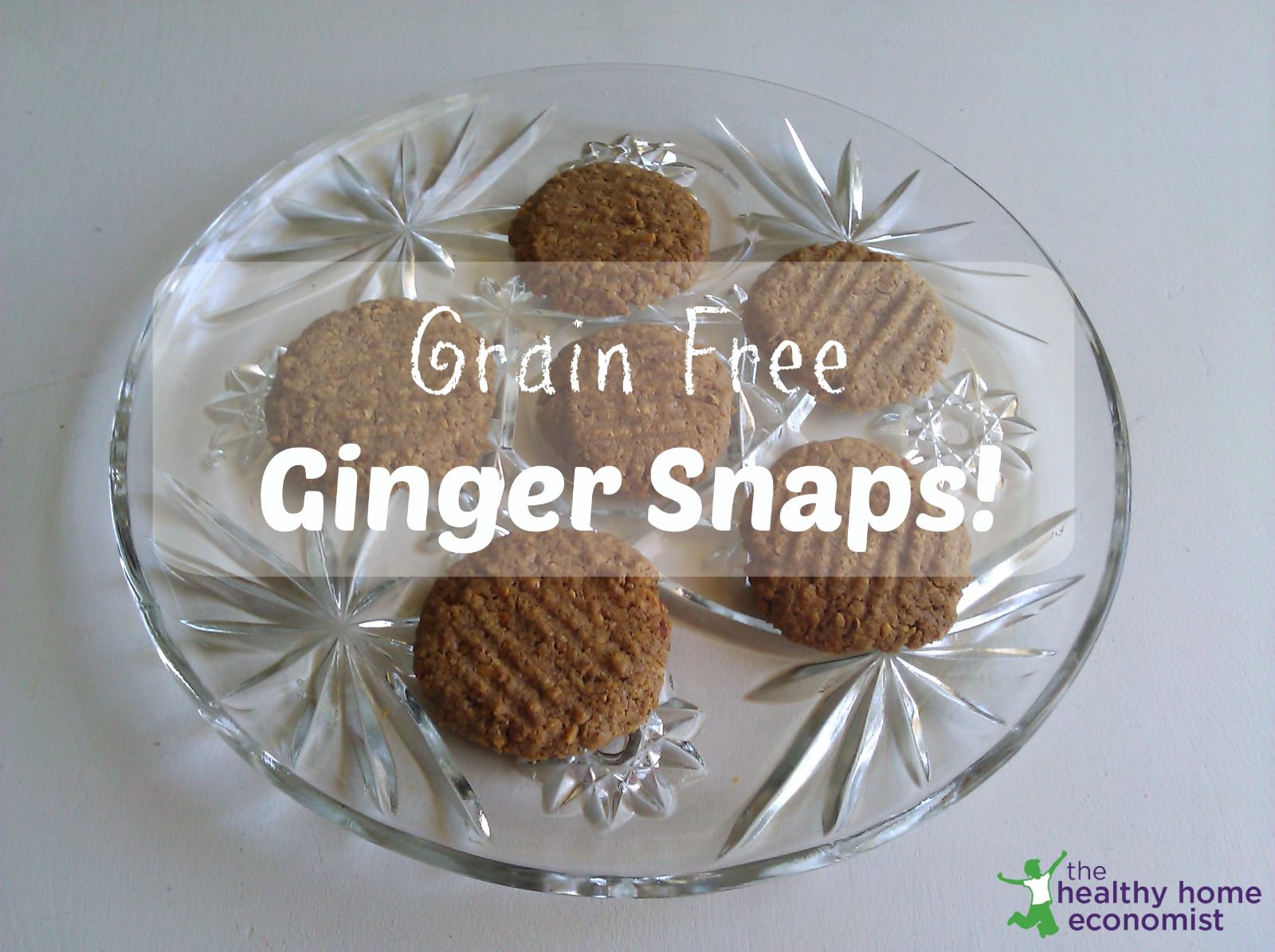
Grain Free Ginger Snaps

by Sarah, The Healthy Home Economist on January 5, 2011


After nearly 10 years of using the Nourishing Traditions Cookbook as a primary guide for all my traditional cooking endeavors, it amazes me how I can still find new recipes that I haven’t tried before that delight my family!

I just recently had this experience once again while I was thumbing through my very well worn, dog-eared, batter stained copy only to come across a grain free recipe for ginger snaps (p. 530 in my edition).    My kids just love ginger snaps and the fact that this recipe is grain free makes it all the better as I really take great effort to provide grain free based snacks for them whenever possible.     Most child friendly snacks from the store, even if organic, rely heavily on refined, grain based carbs.   Even when gluten free, these types of snacks can contribute to weight issues and other health woes in the long run when consumed frequently.

A big bonus is that these cookies were so fast to prepare and bake!    I keep a bag of homemade almond flour from soaked/dehydrated almonds in the freezer most of the time to make grain free pizza crusts, so special prep of the almonds before making these cookies was not necessary.  It is probably the reason why I overlooked this cookie recipe for so many years as well as I have only started maintaining almond flour on hand in the past year or so.    I think these cookies would be amazing with hazelnut flour too, by the way.

These cookies turned out crisp and delicious.   Even my picky eater loved them!
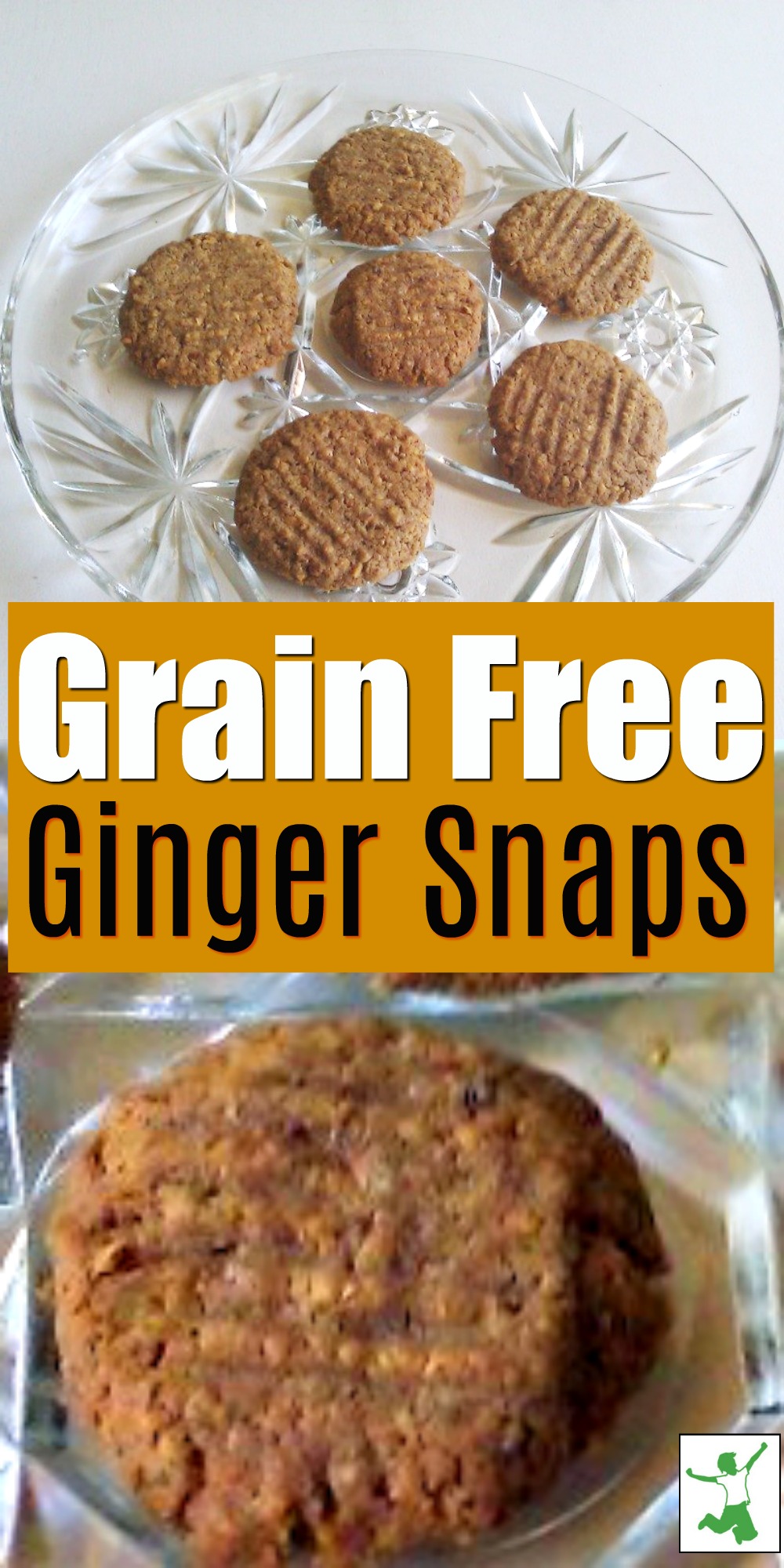
Ginger Snaps

Makes about 24 cookies

Ingredients

1 1/2 cups crispy almonds

1/2 cup butter softened

1 cup arrowroot powder

1 egg

1/2 cup sucanat

1 TBL water

1 1/2 tsp ground ginger

1 tsp cinnamon

1/4 tsp nutmeg

1/4 tsp ground cloves

1/2 tsp sea salt


Instructions

Grind crispy almonds in a food processor until they are ground into almond flour.  It is not necessary for the almond flour to be extremely finely ground as a more coarse texture turns out fine when mixed with the arrowroot powder.   Mix in remaining ingredients. Form into balls the size of a ping pong ball and place on a cookie sheet lined with parchment paper. Bake at 300F for 20 minutes, removing pan from the oven after 5 minutes to press each ball lightly with a fork before baking the remaining amount of time. Cool and store in an airtight container in the refrigerator.

* Note that I added an egg to the recipe to make sure the cookies held together well.   There are no eggs in the Nourishing Traditions recipe.

Sarah, TheHealthyHomeEconomist.com

* This recipe is shared at Real Food Wednesday and Fight Back Friday!


The Healthy Home Economist by E-mail


{ 42 comments… read them below or add one }

Lynda Moulton January 5, 2011 at 11:44 am

Making Crispy Nuts is one part of my 2011 New Year’s resolution. WHERE can I buy reasonably priced RAW nuts ?

Reply

BETHENY January 5, 2011 at 11:48 am

I get the best price on raw nuts at Sams club! Like 3 pds of raw Almonds for $11.00
If no Sams club nearby, maybe Costco

Reply

Lynda Moulton January 5, 2011 at 11:57 am

Thanks Betheny,

Only I heard that they aren’t REALLY raw….that they are pasturized or something.

Reply

Jocelyn G January 5, 2011 at 2:18 pm

You’re absolutely right. Our crazy gov’t makes it illegal to sell TRULY raw almonds. The almonds found in stores (including Sams/Costco) are pasteurized, and worse, usually with chemicals. If you can find Organic Almonds, those are usually steam pasteurized which is certainly preferable. The good news is that you can still legally purchase TRULY RAW almonds directly from the farm. I order mine from Organic Pastured in Cali (I live in Atlanta). They sell for $12 a lb or $50 for 5 lbs and shipping is free. Expensive? Sure. Healthier? Absolutely. Here’s the link. Hope this helps! :-)

-Jocelyn

http://www.organicpastures.com/products_almonds.html

Reply

Jennifer January 5, 2011 at 11:57 am

My kids love these topped with pumpkin butter.

Reply

Carrie January 5, 2011 at 12:13 pm

Nuts can still be labeled as raw in stores, but by law they aren’t any more. Somebody (some big competitor) decided it’s too risky to eat raw nuts. You CAN get them REALLY raw at farmers’ markets, but since S510 passed, it’s likely it won’t last long. Get raw nuts while you can!

Reply

Cara January 5, 2011 at 12:25 pm

I share the same concern and question: Where can you find authentic organic raw almonds that haven’t been gassed? I suppose there is a good source on line. If anyone has found such a place please provide website, etc. Thanks ;)

Reply

Sarah, The Healthy Home Economist January 5, 2011 at 1:13 pm

I ship mine in directly from an almond farmer. By bypassing the food distribution system entirely, you can avoid the mandatory pasteurization.

Reply

Beth January 6, 2011 at 8:05 am

Sarah,

Can you give us some tips on how to find such a person? Also, I am interested in finding a source for clean citrus fruits if you can help with that. Perhaps you have a personal shopping guide posted here somewhere that I haven’t yet seen.

Also, you posted why you decided on the GAPS diet last year as opposed to other options? Was it just the link with WAPF that convinced you? I am wondering if I need to do it …adrenal issues here. Thanks!

I love the blog and am getting reminders and confirmations for our diet. Yours is the best blog I have seen as a fit for our family and I thank you for sharing your work with us.

Reply

Sarah, The Healthy Home Economist January 6, 2011 at 9:08 am

Hi Beth, we decided on GAPS mostly because I saw Dr. Natasha Campbell-McBride speak and spoke to her personally at a Conference in 2007. I had read her books and was very comfortable with her work and research. I found it to be the most likely approach that would give us desired results. And it did! :)

Sometimes, finding these sources is just plain luck! Get to know the people in your community who are getting their food off the grid and ideas like this will come your way naturally. There is no phone book for this kind of stuff unfortunately.

Reply

Sarah, The Healthy Home Economist January 6, 2011 at 9:12 am

Beth, a GREAT place to start finding small farms with the types of products you seek is to subscribe to Wise Traditions Journal from the Weston Price Foundation (westonaprice.org). This quarterly journal has a listing of small farms by state that you can contact directly. This Journal is an invaluable resource in your health journey, in my opinion.

Beth January 6, 2011 at 11:42 pm

Thank you, Sarah. I did check the new WAPF shopping guide that just arrived, but no luck with the nuts. Lots of other gems, though. I will look in the journal. I forgot about it and cannot imagine why. I appreciate the reply!

Kim January 5, 2011 at 1:28 pm

Hi Sarah,
Thanks for sharing this recipe – just one question…..I already have almond flour so how much should I use – thanks. Kim

Reply

Sarah, The Healthy Home Economist January 5, 2011 at 2:37 pm

1 1/2 cups works great.

Reply

Carrie January 5, 2011 at 1:56 pm

After your chat with Rami Nagel have you altered your method of making crispy nuts? If so, how? I read in the past that blanched almonds have much less phytic acid and don’t need to be soaked/dried but after reading about Rami’s take on nuts at Cheeseslave I am more confused than ever as to the best procedure! Is it possible to make already ground nut flour more digestible by soaking as with grains?

Reply

Sarah, The Healthy Home Economist January 5, 2011 at 2:35 pm

Nuts are completely different than grains in their preparation. Nuts are soaked in salted water, then drained and dehydrated and then ground into flour (if you desire) whereas grains are ground into flour first and then soaked in water with an acidic medium like whey, lemon juice, or cider vinegar (assuming wheat or spelt).

Reply

Evie September 26, 2012 at 3:45 pm

Just wondering if coconut flour is made the same way as nuts? I’ve been wanting to make my own.

Reply

Sarah, The Healthy Home Economist January 5, 2011 at 2:45 pm

You can also sub the sucanat with coconut sugar for a really low glycemic alternative.

Reply

Vesna January 5, 2011 at 3:12 pm

Almonds and ginger — wow! Sounds like a match made in heaven. Thanks for sharing it. I really need to cook directly out of my NT more often.
Vesna\’s last post: Jan 4- Food- cooking and nutrition links

Reply

Jessie January 5, 2011 at 3:24 pm

you can buy raw almonds via the green smoothie girl website group buy program here. She does this program once a year & it lasts for a few months. It’s been open since November 2010 this time. http://www.greensmoothiegirl.com/group-buy/products/raw-almonds/

Reply

Sarah January 5, 2011 at 3:42 pm

I made these at Thanksgiving and also used the recipe for a substitute pumpkin pie crust. It was delicious!
Sarah\’s last post: Need a Novel Resolution Make Your Own Mayo- At Least Once!

Reply

Bethany January 11, 2011 at 9:15 am

That is a brilliant idea — I’m going to try that next year!
Bethany\’s last post: Collard Greens

Reply

Tammy R. January 5, 2011 at 3:45 pm

Any chance I could cook these for less time to have a softer gingersnap? LOL I know, it would probably not be considered a true gingersnap but I don’t care for hard cookies and neither does my daughter. I do love the flavor of gingersnaps though!

Reply

Lynda Moulton January 6, 2011 at 3:18 pm

As of September 1, 2007 the Almond Board of California (ABC) and the United States Department of Agriculture (USDA) made it mandatory for all raw almonds sold to consumers in North America to be pasteurized. The Food and Drug Administration (FDA) is the agency responsible for approving treatment processes.

Currently FDA has approved the following treatments for almond pasteurization:

Oil roasting, dry roasting, and blanching: These processes have been around far longer than the recent almond pasteurization requirements and through the historical techniques they reduce harmful bacteria.

Steam Processing (H2O): There are many different techniques being used throughout the industry that are acceptable forms of pasteurization that even meet the USDA Organic Program standards. Short bursts of steam are shot onto the outer skin of the almond and do not effect the nutritional integrity of the almond. This process does NOT “cook” proteins or destroy vitamins and minerals. The steam does not change the nutritional characteristics of the almonds.

Propylene Oxide (PPO): This too is a surface treatment and does not affect the nutritional characteristics of the almonds. PPO has been used on foods since 1958 and is proven to be very effective at reducing harmful bacteria on the almonds and poses no risk to consumers. PPO residue dissipates after treatment. The Environmental Protection Agency (EPA) confirmed that PPO poses no health risk.

LABELED “RAW ALMONDS” – The FDA, the agency that regulates packaging labeling, has determined that raw almonds treated via Steam or PPO methods may be labeled RAW under FDA guidelines.

ONLY TREATS THE OUTSIDE – Steam (H2O) and Propylene Oxide (PPO) treatments only affect the outside surface of the almond. Unlike juice, milk, eggs and canned foods, raw almonds can achieve equal safety protection against harmful bacteria without affecting the inner core.

WHAT MIGHT I NOTICE? – Many of the industry leaders use the PPO method. It is reasonable in price and is not noticeable to the consumer. Most retail stores and warehouses will sell RAW Almonds that have been PPO Treated. We find that most of our consumers that are looking for “non-pasteurized almonds” are very against the PPO Treatment since it is a chemical process (regardless of the EPA’s findings). Steam (H2o) treated raw almonds might have a slightly different color to them. Especially on the scratched areas on the almond, H20 will dull the bright white scratches, and soften the overall almond. You will notice they are not as crunchy as non-H20 treated almonds.

Reply

Christine January 7, 2011 at 10:16 pm

Sarah,

This is my first time posting on your blog, but I have enjoyed reading your posts off and on for a couple of months. Thank you for all of the time and care that you put into this educational effort. I have a question about removing almond skins. Do you blanch and remove the skins before soaking and dehydrating them, or do you leave the skins on? Having recently done GAPS I needed to remove the skins for added digestibility and I found that I preferred the taste of all almond products made without the skins (including basic crispy nuts). But the problem is the labor intensity of removing the skins. Do you have any efficient method of removing the skins of a large volume of almonds? I currently pour hot water over the almonds (about 10-12 cups at a time), let them sit for 20 minutes, and then pop the skins off one by one. Rubbing a towel on them doesn’t work as well as rubber gloves! But it takes FOREVER! I’d appreciate any suggestions!

Reply

Mary January 10, 2011 at 12:40 am

Sarah,

Where do you find arrowroot powder around here in Tampa?

Reply

Bethany March 7, 2011 at 3:56 pm

I know this is an older post, but I’m wondering if anyone knows the measurement for already-made almond flour. I make my crispy almonds into flour all at once, and then store in the freezer. Thanks!
Bethany\’s last post: Pork Adobado- A Versatile Rub

Reply

Sarah, The Healthy Home Economist March 7, 2011 at 5:32 pm

Hi Bethany, it would be about the same – 1 1/2 cups.

Reply

Bethany March 7, 2011 at 7:03 pm

Thank you, Sarah. I’m really surprised, since the almond seem to shrink when ground up. I will try it though and see.
Bethany\’s last post: Pork Adobado- A Versatile Rub

Reply

Dr. Allison Low September 1, 2011 at 10:53 am

Did you use freshly ground ginger or from a spice jar? Thanks!

Reply

Alexia December 9, 2011 at 10:30 pm

Hi Sarah, can I use anything instead of arrowroot flour?
Thanks

Reply

sarah March 29, 2012 at 9:48 am

just made these last night and forgot the butter!!! surprisingly, they still turned out really good!

Reply

Teresa April 8, 2012 at 4:56 pm

Made these today and I loved them! (hubbie too ) Thanks Sarah!

Reply

rita August 15, 2012 at 7:02 am

Hi Sarah, could I use cocoanut flour and cocoanut oil instead of butter…can I grind cocoanut pieces into flour?

Reply

Sarah Aerssen via Facebook September 26, 2012 at 1:59 pm

my 2 year old loves these!

Reply

Jeffrey Joseph via Facebook September 26, 2012 at 2:02 pm

>:0) Heheheh!

Reply

Monique C. Melara via Facebook September 26, 2012 at 2:04 pm

Do you have a grain-free, nut-free cookie recipe?

Reply

thehealthyhomeeconomist via Facebook September 26, 2012 at 2:26 pm

@Meechie what a great idea! I will have to use these as the crust for my pumpkin pie at Thanksgiving!

Reply

thehealthyhomeeconomist via Facebook September 26, 2012 at 2:26 pm

@Sara area healthfood stores all carry arrowroot powder in the gluten free section.

Reply

Erica Helene via Facebook September 26, 2012 at 3:18 pm

Sarah, where can we buy truly raw, organic almonds?

Reply

Sarah DeJarnatt via Facebook September 26, 2012 at 4:38 pm

Just made these with my 2.5-year-old DD, and wow, YUM! For those wondering, I get my TRUELY raw almonds and arrowroot starch through Azure Standard – they drop almost everywhere except the east coast.

Reply

Arlene Marx via Facebook September 27, 2012 at 9:13 am

after you grind the almonds, do you remember how much flour it makes? I bought almond flour already prepared. thanks.

Reply

Leave a Comment

CommentLuv badge

{ 4 trackbacks }

Previous post:

Next post: