
Don’t Waste Your Time: Why the Candida Diet Doesn’t Work

by Sarah, The Healthy Home Economist on November 15, 2012


Candida is a term that refers to a large family of yeasts (one celled fungi) that under normal circumstances, harmlessly inhabit the tissues of humans.   This is because a balanced intestinal tract from mouth to colon contains a preponderance of beneficial bacteria that keep Candida in check.

When not enough beneficial bacteria are present in a given body tissue to keep Candida under control, Candida transforms from a harmless state into an invasive species.  In this rapidly growing state, Candida puts out long stringy hyphae or “roots” which can penetrate through the tissues of the body.

Candida overgrowth can occur in many tissues of the body such as oral candidiasis known as thrush,  the scalp as dandruff, or vaginal yeast infections.

What Causes Candida Overgrowth?

Candida is an opportunistic pathogen that can rapidly take over when a person is under a course of antibiotics.  Antibiotics decimate beneficial gut flora but have little effect on Candida, giving this normally harmless yeast the chance to take over dominance of the gut environment very quickly.

Many women don’t realize it, but oral contraceptives imbalance the gut in the same way as antibiotics giving Candida an open door to take control.

A diet of processed foods high in sugars and simple carbohydrates also encourages Candida overgrowth as yeasts thrive on sugars.

Babies born via C-Section or to mothers who were treated with IV antibiotics during labor are especially vulnerable to the ravages of Candida overgrowth as they are not exposed to a healthy balance of gut flora from their travels down the birth canal prior to the moment of birth.

Symptoms of Candida Overgrowth

Symptoms of Candida overgrowth are many the most common being fogginess in the morning upon waking (brain fog), digestive complaints of all kinds and a myriad of skin issues.

Many women plagued by yeast infections don’t realize that the source of the problem is actually their diet and the pathogenic state of their gut environment.  Using drugs and creams to resolve the problem is only a temporary solution when the source of the problem – gut imbalance – is not addressed head on.

The Anti-Candida Diet

Some 20 years ago, my husband and I tried the Candida Diet to resolve gut imbalance that had been exacerbated by our stressful and overworked lifestyle at the time.

It failed miserably.

Why?

Because the Candida Diet goes only part of the way in attempting to resolve gut imbalance by removing all food sources for Candida.

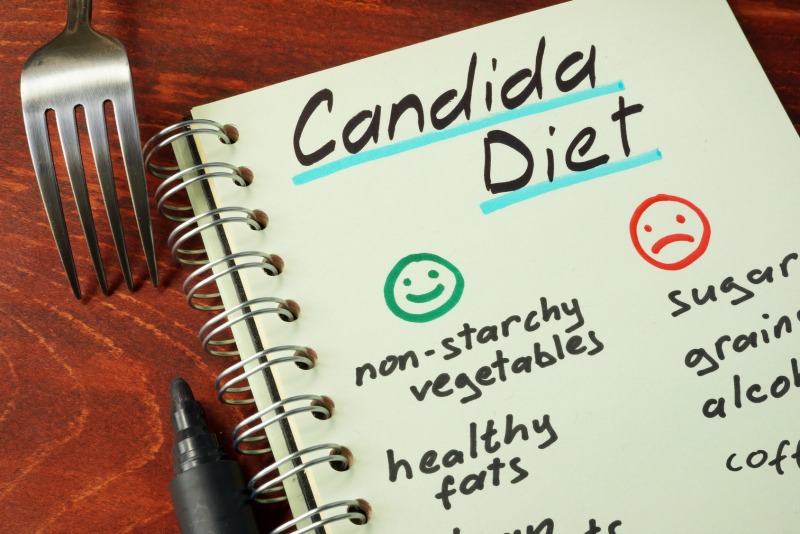
For example, the Candida Diet removes sugar from the diet in all forms – even maple syrup and honey.  Fresh fruit, however, is allowed.

Candida overgrowth can frequently trigger an allergy to molds and other types of fungi, so fermented foods including cheese and dairy are also eliminated along with any breads and other foods containing yeast.

Other foods excluded from the Candida Diet include vinegar, mushrooms, tea, coffee, dried fruit and any form of fruit juices.

People Get Better on the Candida Diet But They Don’t Heal

The typical scenario for a person who goes on the Candida Diet goes something like this:

  • They feel better almost immediately – primarily because all the sugar has been removed from their diet.
  • They continue on the diet for some time perhaps many months or even a year or more and are pleased to see that their symptoms of Candida overgrowth diminish considerably during that time.
  • After a period of time, they try to reintroduce some of the foods that were removed only to discover that their symptoms come raging back with full force.
  • They realize that it is going to be next to impossible to continue the Candida Diet indefinitely as it is simply too hard to give up cheese and any and all sweets forever.
  • They get discouraged, give up and stop the Candida Diet.

Why Doesn’t the Candida Diet Work?

The paradox of the Candida Diet is that symptoms greatly diminish but the person doesn’t actually heal from the root cause of the problem which is a breech in the integrity of the gut lining.

Healing is prevented on the Candida Diet for the following key reasons:

Reason #1:  The Candida Diet allows foods like potato, yams and other starchy vegetables.

Reason #2:  More important than the allowance of starch in the Candida Diet, however, is the ultimate fatal flaw:  the inclusion of grain based foods.

Even if the Candida Diet is used in conjunction with a gluten free, casein free diet, it fails in the majority of instances.

The reason is that disaccharides, or double sugars, are present in many carbohydrates including ALL grains – not just gluten containing ones.  An inflamed, inbalanced gut overridden with Candida is unable to digest double sugar molecules completely because the lack of beneficial gut flora has compromised the function of the enterocytes.

According to Dr. Natasha Campbell-McBride MD, author of Gut and Psychology Syndrome and one of the key scientists at the forefront of gut restoration research today, the enterocytes are the cells that reside on the villi of the gut wall and produce the enzyme disaccharidase which breaks down the disaccharide molecule into easily absorbed monosaccharide molecules.   When the enterocytes are not nourished and strengthened properly by adequate beneficial flora, they become weak and diseased and may even turn cancerous.   They do not perform their duties of digesting and absorbing food properly.

The critical importance of the enterocytes to health cannot be overstated!

Weak and diseased enterocytes also have trouble digesting starch molecules which are very large with hundreds of monosugars connected in long branchlike strands.   People with weak digestion due to Candida overgrowth and messed up enterocytes have a terrible time digesting these complex molecules leaving large amounts of it undigested- the perfect food for pathogenic yeasts, bacteria, and fungi like Candida to thrive upon.

Even the starch that manages to get digested results in molecules of maltose, which is – you guessed it – a disaccharide!     This maltose also goes undigested due to a lack of the enzyme disaccharidase and becomes additional food for Candida.

Therefore, when one follows the Candida Diet and yet still consumes grains and starches, food molecules that are not fully digested continue to putrefy, inflame, and provide food for Candida thereby preventing healing even if some improvement is noted from the removal of all sugars.

What is the Best Diet for Combatting Candida?

In conclusion, it is best not to waste your time with the Candida Diet.  It doesn’t work in the majority of cases and you will ultimately feel frustrated in your efforts to heal over the long term.

The best diets for healing and sealing the gut wall and permanently rebalancing the gut environment are the GAPS Diet or the very similar SCD (Specific Carbohydrate) Diet.

To read more about GAPS, click here for my introductory post on the subject.   Also, the post The Five Most Common GAPS Diet Mistakes is a review of the most common pitfalls of this approach to gut healing.
 

Sarah, The Healthy Home Economist

Source:  Gut and Psychology Syndrome, Dr. Natasha Campbell-McBride MD

Picture Credit


The Healthy Home Economist by E-mail


{ 192 comments… read them below or add one }

Jessica Tebben via Facebook November 15, 2012 at 11:11 am

I need help. I am pregnant and dealing with this.

Reply

Krysia November 16, 2012 at 2:17 am

So as for grain substitutes, what about buckwheat? It’s thought to be a grain but actually a seed with high amino acid, antioxidant, and mineral content. Living in Poland grain free is hard enough as it is… Also what about oats and rice? According to metabolic typing I’m a more carb-mixed type so it would be nice to sort out the options ;)

Reply

Adrienne @ Whole New Mom April 17, 2013 at 10:10 am

Bwheat is still a starch so it has to be seriously limited

Reply

Monique C. Melara via Facebook November 15, 2012 at 11:15 am

I’m on a paleo-ish diet. I just upped my probiotic, bone broth (your instructions:), and coconut oil intake – voila! Problem solved :D

Reply

rawmilklover November 15, 2012 at 3:08 pm

How long did it take for you to heal?

Reply

Alise Napiorski via Facebook November 15, 2012 at 11:15 am

that is disgusting

Reply

Jessica Talstein via Facebook November 15, 2012 at 11:20 am

such a gross pic!

Reply

Multisport Bryan via Facebook November 15, 2012 at 11:20 am

What does work is the Body Ecology Diet.

Reply

Alison November 15, 2012 at 11:21 am

I was at Pam Killeen’s talk at the WAPF conference this past weekend and she talked about copper toxicity. As long as there is an imbalance of copper/zinc in the body it will be unable to fix candida overgrowth. Which for me explains why the gaps diet did not cure my chronic yeast infections. Pam said that copper toxicity is rampant nowadays due to our cultures phobia of red meat (source high in zinc) copper sulfate added to municipal water as an antimicrobial and copper pipes in our homes (source of drinking water).

Reply

Sarah, The Healthy Home Economist November 15, 2012 at 11:30 am

Yes, there are other factors that come into play as well. My husband had to have his amalgams removed before he could completely kick Candida as the constant mercury vapor from the amalgams suppresses immunity. From a strictly diet perspective though, the Candida Diet just doesn’t work and GAPS is a much more effective protocol.
Sarah, The Healthy Home Economist\’s last post: Don’t Waste Your Time: Why the Candida Diet Doesn’t Work

Reply

Amy Love @ Real Food Whole Health November 15, 2012 at 3:52 pm

I see this all the time in my practice! I personally struggled with candida overgrowth for a long, long time and tried the anti-candida diet with no long-term success, exactly as you described. I also had amalgams, but candida and mercury have an interesting relationship- candida does feed off the mercury, but it also has a slightly protective mechanism for us in the short-term. It’s beneficial to address BOTH at the same time.

I’ve also found compromised digestion (starting with low hydrochloric acid production, usually secondary to blood sugar handling problems- this low HCL is also related to low zinc) in ALL my clients with candida overgrowth. Parasites are also usually present, for the same reason- no HCL to protect the gut, and then it’s a field day in there for them with all the dysbiosis.

What finally DID work for me (and my husband) and the protocol I use with my clients now, is a combination of the GAPS diet (or a derivative of), an herbal-based supplement regimen, digestive support, zinc, reseeding the gut with good bacteria (through supplementation and food), and a few other components including lifestyle modifications (water filters, no antibiotics in food, etc).

It is EXTREMELY effective because it addresses the root cause- the imbalance in the gut- and it’s fairly fast- as compared to the anti-candida diet which just goes on and on forever with little results (that don’t last). It also ADDRESSES THE SPORES!!!! This can NOT be overstated. You must, must, must address the spores (we do this via herbal supplementation in our protocol, as well as continuing the diet change, etc during this crucial phase)

Candida is a fungus. When a fungus is threatened, it sends up spores, so that the species will survive after the “attack” (like an anti-candida diet). Once the “threat” is over (you’ve stopped the diet), then the spores (which are all over the body now) can grow again and once the overgrowth is there, symptoms will begin again, often with NEW symptoms because the spores have lodged elsewhere in the body. This is why people are often on candida diets for years and years- the spores keep the overgrowth coming back and it’s a vicious cycle. Once I realized this, it was a no-brainer on WHY these various things I’d tried didn’t work long-term.

All my personal experience went into creating our candida protocol. It’s extremely effective and thankfully does not go on for years and years. Getting candida under control was one of the most significant things I did to improve my personal health, after being practically bed-ridden for years. Thank you for sharing this info, Sarah!! Healing the gut is soooo important!
Amy Love @ Real Food Whole Health\’s last post: Fresh Bites Friday November 9, 2012

Reply

Yokko April 17, 2013 at 6:18 pm

May I ask what type of herbal-based supplement regimen do you use?
I am using ultra inflam X (recommended by my naturopathic doctor) and kolorex.
I wonder if these products works with gaps diet.
I have been spending all my day off making fermented vegetable, drink, bone broth and soup every week…. Hoping my body heal…

Reply

Brenda Slivkoff via Facebook November 15, 2012 at 11:22 am

Check out Bee Wilder for a great Candida diet that includes no carbs…and it does heal, completely.

Reply

D. November 15, 2012 at 4:42 pm

I’ve been following Bee for years! Glad to see someone else mention her work. I don’t necessarily eat the way she recommends but I try to follow her logic and see where it goes. I do agree with her about fermented foods, however, and have done so for years. Whenever anyone in my family (while growing up) had heartburn they drank pickle juice or ate sauerkraut, homemade when it was available.

I also had heard YEARS ago about the copper imbalance and the zinc problems when I was studying some work by Ann Louise Gittleman. She’s been connecting the dots for quite a long time.

One of the best pieces of dietary advice I ever stumbled on was something I did by accident about 14 years ago, and that was adding sea salt to my first afternoon glass of drinking water (filtered with a ceramic filter in our home). Great for the gut and helps to supply those trace minerals we all need.

Reply

Chris Kurtz Young via Facebook November 15, 2012 at 11:23 am

I have been using a yeast cleanse type diet for over 12 years to control Lupus, sjogrens syndrome & borderline anti-phospholipid disease (all auto-immune) from http://www.knowthecause.com

Reply

Tina Zanetti via Facebook November 15, 2012 at 11:24 am

What needs to be dealt with first and foremost to eventually get rid of the yeast overgrowth is to find out the level of Copper in the body.

Reply

thehealthyhomeeconomist via Facebook November 15, 2012 at 11:27 am

@Chris that’s the problem with the Candida Diet .. you can never go off of it and eat normally again. This is because it treats symptoms and not the cause of the problem.

Reply

D. November 15, 2012 at 4:45 pm

I agree, Sarah. I heard about Doug Kaufmann’s “advice” years ago and just shook my head and wondered how you ever get better with THAT diet! You don’t. It’s just like modern allopathic medicine – you may think it’s working because you feel better for the moment, but long-term you aren’t doing much more than hiding the symptoms until later. To me, that’s not a fix.

Reply

Robert Masters via Facebook November 15, 2012 at 11:27 am

Everyone is different – and I’d just like to say that the diet has totally worked for me. On my diet, I stayed away from fruit – something you ate – and also stayed away from potatoes etc. I then went on a maintenance diet that was refined sugar free, gluten-free, and organic. Three years later, I’ve not had a re-occurrence of the problem. Also, to the best of my knowledge, Candida can be bought on several ways – and not just what you describe in your article. So people… don’t despair… maybe this diet will work for you. Thanks for allowing me to share this info. Respect. http://www.wholeapproach.com/diet/

Reply

Tina Zanetti via Facebook November 15, 2012 at 11:34 am

If the copper imbalance is severe, the problem is much worse and often will not go away until copper metabolism is corrected with a nutritional balancing program. It is not just a matter of “lowering copper”, as many doctors believe. It is more complex. Copper is one of the body’s natural yeast fighters. In fact, copper compounds are used on crops such as copper sulfate, and in swimming pools and hot tubs, at times, to control yeast and fungal growth. Also researchers found that one factor that diminishes copper availability is poorly functioning adrenal glands. This may lead to low ceruloplasmin or low metallothionein. Ceruloplasmin and metallothionein are copper transport proteins. With low adrenal activity, copper may not be properly bound and may therefore become less available to the body. Thus until adrenal activity improves, candida will be difficult to control. When the adrenals and thyoid glandular activity normalizes, often copper imbalance and yeast problems disappear on their own without any need for specific therapy.

Reply

Stacy January 20, 2013 at 10:49 pm

Tina zanett, ur post is timely. I found out recently that my ceruplasmin is low and my zinc low… I have bad dysbiosis and yeast and other go issues. My adrenals are also shot. What do u recommend to heal adrenals? Also, any dietary advice and macronutrient ratios? i

Reply

Sarah Schneider via Facebook November 15, 2012 at 11:36 am

Christy Shaffer-Belisle we were just talking about this! ;)

Reply

Chris Kurtz Young via Facebook November 15, 2012 at 11:43 am

thehealthyhomeeconomist – what do you mean by eat “normal” again?

Reply

M1ssDiagnosis November 15, 2012 at 11:44 am

After being exposed to mold and becoming very ill earlier this year, I was put on something called the Candida Diet which does NOT allow fruit, grains, potatoes, or other starches, which makes me wonder where you are getting your information.
M1ssDiagnosis\’s last post: This Just In: I Blogged

Reply

Tina Zanetti via Facebook November 15, 2012 at 11:45 am

A better diet alone often leads to improvement in candida symptoms within a few days to a week. However permanently improving copper balance, eliminating toxic metals and enhancing the oxidation rate take longer, up to several years or even longer. Basically, a lifestyle change is necessary and lots of TLC!

Reply

Ryan November 15, 2012 at 11:59 am

I had a minor case of candida a few years back and found relief by adhering pretty closely to Donna Gates’ Body Ecology diet.
Ryan\’s last post: Protein Power Superfood Smoothie

Reply

Sarah, The Healthy Home Economist November 15, 2012 at 1:05 pm

Fantastic! Glad that worked for you :)
Sarah, The Healthy Home Economist\’s last post: Don’t Waste Your Time: Why the Candida Diet Doesn’t Work

Reply

Heidi November 15, 2012 at 12:00 pm

I have been eating traditionally for a few months now, and the one side effect I have noticed is dandruff. Could this still be from Candida? Is there any way to tell? It’s driving me crazy! I thought perhaps it was a symptom of toxins leaving my body from eating fermented drinks and foods. Is that possible? Just wondering if I really need GAPS. Although I have a history of food and seasonal allergies, so my guess is yes anyway.

Reply

Mary November 15, 2012 at 12:19 pm

I’ve noticed this too! I don’t have any other symptoms, so I don’t think it’s candida.

Reply

Heidi November 15, 2012 at 12:53 pm

Glad I’m not the only one Mary! I do sort of have fatigue and low sex drive, but I’m also nursing an 8 month old, so that could certainly be why! :)

Reply

Sarah, The Healthy Home Economist November 15, 2012 at 1:06 pm

Yes, you need GAPS. Dandruff is fungus of the scalp.
Sarah, The Healthy Home Economist\’s last post: Don’t Waste Your Time: Why the Candida Diet Doesn’t Work

Reply

Mary November 15, 2012 at 2:05 pm

So there’s no such thing as dry scalp, and flakiness is always a result of candida overgrowth?

Reply

Linda November 15, 2012 at 3:10 pm

Dandruff can sometimes be nothing more than shampoo or conditioner that hasn’t been completely rinsed away. I also think regular, natural skin cell turnover can be to blame — if these dead cells aren’t washed away or removed during regular grooming. Too much shampooing can also dry out the scalp. Yes, fungus can be an explanation, but don’t overlook simpler explanations.

Reply

D. November 15, 2012 at 4:50 pm

@ Linda: Indeed. Too bad more people don’t look for the simple answers. They make everything SOOOO complicated.

One tip I could give to those who have dandruff and any other skin issues. Order a quality grade Frankincense oil and add a few drops of it to your shampoo, lotions, etc. Great for skin issues. I mix a little with coconut oil and use it on all kinds of skin issues. Never has failed me yet and helps with wrinkles, too. I’ll be 60 next year and no one believes me when I tell them.

Heidi November 15, 2012 at 6:39 pm

Linda, the issue I have is that this really wasn’t a problem for me until I started eating traditionally. I also wash my hair less because I have a baby and just don’t have the time to shower and wash my hair every day. So I find it odd that it’s dried out, although perhaps the actual shampoo is the culprit. I did change that a few months ago as well. I keep meaning to drop shampoo out of my beauty routine anyway, and just start using baking soda, so maybe I should try that and see what happens.

Iyisa Gardner via Facebook November 15, 2012 at 12:01 pm

that is strawberry tongue, not the same as candida overgrowth visible in the oral cavity (thrush). it is impossible to have a systemic overgrowth of candida without visible thrush or a vaginal yeast infection.

Reply

Brian Stretch via Facebook November 15, 2012 at 12:03 pm

Also, check for low stomach acid. Hypochlorhydria. Betaine HCl, working your way up to large numbers of capsules, helps with this. And definitely test for mercury using Andrew Cutler’s protocol.

Reply

Lyndsey Stark Stang via Facebook November 15, 2012 at 12:08 pm

Every time I hear or read candida, I’m reminded of my husband’s boss’s wife who said, “Have you tried the new Candida Bowl at Taco Bell? It’s sooooo good.” Her daughter replied with, “Mom, that’s gross. And it’s Cabana Bowl, not Candida Bowl.” Blah lol

Reply

D. November 15, 2012 at 4:52 pm

That is too funny! Sometimes people only hear what they want to hear, right?!

Reply

jamie November 15, 2012 at 12:15 pm

My 14 year old dd had rampant candida after a 6 month stint of steroids and antibiotic following a chicken pox that chose to settle in the 5th layer of her cornea rendering her blind in that eye. The meds worked but reeked havoc in her intestines and brain. Our nutritinal council was to follow the candida diet including pommegranite juice (to kill the yeast in the brain). The GAPS diet followed this regiment. A year later she sees perfectly and has no candida in her brain or her bowel.

Reply

Diana November 15, 2012 at 9:27 pm

Jamie, I’m so pleased to hear she has recovered. That must have been stressed for you both. I’m sure one good thing has come from it, your daughter will definately be aware of the importance of diet from an early age – something I wish I knew about in my formative years!

Reply

Britney February 17, 2013 at 5:17 pm

That is sooo great!

Reply

Onika Hardy Nugent via Facebook November 15, 2012 at 12:25 pm

Why is it ok to eat honey on the GAPS diet?

Reply

Amy Love @ Real Food Whole Health November 15, 2012 at 3:57 pm

Because it is a monosaccharide and thus more easy to digest for people with gut imbalance. By contrast, cane sugar, maple syrup, etc. are disaccharides and are more difficult for people with gut imbalance to digest.
Amy Love @ Real Food Whole Health\’s last post: Fresh Bites Friday November 9, 2012

Reply

Suzanne November 15, 2012 at 12:28 pm

I found the diet “healing naturally by bee” to be successful. very strict but effective.

Reply

Sue Sullivan via Facebook November 15, 2012 at 12:30 pm

I can see why that candida diet would never work with fruit, potatoes & grains. Yikes. The candida diet I followed was spartan with zero sugars except for those found naturally in low carbs veggies (no mushrooms). In addition, the candida must be killed using coconut oil, olive leaf oil, garlic, etc.

Reply

Adrienne November 15, 2012 at 12:31 pm

I do think that sometimes more is needed to heal the gut than just a diet change but this infomation, from my experience, is a little misleading. I have gone on several candida diets (and really do continue on one to this day – sometimes really following the SCD diet without meaning to :-) ) and I have personally been advised by several practitioners and sites not to eat fruits on the diet and to severely limit grains.

I know that there are doctors who think you can eat fruits on the diet but I didn’t think that worked for me. I do wonder about GAPS and SCD since they allow fruit and honey. I don’t think I could handle honey at all. I would love to hear from others who have candida and have looked at these diets.

I don’t know if folks who get candida in a moderate to severe way are ever cured. I would be interested in hearing from folks in this situation as well.
Adrienne\’s last post: Why I Don’t Buy Feminine Products Anymore – Naturally Simple Review & Giveaway ($90 value – 2 Winners)

Reply

Alyssa November 15, 2012 at 8:23 pm

Look into GAPS more closely. If you do it properly, there is an intro period where fruit and honey aren’t allowed. It is a time of cleansing and is designed to stave pathogens while doing maximum gut healing and slowly introducing more and more good bacteria. Honey and fruit are slowly introduced right at the end of this intro period.

Reply

Paula @ Whole Intentions November 17, 2012 at 7:50 pm

I agree Adrienne. There are many ‘so called’ Candida Diets. Unfortunately it seems everyone who’s written a book on the subject has a different protocol to follow. Some say yes to fruits, potatoes, and grains, but if you dig deeper there are others out there who say that a true candida diet eliminates all grains as well as all sugar forms, including fruit.

This article is not really fair to say in general that a candida diet doesn’t work. I’m not saying a GAPS diet wouldn’t heal either but I have also been hearing about the importance of copper and getting mercury fillings removed for any diet to be effective.
Paula @ Whole Intentions\’s last post: Weekend Whatever Link-Up #47

Reply

Cathleen November 15, 2012 at 12:33 pm

I found the GAPS DVD set so helpful when starting this diet as it shows how to make many of the foods like bone broths, saurkraut, using almond flour to make pancakes, etc. and answered so many of my questions. Also you can purchase the GAPS book and cookbook, and supplements on their website. One stop shopping! And there is a list of practitioners on the site. Another hint for those wanting to start the diet. Contact your local Weston Price chapter and see if there is someone in your community who is on the GAPS diet who can be like a mini support group for you as you start this journey. So helpful to me as I live by myself and finding the courage to not grab a small bag of chips or whatever when I got tired was difficult before I found someone to talk to who was on the journey ahead of me. Thanks, Sarah, for reposting these 2 columns.

Reply

Renee Kelcey via Facebook November 15, 2012 at 12:34 pm

Honey is okay because it is a monosaccaride. Only raw honey is allowed so that the enzymes are still present and it is to be eaten very minimally.

Reply

Renee Kelcey via Facebook November 15, 2012 at 12:36 pm

I agree with checking for mercury too. Candida chelates mercury so as long as you have elevated levels of mercury in your body you will keep inviting candida in to sort it out. You need to remove the mercury before you can overcome the candida.

Reply

James Israel via Facebook November 15, 2012 at 12:50 pm

detox, detox, detox! i have a crystal heat (bio mat mini) that can heat up to 160 i use it daily to sweat. ive done alot of diets and glad i did, because its a great foundation but fir heat mat has to be at the top….well YAH (God) is really at the top

Reply

Amanda Palmateer via Facebook November 15, 2012 at 1:08 pm

I don’t know which candida diet this article is about, but it’s obviously different than the one i am aware of…. stage 1 is CLEANSING(to rid yourself of parasites, yeasts, and heavy metals then reintroduce gut flora, etc): http://www.thecandidadiet.com/candida-diet-stage-one.htm and during stage 2 there is NO FRUIT… http://www.thecandidadiet.com/foodstoeat.htm .. then after you’ve been on stage 2 for however long you need to be, you can move to stage 3 which does re-allow some fruit……. candida stage 2/3 diet is VERY similar to body ecology, paleo and more….

Reply

thehealthyhomeeconomist via Facebook November 15, 2012 at 1:09 pm

Yes, honey is ok on GAPS. Honey is not a disaccharride and can be digested completely even if gut function is compromised. This is another less serious flaw of the Candida Diet as honey is not allowed.

Reply

Amanda Palmateer via Facebook November 15, 2012 at 1:10 pm

also: “Avoid starchy vegetables such as sweet potatoes, potatoes, yams, corn, all winter squash, beets, peas, parsnips and all beans except green beans.” for stage 2 during the candida diet… DEFINITELY different info than given in your article here…..

Reply

Amanda Palmateer via Facebook November 15, 2012 at 1:10 pm

also: “Avoid starchy vegetables such as sweet potatoes, potatoes, yams, corn, all winter squash, beets, peas, parsnips and all beans except green beans.” for stage 2 during the candida diet… DEFINITELY different info than given in your article here…..

Reply

thehealthyhomeeconomist via Facebook November 15, 2012 at 1:11 pm

Eating “normally” would be eating a sweets (made with whole sugars) in moderation, as well as fruits, grains (properly prepared) and starches without Candida symptoms coming back full fury as what happens after a stint on the Candida Diet as it doesn’t heal .. only addresses symptoms.

Reply

Jennifer Hendricks Brechbill via Facebook November 15, 2012 at 1:12 pm

I follow the anti candida plan found here:

http://www.healingnaturallybybee.com/articles/intro2.php

Reply

Amanda Palmateer via Facebook November 15, 2012 at 1:14 pm

there IS some great info in the article, don’t get me wrong. :) i’ve also researched the GAPS diet for healing the gut which seems the best route to go for years and years of damage…

Reply

thehealthyhomeeconomist via Facebook November 15, 2012 at 1:15 pm

@Iyisa Strawberry tongue is a red tongue. The tongue in the post is oral candidiasis or thrush. Here is a picture of strawberry tongue: http://en.wikipedia.org/wiki/File:Scharlach.JPG

Reply

Michelle Valdes via Facebook November 15, 2012 at 1:38 pm

Very timely article – going thru exactly what you said, with the symptoms coming back in full force. Looks like it’s GAPS for me…

Reply

Heidi November 15, 2012 at 1:41 pm

Sarah, are fermented drinks allowed during the Intro GAPS diet? I wasn’t sure. If so, do you know when they are ok to introduce?

Reply

gloria November 15, 2012 at 2:25 pm

I worked with Pam Killeen after GAPS and SCD failed along with all the other. Eating a nutrient dense diet, and balancing my zinc to copper ratio work not only on my yeast issues but two dozen other symptoms. Weston price dietary recommendation are best and balancing biochemistry. I will add that fermented foods helped which I fermented properly by using a pickl-it jar. Avoid mason jars they leach lead into your ferment and no one needs added health issues.

Reply

Beth November 15, 2012 at 3:27 pm

Can you tell us more about lead leaching from mason jars? Do you have a source for that? Thanks!

Reply

Mary November 16, 2012 at 11:17 am

Oy. Now we have to worry about lead in Mason jars??? You gotta be kidding me.

Reply

jmr November 17, 2012 at 12:13 pm

Mary, I don’t think it is much of a concern. As for Pickl-it’s, I was disappointed. The first time I used one was the first time I ever had a ferment go bad. I’m back to mason jars and fermenting like a fool since the WAPF conference.

Reply

Mary November 17, 2012 at 7:56 pm

Whew! Glad to hear it!

Reply

Stacy January 20, 2013 at 10:56 pm

Gloria, can u elaborate on the nurrient-dense diet u used to beat candida? There are many different kinds. Did u restrict fruits and grains and legumes? What. Was ur Macronutrient ratio?

Reply

Megan January 20, 2013 at 11:23 pm

The Body Ecology Diet!! Simply the best. You can find a lot of information on their website, including ratios and recipes.

Reply

gloria January 31, 2013 at 2:06 am

Mary Diet alone does not rid the body of candida. If you want to know exact what caues it, why diet alone doesn’t work and what you have to do, you are welcome to call me, too much to type. 512-608-4065

Reply

gloria January 31, 2013 at 2:10 am

Stacy, Diet alone does not rid the body of candida. If you want to know exact what caues it, why diet alone doesn’t work and what you have to do, you are welcome to call me, too much to type. 512-608-4065

Reply

Christine Woods Stuart via Facebook November 15, 2012 at 2:56 pm

I can totally relate to your article. I disagree with those that say the candida diet works, Body Ecology diet works, cleansing works, etc, etc. I have been fighting Candida for more years than I would like to count and according to the article was doomed at birth with a C-section, had allergies immediately, infections of every sort as a kid and then antibiotics. Add to that asthma meds(steroids), birth control and stress…I basically have been fighting poor gut health forever. For people like me the suggestions listed in many of the comments don’t work. I am not saying they don’t help mild cases or maybe even moderate. I am to the point of doing the GAPS diet(nobody told me about it and I found out about it recently)…it honestly is my last hope since I am so frustrated with the delayed food intolerances I have developed as well as IBS, weight gain tendencies, etc. Just received my Pickl-It jars today so I will switch anaerobic fermentation(mason jars weren’t working for various reasons). I truly think that healing the gut(which has been missing from everything else I have tried in the past is the key). That and lactofermented foods…I never realized I could get probiotics in something other than dairy which I can’t tolerate. My diet has been better than 95% of the population over the years. I am on a yeast protocol through my doctor that uses Interfase Plus(enzyme/chelator to break up biofilm protecting yeast), high levels of probiotics, Diflucan, Oil of Oregano, S. Boulardii, and IgG. It takes a LONG time to fight something that is so well established. It frustrates me to no end when people assume that I haven’t followed an anti-candida or B.E. diet or haven’t detoxed or whatever else. Everyone is different and the path that brought them to illness is different. Some of us unfortunately had our parents lack of knowledge to bring us to this point. I will say that the copper/adrenal issue is something to look into especially since stress is a factor in this problem.

Reply

Christine Woods Stuart via Facebook November 15, 2012 at 2:59 pm

Tina Zanetti, do you have any links to the copper info? I would love to show my doctor.

Reply

gloria January 31, 2013 at 2:08 am

Tina you can read about copper, there is a lot of confusing info …..what you want to know is how to fix it. If you want to know more call me, I work with women with copper toxicity every day. 512-608-4065

Reply

James Israel via Facebook November 15, 2012 at 3:00 pm

im sure all the chemtrails above us, doesnt help our healing…..

Reply

Beth November 15, 2012 at 3:23 pm

In addition to the GAPS diet and addressing metals mentioned above like mercury and copper, the friendly yeast called Saccharomyces Boulardii helps fight Candida. If candidiasis is a known problem, S. Boulardii can be taken along with Bio-Kult on the GAPS diet.

Reply

Amanda November 15, 2012 at 3:32 pm

The candida diet that I used to cure myself of yeast overgrowth consisted entirely of meat and low-glycemic vegetables. It totally worked. I took a lot of probiotics along with the healthy food. The plan is mentioned in the book “88 Foods to Eat to Help You Get Healthy…” on Amazon along with telling you what are truly healthy foods for everyone to eat (and what to avoid!).

Reply

D. November 15, 2012 at 3:45 pm

As a long time observer of foods and disease (IOW I’ve studied all this stuff, I just don’t have a degree which says so) I’ve come to the conclusion that what we eliminate from our diets is usually the wrong approach. Even with grains. YES. IT. IS.

What’s normally missing is basics like amino acids, electrolytes/minerals, good fats and, of course, good sources of probiotics.

But people are so busy listening to the guru’s of the “industry” they fail to hear the correct message. You gotta learn to read between the lines. It’s what’s missing that’s usually what’s missing! In this case, it’s what’s missing from your diet more than what’s included.

The allergy field is just now starting to take notice of this fact, some 20+ years after I spoke to local people (doctors, lab techs, etc) and finally they are connecting the dots.

Reply

Beyond Baked via Facebook November 15, 2012 at 4:29 pm

I wonder why don’t they mention using kefir to repopulate the gut flora ?

Reply

White Rock via Facebook November 15, 2012 at 5:12 pm

My experience is similar to Christine Woods Stuart’s. Mine started as a child when I was put on daily antibiotics for a chronic eye infection. I took those every day for nine years, then there was birth control pills, steroids for bell’s palsey (twice) more antibiotics for recurrent UTI’s, births, c-sections, and so on. I have had candida for more years of my life than I have had without it. And yes it is frustrating when people (even people that you know love you and are only trying to help you) assume you have just not done enough or done it exactly right or you would be over it by now. I think that we, in the health-conscious community, assume that because we know a person’s afliction that we know their lifestyle and failures. Then we turn into Job’s friends.

Reply

White Rock via Facebook November 15, 2012 at 5:12 pm

My experience is similar to Christine Woods Stuart’s. And yes it is frustrating when people (even people that you know love you and are only trying to help you) assume you have just not done enough or done it exactly right or you would be over it by now. I think that we, in the health-conscious community, assume that because we know a person’s afliction that we also know their lifestyle and failures. Then we turn into Job’s friends.

Reply

Julie Zohovetz Morris via Facebook November 15, 2012 at 5:24 pm

I TOTALLY have experienced this. Trying to contain my candida has been useless! I need to get these fillings out first!”I agree with checking for mercury too. Candida chelates mercury so as long as you have elevated levels of mercury in your body you will keep inviting candida in to sort it out. You need to remove the mercury before you can overcome the candida.”

Reply

Emily November 15, 2012 at 5:48 pm

Tina Zanetti, thank you for that information. Where can I learn more about copper imbalances?

Reply

Brittany Ardito November 15, 2012 at 5:52 pm

Sarah, how did you finally overcome your Candida? Did you try the GAPS diet after the Candida diet didn’t work?

Reply

Liz November 15, 2012 at 6:48 pm

I’m a big fan of Traditional Chinese Medicine for treating candida.

We have had great success with our 4 year old. She even seems to tolerate the odd bit of sugar now, although we definitely do not have it often.

Reply

Tiffany @ The Coconut Mama November 15, 2012 at 7:01 pm

There is a KASHI add at the bottom of this post! =(

I am at a fork in the road when it comes to GAPS. I’m not sure if it is right for a lot of people (I know it works well for some). I’m still researching it at the moment.

Here is some food for thought from Lita Lee, Ray Peat and Josh Rubin…

Candidiasis Myths
I wrote an article years ago on Candidiasis and Other Parasites. It’s available on my website. There are many myths about candidiasis. Below are some of them.
Systemic candidiasis is a myth: According to Dr. Ray Peat, most of what people believe about candida is wrong, but candida can become a problem for sick people. IgA is the main type of antibody on surfaces and secretions and should protect against candidiasis. But IgA is deficient in hypothyroidism, so hypothyroid people have more susceptible membranes, and the yeasts thrive on sugar that can appear in the secretions in diabetes/stress, but they adhere to any cell with estradiol in it, thinking they have found a fertile yeast. Eating sugar and fruit is helpful, rather than harmful as the cultists say, because well nourished yeasts aren’t harmful in the intestine. But starved yeasts need sugar and so they project invasive filaments into the intestinal wall, and can get into the blood stream, at which point — if they aren’t quickly destroyed by white blood cells — they can grow and quickly kill the person. In a typical year, a few people in the world get invasive candida and quickly die, but millions of Americans will insist that they ‘have candida in the bloodstream.’ Eating sugar (fruits, fruit juices) lowers cortisol, keeping the white cells working, helps to increase thyroid, and keeps the yeast from becoming invasive. PUFA (polyunsaturated fatty acids or omega-3 and -6 oils) are yeast stimulants, unlike saturated fats. The white film on grapes is a layer of yeast cells, that live there because of the PUFA in the waxy surface of the grape.” (Source: Dr. Ray Peat; http://www.raypeat.com)

The anti-candida diet is unhealthy. In fact the sugars in fruits as indicated above by Dr. Ray Peat, the yeast in bread and many other foods on this list have nothing to do with candidiasis. The pro-thyroid diet would be excellent for preventing candidiasis, plus the enzymes and nutritional supplements listed below.

Many people who believe they have candidiasis do not really have it. Many clients who come to me believe that they have candidiasis and that it is the cause of all of their health problems. I disagree. Candidiasis isn’t the cause of illness. It is the outcome of a suppressed immune system from a bad diet, overuse of antibiotics or serious illness. Candidiasis is not quite as common as many people believe. Why? Many of the symptoms of candidiasis overlap with those of poor digestion. Also, parasites other than Candida albicans can have very similar signs and indications as those for candidiasis. These symptoms can include bloating, food and environmental allergies, gastrointestinal problems, constipation or diarrhea, itchy skin, skin rashes and so on.

A nutritional support program for candidiasis:
SmI — contains cellulase which digests unwanted species of yeast plus probiotics required to establish healthy intestinal flora.
TRMA — a high protease formula which is for nutritional support of the immune system.
Citricidal Tabs — a botanical formula for many kinds of parasites.

References: from http://www.litalee.com: April 2003 To Your Health; Candidiasis And Other Parasites.

http://www.youtube.com/watch?v=Ta28jJ9e_Uc
Tiffany @ The Coconut Mama\’s last post: Dairy Free Buttermilk Replacement {Coconut Buttermilk}

Reply

Karla Nichols via Facebook November 15, 2012 at 7:50 pm

Thanks for this article!

Reply

Laura November 15, 2012 at 8:38 pm

Sarah- My son was born 7 months ago via C-section and pumped full of antibiotics for ATLEAST 12hrs for the duration of the labor due to Strep B bacteria. Are probiotics, fermented foods for both mama and baby not enough? Will he one day have to do the GAPS diet to balance hi gut flora? He is breastfeeding and also I make his the raw milk baby formula from nourishing traditions plus egg yolk, raw liver, and bone broth. Please advise…

Reply

Carolyn November 15, 2012 at 10:24 pm

The perfect cure for me was the recovery diet in the book by Mary Enig and Sally Fallon: “Eat Fat, Lose Fat.” The menus and recipes are wonderful. Based on coconut products and traditional WAPF cooking methods, it is the only candida-related diet that did not deplete my energy and actually cured me.

Reply

thehealthyhomeeconomist via Facebook November 15, 2012 at 10:31 pm

@Julie don’t lose heart .. you can beat candida! Getting the fillings out does really help at least that is what my husband experienced. Make SURE you get a holistic dentist to take them out who knows what he/she is doing else you can do more harm than good in this regard.

Reply

thehealthyhomeeconomist via Facebook November 15, 2012 at 10:33 pm

Once the fillings were out, candida responded very quickly to the GAPS Diet and has remained in remission after going back to a normal traditional diet which includes properly prepared grains, homemade sweets in moderation. Yay!

Reply

norma tumberg November 15, 2012 at 10:58 pm

One thing I do not understand about candida is how cutting yeast breads out of your diet will affect anything or any yeast baked good. Yeast is inactivated by heat so how can it affect the candida? I think it’s more the sugar thing……. esp refined sugars.

Reply

Margaret Ahlin Estes via Facebook November 15, 2012 at 11:10 pm

I would add using essential oils- melaleuca, oregano, lemon, etc. to kill off the yeast. Thanks~ very interesting!

Reply

James Israel via Facebook November 16, 2012 at 12:07 am

adrenal function is bad due to heavey metals and toxic body…..detox detox detox all with a good clean diet :)

Reply

Jody November 16, 2012 at 1:55 am

The more I read, the more confused I become! I just recently found out about the GAPS diet and really want to give it a try. I have a severely autistic son. He was once on the Ketogenic diet for seizures, which completely eliminated them. That diet was high fat, low carb and protien. He went from the Keto-diet to a casein and gluten free diet. He has HUGE digestive problems. I see a lot of undigested food in his bowel movements. He eats tons of food, but is skinny as a rail. I recently found out he has low-thyroid and low cortisol. He also has TERRIBLE skin, covered with tiny bumps that even dry brushing doesn’t help. I am hoping the GAPS diet could heal his gut, but now I am wondering about all this other info I am reading here about balancing copper and zinc levels, mercury levels (he did have chelation therapy years ago),and lead in mason jars? I know I can handle implementing the GAPS diet (I venture to say no diet is as regimented and strict as the Keto-diet), but I would hate to do it and not be successful because of some other issues mentioned here. Any ideas?

Reply

Alexis November 16, 2012 at 3:07 am

I’d suggest getting the GAPS book, reading the whole thing and then going from there. She covers alot of topics in it.

Reply

Cdubyah December 22, 2012 at 2:35 am

He may want to check out Humaworm. They have a parasite cleanse as well as candida cleanse using powerful organic herbs. The stories about parasites are incredible. He fits a lot of those symptoms. Plus, people with candida, like myself, usually have problems with parasites, too. It is a very informative website. Check it out.

Reply

Luci November 16, 2012 at 4:04 am

I’ve been on full GAPS for almost 10mos, though did make some of the mistakes Sarah mentioned (fortunately only once in a while) bc/ I hadn’t read the actual book :o ). Finally did that last month. I am not doing the intro now as I am pregnant and had been extemely underweight when I started as it was, so I did not feel comfortable cutting out all starches, incl. the permitted ones. There is one question that is plaguing my mind, however. Why is algea and seaweed not allowed on GAPS? I cannot find the answer to this anywhere. Anyone know? I had been taking chlorella and spirulina previously bc/they are superfoods and namely bc/I have 9 mercury/amalgam fillings and chlorella is one of the best ways to detox and flush out heavy metals. I cannot afford to have all my mercury filligs replaced at this time and would not do so presently if I could bc/of the pregnancy and since I plan on BFing for at least a couple of years as I did w/my 1st child. What is so bad about chlorella? As most folks know, we are also getting radiation from Japan (us esp. we live on Hawaii, where we are also sprayed w/toxins and metals by the govt. via Chemtrails :o (,) so it is REALLY important to detox regularly where we live. I feel like the benefits of chlorella would outweigh whatever negative aspects there are, whatever they are, in our case. Please, if anyone has insight on this, let me know ASAP.

Reply

Alexis November 17, 2012 at 12:37 am

You can google “gap questions” or the “gaps guide questions”, something along those lines…if you find what im talking about, theres a series of questions that Natasha McBride answers I think once a month and theres many questions and answers there. If I remember correctly, I thing you can have seaweed and such after your digestion is ok and you tolerate certain foods.

Reply

Sophie Marc-Aurèle via Facebook November 16, 2012 at 9:35 am

the essential oils have to be of pharmaceutical grade, tho – properly prepared…

Reply

Tina Zanetti via Facebook November 16, 2012 at 10:09 am

Most sugars eaten today, including most honey, is refined. This means that some or all of the minerals and vitamins naturally contained in the food are removed. Therefore, the more that one eats of these foods, the more sick one becomes and the worst candida becomes. Best to stay away from any carbs!

Reply

Joi November 16, 2012 at 10:37 am

The Candida diet ALONE will NOT cure candida. I healed mine following the protocol at http://wholeapproach.com. It was the anti-fungal protocol that worked to balance things for me.

HOWEVER,

I realized just recently that the diet, antifungals and sugar free sweeteners are very HIGH OXALATE and I soon developed serious arthritic symptoms. I basically had gout at 35 years old. It was your post Sarah about green smoothies and oxalates that alerted me to what was happening. I’m on a low oxalate diet now to address the oxalates, then I will be transitioning to GAPS to finally heal my gut. In summary, I needed the anti-candida diet to address the candida. It did work for that, but it doesn’t heal leaky gut, which is what I need to do next.

Reply

Mmom November 16, 2012 at 4:33 pm

I started with GAPS diet even when I was nursing my baby. I had candida problem for years and I was treated with antibiotic IV in labor. I was not well and my baby had terrible reactions to anything I ate. I had to remove too many types of food from my diet and it was not much different then GAPS Introduction Diet. But I had trouble taking antibiotics. I would have bad die of and my baby would not be able to keep her food down in her stomach. Somehow we got little better and could eat some new foods, but I still had bad reaction to probiotics and could take almost none. I could not go anymore longer on such limited diet and I worried that my baby probably was not getting what she needed to develop right. I could not eat dairy, any grains and nuts, no seeds, no fruits at all and not too many eggs, no tomatoes and vegetables in this group, and much more.

It was very hard, but I did it for about 4 months. This is were I started thinking that it is better for me just to die then leave like that. I felt even worth when I found out that it might not work anyway. I also found out that fruits are okay to eat with candida, so I introduced them back in my diet. Boy, it was a mistake. I felt worth then ever.

I felt discouraged, but I found Dr. McCombs’ Candida Plan that so far worked for me with few reactions that I could eliminate by going slower. It’s also okay if you are pregnant or nursing which is great news for some of us who needs to something now for our and our babies health. I can take very powerful probiotics without any problems now and I feel great. Sweating is the biggest part of this plan. I hope this info is helpful for some of you. I tried many things, but this was best by far. Diet is not perfect for a long run, but it is okay and not too hard. My baby does not react to fruits anymore and vegetables. Now we are okay with nuts and seeds. I think this is a great indicator that we are recovering.

Here is the link (I am nor an affiliate) http://www.candidaplan.com/

Reply

Mmom November 16, 2012 at 4:35 pm

“But I had trouble taking antibiotics.” I wanted to say “I had trouble taking probiotics.”

Reply

Megan November 16, 2012 at 6:44 pm

The Body Ecology Diet worked for me!!

It addresses ways to “starve” Candida while also rebuilding the cells of the intestinal wall (enterocytes) and replenishing brush border enzymes.

The inclusion of 20% starchy vegetables or traditionally prepared grains means better blood sugar control and supports healthy thyroid function.

Reply

White Rock via Facebook November 16, 2012 at 7:52 pm

You can’t stay away from all carbs tho, because if you slip into ketosis the yeasts will feed on the ketones. Been there done that.

Reply

Roseann Ligenza-Fisher via Facebook November 17, 2012 at 7:06 pm

White Rock…get your carbs from vegetables, not fruits, high sugar carbs and processed grains.

Reply

Official Ugg Boots Sale November 27, 2012 at 9:14 am

I beg your pardon.The boy was too nervous to speak.He led them down the mountain.There are mice next to the refrigerator, under the sink and inside the cupboard!What’s new? Don’t be uneasy about the consequence.He has a remarkable memory.They plan to immigrate to Finland next year.Did you miss the bus? Where can we make the insurance claim?

Reply

ShaunD November 27, 2012 at 10:59 pm

I have been under the immpression that I had candida for over a year. Now I found out that my IgE is over 2000 (should be 25<). get this; High IgE = High TH2 = Low TH1 = temp Over grwoth. Look this up and So get your food intolerance fixed and candida will disapear. All the above is rubbish.

Reply

Monty Blashford December 1, 2012 at 7:03 am

It seems that there is much still to do in this area of bio-medical waste disposal. However, your article can only help to raise awareness and improve things.

Reply

Chey Wood December 20, 2012 at 2:55 pm

I feel obligated as someone who has sufferd with candida overgroth her whole life to share, first off I want to say I have had great sucsess in following a traditional diet though not without some tweaking. When I first read th book Norishing Traditions I thought “wow how cool all I have to do is lower my carbs maybe switch a few to healthier virsions and add plenty of coconut oil and butter to every thing “what a yummy plan” so I tried it and it failed horrably so I cut bake carbs even more and still no improvement I gained weight was puffy constapated and developed even worse thrush my stomach hurt all day it was not until I was frying some eggs in raw grass fed butter one morning watching my eggs cook my gall bladder started hurting like a stabing of a sharp knife just at the Idea of eating it, I dumped out the eggs and ate them poached instead with a big dollop of sour cream and vowed to not let butter coconut oil or any other refined and consentrated oil pass my lips for the next week and like magic my digestion started working again my blood sugar became normal (It was too high even though I was eating no carbs) the next few mounths my thrush dissapeared even adding back nonsweet starches like white potatoes with sour cream and even white rice and unfermented raw whole milk did not bring the thrush back “it was all that butter and oil” I have tried since to add them back but with little success. So maybe I was not the starch, in my case it was the refined coconut oil “yes even the extra virgen is highly refined” and butter they made the candida overgrowth worse! I love the luxury of my traditional diet even without the butter and oils and I feel alot better now too!

Reply

Chey Wood December 20, 2012 at 3:15 pm

I do also have to still stay away from other yaest builders like aged cheeses (even raw goats cheese), vinagar(except raw apple cider vinegar,sweet anything (even winter squash,sweet potato and fruit ),cured meat,soy sauce and whole grains and alcohol.

Reply

Linda Green December 26, 2012 at 6:37 pm

This doesn’t make sense – the Candida Diet definitely does not allow carbs or added sugars. This infographic explains it pretty well – http://www.candidastore.com/guide-to-candida-infographic/

Reply

holisticcandidaremedy.com February 2, 2013 at 5:25 pm

It’s amazing to pay a quick visit this web site and reading the views of all mates about this paragraph, while I am also keen of getting experience.

Reply

Deloras February 4, 2013 at 6:47 pm

Thanks for every other informative blog. The place else could I am getting that type of information written in such an ideal method?

I’ve a undertaking that I’m simply now running on, and I have been at the look
out for such information.
Deloras\’s last post: Deloras

Reply

Candy February 9, 2013 at 11:47 am

As we probably know, that long-standing Candida infestations are harder to eliminate because the Candida forms ‘biofilms’ in gut. These are structures where the Candida colonies can hide from immune system. A part of any good Candida treatment is breaking down these colonies and allowing your body’s defenses to destroy the Candida yeast cells.
I think the best way to tackle a Candida is to follow a structured treatment plan that includes dietary changes, antifungals and probiotics. Just as importantly, choosing the right supplements can make the difference between a rapid cure or many more years of suffering. Just my 2 cent.

Reply

Bee February 9, 2013 at 2:12 pm

Candy, that correct but what dietary changes should one follow? All the advice is conflictin . Same with the supps. What worked for u specifically?

Reply

Kimberley Hawthorne via Facebook February 17, 2013 at 8:58 am

Well Sarah, you just have to accept the fact that to some of us you are a Godsend!! :)
You have been to me and my pregnant daughter, she has changed her diet totally thanks to you and hopefully will start to change the next generation for better health!

Reply

Sheen Perkins-McKeever via Facebook February 17, 2013 at 9:02 am

I agree that the standard Candida Diet does not work. After spending countless hours studying what does work, I have combined a nutritional program, based on Donna Gates work (The Body Ecology Diet) along with anti-fungul CPTG essential oils into a protocol that does work quickly and effectively. I offer a monthly, online private group program that provides all of the information and support to help your body heal.

Reply

Sara James via Facebook February 17, 2013 at 9:04 am

Thanks for posting this. I just had a stool test that confirmed that I have candida. My symptoms are not as severe as some, but my ears drain and itch, I get joint pain, fogginess- those are my main complaints. I have an herbal treatment for four months and very very strong probiotics. I have been thinking about GAPS but have no idea where to start with it. Fortunately, we eat a traditional diet, so the food prep wouldn’t be foreign to me, but I know there’s an intro and then it goes on and on…any thoughts of where to begin?

Reply

Ladonna Beals via Facebook February 17, 2013 at 9:06 am

The Candida diet I am on does not allow grains or potatoes or sugar and has worked very well for me. I have been considering the GAPS diet, but had I not found Dr. Kaufmann and know the cause, I would be totally bedridden. It took me years of suffering to agree to get rid of the sugars, grains and starches, and I admit I was an addict to them. I cannot imagine a candida diet that allows those things and expects to work.

Reply

Kristen Roane Willis via Facebook February 17, 2013 at 9:08 am

The Complete Candida Yeast Guidebook is fabulous, and their dietary protocol really does work along with care that I am getting from a practitioner and vitamins, herbs, and homeopathic remedies!

Reply

Iyisa Gardner via Facebook February 17, 2013 at 9:19 am

don’t we all have candida?

Reply

Heather Schroeder Zwicker via Facebook February 17, 2013 at 9:40 am

Oregano oil is very good for candida. My son occasionally has flares and breaks out in a rash. I give him some Oregano essential oil (must be therapeutic grade) and within a couple of days it’s much better.

Reply

Sarah Couture Pope via Facebook February 17, 2013 at 9:40 am

Iyisa Gardner yes but people with “candida” refers to those who have it out of control and where it is a dominant position within the gut.

Reply

Sheryl Bradbury via Facebook February 17, 2013 at 10:01 am

The candida diet will work for some people. It depends on why you have candida. Antibiotic induced candida can be treated with diet. Heavy metal toxicity candida will go on its own when the metal issues is dealt with.

Reply

Asti Swastiani via Facebook February 17, 2013 at 10:04 am

That tongue is soo yucky! Is that real?

Reply

Brook Johns via Facebook February 17, 2013 at 10:06 am

I have recently been made aware of a gastrointerological procedure where they introduce healthy cultures of gut bacteria from a donor to people with various health problems. The early research has provided positive results. Essentialy, if you have unhealthy or deformed beneficial bacteria, it causes more than a few problems, and even some serious conditions. WNYC’s Radiolab did a segment on the scientists who are doing this.

Reply

Ruthanna Marie Wilkerson via Facebook February 17, 2013 at 10:21 am

thanks for posting i’m going to read when i get the chance. i found that my herbal supplements helped more than the diet the diet made me miserable!!!

Reply

Floyd Culp via Facebook February 17, 2013 at 10:27 am

The GAPS diet works! I recommend for those wondering where to start.. first get the book and read it all even if the some chapters don’t seem for you.. then I went on google and researched lots of sites and testimonies and recipes etc… the diet can seem hard to do but what I did was add in some of the parts of the GAPS diet into my normal diet… I first got myself used to making and drinking the broth’s with every meal and then kept trying new parts of the diet to get comfortable with those foods before starting it… it helped build my confidence I could do this! Here is one of my favorite GAPS stories: http://www.metamorphosisnutrition.com/taras-healing-story

Reply

Floyd Culp via Facebook February 17, 2013 at 10:28 am
Rebecca February 17, 2013 at 10:35 am

AWESOME AWESOME post. Thank you for posting this.

I have to tell you that many doctors these days don’t even believe in such things as “systemic yeasts”. I had an argument with one doctor before I fired him…. I first proved to him that he was wrong, haha! My mom was diagnosed with Leukemia in 1974 and died in 1977. Back then she lived a LONG time with her terminal illness, so the folks at Stanford Research Medical Center wanted to do an autopsy to try and figure out what kept her alive so long… anyway, during the autopsy, they found every one of her organs infested with yeasts, and figured the reason she died was that her organs shut down one by one due to the YEASTS, not the actual cancer. (My thoughts are this is probably true — the body can’t fight when the yeasts overtake the immune system). Anyway, I was 2 when she died (She was pregnant with me during her cancer treatment, too!) She was 31 when she lost the battle.

Well, I brought this autopsy report in to the doctor and dared him to continue saying that systemic yeasts were NOT a factor. HA! Then I fired him from being my doctor. I don’t need narrow minded health professionals taking charge of my health. No thanks.

Reply

Ruthanna Marie Wilkerson via Facebook February 17, 2013 at 10:52 am

does anyone have any thoughts on the GAPS diet during pregnancy? i was never able to finish my gut healing due to getting pregnant and i ate so many carbs in the beginning because of extreme nausea nothing helped it. now my flair ups of pain in my ovaries and utereus are more frequent.

Reply

Eileen Schafer Bader via Facebook February 17, 2013 at 10:57 am

Only Full GAPS (not Intro) is recommended for pregnancy, but be careful that you detox slowly. If you are currently on SAD I would even think about in the beginning doing gluten-free, milk-free, sugar-free, artificial stuff-free. That caused a big detox in us when we were coming from SAD. We then transitioned into Full GAPS and detoxed some more. There is a GAPShelp Yahoogroup and also a GAPS Facebook page which provides lots of support and you could “talk” to other pregnant moms and learn from their experience on GAPS.

Reply

Kati Stiles Carter via Facebook February 17, 2013 at 11:01 am

I have done gaps during pregnancy, however it did dry up my milk. I had previously nursed through two pregnancies, so I attribute the drying up to the change in diet.

Reply

Selissa Richter via Facebook February 17, 2013 at 11:06 am

You can do GAPS during pregnancy just do not do the intro diet until you are done breastfeeding. The into diet is not for starting the diet, it is for later in the diet to determine what foods your body can handle. I am breastfeeding and do a modified GAPS. I have to have oat meal every few days for my milk supply to be enough.

Reply

Lauren Snyder Grosz via Facebook February 17, 2013 at 11:25 am

What a lovely piece of fan mail! People who do what you’re doing aren’t just preaching to the choir. Hats off to you, Sarah!

Reply

Christopher Pequin via Facebook February 17, 2013 at 11:31 am

Saved my moms life

Reply

mary ann February 17, 2013 at 11:36 am

I always suffered from terrible melasma during my pregnancies. I read somewhere that it was connencted to copper toxicity/yeast overgrowth. After cleaning up my diet, adding lots of probiotics/probiotic foods, and taking some extra zinc, I had NO melasma with my most recent pregnancy. Worked like a charm…

Reply

Prudence Vantilburg via Facebook February 17, 2013 at 11:40 am

I had my daughter on the diet for two years and her candida got worse. After three months of anti-fungals, we got it under control and the diet helps keep it from coming back.

Reply

Rebecca K. Agner via Facebook February 17, 2013 at 11:48 am

Thank you for sharing this article. Patients with sever Candida infections NEED to test for HIV. This is one of the first signs for an immune efficiency problem. Other causes are a possibility but if HIV shows up positive, knowing this information will save others from infection. Early detection really helps control the spread of HIV in their own bodies as well. A regular Blood test for cholesterol and sugar levels… will not address HIV. Without a request for a test, your doctor may over look the real problem. Some HIV Cancers can also manifest in the mouth, long before any other signs appear. GET TESTED, remove the possibility and you will be able to get your Candida under control faster.

Reply

Danielle Fischer via Facebook February 17, 2013 at 11:52 am
Alexey Zilber via Facebook February 17, 2013 at 11:54 am

@Brook, I’m guessing you mean fecal transplant. It’s been in the news recently. I’m sure people will want to try other things first before resorting to something so fun. ;)

Reply

Sarah Neylon McNamara via Facebook February 17, 2013 at 12:20 pm

Julie Wiedemann-Ball I thought you might be interested in this

Reply

Renee Kelcey via Facebook February 17, 2013 at 12:29 pm

The body ecology slam down of GAPS is grossly inappropriate. It misrepresents the GAPS diet many times and she clearly doesn’t actually understand it.

Reply

Megan February 17, 2013 at 3:54 pm

I think Donna is simply pointing out differences that she believes are important. She has worked with a lot of parents to recover their kids from autism. It seems like it is an issue that is very important to her (for good reason)– it is important to so many of us.

I admire Donna Gate’s courage.

Reply

Tamara Ward via Facebook February 17, 2013 at 12:39 pm

It didn’t work for me, either: turned out i had an overgrowth of lactobacillus–NOT candida!! Struggled for four miserable years with that. Turns out these two are becoming more commonly mistaken for each other.

Reply

Megan February 17, 2013 at 4:07 pm

I have heard of this too. It really is all about creating *balance* in the inner ecosystem.

Too many bacteria– even the “good” kind– in the small intestine can lead to small intestinal bacterial overgrowth.

Candida can overgrow too. The keys are balance, listening to the body, and doing what uniquely works for you.

Reply

Violet Revo via Facebook February 17, 2013 at 1:27 pm

Whoa Tamara what were your symptoms?

Reply

Pietro Spina via Facebook February 17, 2013 at 1:52 pm

Great article! I also read the link articles and found them so interesting and educational. Thank you.

Reply

Lena Lynch via Facebook February 17, 2013 at 3:04 pm

Olive leaf powder will knock down any candida or fungal overgrowth in your system…..read the book on it, its only $6 on Amazon, and it will change your life!

Reply

Garney Barnes via Facebook February 17, 2013 at 3:07 pm

GSE kills mold bacteria & virus’s, kill infections on would, great for simus infections & so on.. I tavel the world with my GSE bottles, also in equine feed.. check it out http://www.nutribiotic.com/gse-liquid-concentrate.html

Reply

Todd Caldecott February 20, 2013 at 5:25 pm

GSE is a fake, synthetic product:
http://medherb.com/eletter/GSE-Caldecott.pdf

Reply

Brelan Armstrong via Facebook February 17, 2013 at 3:08 pm

Test for Lyme disease if infection persist for years..

Reply

Jacki Saorsail February 17, 2013 at 4:07 pm

Ok, first of all this author is saying that the Candida diet allows grains, mine didn’t and I don’t think any version of a Candida diet allows any starch or sugar at all, including fresh fruit! It does work if you do it the right way, this gal is just trying to make money selling books about her “new” diet, which is in fact the Candida diet! That being said, she does have some good points and the first part is a great description of what Candida is. Also, eating xylitol regularly has helped me keep it from recurring.

Reply

BobbiRae Busch via Facebook February 17, 2013 at 5:13 pm

I have never heard of a candida diet that still allows the consumption of starches and grains. My mother and I have used the candida diet cutting out all sugar, grains, starches, canned foods, dairy etc. with the help of probiotics and homeopathic remedy “Concordistat”. It worked for us.

Reply

Kathie Rytenskild via Facebook February 17, 2013 at 6:18 pm

@Heather Schroeder Zwicker – how do you administer the oil of oregano? My daughter gets occasional flare-ups which keep her itching all night :(

Reply

Kim Mcclain Weatherford via Facebook February 17, 2013 at 9:40 pm

yuk nasty

Reply

Todd Caldecott February 17, 2013 at 11:13 pm

Hi Sarah

Candida is a human commensal, which makes testing very difficult. Having been familiar with the “diagnosis” of candida for 20 years, unless I can see it, i.e. the cheesy concretion on the buccal mucosa, genitalia, nipples etc, I regard it as a wastebasket diagnosis. And yes, some practitioners prefer to be garbage men. But while outing the issue, the article is all confused on the subject, and repeats the same GAPS/specific-CHO diet stuff that has an irrational fear of polysaccharides. Humans very clearly evolved eating a huge variety of sugars – in fact – usually a much greater variety than the modern diet. For e.g., where I live, the local Salishan diet that was rich in fish, also ate lots of dietary CHOs, like springbank clover and the inner bark of hemlock. Apart from the Inuit and other circumpolar peoples, you would be hard pressed to find any traditional people not eating some kind of starchy food, or herb used as medicine, on a regular basis. We also synthesize all the enzymes necessary for digesting various starches. The GAPS/specific-CHO is clinical diet, and yes, it does get results in some people, but not for the reasons practitioners think. Properly processed cereals for e.g. are very well-digested, but most people who eat cereals don’t know how to properly process and prepare them. Similarly, in their ignorance, they buy pre-packaged food and end up eating a lot of CHOs, which increase the risk of CVD, cancer, and diabetes. Reducing CHOs is a good idea – especially the rapidly digesting ones. But if someone can’t tolerate any CHOs, the problem is that they have bad digestion. And there is a way to treat this, but its not the GAPS/specific-CHO, and nor is it the Candida diet.

Reply

Bee February 18, 2013 at 10:13 am

Todd, how Do u suggest poor digesting is treated? And what percent of the diet ought to come from carbs fats and pro?

Reply

Todd Caldecott February 18, 2013 at 12:45 pm

Bee: there is no one size fits all approach. Generally, I am an advocate for removing excessive CHOs from the diet, but not everyone needs to remove all, and some (most) continue to benefit from some CHOs. As I practice Ayurveda, you would need to understand the basis of how this 4000 year old system of medicine works – but in the meantime, you might review Colin Wolcott’s metabolic typing diet.

Reply

Todd Caldecott February 18, 2013 at 12:48 pm

Sorry, that is William Wolcott, not Colin. And I don’t mean to suggest that Wolcott was right in every respect, but his system acknowledges that there are a range of metabolic types.
Todd Caldecott\’s last post: Events

Reply

Ava February 19, 2013 at 2:27 am

My son suffered with severe effects from candida overgrowth. We were blessed to find an herbalist (The Green Herb) that has highly effective products for this. They say the main mistake people make in fighting candida is not realizing that it mutates between a yeast and a fungus. Therefore, every 1-2 months, you switch between an anti-fungal and an anti-yeast, combined with a detox/cleanser at night, and a strict diet for about 2-3 months (avoiding all sugar, grains, fermented foods, mushrooms), and also taking acidophilous or a good quality plain yogurt with live culture. This program quickly cleared up his yeast and symptoms, which he had had for his entire life (about 13 years). He will always be more susceptible and have to watch his sugar intake. Periodically we go there for a live blood cell analysis (prick finger and immed. look at blood on computer) to see if the yeast has come back. Yes, you can see the overgrowth in your blood, as well as parasites that escape a leaky gut caused by the yeast. So easy and I am so grateful! They are in Colorado.

Reply

Todd Caldecott February 20, 2013 at 5:26 pm

A yeast is a fungus, so this makes no sense.
Todd Caldecott\’s last post: Events

Reply

Ava February 21, 2013 at 12:40 am

You are correct. I suppose they use a generic explanation. However, yeast does mutate into different forms, and treating it successfully requires, therefore, attacking the different forms BEFORE the yeast stops responding to one form of attack. It apparently takes only 2 months or so before a yeast becomes ‘immune’ to one attack, which is why it is necessary to switch back and forth every 1-2 months. The Green Herb describes their two products, which include a mix of herbs, as an anti-fungal and an anti-yeast; however incorrect the description, they work wonders combined with the other protocols. There are myriads of products out there, but this combination approach works amazingly well and FAST.

Reply

Todd Caldecott February 21, 2013 at 2:28 pm

Well, many things are effective for the wrong reasons. It just doesn’t help the integrity of a practitioner or the field of CAM for someone to make misleading, contradictory statements. Treating these sorts of issues isn’t all that difficult for a trained, experienced herbalist, which I note by the way, that the folks who run The Green Herb are not. You can find experienced herbalists in your area by checking out http://www.americanherbalistsguild.com.

Reply

Jamie February 21, 2013 at 7:00 pm

I would be interested in further explanation about the avoidance of ferments, and mushrooms. I have my son on the GAPS diet right now, and the use of fermented veggies and dairy (if tolerated) is very important. It’s my understanding that they introduce “good” bacteria for gut health. And mushrooms? I realize they are a fungus, but does it follow that they contribute to fungal in the body?

Reply

Todd Caldecott February 21, 2013 at 7:39 pm

The key thing is to know how to enkindle digestion. It’s not just about the food! This is a practice long established in Ayurvedic medicine – in fact, I don’t think there is any system of medicine that regards the importance of digestion in quite the same way. The concept to restore digestion is called ‘samsarjana’, or the ‘graduated diet’. It isn’t a difficult concept, but it does require a little skill and can take some time – just like you can’t rush a fire that you are trying to build, otherwise you might blow it out. This can take time (2-16 weeks, or more), depending on how long someone has been imbalanced, and sometimes it may even worsen their symptoms initially (esp. in the beginning). In Ayurveda, the process starts with a very thin rice soup called manda, prepared at a ratio of 1:14. What is traditionally used is powha, which is a flaked partially milled rice – I get a red rice variety from Sri Lanka. Basmati rice will do – the trick is to cook it into a thin white liquid. After this comes a slightly thicker version called peya, and so on, until the rice is cooked at a 1:2, and then given with a washed mung bean soup, prepared at a 1:14. Following this, if the appetite improves, the next food is a meat soup (just the broth). Then in the meat soup, various starchy veggies are added, along with rice, and then eventually small bits of meat, and then eventually, even fattier pieces of meat. This becomes the “go-to” diet when things go wrong, but from there one can branch out into eating different foods.

It isn’t absolutely necessary to start with manda, and also, you don’t need to use just rice – oats work too. And some people (many N. Euros) after a lifetime of exposure to antigenic compounds found in improperly processed cereals end up having MAJOR immune reactions to them, and so we would start first with vegetable broth, and then move to a meat broth. However it is possible to get people to tolerate carbs again, but its important to understand unique metabolic differences between us. This is how from all the measures described, someone might use only a particular approach.

Regarding all the fungus stuff – yes its true, but its A LOT more complex, and so much of the language here is speculative. In order to know what you’re dealing with you have to biopsy and culture it. Many issues y’all are attributing to CANDIDA are caused by other things too. Like being stressed out, sitting at a desk all day, or eating antigenic storage proteins in improperly processed cereals. Thus for the rice soups above, the cereals should be fermented before cooked if they’re whole grain.

Btw, if anyone wants to study nutrition and Ayurveda, I am a Western Medical Herbalist and practitioner of Ayurveda, and I developed a distance learning course for both lay-people and practitioners alike: http://eepurl.com/vA2l1

My goal is to provide people with the real information to restore digestive health. It truly works, as it has for the last 4000 years.

Reply

Todd Caldecott February 21, 2013 at 7:47 pm

I should add that with the rice and mung bean soup, more and more above-ground veggies can be added to the diet – ideally – lightly steamed or stir-fried (with a little fat). My goal is to have the volume of my patients diet to comprise at least 50% above-ground vegetation. If properly prepared, and with the use of herbs and spices and fat, they can effectively satiate hunger, and load the body with nutrients, but not the calories.

Fermented veggies too can be added during this phase

Todd Caldecott, Dip. Cl.H., RH(AHG)
Ayurvedic Practitioner, Medical Herbalist
http://www.toddcaldecott.com
- – - – - – - – - – - – - – - – - – - – - – - – - – - – -
Author, Food As Medicine: The Theory and Practice of Food
http://www.foodasmedicine.ca
- – - – - – - – - – - – - – - – - – - – - – - – - – - – -
Editor, Ayurveda in Nepal
The Teachings of Vaidya Mana Bajra Bajracharya
http://www.ayurvedainnepal.com
- – - – - – - – - – - – - – - – - – - – - – - – - – - – -
Author, Ayurveda: The Divine Science of Life
- – - – - – - – - – - – - – - – - – - – - – - – - – - – -
tel: 778.896.8894
fax: 1.866.703.2792
email: todd@toddcaldecott.com
Todd Caldecott\’s last post: Events

Reply

Jody March 6, 2013 at 2:25 pm

Seriously? I have a yeast infection and Im researching things to help me and this comes up. You do realize that the cadida diet says do NOT have and fresh, frozen or dried fruits and NO starchy vegetables.. You have the opposite here. Some other things are fishy too… Not cool.

Reply

Todd Caldecott March 6, 2013 at 2:42 pm

I have treated hundreds of patients supposedly with “candida”, and usually get results where others have failed. What resources are you referencing? Bloggers that aren’t practitioners, and have no clinical experience, and simply repeat the stuff they have read or experimented with? There is no reason to avoid ALL carbohydrates in a vaginal yeast infection – root veggies (with peels) and properly prepared cereals are fine, and often beneficial because they provide a substrate for probiotic organisms, e.g. inulin. The key thing is to avoid rapidly digesting starches (e.g. bread, sugar, fruit etc), but you don’t have to go onto a strict ketogenic diet to treat something as minor as a vaginal yeast infection. Topical treatments are key, and I frequently recommend sitz baths (e.g. Tabebuia), and application of medicated oils – esp. in a base of coconut oil, which contains the antifungal caprylic acid (e.g. 10% Neem seed oil v/v).

Reply

Stacy March 6, 2013 at 3:38 pm

Todd, i like that u don’t take an extreme approach. What is ur opinion on legumes, like lentils, beans, peas for candida and for general health? The nutritional theories tend to be very divided on this food group… Some say they are not healthy at all due to the lectin, phytates, and other so called antinutrients and phytoesteogens. The paleo crowd adhorrs them. But then u have the other side, which views them as one of the best slow-buring carbs (even better than the sweet potatoes and squashes that paleo touts), ey contains many anti cancer properties, and have other high levels of nutrients and blood sugar stabikizing effects.

Some say that they are a food combining disaster due to their mix of pro and carb. Others say this combo is great for insulin regularity and blood sugar stabilization.

Some say beans promote bad flora, while others say their resistant starch content helps balance flora levels and supplies fuel for flora to generate short chain fatty acids

Some say legumes can cause and perpetuate leaky gut and autoimmune problems…. Some say the exact opposite

What’s the concensus?

Reply

Todd Caldecott March 6, 2013 at 4:06 pm

>>Todd, i like that u don’t take an extreme approach. What is ur opinion on legumes, like lentils, beans, peas for candida and for general health?

There isn’t any reason why someone with a simple yeast infection cannot eat legumes. However, many people mistake “candida” symptoms for other issues like intestinal permeability or autoimmune issues, in which case some legumes – esp. if they have not been properly prepared – may create problems. As you identified, I am not a dogmatist, and so I use a variety of nutritional approaches. But there very clearly is a subset of people, usually those of Northern European or First Nations (Amerindian) descent, in which seed crops are inherently problematic. I have been using a Paleolithic approach to nutrition for such folks over the last 15-16 years with success. But where I don’t see issues, and they are tolerated, I just make sure that whatever cereal or legume they want to eat is properly prepared.

>>The nutritional theories tend to be very divided on this food group… Some say they are not healthy at all due to the lectin, phytates, and other so called antinutrients and phytoesteogens. The paleo crowd adhorrs them. But then u have the other side, which views them as one of the best slow-buring carbs (even better than the sweet potatoes and squashes that paleo touts), ey contains many anti cancer properties, and have other high levels of nutrients and blood sugar stabikizing effects., Some say that they are a food combining disaster due to their mix of pro and carb. Others say this combo is great for insulin regularity and blood sugar stabilization., Some say beans promote bad flora, while others say their resistant starch content helps balance flora levels and supplies fuel for flora to generate short chain fatty acids, Some say legumes can cause and perpetuate leaky gut and autoimmune problems…. Some say the exact opposite, What’s the concensus?

There is no consensus, because there isn’t a one-size-fits-all solution. That’s why its important to have the practitioners perspective. We actually “practice” with people, and see just how varied and complex the issue can be. Apart from those with a frank sensitivity to agricultural staples (i.e. cereals, legumes, dairy), I employ an Ayurvedic approach to nutrition, which provides a spectrum of options on the basis of both constitutional aspects and disease symptoms. For example, here is how it would break down, according to each type:

Vata: http://www.foodasmedicine.ca/2011/diet-to-balance-vata-wind/
Pitta: http://www.foodasmedicine.ca/2011/diet-to-balance-pitta-bile/
Kapha: http://www.foodasmedicine.ca/2011/diet-to-balance-kapha-phlegm/

best wishes…

Todd Caldecott, Dip. Cl.H., RH(AHG)
Ayurvedic Practitioner, Medical Herbalist
http://www.toddcaldecott.com
- – - – - – - – - – - – - – - – - – - – - – - – - – - – -
Author, Food As Medicine: The Theory and Practice of Food
http://www.foodasmedicine.ca
- – - – - – - – - – - – - – - – - – - – - – - – - – - – -
Editor, Ayurveda in Nepal
The Teachings of Vaidya Mana Bajra Bajracharya
http://www.ayurvedainnepal.com
- – - – - – - – - – - – - – - – - – - – - – - – - – - – -
Author, Ayurveda: The Divine Science of Life
- – - – - – - – - – - – - – - – - – - – - – - – - – - – -
tel: 778.896.8894
fax: 1.866.703.2792
email: todd@toddcaldecott.com

Reply

Jody March 6, 2013 at 6:29 pm

Well, I definitly do not go to bloggers for my information.. Maybe recipes for supper I do but thats it. Anything I saw that said no fruit or potatoes were Medical doctor based.. or a certain hospital. You are saying we can have fruit and potatoes than, and still get rid of our yeast infection?

Reply

Todd Caldecott March 6, 2013 at 6:34 pm

I didn’t mention fruit anywhere in my comments – in fact, I said that it is wise to AVOID fruit in yeast infections, and dysbiosis generally, to inhibit pro-inflammatory microbiota. Potatoes are among the potentially problematic starchy root veggies, primarily because they have been hybridized to have very little of the fiber that supports probiotic growth, and the texture, i.e. sticky and heavy, is not ideal for digestion. Best to stick to small, new potatoes, and simply not eat too many. Also, food combining is an issue for many, and so it is wise to keep very starchy foods separate from very fatty/proteinaceous foods, e.g. a steak and a potato.

Reply

Jody March 6, 2013 at 6:46 pm

“The key thing is to avoid rapidly digesting starches (e.g. bread, sugar, fruit etc),”

“I didn’t mention fruit anywhere in my comments – in fact, I said that it is wise to AVOID fruit in yeast infections, ”

Well this just confused me more. Thanks anyway. :)

Reply

Todd Caldecott March 6, 2013 at 8:03 pm

The key thing to realize in any digestive disorder, no matter what the label, e.g. candida, SIBO, leaky gut, dysbiosis, etc., the problem is still one of poor digestion. Alterations in the gut ecology occur as the RESULT of poor digestion, not vice versa. Labels are thus unimportant when we know how to restore digestion. Any additional therapy, whether to kill parasites or yeast cells, to inhibit or stimulant various secretions, to stimulate or inhibit movement – are secondary to the restoration of digestion. Otherwise we we might end up playing a game of whack-a-mole, treating labels instead of causes.

We simply cannot digest much of the sweet foods we eat, and thus we have acquired a microbiome that helps us out – except that it is pro-inflammatory. It has yeast and many other types of pro-inflammatory bacteria, with some variations person to person. Withdrawal of these sugars naturally inhibits some of the proinflammatory organisms, and with fermented veggies and properly-prepared complex carbs, we can encourage a healthy gut ecology. But some folks clearly can’t handle much starch – especially if they are diabetic (kapha type) or hypoglycemic (vata type), or have profound sensitivities, which are easy if not a little time-consuming to test for (paleodiet->elimination/challenge).

Btw, a simple and excellent remedy for weak digestion and the problems associated with “candida” is an Indian (Ayurvedic) remedy called Hingwastak:

Ingredients: Śuṇṭhī rhizome (dry ginger), Marica fruit (black pepper), Pippalī fruit (long pepper), Ajamodā fruit (wild celery), Saindhava (pink salt), Śvetajīraka fruit (cumin), Kṛṣṇajīraka fruit (nigella or caraway), Hiṅgu resin (asafoetida)
Anupāna dravyāṇi (vehicle): clarified butter
Indications: digestive weakness, poor appetite, colic, malabsorption, bowel disorders, bloating
Dose: 1/4-1/2 tsp, mixed with a little ghee, before meals; or eaten with food, 3x daily

As can be expected – it has a very “indian” odor, so if you are new to curry it might seem a little strange. But this formula has a great ability to dispel coldness in the gut and stimulate a good appetite, and a mild but nonetheless efficient activity to inhibit parasites and pathogenic bacteria. It would only be contraindicated in folks with heat and burning sensations, like GERD or an ulcer. If which case, another remedy is used, called Avipattikara churna.
Todd Caldecott\’s last post: Events

Reply

Jody March 6, 2013 at 8:17 pm
Stacy March 7, 2013 at 12:11 am

I find it odd that gf grains are allowed, but not legumes. Stupid bioscience if u ask me

Reply

sonichka March 20, 2013 at 10:38 am

the so-called candida diet worked beautifully for me:

I was battling 72 hour migraines and constant yeast infections that wouldn’t go away even with Fluconazole and the likes.
It sucked bad.
after 6 months of no gluten, no sugar and partially no dairy I am yeast infection free and migraines are very sporadic and much lighter in intensity.
I lost about 15 pounds (they are creeping back as I slowly introduced more foods..) and for the most part I felt wonderful.
It was hard, but so worth it – I stopped the severe diet over 6 months ago, still feeling great.

What I avoided:
- nothing gluten – including soy (used the gluten free one) and oatmeal
- No sugars / sugar substitutes / honey – that includes banana, mango pineapple, grapes and dry fruits, no tomato sauce with sugar, tried to cook mostly at home, but whenever we went out i would ask about sugar and they prepared it without
- for 3 month no dairy, then goat products in moderation
- alcohol

What I ate:
- organic vegetables
- fish (i don’t eat meat)
- organic rice, millet, quinoa and corn (quinoa pasta and rice noodles were great)
- organic legumes
- eggs
- nuts
- in moderation: organic berries, pear, apple
- in moderation: potatoes and sweet potatoes
- less than 1 cup of coffee a day with unsweetened almond milk

Important: it’s not easy, but if you decide to go on this diet you need to be very strict. Some suggest to go even stricter than I did, but it worked for me. I decided to introduce goat dairy again because i felt week at some point but everyone obviously is different.

I can’t stress the strictness enough. i dabbled with the diet before i went full-on, and each time I mildly lapsed the symptoms would come back with avenges. It was hard at times but living with migraines and yeasts was much harder. Feeling so clean and light is an amazing sensation. As a sweet tooth – noticing cravings diminish and flavors get stronger (an apple is so sweet when there’s no sugar around!) is mind blowing.
I now know sugars are evil – the more you have it them more you crave it. gluten is a problem since we eat bad wheat. I use them both in moderation and contemplate removing them altogether again although I’m symptom free. I just felt healthier without them..

Reply

Myself March 23, 2013 at 10:04 am

I find the information here erroneous as far as the candida diet is concerned. It does NOT allow fruits, although some low sugar fruits have been deemed “okay” for some but not all candida sufferers, also starchy vegetables are not allowed. If the diet did not help you then it is because you did not adhere properly. If you ate anything like potatoes, yams, apples etc.. then you were not following the diet.

Reply

Jose Pina April 9, 2013 at 7:54 pm

You are absolutely right. This Report has a lot of flaws that by no means define the true candida diet. People should research….

Reply

Jamie Tee April 13, 2013 at 10:21 pm

you can drink tea as long as theyre herbal, you arent allowed to eat fruits or starchy veggies, and also, non glutenous grains like quinoa actually help clean intestines because they contain a lot of fiber.

The candida diet does work because it starves the candida. Its up to you to add probiotics and antifungals so that you can permanently kill the candida and restore the good bacteria.

This article is very off.

Reply

Stacy April 14, 2013 at 9:40 am

Jamie tee, so what carbs are ok and how much? Most sources say even gf grains aren’t good… But then some say small servings of squash peas, and sweet potatoes are ok. This is all so confusing

Can u layout the proper anti candida diet and what would be a good plan to follow for bf, lunch, dinner snacks?

Reply

Johnny May 8, 2013 at 12:42 am

I have a rare neurological disorder that causes a need to go to the bathroom 10x/day. Its not autoimmune or inflammatory. My GI tract is healthy, but the nerves overstimulate healthy muscles and cause problems. I have an implanted nerve-stimulator that helps a little, but there are no other medical options. Since getting diagnosed years ago, I’ve been eating extremely healthy. My diet is unintentionally very similar to the Candida Diet. You say the main difference between the CD and GAPS is that the GI relief is temporary with CD and permanent with GAPS. My diet has been excellent for general health but has brought no relief in GI symptoms, so it sounds like the GAPS diet wouldn’t be any more effective for me.

However, I’m desperate and will try GAPS, which mainly means eliminating green tea, organic milk, rolled oats, and oranges. I’ll also switch to the recommended probiotic.

You posted a couple of links to cookbooks, but at the moment I work 70 hrs/week and don’t have much time to cook. Do you have any links to meal plans based more on raw foods or simpler recipes? For example, I commonly eat Fage Greek Yogurt w/ blueberries and rolled oats w/ cinnamon for breakfast. I depend on oats and it’d be difficult to switch to baking bread with coconut flour.

Do you know of anyone offering an equally simple GAPS meal plan?

Also, what’s your opinion of green tea? CD says to avoid it, but I drink 2 cups/day and have excellent energy/concentration after drinking it. Its a very healthy feeling and not at all like a “rush” from a disgusting energy drink.

Thanks very much for your time.

Reply

Jen May 9, 2013 at 7:08 pm

The particular Candida program that was done was flawed. A proper Candida program does not allow fruits unttil 21 days after the start of the program and bananas, oranges, and apples are still not permitted on the diet because of their high sugar content. Grains and starchy veggies are also not permitted. If you follow a reputable program in conjunction with detoxification treatments your end results are amazing!!!

Reply

Arletta May 15, 2013 at 2:26 am

Too true. I was wondering about that, myself, because I have the Yeast Overgrowth Cookbook and the companion book to that, and, I am quite sure they took out almost, if not all, grains and fruits for a while.

But, grains are also prebiotic, which means if you eat them, you are helping the good bacteria to flourish. Wheat and corn, white rice , are still not recommended for this approach due to chances of allergies, being harder to digest and/or being more starchy than other grains, though.

Also, don’t use the microwave to cook them, because, microwaves kill the good bacteria in food and sap nutritional value!

Reply

Arletta May 15, 2013 at 2:22 am

I find this to be less than accurate. Perhaps it failed miserably for you and your husband, or vice versa, but, I only followed the diet poorly, and, for a short period of time, and even so, I was oodles better for years.

It was being under severe stress and returning to the same style of living and eating that changed that. But, it was not because I included moderate portions of foods, occasionally, that are not on the diet; it was because I started binging on many of them, at different times,

The fact of life is that if you are susceptible to yeast overgrowth, you are going to have to change your way of eating and living. It does not mean that you can never have pizza or beer, again, though. It means that you should be careful to only have these things every now and again, and, when you do have them, plan on eating more things like grapefruit, garlic, jalapenos, cutting back on sugar, and other things which you know to be helpful in keeping your intestinal bacteria balanced.

I have found that when I eat meals mostly made of vegetables, then grains, then fruit and use meat not at all or only as flavoring, I feel wonderful and it is very easy to keep balanced. It is not a hardship. It is simply learning to eat differently. In fact, I have more wonderful food, now, than I ever did before. Yes, granted, I don’t eat macaroni and cheese, but, I can eat macaroni and nutritional yeast flakes, which taste very cheesy; and the reason I can’t eat macaroni and cheese is not because of the problem with yeast overgrowth. It is because I am allergic to dairy, so, taking in things that I am allergic to would make me feel miserable. In turn, that would put me under a great deal of stress, and that stress and illness, and digestive troubles caused by allergic reaction, would affect my potential to re-experience yeast overgrowth. Not the other way around!

There is a wonderful world of spices to explore, which make a big deal of difference in how much one would enjoy eating less traditional western foods and more traditional Asian or Middle Eastern foods. Everything doesn’t have to be fat, cheese and yeast laden. Experiment, explore.

It sounds like you two were so busy focusing on what you couldn’t have, that you forgot to learn the joys of what you could have. Try a little positive thought. If you have more positive thought, you have less chance of yeast overgrowth in the first place!

Reply

Kate May 15, 2013 at 8:59 am

Arletta, a very balanced response. Can u post what a typical days bf, lunch, dinner, and snacks consist for u? Did u continue to eat starches and legumes while beating candida? Are u vegan?

Thanks

Reply

Scott Hill May 17, 2013 at 9:26 am

This article states that the Candida diet downfall is that it allows starches and breads? What?! I have combed the internet and have not found one Candida diet that allows breads/grains and starches/potatoes. Please do some research before standing on your soapbox!

Reply

Jason K May 17, 2013 at 11:18 pm

The candida diet works perfect. It depends on which one you use. There are a lot of different versions out there. But the one I use eliminates ALL grain, ALL fruits except lemons and limes, ALL starches, and ALL mushrooms.

Want sweets? Make Almond butter cookies thickened with eggs, and sweetened with Stevia. Want cheese then have a piece after you have cleansed for at least 2 months. If you feel sick then you make a choice between do I want to feel sick or do I want to swear off dairy.

I don’t think that BA in Economics gives you insight into elimination diets, would you recommend people with Celiac’s go off a gluten-free diet because their Celiac’s doesn’t go away?

People who do the candida diet most often have chronic diseases. And they are not naive enough to believe they will magically disappear because they ate right. But if you feel better and you aren’t making your self deficient in something you need with your elimination diet, then why go off it.

Reply

Leave a Comment

CommentLuv badge

{ 4 trackbacks }

Previous post:

Next post: