
A school of thought that “cow milk is just for baby cows” and that it is unnatural for humans to be drinking it has become somewhat of a catchphrase by some in the health community in recent years.
In two of the radio interviews I’ve done over the years, this point was specifically addressed as a counterpoint to my discussion of the health benefits of drinking grassfed raw milk.
No doubt this notion is bolstered by the ever increasing rates of allergies to processed dairy, and so naturally, more folks are wondering if dairy should be consumed by humans at all. The vegan community also espouses this line of thinking on the principle that consumption of animal foods is fundamentally wrong.
Certainly, this is a valid point to ask and the answer I have typically given is that healthy cultures consumed raw dairy for centuries and that it was, in fact, a foundational food that supported their vibrant health, excellent bone structure, fertility, and resistance to chronic and degenerative disease.
Swiss of the Loetschental Valley
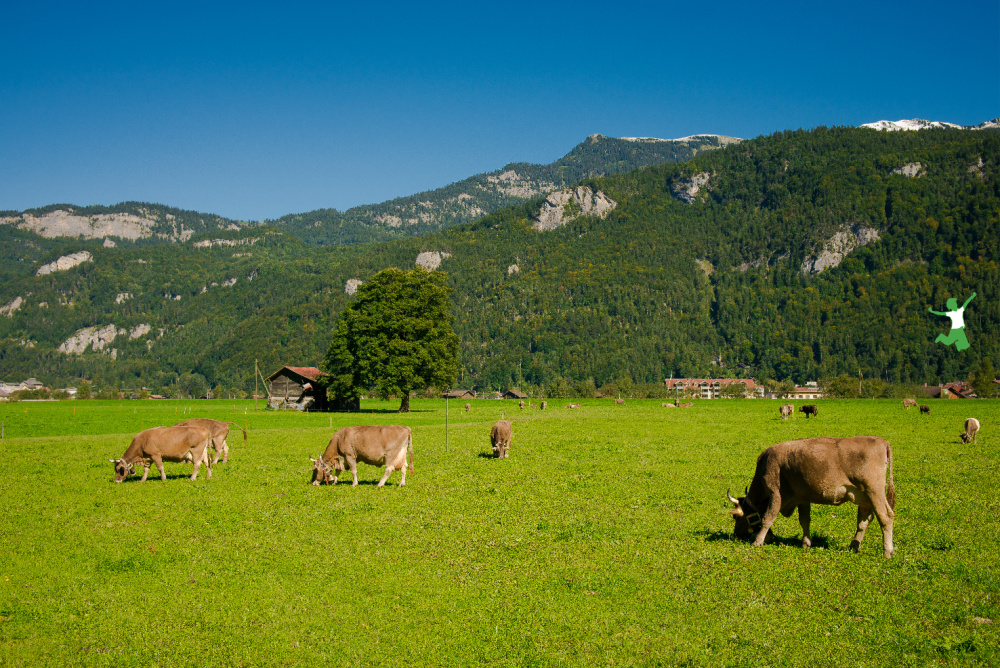
To the Traditional Swiss living in the isolated Loetschental valley, raw dairy and, in particular, butter was a sacred food. Not a pale supermarket type butter, but a golden alpine butter made from the rich, beige cream of cows grazing on thick grass.
The children raised on this nutrient dense, raw butter had strong physiques, wide faces with plenty of room for their teeth, and a high resistance to disease. There wasn’t a single case of TB in Loetschental despite this illness raging elsewhere in Switzerland during the early part of the 1900′s.
The young men raised on this nutrient dense traditional diet based primarily on dairy with plenty of raw, deep yellow to orange butter were so perfect and pleasing in physique, strength, and character that the Vatican favored them over all others in Europe to serve as the Papal Guard.
The Masai of Africa
During the travels of Dr. Weston A. Price in the early part of the last century, five cattle keeping groups in Africa were examined who were still subsisting upon a completely ancestral diet: The Masai of Tanganyika, the Muhima of Uganda, the Chewya of Kenya, the Watusi of Ruanda, and the Neurs tribes on the western side of the Nile near the country of Sudan.
These groups were largely carnivores with their diet consisting primarily of blood, meat and milk.
These largely carnivorous tribes were very tall with even the women averaging over 6 feet in height in some tribes. All these tribes had marvelous physiques and perfectly straight, uncrowded teeth. Six tribes had no dental decay whatsoever.
Clearly, the basis of milk in the diet was a critical component of the vibrant health enjoyed by these tribes.
Dairy Sustained Humans Even Before Agriculture!
Now, new evidence is emerging that humans consumed dairy even before the advent of agriculture and civilization itself.
That’s right. Before humans ever cultivated fruits, vegetables, and grains in prehistoric Africa, they were actively utilizing dairy producing cattle to sustain themselves.
While these early dairy farmers did not appear to drink the raw milk, they did use it to make butter, cheese, and yogurt.
Julie Dunne of the University of Bristol, lead author of the archaeological study published in Nature which found the first direct evidence that prehistoric people of the African Sahara used cattle for their milk many thousands of years ago long before the cultivation of plants in this region said:
“Milk is one the very few foods that give us carbohydrates, fats and proteins in one go. So being able to use milk like these people did would’ve made an enormous difference to their health. It would’ve provided food for life.”
The initial evidence was found in rock art images illustrating domesticated cattle from the Wadi Imha, in the Tadrart Acacus Mountains, Libyan Sahara. Scientists have dated these images at between 5,000 and 8,000 years old.
Additional evidence came via analysis of organic residues from pottery fragments excavated from the Takarkori rock shelter in Saharan Libya which indicated that half the vessels inspected were used to process dairy products.
While it seems implausible that dairy cattle could have once roamed the Sahara given its harsh and arid conditions today, Dunne notes that this region was completely different 10,000 years ago and was in fact, much wetter and greener than most people realize.
So the next time someone slaps the “cow milk is for baby cows” line on you, you can casually mention that in Africa, the location of humanity’s earliest roots according to some scientists, humans have consumed dairy far longer than they’ve been cultivating plants!
Sarah, The Healthy Home Economist
Source: First Evidence for Early Dairy Farming in North Africa
|
|


{ 116 comments… read them below or add one }
Cool, dairy farming is now the oldest profession!!
Now all we have to do is remove the prostitution aspect out of the dairy industry!
Great Post Sara!
Tim
Love this reply
Mrs. Mac\’s last post: Mid Summer Blooms
Amusing and astute all wrapped into one superb comment!!! Thanks for chiming in Tim
I get this one all the time: “We are the only species on Earth that consumes another animal’s milk.” Which is clearly inaccurate, as anyone who’s ever seen any National Geographic show depicting the take-down of a lactating mammal by a predator knows. One of the first parts devoured are the milk sacs.
Not to mention that even if that WERE true, we’re also the only species to cultivate plants, wear clothes, and drive cars. Should we also stop doing those things because other species don’t do that? Such a stupid argument.
Kate @ Modern Alternative Mama\’s last post: Real Food Confessions: Jerri Ann from Sharing My Simple Dreams and Joanna from Plus Other Good Stuff
Exactly. It never ceases to amaze me how an illogical argument can take hold and be spread around and accepted as truth despite clear and obvious flaws.
Sarah, TheHealthyHomeEconomist\’s last post: Dairy Precedes the Advent of Agriculture in Human History
I completely agree. It is a totally ridiculous argument that just doesn’t hold water. And just because, cow milk is made for baby cows, like human milk is made for baby humans, does NOT mean that it’s not a healthful food for multiple species. Next time you pour yourself a glass of fresh, raw milk from grass-fed cows, pour a little for your dog too and see how fast they lap it up! Put a saucer outside (ok, maybe not really) and see how many animals flock to it. It’s real, nutrient-dense food, and when it’s appropriately sourced AND raw, and can be tolerated by YOUR body (some people just can’t do dairy no matter if it’s pristine or not) then it’s a healthful food. Like Kate said, we were clothing and make baskets and have a written language- so just because humans are the only ones doing this means we should stop?
Amy Love @ Real Food Whole Health\’s last post: Fresh Bites Friday July 27, 2012
Ok, typing with one hand while distracted makes for grammatical errors- LOL. We actually WEAR clothing, and don’t need to use so many commas
Amy Love @ Real Food Whole Health\’s last post: Fresh Bites Friday July 27, 2012
I agree! My dog and both of my cats love raw milk (They are raw food eaters overall) and they are super healthy and vibrant.
Actually, Ants herd, milk and protect aphids because they convert tree sap into a life giving nectar.
@Annie, good point and what about lactating mammals that take in orphaned baby animals of another species and nurse them?
Yeah! I thought we were the only species to keep livestock for milk until I researched ants and aphids. Had an ant problem in the garden and was watching ants take aphids into their colony with joy thinking they were eating them. Nope they keep them as livestock! Ants are said to secrete a hormone that keeps aphids around their colonies. Ants actually move them from plant to plant to feed. The aphids secrete a sweet substance that ants feed to baby ants. So if you have an aphid problem you have to get rid of the ants too. So we can’t use the excuse we are the only ones either.
That’s fascinating, Lisa! I knew aphids and ants had some sort of symbiotic relationship, but I didn’t realize it was quite that complex!
Fascinating, Lisa.
I thought it was amazing as well, just sad for my garden lol.
I was once at a goat farm and noticed that when the kids weren’t nursing, the guard dogs enjoyed stealing a few squirts. My conclusion – it does happen in nature.
LOL, my kitties sit patiently during goat milking time waiting desperately for a squirt here and there!
I think that this is actually the first article that I have read on this blog that I disagree with. And here’s why. According to the Bible, Adam and Eve, the first humans created, were put in the garden to keep it and they were also given charge of the animals. They were told to subdue the earth. Gardening was then the first profession, Since the animals were likely created in their adult state as Adam and Eve were, then there couldn’t have been any milking of any animal until after the first baby animals had been born several months later and very likely humans did not consume milk until after sin was introduced into the world and Adam and Eve were banished from the garden. It was at that time that God then allowed them to consume animal and animal products including dairy.
Not that I think this has any bearing on Sarah’s argument, but I think you should read Genesis again;
26 Then God said, “Let us make man in our image, in our likeness, and let them rule over the fish of the sea and the birds of the air, over the livestock, over all the earth, and over all the creatures that move along the ground.” 27 So God created man in his own image, in the image of God he created him; male and female he created them. 28 God blessed them and said to them, “Be fruitful and increase in number; fill the earth and subdue it. Rule over the fish of the sea and the birds of the air and over every living creature that moves on the ground.” 29 Then God said, “I give you every seed-bearing plant on the face of the whole earth and every tree that has fruit with seed in it. They will be yours for food. 30 And to all the beasts of the earth and all the birds of the air and all the creatures that move on the ground–everything that has the breath of life in it–I give every green plant for food.” And it was so.
He instructs us to rule over the animals first, THEN gives us every seed bearing plant to eat.
Make of it what you will.
Rachel @ Rediscovering the Kitchen\’s last post: How to Eat Locally and in Season – Part1, Find Your Farmer’s Market
They would have been concurrent jobs. But, you are missing the point. The point is that there wouldn’t have been an animal to milk until after it had given birth and in the meantime the fruits and vegetables were growing.
Most theological scholars agree that the “days” in Genesis may not have been actual days. Since animals were created before humans, there may or may not have been long enough before humans were created for animals to be having babies.
And now we are debating semantics, which REALLY misses the point of Sarah’s post.
She is not making any claim or even reference to the first foods that humans ate. She is talking about agriculture, which happened after we have been around for quite some time, hence, nothing to do with Adam and Eve.
Rachel @ Rediscovering the Kitchen\’s last post: How to Eat Locally and in Season – Part1, Find Your Farmer’s Market
I really wouldnt put much thought into the bible on this….. Its wacked out so much, and changed by so many people. Its the last thing I would take any facts or anything from…
“If God Wanted People to Believe in Him, Then Why Did He Invent Logic?”
Jennifer,
I had to do a double take when I read your post, as I wrote almost the exact same thing yesterday before it disappeared! I agree 100% with your point. The Bible is our authority, as Christians. It is historically correct. It is TRUTH, whether one believes it or not, and it does not change like man’s “discoveries”. Agriculture was first. Glad to know I am not the only one that knows this! Thanks for your post! God bless!
Yeah, so when the sun stopped for three days in the sky, you literally think the entire solar system stopped turning. The earth would have been destroyed. Not everything in the bible is literal. And it was not written to be a science book. It was written to instruct us in our faith. Period. There are many places where the bible is historically off, but that doesn’t matter because its not a history book. It was written to instruct a community following God.
I can’t believe there are more of people like you. The very fact that there is an old and a new testament is proof that the bible does change. Do we stone people for certain sins anymore?
And I still don’t see what the bible has to do with this post, or why anyone would bring it up.
Rachel @ Rediscovering the Kitchen\’s last post: How to Eat Locally and in Season – Part1, Find Your Farmer’s Market
“People like you,” Wow Rachel, how nice. The Bible changes? I guess you don’t study it much do you? “Changed by so many people,” another worn out cliche, and “whacked out,” Rhianna, really? Have you studied manuscripts???? If you don’t know what you are talking about maybe you shouldn’t bring the subject up. I like Sarah’s statement above, “illogical argument can take hold and be spread around and accepted as truth despite clear and obvious flaws.”
I don’t normally bring up my faith on a non faith topic but I am getting so sick of those who have no problem slamming a person for a positive comment that implies their faith. Is it appropriate to slam someone who relates a topic to a family member or is it only ok if they are Christian? No one was preaching or lecturing here, just commenting on how it relates to them. If you truly want to understand why your statements above are incorrect we can have a private conversation. This is not the place to do it. If you only want to argue and spread hate I’m not interested.
SoCalGT, I grew up studying the Bible from a very young age. My Father learned Latin and Greek just to be able to read the Bible in it’s original languages. I have studied alongside many biblical scholars who were able to explain some excellent historical context to me – the original meaning of the texts. These Christian scholars would absolutely say that yes, the bible has changed. At the very least our understanding of it has.
I personally am not bashing anyone’s faith here. If you read the full thread, you will see that my comments to Jennifer was a quick and friendly debate showing that the Bible could be used to “prove” many different viewpoints on this topic. I took issue with Judi’s comment because she took Jennifer’s comment – an honest, personal, “this is my viewpoint” and warped it into something exclusive and hateful. That is never ok, no matter what disguise you try and hide it under.
Sarah, I am sorry that this conversation took the turn that it did, that was not my intention at all. I will not be replying to anymore comments on this particular conversation to avoid it going further downhill.
Rachel @ Rediscovering the Kitchen\’s last post: How to Eat Locally and in Season – Part1, Find Your Farmer’s Market
Yes! Great post. Thank you for sharing this.
Our Small Hours\’s last post: Pumpkin Risotto
Amie- thanks for pointing that out. My usual response to people spouting off that only infants drink milk and/or humans being the only mammal to drink other animal’s milk is to point out how often orphaned animals are taken in by other species. I’ll have to expand & include the observation you shared. And Lisa, sorry for your garden but what a neat piece of info.
i’ll admit, i’ve used that line a time or two. glad to have some new information to pass around the dinner table.
Oh yes, had that used on me many a time.
I have used this line many times. Drinking another animal’s milk completely grosses me out. Yet, I love cheese. Such a dichotomy.
I wouldn’t be at all surprised to learn that early agriculture had more to do with infrastructure than food. The straw from wild grass would produce much more straw for pavers, bricks and thatching than cereal for food.
Ciao, Pavil
Very interesting viewpoint! I had not thought of that.
Rachel @ Rediscovering the Kitchen\’s last post: How to Eat Locally and in Season – Part1, Find Your Farmer’s Market
Very interesting!
Yes! And one of them was Dr. Mercola!!!! sad……
Abraham lived around 2000 BC. In Genesis 18 it says that he “took butter, and milk, and the calf which he had dressed, and set it before them; and he stood by them under the tree, and they did eat”. This is the first occurrence of the word “milk” in the KJV of the Bible. Evidently Abraham had no beefs about providing butter and milk to his guests and they had no beefs with eating it…
I have seen at least one vegan use that line on virtually every site that promotes real food. It seems to be the vegan mantra.
When I had my dairy farm, our dogs, cats and goats lapped up the raw milk by the bucketful. They loved it. Animals know what is good and what isnt. Dogs also ate the placenta from a cow who had just given birth if the cow didnt eat it herself first.
I hear it all the time from vegans on Food, Inc. One person had a comeback that we are the only species smart enough to do it and that other animals would also if only they had thumbs!
My chickens love clabbered milk as well!
interesting early farmers didn’t drink the raw milk, but used it to make butter, cheese, etc. i love raw butter and cheese, but don’t enjoy the taste of raw milk. maybe it’s because i identify with my early ancestors.
Very interesting indeed.
I thought the advent of agriculture was 10,000 years ago?!?!
I agree it’s a pretty stupid argument, however thousands of years ago (and even 50 years ago) there was also no such thing as E coli 0157:H7.
Personally we sourced a local supply of raw milk earlier this year. I had been thinking about it for quite some time and was happy to finally find one. The farm was very clean, the family fed their own small children raw milk, they never skimped on sterilizing or cleaners. It was as clean as could be. Then their cows grazed on some immature pasture grass and got E coli 0157:H7. By the time this was confirmed there were several people ill, including my 2 year old (who up until then had consumed half a gallon of raw milk a week) and several other kids, some of whom barely made it out alive. My son had bloody diarrhea about every 30 mins to an hour for four or five days, accompanied by severe stomach cramps. Then just after the diarrhea stopped he got Hemolytic Uremic Syndrome (the potentially life threatening complication that can cause the kidneys to shut down). Fortunately he had a fairly mild case of HUS and didn’t need to be hospitalized, unlike some of the other kids who were in hospital and on dialysis for a month. Then on top of that we had to get stool samples for the health department every other day and he had to be isolated from other kids (no school or daycare) until he was no longer excreting the E coli. This took another 6 weeks or so.
Believe me when I say that you don’t want to mess with this strain of E coli. I used to think that the benefits of raw milk outweighed the risks, but after going through what we went through I wouldn’t give it to my kids again. And I understand that you can get sick from anything, spinach, strawberries, you name it, but after that experience I just can’t in my right mind make the same choice for my kids. I get pasteurized (non-homogenized) grass fed milk that I use to make kefir, but for drinking and cereal and such we use home made almond milk now.
I agree it’s a pretty stupid argument, however thousands of years ago (and even 50 years ago) there was also no such thing as E coli 0157:H7.
Personally we sourced a local supply of raw milk earlier this year. I had been thinking about it for quite some time and was happy to finally find one. The farm was very clean, the family fed their own small children raw milk, they never skimped on sterilizing or cleaners. It was as clean as could be. Then their cows grazed on some immature pasture grass and got E coli 0157:H7. By the time this was confirmed there were several people ill, including my 2 year old (who up until then had consumed half a gallon of raw milk a week) and several other kids, some of whom barely made it out alive. My son had bloody diarrhea about every 30 mins to an hour for four or five days, accompanied by severe stomach cramps. Then just after the diarrhea stopped he got Hemolytic Uremic Syndrome (the potentially life threatening complication that can cause the kidneys to shut down). Fortunately he had a fairly mild case of HUS and didn’t need to be hospitalized, unlike some of the other kids who were in hospital and on dialysis for a month. Then on top of that we had to get stool samples for the health department every other day and he had to be isolated from other kids (no school or daycare) until he was no longer excreting the E coli. This took another 6 weeks or so.
Believe me when I say that you don’t want to mess with this strain of E coli. I used to think that the benefits of raw milk outweighed the risks, but after going through what we went through I wouldn’t give it to my kids again. And I understand that you can get sick from anything, spinach, strawberries, you name it, but after that experience I just can’t in my right mind make the same choice for my kids. I get pasteurized (non-homogenized) grass fed milk that I use to make kefir, but for drinking and cereal and such we use home made almond milk now.
That us fascinating! We are dairy-free (except ghee) for allergy reasons, but I wish we could have yummy, grassfed raw milk!
Tijana, I’m so sorry that happened to your family.
@Tijana you of course are free to choose not to drink raw milk if you like and I’m sorry for your ordeal, but as for me, the miniscule risk (and it is miniscule compared with other foods) compared with the huge benefits I have observed in over 10 years of drinking it from over a dozen farms is clearly worth it. I wonder if you got e coli from cantaloupe like the outbreak of e coli in cantaloupe last year that killed dozens of people … would you stop eating cantaloupe for the rest of your life? Just wondering as it seems pretty extreme reaction to ban a complete food group and drink a factory food instead to a wholesome unprocessed food like grassfed raw milk.
Hi Sarah, we don’t drink factory food, the milk we get is also from a local farm (http://www.ladylanefarm.com/), the only difference between that and the raw milk is that this one is low heat pasteurized and they have more cows (45, but that’s not the same as the hundreds of cows of CAFO’s, hormones, corn feeding, etc. etc.). Like I said, I know you can get sick from cantaloupes, strawberries, spinach and everything in between, but I can’t discount what we went through. I talked to our farmer lady after it was all over (I don’t blame her one bit for what happened by the way) and she said that she had talked to their vet afterwards and he explained that after you clean the cow’s butt, before you milk it, all it takes is a drop of water to slide down off their skin into the milking vat while you’re not looking and your whole vat is contaminated. They ended up closing their farm and selling off the animals and they don’t drink raw milk anymore either (one of their kids got sick and was in hospital for several weeks). I honor raw milk and anyone who chooses to drink it – I agree it’s a superfood and very delicious, I loved drinking it. However it does have risks. While I may choose to accept those risks for myself, I can’t make that choice for my kids.
So eventhough this post is about raw milk, your experience was with low-temp pasturized milk. I will look forward to the post on low-temp pasturized milk as I had assumed it would be an alternative if raw milk wasn’t available. And now we also have your experience.
Thank you Ann
Interesting! I knew that cows were first domesticated before agriculture rise so I figured that milk must have been in human diet for years before.
@Tijana The problem is that low temp pasteurized is just as denatured as the ultrapasteurized from what I’ve heard lately as some lab tests are being conducted comparing the two. If you choose not to drink raw milk, I would suggest not drinking any milk then as low temp pasteurized does not seem to be a good second choice as was once thought. I am planning a blog post on this when the data becomes available.
Okay, thanks for the info. We only use it to make kefir. For drinking and cereal I make almond milk. I don’t really know what to use for kefir, I know coconut milk will work but it’s very expensive (I get the bpa free cans you linked in one of your posts).
It’s cheaper to make coconut milk than buy it and very easy as well. http://www.crunchybetty.com/homemade-coconut-milk-the-recipe-to-remember
While reading my Bible yesterday, I noticed that Abraham, who lived roughly 4,000 years ago, happily served his guests a meal of butter, milk, roasted beef, and cakes made of oil and some kind of grain. Interesting!
Lol! I just read the comment made by Narrow Gate Family Farm! Guess I’m not the first one to reference that.
@Tijana Making kefir with it sounds like a great idea.
Hi Sarah,
Since low-temp pasteurized milk is not really good, then what about pasteurized grass-fed cheese?
Wow, this thread’s misinformation and conspiracy theorizing is frighteningly reminiscent of Fox News. These issues regarding vaccinations have been definitively resolved for decades.
This article addresses the whole topic, specifically the issue of the false correlation of SIDS with vaccinations (page 6)
http://tiny.cc/scp4hw
“This American Life” did a fantastic report addressing this issue.
http://tiny.cc/gep4hw
Here is an example in the recent news of the public health implications of not vaccinating.
http://tiny.cc/7hp4hw
Joel, you appear to have joined thehealthyhomeeconomist on Facebook today – is that simply so you can make this post? A little random if you don’t follow Sarah on a daily basis. Just my thought, but you must have a motive for that?
Also, the advice I have from those in the know is to NOT follow tiny.cc URLs as they can contain viruses. Why don’t you put the full URLs up so people know where you are directing them too?
Great article Sarah (as usual). I learned SO much and feel even better about buying raw milk. Thanks!
I love your homesteading posts, and this was very interesting. I’m also a vegan. I am aware of the health benefits of raw milk. Like all people, we can’t all be stereotyped.:)
For me, the problem is factory farming, which I know from reading your blog, your also opposed to. If we could have raw milk without being arrested, and if dairy cows and their young could be kept on clean, healthy, humane family farms, I’d say…drink to your health folks!
But until that time, and things change in terms of the factory farmed dairy cows, I protest with my money and my lifestyle and will remain vegan.
Thanks you for the interesting raw milk information. I do wish people were allowed those benefits.
My ex-Partner is from Tanzania. When we first tried homemade kefir last year ( with organic, non-homogenised milk since we can’t access raw dairy), he told me that it tasted exactly like a traditional food he grew up with. In traditional kitchens there is a large hollowed gourd hanging from the ceiling. Milk is poured in and swished around in there a few times per day. After a day or two the contents were taken out to serve for breakfast. They usually had it with sugar added (eek!). I don’t know any further details—he wasn’t allowed in the kitchen much himself as a boy.
Tijana, are you the family I recently read about in OR? We’re in the metro area and my heart was so broken for that family. We drink raw milk and love it, make kefir and lacto ferment as well. I am so sorry for your ordeal. <3
Charlotte, I don’t think it was our family you read about (not to my knowledge anyway
), though the outbreak made the news back in April, and the Oregonian wrote some very negative and misinformed stuff about the farming family.
I often drink watered down cream when we don’t have raw milk. Just a thought. I can barely tell the difference. Sally Fallon has said it is better to drink watered down cream than pasteurized milk. Just an idea for you!
Thanks for saying that, Joy. I have been reading all of these comments wondering about store bought milk. We don’t drink raw milk. I’ve been hearing that perhaps drinking milk was not a good thing for the reasons mentioned above. If you don’t drink raw milk should you still drink milk?
You can make water kefir, if you don’t want to use raw dairy. I make both. Love the raw milk kefir the best though :@)
historically inaccurate? lol Not a strong argument if you ask me. There are many reasons to refrain from drinking milk from another species. Historical reasoning doesn’t mean it is safe or recommended. Bovine Aids, Bovine Leukemia, Mad cow dis-ease (which is not a live virus thus cannot be ‘killed’ with heat (for those who feel its safer to consume). Intuition )not fear( … African’s may have and continue to drink milk from cows … so ask yourself ‘why’ this is necessary in the first place – common sense is not that common these days
I’ve been wondering for a while about the difference in raw vs. pasteurized milk when it comes to dairy allergies/sensitivities. My naturopathic doctor has me off my raw milk (and kefir and cheese) right now, as we try to address some thyroid, and adrenal problems and ulcerative colitis.(since dairy showed up as a moderate sensitivity on the blood test)
I truly believe in the benefits of raw milk, and it kills me not to drink it. So, I keep wondering if maybe the sensitivity/immune reaction the test is measuring might not be different in my body with raw milk vs. pastuerized.
any thoughts?
Long story short is that the scientific community doesn’t really know how the whole timeline of agriculture and domesticated animals works out.
I had the good fortune to have studied paleolithic and neolithic times before the paleo diet/culture came on the scene and have been able to view this from the perspective of knowledge already gained, and not from the view point of defending or attacking a favorite diet or health idea.
Farming and domesticated animals came about between 8,000 and 10,000 years ago. There is ample physical evidence for this. And Paleo man segued to neolithic man somewhere in that same time period. There is ample evidence for this as well.
What they don’t have much actual evidence for is the existence of homo sapiens before 10,000 years ago. I’m not saying that they didn’t exist – we can argue about the merits of the currently accepted theories on evolution some other time. I’m just stating the facts that a sincerely curious person can find in any comprehensive text book on the subject. The available evidence prior to 10,000 years ago compared to the “modern” time period of the most recent 10,000 years is night and day.
Point being is that the scientific community only has a relatively small bit of physical evidence to work with when they’re trying to piece together their various theories on man prior to 10,000 years ago. So if someone is basing their health needs on whether or not dairy was used by paleolithic man, it’s really too much of a guess.
We do know with certainty that paleolithic man had some rudimentary forms of farming and animal usage leading up to the neolithic revolution that brought farming and domesticated animals to a degree that we would recognize today. So who’s to say that it wasn’t this “discovery” of the benefits of dairy that enabled paleo man to become neolithic man? The available evidence supports both theories. Those that say dairy usage was part of the beginning of the down fall of modern man’s health, they’re guessing, pure and simple. They don’t have the evidence to actually support that or to refute the possibility that it was the use of dairy products that enabled them to advance beyond the stone age and into the various metal ages.
Think of two ancient philosophers arguing about whether or not the earth revolves around the sun, or the sun around the earth. From their limited vantage point the evidence supported either view, and that’s where the scientific community is today.
You can argue all day long about raw milk, but it healed me from chronically grave illness. Should I feel guilty for consuming milk from a cow? Well, I’ve seen the cows where the grassfed milk comes from–and they are happy animals. They all have names cause the farmer loves them. If those cows were wandering in the wild, they would be miserable comparatively. I would rather thank the cows and the farmer than curse the processed foods my body couldn’t handle.
How about the 2 million years plus before that?
The “dairy” that is legally available in most states is so altered and transformed that our bodies don’t recognize the molecules they have become. The blood, pus, antibiotics, hormones, pasteurizing, homogenizing, etc…no thank you.
Except if one is unable to digest dairy products (casein), which can be the case for some with gluten issues. It may be safe for some, but not others.
@Kyle well, people weren’t around then and agriculture certainly wasn’t either.
@Rebecca well, I don’t think the folks 8000 years ago were consuming that kind of dairy and the dairy I consume is raw and grassfed and not full of pus or factory altered in any way so that is of course healthy and fine.
I’m not arguing for agriculture. I’m saying we didn’t evolve for either one. I don’t think saying that some cultures drank cows milk before agriculture is a relevant argument to make to vegans.
good for you. it’s illegal where i live.
I’m so happy I went out of my way on my trip last may to bring home a cooler full of raw pastured milk. I’ve been enjoying the things I can make from good whey ever since. Now I just need to figure out how to have it more consistently so that we can consistently have real butter that is actually good for you!
which, as you can see, really makes me angry
I think that you have to personally do the research and make the decision. We (I and my family) consumed dairy regularly and now my insides hurt very much when I consume. Raw, organic etc I cannot touch it. While it was a part of agriculture many years ago it is not what it use to be. Most cannot afford to only drink raw or even organic milk. They are financially forced to settle for the anti-biotic,factory farmed milk. Not good. How do we help that population? What about the school system who has the bad stuff in place? I get that you can afford to drink the good stuff and thus endorse it, there are soooo many that cannot and this includes our youth. :-/
Since I have no access to raw, I rarely consume any milk products.
Just because most peoples bodies have adapted over the years to drinking/eating milk and cheese doesn’t mean we were intended to do so, Cows milk originally was intended to turn a 25 lb. calf into a 35o lb. cow/bull in a year….humans are the only species that drink another animals milk….or that drink it after they are grown.
I think it’s dependent on the individual’s body. My husband is severely intolerant to milk & gluten, but my kids & I do okay with raw dairy, particularly cultured goat dairy.
what ever eat it and drink it your all going to die some day anyway.
Most people can afford to buy and eat healthy. It’s whether they choose to. It is definitely more work to eat healthy on a budget but it’s possible. You make your own food and snacks from scratch instead of buying the pricey unhealthy junk. My husband and I both work full time and we find the time. We are on a budget and we manage to feed our kids healthy and REAL food. There are definitely lots of excuses why people can’t, but if you and your family’s health is important you find a way. You don’t have to buy everything organic but milk and dairy is huge. Those hormones and antibiotics are horrible. It’s tough but good luck!
Totally unsuitable for human babies.
I <3 raw milk!! I make a 100 mile round trip to the dairy to buy raw milk, cheese, and kefir once a week. Here, it is $2 per gallon cheaper than store bought organic. It makes me so happy to drive up to the dairy and see all the cows grazing on grass!! I agree, you make the time and find the money for the things that are important to you!
Virginia, that isn’t true. Although no one will argue that breastmilk is best, sometimes that just isn’t possible so accommodations must be made. My son is 13 months old and has been drinking raw milk formula since he was 5 weeks old. He is the healthiest and strongest baby I have ever known.
I have a question. I started my real food journey about a year ago. We drink raw goats milk, however it comes frozen and we thaw it. About three months ago I started not being to eat dairy AT ALL. I get very sick. Doc says lactose intolerance. Now even a little cream in my morning tea or coffee makes me have terrible bloating cramping. Im so so angry about this as I know how crucial dairy is. Would raw fresh milk be better rather than raw froze/thawed milk? Would that make a difference? Please suggest something. Im distraught over this. Thank you.
the statement that humans are the only species that consume the milk of other species is totally irrelevant. Humans are also the only species that weave cloth and sew it into clothes, the only species that build musical instruments and combine them into symphonic music, the only species that build printing presses and libraries….
The flawed logic that tries to reduce humans and raise up other species so that we are all equal “animals” is nonsensical at best. And most of the arguments that come out of that are akin to if you recognize that there are many animal species that do not mate for life and you extrapolate that there is something badly wrong with swans because they generally do.
Amy Jo, dairy isn’t crucial. You are being led to believe that by a super rich industry that makes commercials to sell their product. If you can’t have dairy, you can thrive and live just as well. Leafy greens, seeds and other foods have plenty of calcium that is more easily assimilated and doesn’t cause the body to become acidic, and thus lead to bone loss. You will be well.
I’ve never seen a starving vegan with a chicken in the yard. Big ideals come from big conveniences. The Economist is correct, animals can graze where and when edible vegetation will not grow; plus, you gotta factor in weather, pestilence and famine – your crops will go first, grass is tougher to kill. You get hungry enough, you’ll drink that milk and it’ll do more than keep you alive, it’ll keep you strong.
Don’t know if I agree with you on this one. I was warned about
using non pasteurized milk fresh right from the cow by our pediatrician then 4 months after drinking it my daughter became very ill from Shia-toxin Ecoli and the typing came back from the cow.
er… sure it’s good for you, if it’s straight from the cow! the way modern people pump homogenized, pasteurized milk into their little ones, thinking it’s good for them, is really sick.
Guys, you are missing the point here. The argument that we, as humans, aren’t meant to drink milk is what she is talking about. There is this generalization out there, that we are not “meant to” and I think it has more to do with where you hail from….your ancestry on whether you are able to tolerate it. Also, this statistic that 60% of the population is lactose intolerant (another “evidence” given by those that believe milk is bad) is also misleading as it has to do alot with drinking pastuerized milk and not true intolerance to lactose.
I found a raw source for dairy about a month ago and I’m absolutely loving it. I’ve never truly loved the taste of milk and mostly used it in baking, but raw milk is very delicious and I enjoy it on my granola every morning.
Well said @sheril Carey.
I enjoy all of your posts but I completely disagree with this one. These tribes did not have tooth decay because they did not eat processed foods. I believe we can consume dairy but we were not made to do so. If I needed it to survive because other food sources were lacking I would but cows milk is made for it’s calf and my milk is made for my baby.
I like this, we love raw milk at our house. Thanks!
everyone is lactose intolerant
I was created to drink raw milk! Lol.
There is a good reason why cows’ milk is pasteurized. Please educate yourselves and take a look back in history….and certainly no cows milk for human babies their little bodies can not digest it.
There is a better reason not to pasteurize milk, please educate yourself and take a look back in history…..
I eat it now. But why do we need to give kids cows milk at one. Why can’t they still nurse. That makes the most sense. Also even though I eat dairy it is weird that we drink and eat another animals milk that they use to nurse their young.
My typical response to the “No other animal drinks the milk of another species after weaning. Why do we?” is: Because God made me with hands to milk the animal, and intelligence to care for them and to make butter, cheese, and kefir from that milk. And I am no animal – I am made in God’s image and I thank Him for the gift of intelligence and RAW DAIRY!!!
Well, geez whiz – wasn’t it GOD Himself who said The Promised Land was a Land of Milk and Honey !!!!!
o leitinho é bom e faz crescer;)))))))rsrsrsrssrrssrs
Evolution is a beautiful thing. Eating the foods we evolved to eat over millions of years instead of synthetic stuff produced in a lab. What a crazy thought.
Sorry, but I just have to comment. The “crazy thought” is that anything on this earth could have come about by chance – over “millions of years”. All of the evidence refutes that – soundly.
How do you know your raw milk is safe? Chances are you don’t know !! Diseases pasteurization can prevent include tuberculosis, brucellosis, diphtheria, scarlet fever, and Q-fever; it also kills the harmful bacteria Salmonella, Listeria, Yersinia, Campylobacter, Staphylococcus aureus, and Escherichia coli among others.
@Virginia Coster, you don’t know the answers to those questions if you cannot meet the dairy owner face to face and ask what they test for and how often. I own a family milk cow and we KNOW our cow is free of disease. Personally, if I didn’t have her, I would only want to buy milk from a farmer with a very small herd. It is much easier to spot a cow with a potential illness if you are only handling a small number of animals.
“dairy I consume is raw and grassfed and not full of pus”
Incorrect. ALL milk, even HUMAN milk, is full of pus.
{ 1 trackback }