

Table of Contents[Hide][Show]
- What is Lead Doing in Broth?
- Types of Broth Used to Test for Lead
- How Much Lead Was in the Broth?
- Is This Amount of Lead a Problem?
- Best Broth Scenario
- How Much Contamination Is Too Much?
- Critical Research Flaws
- Many Unanswered Questions
- Types of Chickens and Their Feed
- UK Has Environmental Lead Issues
- Other Studies on Lead in Bone Broth
- National Food Lab Testing Finds No Lead in Broth
Examination of the research that raises concerns about lead in bone broth and how to source this important traditional food completely free of contaminants.
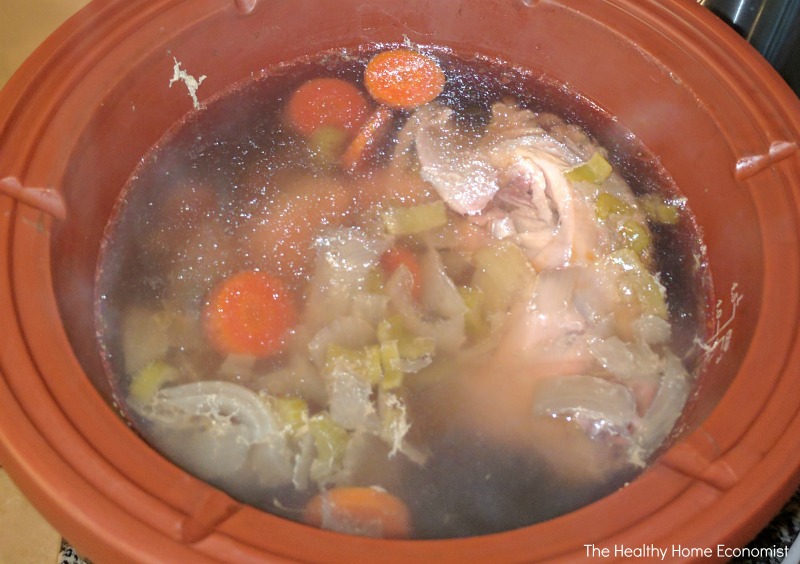
A study about lead in bone broth has been ruffling a lot of feathers lately, and it’s been scaring way too many people away from making bone broth at home.
The study, which appeared in the journal Medical Hypothesis (not peer-reviewed), is entitled “The Risk of Lead Contamination in Bone Broth Diets.”
It reports broth made from organic chickens was contaminated with lead, one of the deadliest toxic metals known.
That’s scary news, and if the study were valid, there would be plenty of reason for concern.
What is Lead Doing in Broth?
Lead, after all, is a neurotoxin that can cross the placenta and blood-brain barrier. It is associated with abnormal fetal development as well as a very long list of neurobehavioral disorders and diseases in children and adults, including ADHD, violence, social withdrawal, depression, substance abuse, and Parkinson’s.
Lead is so bad that the body in its wisdom sequesters it as far from the action as possible. About 90 percent of lead in birds and mammals goes deep into the bones. Other favored organs of accumulation are the kidney and liver. When the body tries to eliminate lead, the principal route of excretion is through the urine, not through the skin.
Lead is a double whammy for children — even well-nourished children — because their bodies and brains are developing and they can absorb a whopping 50 percent of the lead found in their dietary intake. In contrast, adults will absorb 1 to 10 percent.
Clearly, what we need to know is this: Is all broth contaminated with lead because of our toxic world? Or was the batch stirred up by the three UK researchers unusually contaminated?
Let’s take a closer look at that study.
Types of Broth Used to Test for Lead
The researchers cooked up and tested the following for lead.
- Broth made from tap water plus skin and cartilage
- Broth made from tap water plus bone
- Broth made from tap water plus meat
- Tap water alone cooked for the same amount of time as a control.
How Much Lead Was in the Broth?
The bones, skin, cartilage and meat all came from the same source. Surprisingly, the researchers found the highest levels of lead in the broth made from cartilage and skin, not in the broth made from bones, the place where 90 percent of ingested or inhaled lead accumulates.
Broth made from meat alone showed the lowest levels, as would be expected, while the water used showed minimal lead contamination. The figures for lead are:
- 9.5 ugL for broth made with skin and cartilage
- 7.01 ugL for broth made with bones
- 2.3 ugL for broth made with meat
- 0.89 ugL for the lead found in tap water cooked alone
Is This Amount of Lead a Problem?
Seeing those figures, it’s hard not to worry about good old-fashioned broth. What kind of bones are used to make bone broth? Typically using a combination of bones, meat, cartilage, and skin…all of which showed up as worrisome sources.
Indeed the news is so alarming that some people have already cut back on drinking broth. Others have chosen not to panic, and have simply shrugged off the news as the latest scare tactic taken by Big Food, as evidence that ALL foods are contaminated today, or both.
Chris Kresser has pointed out in an article on this study that the levels of lead found in the broth tested for this study are lower than the EPA limit for lead in tap water, which is 15 ug/L. That, of course, begs the question of whether the level of contamination permitted in tap water is acceptable. In any case, as Kresser pointed out, a cup or two of broth a day would go well under that level and should not be considered dangerous.
Kresser and others have further argued that there’s no reason to worry about a little lead when bone broth also contains calcium. The idea is, calcium interferes with lead absorption in the intestines.
We also know Vitamin D deficiency will increase lead accumulation in bones and Vitamin C and/or iron deficiencies will increase lead levels in the blood. Adequate iron and B vitamins (particularly thiamine and folate) status also play roles in reducing the risk of lead toxicity. Clearly is it wise to be well-nourished.
Best Broth Scenario
In the best broth scenario then, people replete in calcium would not suffer ill effects from lead in the broth. Such people would also benefit from the ample quantities of the amino acid glycine in the broth because glycine — along with the cysteine and glutamic acid also found in broth — are needed by the body to produce the powerful antioxidant glutathione, which helps us dispatch lead and other heavy metals.
Unhappily, that beneficial broth scenario does not hold true unless people already have a healthy gut. It is far less likely to be the case in those already suffering from digestive disorders and compromised gastrointestinal integrity. This is definitely the case with children afflicted with autism and other disorders, and unfortunately, these are the very children being given broth as part of their gut healing.
As already pointed out, even normal children can absorb up to 50 percent of the lead in food. Furthermore, as Dr. Russell Blaylock has pointed out, lead will magnify the possibility of excitotoxicity fueled by glutamic acid.
Although the body needs glutamic acid, people who are highly sensitive to MSG may have to limit direct consumption of even glutamic acid from food.
This is the probable reason why many GAPS practitioners have observed that people often do better if they start their healing journeys with meat broth and later move on to full-fledged broth that has also been made with skin, cartilage and bones.
How Much Contamination Is Too Much?
The takeaway is that broth containing lead may not be an appropriate prescription for gut healing. Yes, calcium from broth may protect us from lead in the way selenium in fish protects us from mercury.
But no, I would say it is still not wise to consume high-mercury tuna or other fish daily or to drink copious amounts of broth every day if that broth comes with a load of lead.
All of which leads us back to our key question.
Is all broth contaminated with lead because of our toxic world? Or was the batch stirred up by the three UK researchers unusually contaminated?
Critical Research Flaws
Those curious enough to pay $31.50 to see the full text of this study online won’t find out very much. The researchers do not tell us how the broth was made, where it was made, where the chickens came from, how they lived, or what they were fed.
All the researchers tell us is they made “broth” and tested three types of it (broth from meat, broth from skin and cartilage, and broth from bones).
They also report they tested the water for lead as a control, apparently after being simmered in the same cookware for the same length of time as the broth. The chickens were “organic” though the study offers no specifics on what is meant by that.
Many Unanswered Questions
That leaves a flock of unanswered questions, starting with the cookware and the ingredients.
- What type of cookware was used?
- What recipe was used? Was the broth made with vinegar or wine? If so, how much?
- Was the tap water fluoridated?
- What was the pH of the tap water?
- If wine or vinegar was used in the recipe, why didn’t the researchers simmer the
- combination of water plus the vinegar or wine and then test for lead?
Why do we need answers to these questions? Some types of pots, particularly those made with ceramic, have been found to be high in lead.
Water with an alkaline pH would be less likely to leach lead out of the cookware, while water with an acid pH would be more likely to leach lead. Along this same line, the water should have also been tested after cooking with the same amount of vinegar or wine used in the recipe.
Fluoride matters because it increases lead accumulation.
Without the answers to these questions, it’s not fair to indict the broth when the cookware might have been the culprit.
A query to Basant Puri, the corresponding author of this study, was forwarded to Dr. Jean Monro, Director of the Breakspear Medical Group, who answered some of our questions. She reported the ingredients for the broth were only chicken and water, that the pH of the water was “irrelevant” and the cookware was stainless.
Although stainless steel cookware toxicity issues related to chromium and nickel are very real, this material has never been found high in lead. Having ruled out the cookware as the source of the lead, it’s time to learn more about those chickens.
Types of Chickens and Their Feed
A careful reading of the study once again leaves us with a flock of unanswered questions.
- What were those “organic” chickens fed?
- What water did those “organic” chickens drink?
- Were the chickens “free range” or confined?
- Where were the chickens raised?
- What were their living conditions?
In Medical Hypotheses, the researchers report the chickens were “organic birds.” That’s all, and it is not enough information. Generally, the term “organic,” refers to the process by which that food was grown or produced.
Organic certification — both in the US and UK — fails to address environmental contamination, and there is no limit to how much lead or other toxic metals such as mercury, cadmium, arsenic and aluminum are allowed in organic feeds. In brief, for this study to have any validity, the feed needed to be tested for lead.
“Organic feeds” also contain grains, which are known to contribute more dietary exposure to lead than the grasses and bugs eaten by pastured chickens living in areas where the soil itself is not contaminated.
Organic certification also fails to address the possibility of lead-contaminated water supplies. Was the chicken’s drinking water tested for lead? Was it piped in through old lead pipes? Were the water troughs soldered with lead? And what was the lead level of water in the area where the chickens grew up.
Since none of these important questions were answered in the study itself, we requested more information. Dr. Monro replied that the chickens were from an attested organic farm, “unlikely to have been on land close to a highway” and produced by an organic company called Highlander. She stated that neither the soil nor the water drunk by the chickens was tested for lead.
Contaminated Chicken Farms?
Attempts to reach the Highlander Company to learn more about the chickens and their living conditions proved fruitless. The company was apparently dissolved and extensive online searching yielded no information about where this company’s farms were located or whether their “organic” chickens were free range or confined. A follow-up question about this to Dr. Monro has not yet been answered.
The location of the farm is critically important yet we don’t even know if the farm was in the UK. To understand the basic issues that a valid study would have taken into account let’s take a look at a likely scenario for lead contamination.
To do this, let’s assume the farm in question was located somewhere near the Breakspear Medical Group, which is based in Hemel Hempstead, Hertfordshire, in the Thames region of England, west of London. In 2011, the Chief Inspector of Drinking Water reported multiple locations east of Hemel Hempstead where public water supplies tested failed to meet the acceptable future lead standard of 10 ug/L in 2004 and 2010.
Areas to the north, south and west of Hemel Hempstead also had pockets where the water supplies failed to meet that standard. If the organic chickens were grown in any of those pockets, they could have become lead toxic from the public water supply.
Groundwater Contamination
Groundwater, too, can become contaminated if the water is acidic, a common situation in acid mine drainage areas. Sources of lead in surface water or sediment include lead-containing dust from the atmosphere, wastewater from industries that handle lead (iron and steel and lead producers), urban runoff, and mining piles.
Because we do not know where the chickens were raised, we can only speculate as to whether conditions such as these might have been present.
Fluoridated Water
Another confounding factor could have been fluoridated water. Fluoride and lead have high synergy, and fluoride has been proven to increase lead accumulation in birds and mammals.
Not all public water in the Thames Basin Region is fluoridated, but, according to the Drinking Water 2010 Report, there is much natural fluoride there, and it is not removed by conventional water treatment. So fluoride too could have increased the levels of lead had those chickens been grown there.
Clearly, the researchers have failed to provide us with sufficient information about the chickens and their living conditions. Those needed details might also have solved the mystery of why the broth found to be the most contaminated by lead was not made from bones but from skin and cartilage.
Lead in the Soil
Textbooks report that 90 percent of lead ingested or inhaled goes into the bones and is excreted through the urine, not out through the skin.
Yet these chickens had more lead in their skin and cartilage than in their bones.
How could that be? High lead in chicken skin only makes sense if the chickens were free-range and raised in an area where the soil had high lead content. Given the chance, chickens not only go hunting and pecking but root, rock and roll around in the soil. Poultry farmers call this “dusting.”
If the chickens were both free-range and local to the Hemel Hempstead area, they may well have been rolling around in soil high in lead. That area, as discussed above, has pockets where water supplies have been contaminated by lead.
The chickens might also have lived near an industrial site (past or present) or beside a highway, though Dr. Monro thinks this “unlikely.” Dirt near highways is almost always contaminated with lead because leaded gasoline was used in cars and trucks prior to the 1970s.
Yet another possibility is the chickens lived in an old fruit orchard where lead arsenate, a pesticide widely used in England, as well as other countries, would have accumulated in the soil.
Lead arsenate was mainly used on apple trees, but also on other fruit trees, garden crops, turf grasses and against mosquitos. High lead content would also be expected in the soil near old houses or other structures now painted or once painted with lead paint.
UK Has Environmental Lead Issues
In fact, the UK is riddled with lead problems in its water, soil and air. A 2009 comparison of lead exposure standards revealed the UK had the worst occupational exposure limit for airborne lead of 20 countries.
“Dusting” is the probable reason those chicken skins were high in lead, but there is no obvious explanation for the cartilage. Textbooks do not list cartilage in the body as an accumulation site for lead, which makes sense given the fact that cartilage is not nourished by the blood supply.
The likeliest explanation is that the high lead content of the broth made with both skin and cartilage got its lead almost entirely from the lead-dusted skin.
At this time, we have located just one other research study that looked at lead contamination of broth. In that case, the researchers determined the predominant source of the metal was tap water.
They found very little lead in a beef bone broth, more in a beef casserole that used red wine, but the highest level by far in baked potatoes with skins contaminated from the lead in the soil.
Other Studies on Lead in Bone Broth
Several other studies have investigated the levels of lead found in the muscles and organs of conventionally raised chickens. In each case, the lead appeared where it would be expected — i.e. in the bones, with much less in the skin and cartilage.
In conclusion, there are many reasons to think the broth used for the Breakspear Medical Group’s non-peer-reviewed study was a contaminated sample.
At the very minimum, a competent study would have tested broth made from chickens grown in several locations and provided full information about the chickens’ living conditions.
Competent researchers would also have tested the chickens’ feed, water, and soil for lead.
Rather than make a serious effort to find out what particular conditions contribute to lead in broth and help people source their broth carefully, the three researchers chose to do a quick and dirty study that casts aspersion on a traditional healing food.
At most, their finding of lead in broth should serve as a warning to consumers that the careful sourcing of broth is warranted in our toxic world.
National Food Lab Testing Finds No Lead in Broth
To end on a very positive note, we would like to announce the results of testing performed by The National Food Lab on bone broth from grass-fed beef and pastured chicken.
These broths were prepared in stainless steel soup pots by Three Stone Hearth Co-op in Berkeley. Testing results were as follows:
- Grassfed beef broth. No lead detected
- Pastured chicken broth: No lead detected
- Reverse osmosis water: No lead detected
The takeaway? The flap about lead in bone broth is a lot of clucked-up nonsense.
Just take care with the source of your broth, and all will be well!
More Information
For Dr. Daniel’s longer, more comprehensive version of this article complete with 62 references, please click over to the Weston A. Price website.


I have been using Fond Bone Broth, a regenerative one that I think is very good and tasty too.