

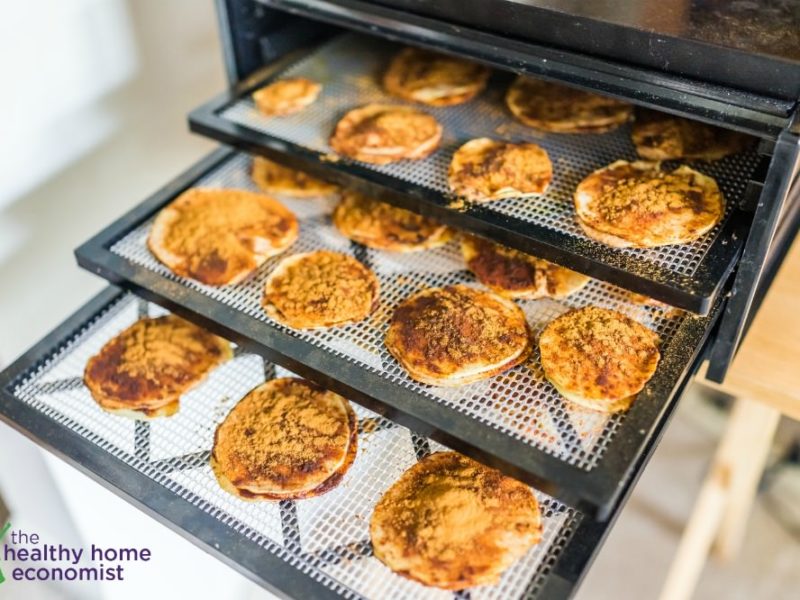
My videoclass from last week, Raw Nuts Done Right, appears to have caused a bit of a stir. Nothing new for this blog, as challenging the status quo is something that happens with regularity in these parts!
In Raw Nuts Done Right, I demonstrate how to properly soak raw nuts in brinewater and then dry them in a warm oven set at 150F. This practice deactivates antinutrients and ensures maximum digestibility and nutrient absorption and is in accordance with the wise preparation methods of Traditional Cultures like the Aztecs.
Numerous comments on the post itself, my YouTube Channel, email, and Facebook have insisted that drying nuts at 150F is far too high and that the food enzymes are destroyed.
So, what’s the truth? Are nuts dried in a warm oven set at 150F still raw or not?
The confusion seems to rest with the difference between wet heat and dry heat. When a liquid food like milk is heated, you will find that you burn your finger at a temperature of 118F. If the milk is heated only to 117F, you will not burn yourself and this is nature’s magical way of letting us know that the food still has all of its enzymes intact.
Food enzymes withstand dry heat much better than wet heat. According to Dr. Mary Enig, Board Member Emeritus of the Weston A. Price Foundation in an article about food enzymes:
“All enzymes are deactivated at a wet-heat temperature of 118 degrees Fahrenheit, and a dry-heat temperature of about 150 degrees.
It is one of those happy designs of nature that foods and liquids at 117 degrees can be touched without pain, but liquids over 118 degrees will burn. Thus we have a built-in mechanism for determining whether or not the food we are eating still contains its enzyme content”.
I hope this information clears up the confusion about drying raw nuts in the oven and whether or not the food enzymes are still intact. It is especially important to harness the convenience of drying large batches of raw food in the oven as not everyone has access to or can afford a large dehydrator.
If you are still unconvinced, dry out a batch of soaked nuts in a 150F oven and then eat a handful straight out of the oven. You will be delighted to see that the nuts are not hot and that you do not burn your hand or mouth, an indication that the food enzymes are indeed preserved.
Sarah, The Healthy Home Economist
|
|

{ 64 comments… read them below or add one }
Thanks Sarah! I’ve been wondering about that because I have heard that the drying temperature has to be below 118 but just read in the Nourishing Traditions to use 150 oven.
Great post! Thank you for learning me something cool
Amazing! God designed us in an amazing way to have that built in gauge. Great info Sarah.
Yeah, it’s amazing if you don’t test it.
Indeed, God is amazing! Jesus is His name!!!
Debbie Vail\’s last post: Squash Puppies
There is no God and Jesus is as fictional as Spiderman.
@Hollywood, this is a food/wellness blog. Do you really find it necessary to make a statement like that here? If you’re so anti-God/anti-Jesus, why not find a blog of the same nature and comment about deity to your heart’s content? And let those of us who just want to read and comment about food enjoy this space that is supposed to be dedicated to just that. So not classy.
Lindsey\’s last post: I’m just rambling.
Thanks, Lindsey!
Lindsey – that comment needed a ‘like’ button
To be fair, I do have to say that Debbie V’s comment about how God is amazing is just as off-topic as Hollywood’s – why is that ok? I agree, let’s just read and comment about food – leave God out of it completely -
There is no Hollywood, it is all fantasy.
Like.
I’m a long time reader of this blog. Big fan. Lately I’m finding more and more superstitious thinking that is taking away from all the good info you put out.
I trust Mary Eng as a source, so I’m assuming the temperatures given are accurate. But anyone knows that some people are more sensitive to heat than other. My friend an I always laugh about how she tries to pick up a hot item and feels as though it’s burning while I can hold it indefinitely with no problem. Of course 117 isn’t ok while 118 is too hot to handle. For whom?
This just takes away from your credibility. Sarah, I hope you get back on track. As that Dragnet guy used to say, just the facts ma’am.
I’m with Jo. Water gets to be uncomfortable to the point of thinking it is pain at about 100, 110 is painful, I’m sure 117 is very painful and I’m sure if you stay in contact with it for more then a moment or two it is going to do damage to your skin. To say, or even quote someone as an authority, that 117 won’t hurt but 118 will burn seems to, as Jo says, takes away from your crediblity.
What I want to know is how do “they” and by extention you, know? What tests can be done to prove enzymes are still viable at what stages? who would do this? and a solid object in a heated environment takes a while before the internal temp gets up that high (think cooking a piece of meat) so are the enzymes on the outside dead while the enzymes in the center still good? and if so is that ‘enough’?
oh so many questions.
and by asking the questions we learn.
My oven only goes down to 170. I do have a dehydrator tho.
My oven also only goes down to 170 on bake. It took me three years to figure out that if I put it on “warm” I can go down to 140.
check your manual. you may be able to set it lower after an adjustment.
Also to remember, heat doesn’t just kill some enzymes, it also activates other ones…
This makes perfect sense! Thanks so much for the great info, Sarah!
This is simply an illustration of heat transfer. http://en.wikipedia.org/wiki/Heat_transfer
Interesting!!
Thanks for the article!
What about the temperature when you put the wet nuts in the oven? If they are wet when they go in a 150 degree oven, won’t the temperature exceed 118 for a short period until they dry out? (Stated in your article that all enzymes are deactivated at a wet heat temp. of 118.)
Thanks, I enjoy your website!
Stick your hand in there while they are still damp and you will see that they never get hot to the touch. I stick my hand in there and turn the nuts over and never feel any discomfort.
Sarah, TheHealthyHomeEconomist\’s last post: At What Temperature Are Food Enzymes Destroyed?
Thanks, Sarah!
Are the soaked nuts not wet?
That’s what I’m wondering. The nuts are wet and hot until they dry out… ?
Sarah, I still struggle with liking my hot chocolate at 117 degrees! It just does not seem hot enough, and therefore loses some of it’s taste. Also, it gets cold so quickly. I’m excited about trying the nuts though. Thanks for the info.
I’ve tried dehydrating at 115 degrees and it took waaaaaay too long. After 2 days they were still mushy inside. I now dehydrate at 125-130 degrees. The nuts still come out light, crisp, and easily digestible. I haven’t tried going up as high as 150. Maybe I’ll try that will my next batch and see out they turn out.
Now can we see the scientific data that would back this up?
What if my oven only goes down to 170? I can’t get it any lower than that, so that is the temp I’ve been using for my drying/dehydrating.
Lindsey\’s last post: I’m just rambling.
My oven only goes to 170, also. I turn it on to 170, it beeps when it reaches 170, so then I turn it off, open the door a bit and leave it off. I have no idea if this is a *good* strategy, it’s just what I do. ha! It takes a couple days if I’m not around to keep turning the oven on.
If your oven is programmable, it’s possible to manually adjust the temp downwards up to 20-30 degrees. It will still read 170, but the internal temp will be lower. Unless you have double ovens remember to adjust all of the rest of your baking to this “real” temp. Google online for the owners manual and it will show you how for your model.
I also have this problem and I turn the oven on and then turn off before it hits 170. I use an infrared thermometer to check the heat to make sure it’s hot enough. I would imagine any oven thermometer would do. It stays pretty hot for hours when I leave the light on, then I just turn it on for a few minutes to keep it hot throughout the day.
This is so true. I’ve seen studies that demonstrated that beans would still sprout after heat treatment at various temperatures – definitely higher than 118 degrees! Clearly the enzymes are still there if they are able to sprout.
This article is self contradictory. It says that enzymes are deactivated at 150 and then later says enzymes are intact at 150. Which is it?
Maybe we’re being too picky! Mother nature doesn’t work like a science textbook. I presume that the nut enzymes are pretty much active up to about 150 dry heat, but somewhere around that temp they start to become inactivated (denatured). Since the nuts have been soaked and the minerals released in the process, I’m not sure the enzymes that are left in the nuts are of great consequence. If you oven only goes to 170 (as mine does), I’d just use that temp and not worry about it. Obviously it takes awhile for wet nuts to heat up, since the evaporation as they dry cools them – hence they don’t dry at too low a warm temp. If you don’t dry them to crispy hard and keep them in the freezer (otherwise they may get moldy), they can still be delicious, but be closer to ‘raw’. I like mine a little softer, so the macadamia’s go into the freezer. Those of us lucky enough to have dehydrators with temp control can be more particular about drying. I always start out fairly hot for an hour or so and then lower the temp.
Oh, thanks for that comment. My oven only goes as low as 170. After 12 hours the nuts were definitely VERY warm. Maybe I over did the walnuts. The first time I might have done less time. I put them in the fridge. They taste pretty good so hopefully I didn’t make the oils rancid by drying too much. I wonder why I get constipated eating other nuts that are soaked and dried (organic) at low temp. Hmmm, maybe too much nuts in general for my body type? I was buying them from Wilderness Family Naturals. Delicous by the way.
You can also soak them and eat them as is. Sometimes we soak small batches at night and eat them the next day. They last several days in the fridge without dehydrating.
JoannaTX\’s last post: The Covenant
I changed my diet several years ago due to a Lupus diagnosis. If I ate any nuts, especially walnuts, raw or processed from the store, the inside of my mouth would sting and little bumps would swell. I tried this method and now I can eat them to my heart’s content. Something for the better changes in them, for my body anyway. I loved the study on Pork that was done to show if you marinate it, it doesn’t trigger inflammation – maybe they will be able to do that with nuts as well. Either way, I trust this method. My oven’s lowest temp is 170, but I heat it to that temp, turn it off, and turn the light bulb on – then I place the nuts in the oven and shut the door. By the time they warm up, the temp is down, I’ve used a BBQ thermometer before, there is one you place the sensor inside the oven and the gauge is outside so you can monitor the temp.
Hi Sarah – great article! I was just wondering, the only “raw” almonds I have been able to purchase are those that are flash pasteurized. Can these be sprouted and is it worth buying – are they still “raw”?
Aimee,
Hi, I’m not Sarah so can’t answer on same level of expertise but I was told by a sprouting company that being heat-treated (like pasturized almonds) means they won’t sprout well,
but soaking still is important to reduce anti-nutrients and make them more
easily digestible. I can’t find unpasteurized almonds either. Wonder why they are hard to find and why most companies pasteurize them.
Debbie\’s last post: Squash Puppies
Hi Debbie, Thank our government for that one. Despite strong objections, a law was passed a year or two ago requiring all almonds grown in the US to be either pasteurized or fumigated. Growers are still allowed to sell directly to consumers untreated nuts. This is one of the few benefits we have living in California. I can buy directly from growers at a local farmer’s market or at their farms. I’m not sure but I think they are also allowed to ship to individuals so you may want to do a web search. Ironically almonds brought in from other countries do not need to be treated so if you can find imported raw almonds they probably really are.
These sites have some raw almonds http://www.sunorganicfarm.com
http://shop.livingnutz.com/category.sc?categoryId=3
http://essentiallivingfoods.com/products/almonds-organic-raw-2lb?gclid=CJml-96MpLECFSQ0QgodgB7nyw
Thanks, I knew our government probably had something to do with this. Appreciate you taking the time to list the sites that carry raw almonds.
Truly raw almonds are difficult to find because most American almonds are grown in California where there is a law mandating their pasteurization. Almonds labeled as raw are only raw in the sense that they are not roasted. Unless you specifically ask the company or the almonds are certified organic- the most common way of meeting this law is for the nuts to be fumigated with propylene oxide (a banned racing fuel- yum yum!). Organic domestic almonds are steam pasteurized. You can get truly raw domestic almonds by buying direct from a farm- and unless you actually live in CA, this means ordering online, but there are some companies that say they are farmers selling raw almonds when in fact they are selling steam pasteurized nuts. So look at reviews and be sure you trust your source! Imported almonds are not subject to the California pasteurization law and so it is also possible to purchase truly raw imported almonds.
You can get truly raw almonds from Organic Pastures – Mcafee Farms – if you purchase directly from his “On Farm” store.
Thanks for this information. Just still a bit curious. Why is there a law requiring them to be pasteurized? Was there a problem with come kind of illness that caused this law to come about?
Debbie\’s last post: Making the Best of the Worst
The USDA mandate was passed to eliminate any pathogens that may be present on the almonds. I don’t recall anyone ever having gotten ill from raw almonds but then again I have long since given up trying to make any sense out of government rules and regulations. Organic Pastures has some good info on current “raw” almonds and real raw almonds.
http://www.organicpastures.com/raw-almond-expose.html
In addition to making it difficult for health conscious individuals to obtain a healthy product, this mandate has put a huge financial strain on small growers which most of the organic growers are. In my opinion this was the whole purpose of the law, to eliminate the competition of small producers.
I don’t understand. If food enzymes are deactivated “at a dry-heat temperature of about 150 degrees,” then why would you heat your nuts up to 150 degrees? Doesn’t 150 degrees qualify as “about 150 degrees”? Wouldn’t you heat them up to 147 or 148 to be safe? Why would you pick the exact degree around which you expect the enzymes to be deactivated?
You dry them to your liking. Ideally as you get closer to the desired dryness you reduce the heat (turn off the heat and leave oven light on),
To get an idea of what happens to the wet nut in the oven, think of taking a very wet washcloth outside on the very hot day. Shake it around in the breeze and it will feel very cool. It will have to dry considerably before it begins to feel warm.
“All enzymes are deactivated at a wet-heat temperature of 118 degrees Fahrenheit, and a dry-heat temperature of about 150 degrees.”
I hadn’t even read that post yet; however, this quote does say that enzymes are deactivated at a temp of about 150 degrees. Yet this is the temp you are using, so I’d assume the enzymes are being deactivated, maybe if you were using 130 or 140 at dry heat? But 150 looks like it is deactivated if you take that quote as accurate.
I agree with JIm.
Sarah,
Could you give some guidance on Brazil nuts? One of the recent presenters at the Real Food Summit was talking about their nutritive value, but when I read online about whether or not they should be soaked first, I get conflicting information. If they do need to be soaked first and dried, what are the parameters for doing so? Thank you.
Nourishing Traditions by Sally Fallon explains all about soaking nuts. I soak brazil nuts in sea salt about 6 hours and then drain and dry in my warming oven at 150 or less overnight and until they are dry. They taste better and are better for you! Try it!
Jean
A local farm sells milk “low-vat pasteurized”… 145 degrees F for 30 minutes. Their website unashamedly advertises that the enzymes are intact. How can we know FOR SURE whether they are there or not?
That’s moist heat, so over ~118 the enzymes would suffer.
The temperature of the nuts once they are finished is probably far less than the oven temperature it is cooked at.
In other words, just cooking it at 150 is very unlikely to cause the temperature of the nuts to be 150.
For example, I roast chicken in the oven at 400 degrees, but the chicken is at the temperature of 160 – 170 after about an hour of roasting.
Stanley Fishman\’s last post: Not Fit for a Dog, or for Humans Either
Oh my goodness, who ever knew that drying nuts could be such a “heated” topic!? I had to laugh reading the comments with the intensity that came through…especially the one about “losing credibility over it.” Sarah, thanks for going out on the ledge over such a controversial issue. (She says, cheekily.) You are not only credible, but you are incredible for taking a stand for what you believe, raising your family, and setting an example for so many to follow. Keep up the great work!
JoannaTX\’s last post: The Covenant
My Excalibur dehydrator’s manual/directions for dehydrating soaked nuts is to use a temperature of 145 for two or three hours and then to reduce the temperature to below 120 for the balance of the time. The manual states that the actual FOOD temperature of the wet nuts stays low enough to not destroy the enzymes for the first several hours even though the dehydrator is at 145. I find that after an overnight salt water soaking, nuts that are dehydrated following this method are dehydrated by the evening. They are gently warm when removed from the 115 dehydrator (the temp I use), I let them cool overnight, and then I freeze them the following morning.
The Excalibur manual states that this is the best way to preserve the enzymes and overcome the potential of spoilage or bacteria growth according to Ann Wigmore and Viktoras Kulvinskas. They also cite work performed by Dr Edward Howell (temps above 140 destroy enzymes) but he also advocates for use of a 118 FOOD temp.
I enjoyed this video and the problem I had with raw almonds were they were so hard when I tried to eat them in the past. That caused me to stop eating them, even tho they are a good source of nutrition. Now I know that raw nuts are not as nutritious as soaked and dried nuts, I may give them another try. I broke a tooth on another food in 2011 and had to have it pulled which really hurt in more ways than one.
I was disapointed to see a Dupont ad with this video for a fungicide, but I guess you can’t control what ads are placed on your videos..
I heard about soaking the almonds but never got around to it because it didn’t sound appetizing to me, but I wonder if soaking them and drying them make them easier to eat as far as how hard they are?
Most definitely soaking and drying can make for a more tender almond. Just don’t dry them to rock hard. I much prefer almond that are not dried so hard. You do have to be aware that if they aren’t dry enough they can become moldy – in which case it’s put most of them in the freezer and just keep a few in the frig.
My friend was testing the enzyme theory and decided to rehydrate sunflower seeds at 180 degrees for 12 hours and then planted them and they did grow sprouts. So if it is still able to produce a plant, I am guessing the seed is still intact.
Thanks for posting this, what a great clarification. I currently have an electric oven that has a low setting of 170 degrees. I have been using that setting to dry my ‘crispy nuts’ and have found that I don’t burn myself eating them right out of the oven. I know its not as ideal as the recommend 150, but if anyone else is dealing with the same restriction I’d definitely say go for it, as its better than eating them completely raw or roasted to oblivion. I tend to open up the oven frequently to shake up the nuts and hope that it brings down the temperature a bit too.
I have a question about fermented tea. Around here (Maine) people used to pick teaberry leaves (checkerberry/wintergreen) and ferment them in water, then dry for use in winter for tea. My question is: Does pouring boiling water over dried fermented leaves destroy the benefits of fermentation?
I imagine that the fermenting process breaks down certain molecules in the tea leaves to make them more accessible or change the taste. Heating wouldn’t hurt that. I doubt that live enzymes or microbes that might be killed by heat are of importance.
Thank you for clearing that up Sarah. I am so thankful that you posted a video of how to successfully dehydrate nuts in the oven as I do not yet have a dehydrator and those can be pricey. Hoping for one as a Christmas present this year though
{ 2 trackbacks }